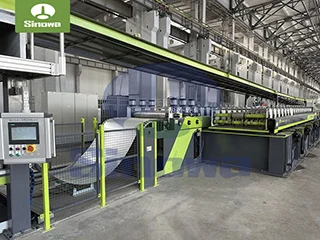
sandwich panel line
The cold storage sandwich panel line usually consists of multiple systems, including unwinding system, steel plate feeding system, automatic steel plate docking system, reinforcement unit, forming machine system, high-strength bonding system between steel plate and polyurethane, corona system, steel plate preheating system, double track machine and heating system, cutting saw system, etc. These systems work together to achieve an automated production process from raw material uncoiling to finished product cutting.
Characteristic
Efficiency: The continuous cold storage sandwich panel production line has high production efficiency and can quickly produce a large number of cold storage sandwich panels that meet quality standards.
High degree of automation: The entire cold storage sandwich panel production line adopts an automated control system, reducing manual operations and improving production efficiency and product quality.
Flexibility: The automatic production line for cold storage sandwich panels can produce different specifications and materials of cold storage sandwich panels according to customer needs, meeting diverse market demands.
Environmental friendliness: The cold storage sandwich panel continuous production line is equipped with dust removal and environmental protection equipment to ensure effective disposal of waste during the production process and meet environmental protection requirements.
Cold storage sandwich panels are widely used in various cold storage constructions, such as food cold storage, pharmaceutical cold storage, logistics cold storage, etc. These cold storage facilities need to have good insulation performance and structural strength to ensure the quality and safety of stored items.
Production Process
Raw material preparation: The uncoiling system uncovers the raw steel plates and performs necessary preprocessing.
Forming and bonding: Steel plates are formed into the required plate shape through equipment such as reinforcement units and forming machine systems, and then high-strength bonded with core materials such as polyurethane.
Heating and curing: After bonding, the sandwich panel enters the double track machine and heating system for heating and curing treatment to ensure bonding strength.
Cutting and packaging: Finally, the product is cut into the required size by a cutting saw system and packaged and stored.
With the rapid development of the cold chain logistics industry and the increasing demand for storage quality of food, medicine, and other products, the market demand for cold storage sandwich panels will continue to grow. Therefore, the cold storage sandwich panel line has broad development prospects.
Cold storage infrastructure stands as an indispensable backbone for the global cold chain ecosystem, supporting the safe preservation, long-term storage, and seamless circulation of fresh food, pharmaceutical supplies, perishable industrial raw materials, and various temperature-sensitive commodities across diverse regions and industries. The overall operational efficiency, long-term energy consumption stability, and reliable temperature retention performance of any cold storage facility are not determined solely by later refrigeration equipment configuration and daily operational management, but fundamentally rely on the structural quality, thermal insulation performance, and overall installation adaptability of the building envelopes that form the closed cold storage space. Among all core building materials used for cold storage construction, insulated sandwich panels have always been the most preferred and widely applied option, as they integrate structural rigidity, exceptional heat insulation, airtight sealing, and convenient on-site installation into a single integrated component. The quality uniformity, structural consistency, and performance stability of these cold storage-specific sandwich panels are entirely dependent on the professional configuration, technological maturity, and operational precision of the dedicated sandwich panel production line designed exclusively for cold storage panel manufacturing. Unlike ordinary sandwich panel production equipment used for common industrial factory buildings, temporary construction facilities, or conventional partition walls, the sandwich panel line for cold storage is professionally optimized and upgraded targeting the extreme low-temperature working environment, long-term anti-aging requirements, high-standard thermal insulation demands, and strict airtight performance needs of cold storage projects. Every functional module, production process link, and parameter control standard of this professional production line is carefully adjusted and precisely calibrated to ensure that each finished sandwich panel can maintain stable physical properties and thermal insulation effects for decades under continuous low-temperature operation, frequent temperature fluctuation cycles, and high-humidity internal environmental conditions inside cold storage warehouses, avoiding common problems such as insulation performance attenuation, core material delamination, metal surface corrosion, and structural deformation that often occur in ordinary panels after long-term use in cold storage scenarios.
The entire operational workflow of a professional sandwich panel line for cold storage follows a continuous and integrated production mode, realizing automated processing from raw material input of metal surface materials and thermal insulation core raw materials to final finished panel output, cooling shaping, and automatic stacking and packaging. This continuous production mode effectively avoids the quality differences and structural instability easily caused by intermittent manual operation and segmented processing in traditional production methods, ensuring that every batch of cold storage sandwich panels maintains consistent thickness uniformities, stable core material foaming density, firm bonding strength between metal surface and core layer, and precise edge forming dimensions throughout the production process. The front-end working area of the production line starts with the raw material unwinding and leveling processing link, which is the initial foundation for ensuring the flatness and dimensional accuracy of subsequent finished panels. Metal coil materials used for cold storage sandwich panel surfaces usually adopt high-quality anti-corrosion and anti-rust metal materials with good low-temperature resistance, which need to be installed on the automatic unwinding equipment of the production line. The unwinding equipment is designed with a stable rotating support structure and automatic tension adjustment function, which can slowly and evenly unfold the rolled metal coil materials without causing tensile deformation, surface scratches, or edge warping of the metal plates during the unwinding process. After the metal coils are unfolded, the plates will be immediately sent to the precision leveling equipment connected in series behind the unwinding device. The internal multi-group staggered leveling rollers of the leveling equipment can effectively eliminate the internal mechanical stress generated during the metal coil rolling and long-term storage process, thoroughly improve the slight bending, uneven radian, and local depression problems on the surface of the metal plates, and ensure that the upper and lower metal surface plates entering the subsequent forming and foaming links maintain an absolutely flat and smooth state. Good flatness of metal plates is not only related to the flat appearance of finished sandwich panels but more importantly, can ensure the uniform bonding fit between the metal surface and the thermal insulation core material in the later stage, preventing gaps from appearing between the plate layers due to uneven plates, which would otherwise lead to cold bridge generation, heat loss, and reduced overall insulation performance of the cold storage after installation.
After the completion of unwinding and leveling treatment, the metal plates will enter the surface protection film laminating and edge trimming processing area of the production line in sequence. In the surface protection link, the production line is equipped with an automatic film covering mechanism, which can evenly attach a layer of transparent protective film on the inner and outer surfaces of the metal plates. This protective film can effectively isolate external dust, debris, and mechanical friction damage in the subsequent production, transportation, and on-site handling processes, preventing scratches, abrasions, and surface coating damage on the metal panel surface. For cold storage sandwich panels, the integrity of the metal surface coating is extremely critical, because any surface damage will become a potential corrosion starting point in the long-term high-humidity and low-temperature internal environment of the cold storage, gradually causing rust expansion and panel damage, and affecting the overall service life of the cold storage enclosure structure. After the film laminating process is completed, the metal plates will be sent to the edge slitting and trimming equipment. This equipment can precisely cut the two side edges of the metal plates according to the preset dimensional standards of cold storage panels, removing the irregular rough edges and uneven parts generated during coil production and unwinding, ensuring that the width dimensions of the upper and lower metal plates are completely consistent, and the two side edges are neat and smooth. The trimmed metal plates can ensure precise alignment and matching in the subsequent roll forming and edge groove processing links, avoiding assembly gaps and poor airtightness caused by inconsistent plate widths after the panels are made into finished products and installed on site.
Subsequently, the neatly trimmed metal plates will be transported to the core roll forming station, which is a key processing link for shaping the edge connection structure of cold storage sandwich panels. Different from ordinary building sandwich panels, cold storage panels need to have excellent assembly airtightness and structural firmness after on-site splicing, so the plate edges need to be processed into special tenon-and-groove connecting structures through precise roll forming. The roll forming part of the production line is composed of multiple groups of high-precision synchronous forming rollers arranged in an orderly manner. According to the structural design requirements of cold storage panel connection, these forming rollers gradually bend and press the edges of the flat metal plates through multi-stage gradual pressure processing, slowly forming standardized tenon-and-groove profiles with precise dimensions. The multi-stage gradual forming design avoids the problem of metal plate cracking or coating peeling caused by one-time strong bending, ensuring that the metal structure at the panel edges is intact and the surface protective layer is not damaged. All forming rollers in this link are controlled by a synchronous transmission system, which can ensure that the forming speed of the upper and lower metal plates is completely synchronized, no relative displacement or position deviation occurs during the forming process, and the symmetry and consistency of the edge structures of each panel are guaranteed. The high-precision roll forming effect enables the subsequent on-site splicing and installation of cold storage sandwich panels to achieve a tight fit between tenon and groove, effectively improving the overall airtightness of the cold storage wall and roof structure, reducing cold air leakage and external hot air infiltration, and fundamentally reducing the long-term refrigeration energy consumption of the cold storage operation.
After the roll forming of the metal surface plates is completed, the plates will pass through the preheating area set up by the production line and then enter the most core foaming and composite laminating integration station of the entire production line. The preheating treatment before foaming is a necessary process specially set for cold storage sandwich panel production. The low-temperature resistant thermal insulation core materials used for cold storage panels have strict requirements on the temperature environment during foaming and chemical reaction molding. The preheating equipment can heat the upper and lower metal plates to the optimal constant temperature range required for core material foaming reaction, eliminating the temperature difference between the metal plates and the foaming raw materials. This can make the chemical reaction of the subsequent injected foaming raw materials more sufficient and uniform, avoid insufficient local foaming or uneven core material density caused by excessive temperature difference, and enhance the bonding fastness between the metal plates and the foamed core layer. The foaming system of the production line adopts a high-precision automatic metering and mixing injection structure. Various chemical raw materials required for preparing the thermal insulation foam core are accurately transported to the mixing device through independent high-pressure conveying pumps according to the precise proportion parameters set in advance. The precise proportioning of raw materials directly determines the thermal insulation performance, compressive strength, low-temperature resistance, and anti-aging performance of the final foamed core material. After full and uniform mixing, the liquid foaming raw materials are evenly injected between the upper and lower preheated and formed metal plates through a special injection nozzle arranged in the middle of the production line.
Immediately after the completion of foaming raw material injection, the upper and lower metal plates wrapped with the liquid foaming core material will enter the double-belt laminating and pressure curing device of the production line. This device maintains a stable pressure environment and constant temperature curing space inside, which can make the liquid foaming raw materials expand freely and evenly in the closed interlayer space according to the preset process requirements, and complete chemical cross-linking reaction and solidification molding in a controlled state. The internal pressure value and curing temperature of the double-belt laminating device are precisely adjusted for cold storage panel production, ensuring that the foaming core material forms a fine and uniform closed-cell structure after molding. The closed-cell structure is the key to the excellent thermal insulation performance of cold storage sandwich panels, which can effectively lock static air inside the core layer, greatly reduce heat conduction and heat convection efficiency, and achieve long-term stable low thermal conductivity effect. At the same time, under the action of constant pressure and temperature lamination, the foaming core material can form a strong and integrated bonding effect with the inner surfaces of the upper and lower metal plates, no delamination, hollowing, or local separation will occur between the core layer and the metal plates, and the overall structural integrity of the sandwich panel is guaranteed. The panels move forward slowly and continuously with the operation of the double-belt laminating device, completing the whole process of foaming expansion, chemical reaction, solidification molding, and preliminary strength stabilization in the advancing process, realizing the integration of continuous production and one-time composite molding.
After completing the core foaming and composite curing process, the initially molded continuous sandwich panels will be sent to the fixed-length precision cutting station of the production line. According to the different specification requirements of cold storage engineering projects for panel length, the production line’s numerical control cutting system can preset various fixed-length cutting parameters in advance. When the continuous panels are transported to the cutting position, the automatic sensing device will accurately identify the conveying position and send a cutting signal. The high-speed cutting equipment adopts a stable cutting structure, which can complete the fixed-length cutting operation of the panels in an instant, ensuring that the cutting sections of each panel are flat and smooth, without core material fragmentation, metal edge deformation, or foaming layer peeling. The fixed-length cutting process does not produce excessive processing debris and dust, and the overall neatness of the panel ends is maintained, which is convenient for subsequent edge sealing treatment and on-site installation and splicing. After cutting, the individual sandwich panels will be transported to the natural cooling and secondary shaping area behind the production line. Although the panels have completed the preliminary curing and molding in the double-belt lamination link, the internal core material still has residual reaction temperature and needs to be naturally cooled down to room temperature slowly. The gradual cooling process can further stabilize the internal molecular structure of the foamed core material, eliminate internal stress generated during the foaming and pressing process, prevent the finished panels from bending or deforming due to temperature changes after being produced and stacked, and ensure that the dimensional stability and flatness of the panels are maintained for a long time.
After cooling and secondary shaping, the finished cold storage sandwich panels will go through simple edge finishing and surface inspection procedures on the production line. The edge finishing process mainly trims and smoothes the tiny burrs and uneven parts at the cutting ends of the panels to ensure that the ends of the panels are neat and the later installation and sealing effects are not affected. The surface inspection link is completed by the production line’s automatic sensing and manual auxiliary inspection, focusing on checking whether there are surface scratches, coating damage, core material foaming defects, edge forming deformation, and poor bonding between layers on the surface of the panels. Unqualified panels will be automatically screened out of the production line for reprocessing, while qualified panels will be transported to the automatic stacking area. The automatic stacking equipment can neatly stack the finished qualified panels according to the fixed quantity and specification requirements, realizing automatic stacking without manual handling, reducing labor input, avoiding panel damage caused by manual carrying, and improving the overall production efficiency and finished product stacking standardization. The stacked finished sandwich panels can be directly packaged and stored, waiting to be transported to various cold storage construction sites for installation and use.
The intelligent centralized control system equipped with the entire sandwich panel line for cold storage runs through all production links from front-end raw material unwinding to back-end finished product stacking. The control system can uniformly adjust and monitor all operating parameters of each functional module of the production line, including unwinding tension, leveling strength, forming speed, preheating temperature, foaming raw material proportioning, lamination pressure, curing time, cutting length, and conveying speed. All production parameters can be preset and stored according to different cold storage panel specifications and performance requirements, and the production line can quickly switch production specifications according to project needs, realizing flexible production of panels with different thicknesses, widths, and structural types. During the whole production process, the control system can monitor the operating status of each equipment in real time. Once abnormal parameter fluctuations or equipment operation failures occur, the system will automatically send out prompt signals and perform automatic shutdown protection, avoiding batch unqualified product production and equipment failure expansion. This intelligent automatic control mode not only greatly reduces the dependence on manual operation skills but also ensures the long-term stability and consistency of product quality, making the produced cold storage sandwich panels always meet the high-standard requirements of cold storage low-temperature operation environment.
The rational application and stable operation of the professional sandwich panel production line lay a solid material foundation for the construction and long-term efficient operation of cold storage facilities. Cold storage projects have extremely high requirements for the thermal insulation, airtightness, structural stability, and low-temperature aging resistance of enclosure materials, and only through the professional and standardized production process of the dedicated sandwich panel line can these strict requirements be fully met. Each production link of the production line is closely connected and mutually matched, from raw material pretreatment, precise forming processing, core material foaming composite molding to post-processing cutting and stacking, every detail is optimized for the actual use scenario of cold storage. With the continuous development of the global cold chain logistics industry and the increasing improvement of cold storage construction standards, the performance requirements for cold storage sandwich panels are constantly upgrading, which also promotes the continuous technological optimization and functional upgrading of supporting sandwich panel production lines. In the future, cold storage sandwich panel production lines will develop towards higher automation intelligence, more precise parameter control, more diversified product customization, and more energy-saving and environmentally friendly production processes, continuously providing high-quality and high-performance insulated sandwich panel products for various types of cold storage construction, helping the cold chain industry achieve more energy-saving, efficient, safe, and stable long-term operation, and supporting the stable development of temperature-sensitive commodity storage and circulation in various fields.
https://www.cnsinowa.com/sandwich-panel-machines/sandwich-panel-line-for-cold-storage.html