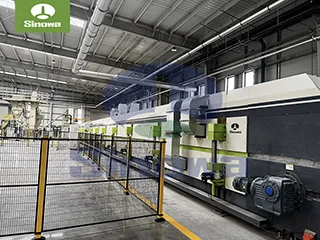
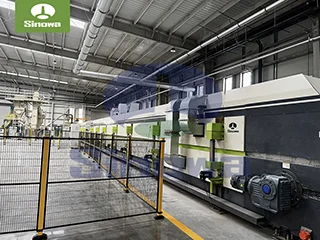
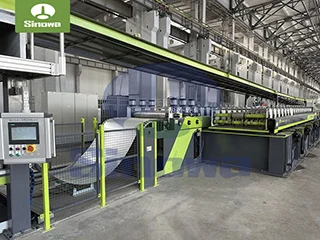
sandwich panel machine
The overall structural design of the color steel sandwich panel production line follows the logic of continuous assembly line operation, with multiple functional modules closely connected and synergistically operated to form a complete closed-loop production system. The front-end part of the equipment is mainly responsible for the feeding and preprocessing of color steel coil raw materials, adopting a stable unwinding structure to support large-capacity steel coil placement. This structural configuration ensures continuous and steady material supply during long-term production, avoiding frequent shutdowns caused by raw material replacement. Equipped with automatic deviation correction and leveling components, the preprocessing module can precisely adjust the conveying track of color steel sheets and eliminate the bending, warping, and surface unevenness generated during steel coil storage and transportation. This pre-treatment process lays a solid foundation for subsequent composite molding, ensuring the flatness and dimensional accuracy of the final panel surface, and effectively reducing the rate of defective products caused by raw material deviation.
After preprocessing, the color steel sheets enter the roll forming module, which is a key unit that shapes the geometric structure of the panel surface. Through multi-group orderly arranged forming rollers, the equipment implements gradual cold pressing and bending on the flat color steel sheets, enabling the sheets to form the required edge profiles, grooves, and assembly structures. The progressive rolling process avoids local stress concentration on the steel plate, preventing surface cracking and structural deformation that often occur in one-time stamping forming. The density and spacing of the forming roller groups can be adjusted according to different panel design requirements, making the equipment adaptable to various panel specifications used in roof, wall, and partition applications. All forming parameters are regulated by an integrated control system, ensuring consistent forming accuracy of each batch of panels and realizing standardized production of structural dimensions.
The foaming and composite bonding module constitutes the core technical part of the color steel sandwich panel line, directly determining the insulation performance, structural firmness, and service life of the finished sandwich panels. This module mainly completes the online mixing, injection, foaming, and compounding of foam core materials. The internal metering and mixing system accurately proportion various raw materials for foam production according to set process parameters, realizing uniform mixing of liquid raw materials. The well-mixed foam raw materials are evenly injected between the upper and lower layers of formed color steel sheets through a precise injection structure. In the subsequent closed laminating space, the raw materials undergo chemical foaming and expansion reactions, gradually filling the gap between the two steel plates and forming a dense and uniform foam core layer.
Precise control of temperature and pressure is critical in the composite forming process. The foam core sandwich panel line is equipped with a constant temperature heating system and a pressure balancing structure, which can maintain a stable reaction environment during foam expansion and curing. Appropriate temperature conditions accelerate the cross-linking reaction of foam materials, enabling the core layer to form a stable three-dimensional porous structure with excellent thermal insulation and sound absorption properties. Reasonable laminating pressure ensures that the foam core layer is closely bonded with the inner surface of color steel sheets, forming an integrated composite structure without gaps and delamination. Insufficient pressure will lead to loose foam density and weak bonding force, while excessive pressure will cause excessive extrusion of the foam layer and even local deformation of the color steel sheets. The real-time feedback adjustment function of the equipment can dynamically balance pressure and temperature parameters during continuous operation, maintaining the stability of the composite state at all times.
Following the composite lamination process, the semi-finished panels enter the long-distance curing and shaping area to complete the final structural stabilization. In the constant temperature curing environment, the foam core layer further completes molecular cross-linking and solidification, gradually stabilizing its physical properties such as density, hardness, and compressive strength. The curing process is a key link to eliminate internal stress of the panel; sufficient curing time and stable temperature conditions can effectively avoid subsequent quality problems such as panel warping, core layer shrinkage, and bonding failure. The length of the curing zone is scientifically designed to match the continuous production speed, ensuring that each section of the panel can complete full curing before entering the cutting process, thus guaranteeing the overall structural uniformity and performance consistency of the finished product.
The rear-end functional modules of the equipment include automatic trimming, fixed-length cutting, and finished product conveying systems. After curing, the continuous integral panel is first trimmed on both sides to remove irregular edge parts generated during the composite process, making the panel edges neat and uniform, which facilitates subsequent assembly and installation. The automatic cutting system adopts high-precision positioning and servo driving technology, which can intelligently identify and cut according to the preset panel length specifications. The cutting action is stable and fast, with flat and smooth cutting sections without burrs or deformation. The entire cutting process realizes unmanned automatic operation, which not only improves production efficiency but also ensures the consistency of panel size accuracy. The cut finished panels are stably output through the conveying device, laying the foundation for subsequent stacking and packaging.
The intelligent control system runs through the entire production process of the sandwich panel equipment, serving as the central nerve to coordinate the operation of all functional modules. The system integrates parameter setting, real-time monitoring, data feedback, and fault self-diagnosis functions. Operators can complete the adjustment of production speed, panel specifications, foaming parameters, and temperature and pressure values through a simple interactive interface. During continuous production, the system automatically monitors the operating status of each unit, synchronously collects production data, and adjusts operating parameters in real time according to the production state, ensuring the collaborative and stable operation of each link. In case of abnormal conditions such as material blockage, parameter deviation, or equipment failure, the system will trigger timely protection measures and prompt fault information, effectively reducing the probability of equipment damage and defective product generation, and improving the safety and stability of long-term continuous production.
Compared with traditional manual and semi-automatic panel production equipment, the fully automatic color steel foam sandwich panel machine has prominent technical and production advantages in industrial application. First of all, it realizes highly integrated continuous production, integrating multiple independent processes such as steel plate forming, foam foaming, composite bonding, curing and cutting into one assembly line, which greatly shortens the production cycle and significantly improves single-line production capacity. The highly automated operation mode reduces manual intervention links, lowers the dependence on skilled workers, and effectively reduces human error in the production process, making product quality more stable and reliable.
Secondly, the equipment has excellent product performance control capability. Through precise foaming proportion control, constant temperature and pressure composite technology, and standardized curing process, the produced sandwich panels have uniform core layer density, firm bonding between layers, stable thermal insulation performance, and good overall structural rigidity. The finished panels can effectively resist external pressure and bending deformation, while maintaining excellent heat insulation, sound insulation, and moisture resistance, fully meeting the performance requirements of building enclosure structures in different climatic environments. In addition, the equipment has strong production flexibility, which can adapt to the production of panels with different thicknesses, widths, and structural specifications by adjusting process parameters and component positions, and can meet the diversified production needs of different building scenarios.
In terms of operational stability and energy consumption, modern color steel foam sandwich panel making machine adopts optimized mechanical structure design and energy-saving control technology. The transmission structure is refined and matched with high-precision matching parts, which reduces mechanical friction loss and equipment operation noise, and extends the service life of the equipment. The intelligent temperature control and power regulation system can automatically adjust energy output according to production load, avoiding energy waste caused by long-term high-load standby operation, and realizing energy-saving and efficient production. At the same time, the closed foaming and composite structure effectively reduces the volatilization and waste of foam raw materials, improves the utilization rate of production materials, and reduces the production cost of unit products.
In the field of practical engineering applications, the panels produced by this sandwich panel production equipment are widely used in various prefabricated buildings, industrial factory buildings, warehouse enclosures, cold storage insulation structures, temporary construction facilities, and commercial building interior and exterior wall decoration. The lightweight characteristics of the color steel foam sandwich panels reduce the self-weight of building structures, effectively lowering the load-bearing pressure of the building foundation and main body, which helps reduce the overall construction cost. The excellent thermal insulation performance of the panels can significantly reduce the energy consumption of building heating and cooling, conforming to the global green building and energy-saving development concept. In addition, the integrated forming characteristics of the panels make the on-site installation process more convenient and efficient, greatly shortening the construction cycle of building enclosure projects and improving the overall construction efficiency.
With the continuous upgrading of building material manufacturing technology and the continuous improvement of market requirements for building panel performance and production efficiency, the color steel foam sandwich panel production machine is also evolving toward higher intelligence, higher precision, and more diversified adaptation. The iterative upgrading of control technology makes the equipment realize more refined parameter control and more accurate product molding; the optimization of mechanical structure improves the stability and durability of long-term operation; the expanded process adaptation capability enables the equipment to be compatible with more types of foam core materials and color steel plate specifications, meeting the personalized production needs of the market. As a core equipment in the field of prefabricated building materials, the color steel foam sandwich panel manufacturing machine will continue to play an important role in promoting the standardized, efficient, and green development of the modern construction industry, and provide reliable equipment support for the popularization and application of high-performance building enclosure materials.
https://www.cnsinowa.com/sandwich-panel-machines/color-steel-foam-sandwich-panel-machine.html