sandwich panel line
The overall structural design of the sandwich panel production line follows the logic of streamlined continuous production, with multiple functional units interconnected and coordinated to form an autonomous and closed-loop production process. The entire system mainly includes surface material feeding and forming unit, core material processing and laying unit, polyurethane glue spraying and foaming unit, constant-temperature composite laminating unit, fixed-length cutting and trimming unit, cooling curing conveying unit and automatic stacking and discharging unit. Each functional unit operates in precise synchronization through intelligent transmission and control systems, avoiding manual intervention errors and ensuring that every link from raw material input to finished product output maintains standardized operating standards. The modular design of the sandwich panel line not only facilitates daily maintenance and equipment debugging but also allows for flexible adjustment of production parameters according to different raw material specifications and product performance requirements, realizing diversified production of sandwich panels with different thicknesses and structural configurations.
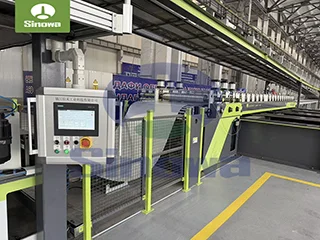
The front-end feeding and forming process is the foundation of panel production, which determines the flatness and structural accuracy of the outer surface of finished sandwich panels. Metal coiled materials used for panel surface layers are transported to the glass wool sandwich panel production line through automatic feeding equipment, and the first step is to complete unwinding and continuous feeding. The coiled materials often have minor bending and deformation due to long-term winding and storage, so a precision leveling device is equipped in the feeding link to eliminate internal stress of the materials and ensure the flatness of the surface materials in the subsequent forming process. After leveling, the surface materials pass through multi-group roller forming structures, which gradually bend and shape the flat metal plates according to the preset structural mold, forming the edge locking and assembly structures required for panel installation. In this process, the transmission speed and roller forming pressure are precisely matched with the subsequent composite process speed to ensure the continuity of production and avoid material stretching or deformation caused by inconsistent speed. Meanwhile, the system is equipped with a trimming function to uniformly trim the two sides of the formed surface materials, removing irregular burrs and edge defects to ensure the consistency of panel width and the tightness of subsequent composite bonding.
The core material processing and laying link is crucial to the thermal insulation and fire resistance performance of sandwich panels. Glass wool, as the main core material of the product, has excellent fiber flexibility, thermal insulation and flame retardant properties, but its loose fiber structure puts forward high requirements for laying uniformity and compactness. Before formal laying, glass wool raw materials are processed through special material arrangement equipment to disperse stacked fiber layers, eliminate bulk gaps inside the core material, and ensure the uniform density of the glass wool layer in the whole panel. The processed glass wool materials are continuously and evenly laid between the upper and lower surface materials through an automatic laying system. The laying thickness can be dynamically adjusted according to product design requirements, and the equipment can maintain stable laying accuracy in long-term continuous operation, effectively avoiding local thickness deviation and density unevenness of the core material. In order to enhance the bonding firmness between glass wool core material and surface materials, the polyurethane sandwich panel production line is designed with a pre-compression function for the core material, which appropriately compresses the loose glass wool fiber layer to make its structure more compact, laying a good foundation for the subsequent polyurethane composite bonding process.
Polyurethane glue spraying and foaming composite technology is the core process of the sandwich panel machine, which realizes the permanent bonding between glass wool core material and metal surface materials. The polyurethane raw materials are transported to the high-precision mixing and spraying system through a metering feeding device. The system can accurately proportion polyurethane components according to environmental temperature and production process parameters, and complete high-speed stirring and instantaneous mixing of raw materials. The mixed polyurethane adhesive is evenly sprayed on the contact surface between the glass wool core material and the upper and lower surface materials through an automatic spraying nozzle. The spraying amount and spraying speed are intelligently adjusted in real time according to the thickness of the core material and the running speed of the PU sandwich panel production line, ensuring that the adhesive layer covers the bonding surface completely and uniformly without local accumulation or missing spraying. After spraying, the polyurethane material undergoes mild foaming reaction in a constant-temperature environment, and the foamed body can fully fill the tiny gaps on the surface of glass wool fibers and metal plates, forming a seamless integrated bonding structure after curing. This composite mode not only makes up for the defect of weak bonding force of single glass wool core material but also gives full play to the excellent thermal insulation and adhesion performance of polyurethane materials, greatly improving the overall structural strength and thermal insulation effect of the sandwich panel.
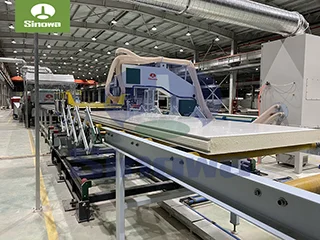
The constant-temperature composite laminating process determines the molding quality and structural stability of the sandwich panel. The semi-finished products after glue spraying and core material laying are continuously sent to the double-belt laminating equipment, which is the key equipment for panel integral molding. The laminating equipment adopts a closed constant-temperature heating structure, which can maintain a stable processing temperature range inside the cavity to provide a suitable reaction environment for polyurethane curing and composite molding. During the lamination process, the upper and lower belt bodies apply uniform and constant pressure to the composite material layer, so that the surface materials and core material are closely fitted, and the polyurethane adhesive completes full curing and cross-linking reaction under the dual action of constant temperature and constant pressure. The lamination time is automatically matched according to the panel thickness and material characteristics, ensuring that the polyurethane material is completely cured without excessive heating and aging. The synchronous operation of the upper and lower belts effectively avoids the relative displacement of the surface material and the core material during the molding process, ensuring the overall flatness and structural uniformity of the continuous panel strip. After lamination and curing, the scattered raw material layers are compounded into a solid and integrated continuous sandwich panel structure with stable internal structure and no layered gaps.
The fixed-length cutting and finishing process realizes the specification shaping of continuous panel strips. The continuous integrated panel output from the laminating equipment is transmitted to the precision cutting unit through the conveyor system. The cutting system adopts automatic tracking and fixed-length cutting technology, which can accurately identify and set the panel length according to production requirements, and complete high-speed and precise cutting through professional cutting tools. The cutting equipment has stable operation and neat cutting section, without burrs, cracks and other defects, ensuring the dimensional accuracy of single finished panel. After cutting, the panels enter the trimming and finishing link, and the equipment uniformly polishes and trims the edges and corners of the panels to remove residual adhesive and irregular edges generated in the production process, optimizing the appearance quality of the products. For panels needing special edge sealing treatment, the polyurethane sandwich panel line can complete automatic edge sealing and shaping operations in the finishing link to enhance the structural tightness and aesthetic degree of the panel edges.
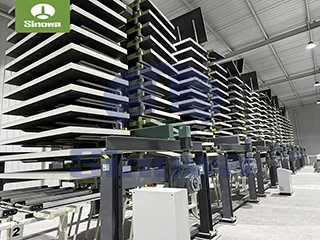
Cooling curing and automatic stacking are the final links of the entire production process, which ensure the stable performance and convenient storage and transportation of finished panels. The cut panels still have residual temperature after hot pressing and curing, so they need to be transported through an extended cooling conveyor platform to complete natural cooling and secondary curing. In the cooling process, the internal stress of the panel is fully released, and the polyurethane bonding structure is further stabilized, effectively avoiding panel deformation, warping and degumming after leaving the factory. After cooling to normal temperature, the qualified panels are automatically sorted and stacked by the intelligent stacking system. The stacking equipment can adjust the stacking height and arrangement mode according to product specifications, neatly stacking the panels in order to avoid extrusion damage between panels. The whole stacking process is automated without manual operation, which not only improves production efficiency but also ensures the neatness and uniformity of finished product stacking, facilitating subsequent packaging, storage and transportation.
This polyurethane glass wool sandwich panel production machine has remarkable technical advantages in production process and product performance compared with traditional single-process production equipment. Firstly, it realizes fully continuous automated production, integrating multiple independent processes into one streamlined system, which greatly reduces intermediate handling links and manual operation errors, and significantly improves production efficiency and product yield. Secondly, the composite process of polyurethane bonding and glass wool thermal insulation perfectly complements the performance advantages of the two materials. The glass wool core material provides excellent flame retardancy, sound insulation and high-temperature resistance, while the polyurethane adhesive layer enhances the overall bonding strength, thermal insulation tightness and waterproof performance of the panel, making the finished product have comprehensive performance advantages of light weight, high strength, heat insulation, fire resistance and sound absorption. In addition, the intelligent parameter adjustment function of the production line enables it to adapt to the production needs of different scenarios, and the produced panels can meet the application requirements of different environmental conditions such as high temperature, low temperature and humid environment.
In terms of production quality control, the PU sandwich panel machine is equipped with real-time monitoring and feedback systems to track and adjust key process parameters in real time. Equipment sensors continuously monitor key indicators such as feeding speed, spraying volume, lamination temperature, lamination pressure and cutting size during operation. Once parameter deviation is detected, the system will automatically adjust and calibrate to ensure that all production links are always in the optimal process state. This real-time closed-loop control mode effectively avoids product quality fluctuations caused by equipment operation changes and environmental factor interference, ensuring the consistency and stability of batch production quality. At the same time, the continuous molding process makes the internal structure of the panel more uniform, with no hollowing, layering or local performance differences, which greatly improves the overall quality grade and service life of the product.
In practical industrial production applications, this sandwich panel manufacturing line has strong production flexibility and operational stability. The modular equipment structure is convenient for daily maintenance and fault detection, reducing equipment failure rate and maintenance cost. The automated production mode greatly saves labor costs, reduces the dependence on skilled operators, and realizes standardized and large-scale production. The produced polyurethane glass wool sandwich panels are widely used in building exterior wall insulation, roof waterproof insulation, clean room enclosure, industrial workshop partition, cold storage thermal insulation and other fields. With the continuous improvement of modern building energy-saving standards and environmental protection requirements, the high-performance composite panels produced by this production line have gradually replaced traditional single insulation materials, becoming the mainstream choice in the field of building thermal insulation and energy conservation.
In the context of the continuous upgrading of the building materials industry and the increasingly stringent energy-saving and environmental protection policies, the polyurethane glass wool sandwich panel production line is also constantly optimizing and iterating in technology and process. The continuous improvement of intelligent control technology further improves the precision and automation level of production, while the optimization of material matching and process formula further enhances the environmental protection performance and comprehensive service performance of finished products. As a high-efficiency and low-consumption integrated production equipment, it not only meets the market demand for high-quality composite insulation panels but also promotes the standardized and intelligent development of the entire sandwich panel manufacturing industry, providing reliable equipment support for the innovation and upgrading of modern building energy-saving materials.
https://www.cnsinowa.com/sandwich-panel-machines/polyurethane-glass-wool-sandwich-panel-production-line.html