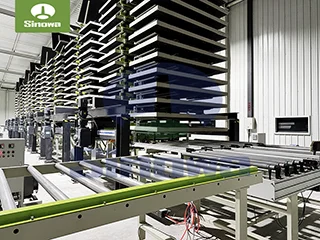
sandwich panel line
The fundamental structure of a PU sandwich panel for partition walls consists of two outer facer sheets and a core of polyurethane foam. The outer facers are typically made of metal sheets, such as steel or aluminum, which provide structural rigidity and resistance to external impacts. These metal sheets are often processed with specific profiles to enhance their strength-to-weight ratio, making the final panel sturdy yet easy to handle. The PU foam core, sandwiched between the two facers, is responsible for the panel’s exceptional thermal insulation and sound absorption properties. Polyurethane foam, when cured, forms a dense, closed-cell structure that minimizes heat transfer and effectively dampens sound waves, making it ideal for creating comfortable and energy-efficient indoor environments. The synergy between the outer facers and the PU core results in a panel that can withstand the demands of daily use while maintaining its performance over time.
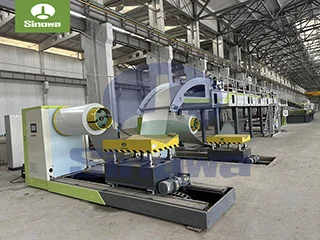
A complete PU sandwich panel making line for partition walls comprises several interconnected modules, each designed to perform a specific function in the production process. The workflow begins with the uncoiling and feeding of the metal facer sheets, a critical initial step that sets the foundation for consistent panel quality. Large coils of metal sheets are loaded onto uncoiling devices, which unwind the sheets smoothly and feed them into the next stage of the line. The uncoiling devices are equipped with tension control mechanisms to prevent the metal sheets from wrinkling or stretching, ensuring that the facers maintain their flatness and dimensional accuracy. This is particularly important for partition walls, where uneven panels can lead to installation difficulties and compromised structural integrity.
After uncoiling, the metal sheets proceed to the roll forming section. In this stage, the sheets pass through a series of tandem rolling stands, each equipped with precision rollers that gradually bend and shape the metal into the desired profile. The roll forming process is highly customizable, allowing for the creation of various profiles to suit different partition wall designs and structural requirements. Some profiles are designed with interlocking edges, which facilitate easy and secure installation of the panels on-site, while others may feature ribbed surfaces to enhance load-bearing capacity. The rollers are carefully calibrated to ensure that each sheet is formed with consistent dimensions, as even minor variations can affect the bonding of the PU foam core and the overall performance of the panel.
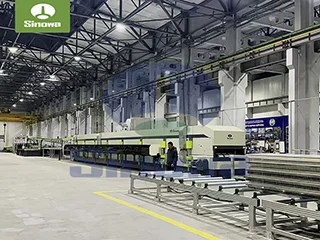
Once the outer facers are roll formed, they move to the PU foam injection and lamination area, the heart of the production line. This stage involves the precise mixing and injection of liquid polyurethane chemicals between the two moving facer sheets. The polyurethane chemicals, typically a polyol and an isocyanate, are mixed in exact proportions using a high-pressure mixing head, which ensures a homogeneous mixture that will cure into a uniform foam core. The mixed chemicals are injected continuously between the two facers as they move through the lamination section, where pressure is applied to ensure that the foam spreads evenly and adheres firmly to both outer sheets. The injection rate is synchronized with the speed of the moving facers to maintain a consistent core thickness, which is crucial for achieving uniform thermal and acoustic performance across the entire panel.
Following injection, the panels enter a cooling and curing zone. The polyurethane foam undergoes a chemical reaction that causes it to expand and cure into a solid core. During this process, the panels are passed through a controlled environment where temperature and humidity are regulated to optimize the curing process. Cooling systems, such as air blowers or water-cooled rollers, help accelerate the curing time while preventing the panels from warping or deforming as the foam sets. The curing time varies depending on factors such as the thickness of the PU core, the ambient temperature, and the specific formulation of the polyurethane chemicals. Proper curing is essential, as it ensures that the PU foam core achieves its full density and mechanical properties, providing the panel with the required insulation and structural strength.
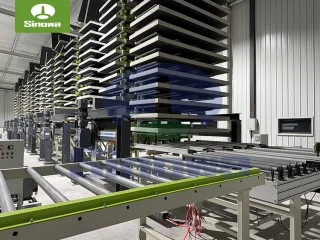
After curing, the continuous panel sheet is moved to the cutting section, where it is cut into individual panels of the desired length. The cutting equipment is typically a high-precision saw or cutter that operates in sync with the line speed to ensure clean, straight cuts without damaging the panel edges. Some production lines are equipped with computer numerical control (CNC) systems that allow for automated length adjustment, enabling quick changes between different panel sizes to meet customer specifications. The cut panels are then transferred to a handling or stacking system, which carefully moves the finished products to a storage area or directly to packaging. This automated handling minimizes the risk of damage to the panels during transportation within the production facility.
Quality control is an integral part of the entire production process, ensuring that every panel meets the required standards for partition wall applications. Throughout the line, sensors and monitoring devices continuously check key parameters, such as the thickness of the metal facers, the uniformity of the PU foam core, the bonding strength between the facers and the core, and the dimensional accuracy of the finished panels. Raw material inspection is also a critical step, with the metal coils and polyurethane chemicals tested for quality before they are introduced into the production line. Any panels that fail to meet the quality standards are removed from the line, preventing defective products from reaching customers. This rigorous quality control process ensures that the PU sandwich panels are reliable and consistent in performance, making them suitable for use in a wide range of construction projects.
One of the key advantages of PU sandwich panel making lines is their high level of automation, which offers numerous benefits over manual production methods. Automation reduces labor costs and minimizes the risk of human error, resulting in more consistent product quality. It also increases production efficiency, allowing for the continuous manufacture of panels at high speeds. Modern production lines can produce hundreds of square meters of panels per hour, making them ideal for large-scale construction projects where time and volume are critical factors. Additionally, automation enables greater customization, as the line can be quickly adjusted to produce panels of different sizes, thicknesses, and profiles without significant downtime.
The performance characteristics of PU sandwich panels produced by these lines make them particularly well-suited for partition wall applications. Their excellent thermal insulation properties help reduce energy consumption in buildings by minimizing heat loss or gain through the walls. This not only lowers utility costs but also contributes to a more sustainable built environment. The soundproofing capabilities of the PU foam core are another major advantage, as they help create quieter indoor spaces by reducing the transmission of sound between rooms. This is especially important in commercial buildings, such as offices, hospitals, and schools, where privacy and comfort are essential. The lightweight nature of the panels makes them easy to transport and install, reducing the need for heavy machinery and speeding up the construction process.
PU sandwich panels for partition walls are also highly durable and require minimal maintenance. The metal outer facers are resistant to corrosion, moisture, and physical damage, while the PU foam core is impervious to mold and mildew growth. This makes the panels suitable for use in harsh environments, such as industrial facilities, food processing plants, and cold storage units, where hygiene and durability are paramount. The panels can also be finished with various coatings or claddings to enhance their aesthetic appeal, allowing them to blend seamlessly with different interior designs. Whether used in industrial warehouses, commercial offices, or healthcare facilities, PU sandwich panels provide a long-lasting, cost-effective solution for partition wall construction.
The application range of PU sandwich panels produced by these making lines continues to expand as the construction industry embraces more efficient and sustainable building materials. In industrial settings, they are used to create partition walls that divide large spaces into functional areas, such as production zones, storage areas, and offices. In commercial buildings, they are employed in interior partitioning to create individual offices, meeting rooms, and corridors. They are also increasingly used in modular construction, where prefabricated panels are assembled on-site to form entire buildings or building components. The versatility of PU sandwich panels allows them to be adapted to various design requirements, from simple straight walls to complex curved structures.
Advancements in technology are driving continuous improvements in PU sandwich panel making lines, making them more efficient, flexible, and environmentally friendly. Newer lines are equipped with energy-saving systems that reduce power consumption during production, aligning with the industry’s focus on sustainability. Innovations in polyurethane foam formulations have also led to the development of foam cores with enhanced fire resistance and lower environmental impact, addressing safety and environmental concerns. Additionally, the integration of smart technologies, such as IoT sensors and data analytics, allows for real-time monitoring and optimization of the production process, further improving efficiency and quality control.
Another trend in the industry is the increasing demand for customized PU sandwich panels, which has led to the development of more flexible production lines. Modern lines can accommodate a wide range of panel thicknesses, from thin panels for lightweight partitioning to thick panels for high-insulation applications. They can also produce panels with different facer materials, including stainless steel for hygienic environments and aluminum for lightweight applications. This flexibility allows manufacturers to meet the specific needs of each customer, whether they require panels for a small office renovation or a large industrial complex.
In conclusion, PU sandwich panel making lines play a vital role in the production of high-quality partition wall materials that meet the evolving demands of the construction industry. These lines combine advanced automation, precision engineering, and rigorous quality control to produce panels that offer exceptional thermal insulation, soundproofing, durability, and ease of installation. As the industry continues to prioritize sustainability, efficiency, and customization, PU sandwich panel making lines will continue to evolve, incorporating new technologies and innovations to meet these needs. Whether used in industrial, commercial, or modular construction, PU sandwich panels produced by these lines provide a reliable, cost-effective, and sustainable solution for partition wall applications, contributing to the creation of safer, more comfortable, and energy-efficient buildings.
https://www.cnsinowa.com/sandwich-panel-machines/pu-sandwich-panel-making-line-for-partition-wall.html