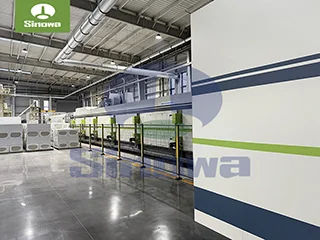
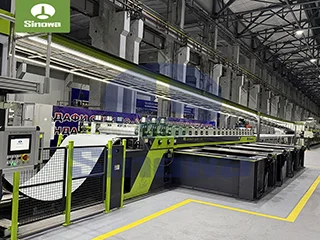
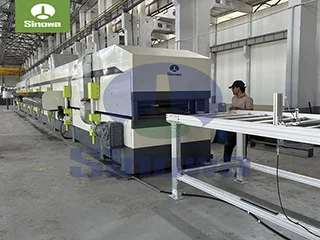
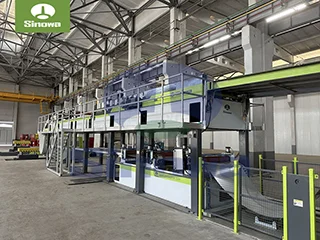
sandwich panel line
The PIR sandwich panel with film laminating function is a composite material consisting of two outer facing materials, a PIR foam core, and a laminated film layer on the surface. The PIR foam core, known for its low thermal conductivity (typically ≤0.020 W/(m·K)) and excellent fire resistance, forms the core insulation layer, while the outer facing materials (commonly metal sheets such as color-coated steel or aluminum sheets, or non-metallic materials like fiber cement boards) provide structural strength and protection. The additional film laminating layer, which can be made of materials such as PET, PI, or PVC, adds extra functionalities such as enhanced weather resistance, corrosion resistance, scratch resistance, and aesthetic appeal. The manufacturing line that produces such panels is a highly integrated system that coordinates multiple processes, from raw material preparation to final product packaging, with the film laminating process seamlessly integrated into the production flow.
Raw material preparation is the first critical stage in the production process, laying the foundation for the quality and performance of the final PIR sandwich panels. For the outer facing materials, metal coils (such as galvanized or aluminum-zinc coated steel coils) or non-metallic sheets are inspected for surface quality, thickness uniformity, and mechanical properties before being fed into the production line. The coils are then uncoiled using a decoiler, and the material is leveled to remove any wrinkles or deformations caused during storage and transportation. Precision cutting equipment is used to cut the facing materials into the required width and length according to production specifications. For the PIR foam core, the raw materials include polyol, isocyanate, blowing agent, catalyst, and other additives. These chemicals must be strictly proportioned and mixed uniformly in a high-pressure foaming machine. The blowing agent, often cyclopentane or other environmentally friendly alternatives, ensures the formation of a closed-cell foam structure with excellent thermal insulation properties. The film material for laminating is also prepared at this stage, with rolls of film inspected for thickness consistency, surface smoothness, and adhesion performance to ensure compatibility with the facing materials.
After raw material preparation, the production process moves to the panel forming and foam core casting stage. The lower facing material is first conveyed to the foaming station via a precision conveyor system. At this station, a uniform layer of adhesive is applied to the inner surface of the lower facing material using an automatic spraying system. This adhesive ensures strong bonding between the facing material and the PIR foam core. For the PIR foam core formation, the pre-mixed chemical ingredients are injected onto the lower facing material through a high-pressure mixing head. The injection process is precisely controlled by an automated system to ensure uniform distribution of the foam mixture across the entire surface of the facing material. The upper facing material, which has also undergone pre-treatment and adhesive application, is then carefully placed over the foam mixture. The combined structure (lower facing, foam mixture, upper facing) is then conveyed into a continuous laminating press, where it is subjected to controlled temperature, pressure, and time conditions. These conditions facilitate the foaming and curing of the PIR core, ensuring that the foam expands to the desired thickness and forms a dense, uniform structure. The laminating press plays a crucial role in ensuring the flatness of the panel, the bonding strength between layers, and the overall structural integrity of the sandwich panel.
The film laminating process, a key feature of this specialized production line, is integrated into the production flow either before or after the panel forming stage, depending on the specific requirements of the final product. If the film is to be laminated onto the outer surface of the facing material, the process is typically carried out after the facing material has been uncoiled and leveled but before it is cut to size. In this scenario, the film is unwound from a separate roll and fed into a laminating station, where it is bonded to the surface of the facing material using heat and pressure. The laminating station is equipped with precision rollers that ensure uniform pressure distribution, promoting strong adhesion between the film and the facing material. The temperature and pressure parameters at the laminating station are carefully controlled to match the properties of the film and facing material, preventing damage to either material and ensuring a smooth, wrinkle-free lamination. Alternatively, if the film is to be applied to the finished sandwich panel, the lamination process is carried out after the panel has been cured and cut to size. In this case, the finished panels are conveyed to a dedicated laminating machine, where the film is applied to one or both sides of the panel. This post-forming lamination process is often used when specialized film properties (such as high gloss, matte finish, or specific color matching) are required for the final product.
After the film laminating process, the sandwich panels undergo a cooling and shaping stage. The newly formed panels, which are still at an elevated temperature from the foam curing and laminating processes, are conveyed through a cooling tunnel. The cooling tunnel uses forced air or water cooling to rapidly and uniformly cool the panels to room temperature. This rapid cooling helps to stabilize the structure of the PIR foam core, prevent dimensional changes, and ensure the flatness of the panel. During the cooling process, the film layer also fully adheres to the panel surface, developing its final performance characteristics. Once cooled, the panels are conveyed to a precision cutting machine, where they are cut to the exact length specified by the customer. The cutting process is automated to ensure high precision, with minimal material waste. After cutting, the panels undergo edge trimming to remove any irregularities and ensure clean, straight edges. This edge trimming process also helps to improve the installation efficiency of the panels, as clean edges facilitate easy joining and sealing during construction.
Quality control is an integral part of the entire production process, ensuring that every panel produced meets the required performance and quality standards. Multiple quality inspection points are strategically placed along the production line. At the raw material stage, incoming materials are inspected for compliance with specifications, including chemical composition, physical properties, and surface quality. During the foam core formation and lamination processes, automated sensors monitor parameters such as foam density, panel thickness, temperature, and pressure, making real-time adjustments to ensure consistency. After cooling and cutting, the finished panels are inspected for flatness, dimensional accuracy, bonding strength between layers, and the quality of the film lamination. Random samples are taken from each production batch for additional testing, including thermal conductivity testing, fire resistance testing, tensile strength testing, and film adhesion testing. Any panels that do not meet the quality standards are rejected and removed from the production line, ensuring that only high-quality products reach the customer.
The final stage of the production process is packaging and storage. The finished PIR sandwich panels, after passing all quality inspections, are conveyed to an automatic packaging station. At this station, the panels are stacked vertically (to prevent deformation) and wrapped with a protective film or packaging material to protect them from damage during transportation and storage. The packaging also helps to prevent moisture absorption and dust accumulation on the panel surface. Each package is labeled with relevant information, such as panel dimensions, material specifications, and production date. The packaged panels are then stored in a dedicated warehouse, which is maintained in a dry, well-ventilated environment to ensure the long-term stability of the panels. The warehouse is also organized to facilitate easy access and retrieval of panels for shipment, ensuring efficient order fulfillment.
The PIR sandwich panel manufacturing line with film laminating function offers several key advantages over traditional manufacturing lines. One of the primary advantages is the enhanced performance of the final product. The film lamination layer significantly improves the weather resistance of the panels, making them suitable for use in harsh environmental conditions (such as high humidity, extreme temperatures, and exposure to UV radiation). The film also provides excellent corrosion resistance, extending the service life of the panels in industrial environments where they may be exposed to chemicals or corrosive substances. Additionally, the film layer enhances the aesthetic appeal of the panels, offering a wide range of color options and surface finishes to meet the architectural requirements of different projects. Another advantage of this production line is its high level of automation. The integrated automated control system coordinates all production processes, reducing the need for manual intervention and minimizing the risk of human error. This automation not only improves production efficiency but also ensures consistent product quality. The modular design of the production line is another key benefit, allowing for easy customization and expansion to meet the specific needs of different production volumes and product specifications. For example, the line can be configured to produce panels of varying thicknesses (from 10mm to 200mm) and widths, and can accommodate different types of facing materials and film layers.
The application scope of PIR sandwich panels produced by this manufacturing line is extremely wide, covering various fields of construction and industry. In the construction sector, these panels are widely used for the exterior walls, roofs, and internal partitions of industrial workshops, warehouses, stadiums, supermarkets, hospitals, and cold storage facilities. The excellent thermal insulation performance of the PIR core helps to reduce energy consumption for heating and cooling, making buildings more energy-efficient. The fire resistance of the panels also ensures compliance with strict building fire safety regulations. In cold storage facilities, the combination of PIR core and film lamination provides superior thermal insulation and moisture resistance, maintaining stable internal temperatures and preventing condensation. In the industrial sector, these panels are used for the construction of clean rooms, laboratories, and chemical plants, where the corrosion resistance and cleanliness of the panel surface are critical. The film lamination layer ensures that the panels are easy to clean and maintain, making them suitable for use in environments with high hygiene requirements. Additionally, the lightweight nature of the panels makes them easy to transport and install, reducing construction time and costs.
Looking towards the future, the PIR sandwich panel manufacturing line with film laminating function is expected to undergo further technological advancements. One area of development is the improvement of energy efficiency in the production process. Manufacturers are exploring the use of more energy-efficient equipment and processes, such as low-energy foaming technologies and waste heat recovery systems, to reduce the environmental impact of production. Another area of innovation is the development of new film materials with enhanced properties, such as self-cleaning films, anti-microbial films, and films with improved thermal insulation properties. These new film materials will further expand the application scope of PIR sandwich panels and meet the evolving needs of the market. Additionally, the integration of smart manufacturing technologies, such as the Internet of Things (IoT) and artificial intelligence (AI), is expected to transform the production process. IoT sensors can be used to monitor equipment performance and product quality in real-time, while AI algorithms can analyze production data to optimize process parameters and predict potential equipment failures. This smart manufacturing approach will further improve production efficiency, reduce downtime, and enhance product quality.
In conclusion, the PIR sandwich panel manufacturing line with film laminating function is a sophisticated and efficient production system that combines advanced materials science and precision engineering. The integration of film laminating technology into the production process enhances the performance and versatility of PIR sandwich panels, making them suitable for a wide range of applications. The high level of automation, modular design, and strict quality control measures of this production line ensure consistent product quality and high production efficiency. As the construction and industrial sectors continue to demand more energy-efficient, durable, and high-performance materials, the PIR sandwich panel manufacturing line with film laminating function is poised to play an increasingly important role in meeting these demands. Future technological advancements in energy efficiency, film materials, and smart manufacturing will further enhance the capabilities of this production line, driving the continued growth and development of the PIR sandwich panel industry.
https://www.cnsinowa.com/sandwich-panel-machines/pir-sandwich-panel-manufacturing-line-with-film-laminating-function.html