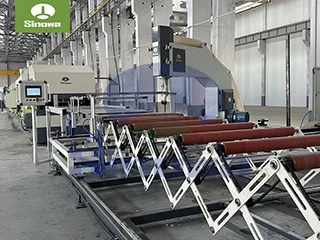
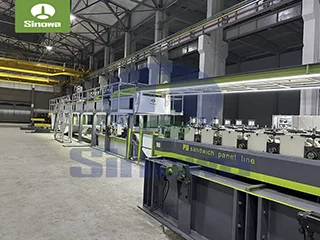
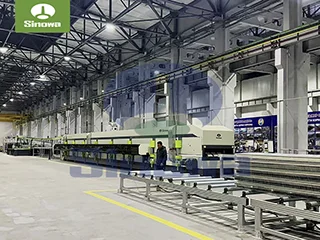
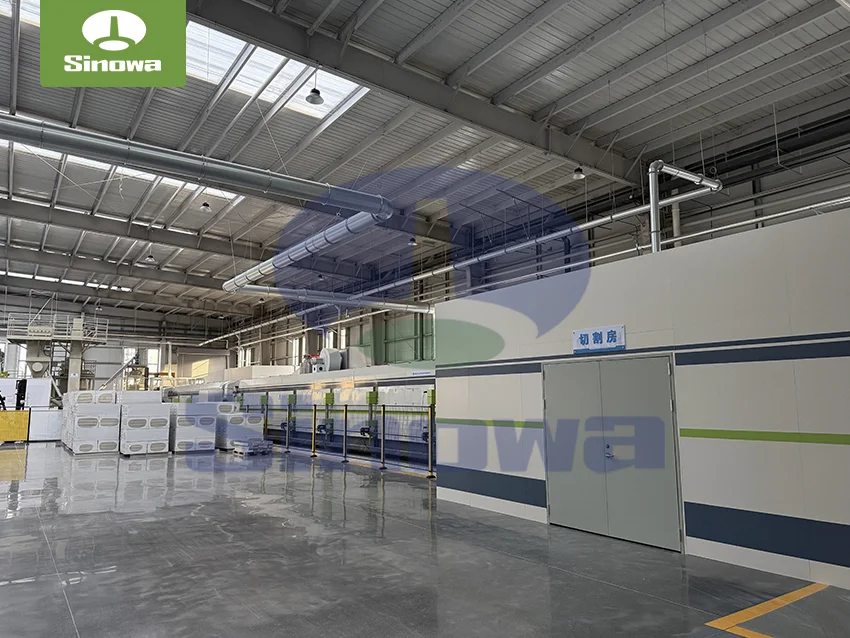
 sandwich panel line
Polyurethane sandwich panels consist of a rigid polyurethane foam core bonded between two facing materials, which are typically metal sheets such as galvanized color-coated steel, aluminum, or stainless steel. The combination of these materials creates a composite structure that leverages the strengths of each component: the facing materials provide structural rigidity, impact resistance, and weather protection, while the polyurethane core delivers superior thermal insulation, sound absorption, and moisture resistance. For modular houses, these panels are used for walls, roofs, floors, and ceilings, enabling the creation of energy-efficient, comfortable, and durable living spaces. The production line for these panels is a highly integrated, automated system designed to handle the entire manufacturing process from raw material preparation to finished product packaging, ensuring that each panel meets the strict specifications required for modular construction.
The working principle of a polyurethane sandwich panel production line revolves around the continuous and precise integration of three key stages: facing material preparation, polyurethane foam mixing and foaming, and lamination, curing, and post-processing. Unlike discrete manufacturing methods, continuous production lines ensure a seamless flow of materials, minimizing waste, reducing production time, and maintaining consistent quality across all panels. The process begins with the preparation of the facing materials, which are supplied in large coils to maximize efficiency. These coils are loaded onto decoilers, which unwind the material at a controlled speed to match the production line’s overall throughput. Before entering the lamination stage, the facing materials undergo pre-treatment processes to enhance adhesion with the polyurethane core. This pre-treatment may include cleaning to remove dust, oil, or other contaminants, as well as heating to optimize the bonding conditions between the facing and the foam core. Proper pre-treatment is essential to ensure the long-term structural integrity of the panels, preventing delamination even under harsh environmental conditions or heavy loads.
After pre-treatment, the upper and lower facing materials are fed into the core production area, where the polyurethane foam is mixed, dispensed, and foamed between them. The polyurethane foam is produced by reacting two main components—polyol and isocyanate—along with a range of additives tailored to enhance the foam’s performance. These additives may include catalysts to control the reaction rate, foaming agents to regulate the foam density, flame retardants to improve fire resistance, and stabilizers to ensure uniform cell structure. The mixing of these components is a critical step that requires precise metering and thorough blending to achieve consistent foam properties. High-pressure mixing heads are used to combine the components at a controlled ratio, ensuring that the reaction occurs uniformly and that the resulting foam has the desired density, thermal conductivity, and mechanical strength. The mixed foam is then continuously dispensed onto the lower facing material as it moves along the production line, forming a uniform layer that will expand to fill the space between the two facing materials.
Once the foam is dispensed, the upper facing material is carefully positioned over the foam layer, and the entire assembly enters a double-belt laminating conveyor. This conveyor consists of two parallel, continuous belts that apply uniform pressure and temperature to the sandwich structure as it moves forward. The pressure ensures that the foam adheres firmly to both facing materials, eliminating air gaps and ensuring a tight bond. The temperature within the laminating conveyor is controlled to facilitate the curing of the polyurethane foam. Curing is a chemical process where the foam expands to its final volume and hardens into a rigid structure, forming a strong composite with the facing materials. The speed of the conveyor is synchronized with the foaming and curing rates to ensure that the foam fully cures before the panel exits the laminating section. The double-belt design also ensures that the panels maintain a flat, uniform thickness, which is crucial for modular construction where precision fitting is essential.
After curing, the continuous panel web moves to the post-processing section, where it undergoes a series of operations to transform it into finished panels of the required size and specifications. The first step in post-processing is cutting, where the continuous web is sliced into individual panels using high-precision cross-cut saws. These saws are automated and controlled by computer systems to ensure accurate length measurements, minimizing waste and ensuring that each panel meets the exact dimensions required for modular house assembly. Some production lines are equipped with multi-blade cutting systems that can cut multiple panels simultaneously, further increasing production efficiency. Following cutting, the panels may undergo edge trimming and profiling to refine their edges, removing any excess material and creating precise joints that facilitate easy assembly in modular construction. Edge profiling can also include the creation of waterproof grooves or interlocking systems, which enhance the panel’s performance by preventing water leakage and reducing thermal bridging.
Cooling is another important post-processing step, particularly for panels with metal facings. After exiting the laminating conveyor, the panels may still retain some heat from the curing process. Cooling systems, which can include air blowers or water-cooled rollers, lower the panel temperature to room temperature, preventing thermal expansion or contraction that could affect the panel’s dimensions or structural integrity. Once cooled, the panels are inspected for quality to ensure that they meet all performance and aesthetic standards. Quality checks may include visual inspections for surface defects such as scratches, dents, or uneven foam distribution, as well as tests for bond strength, thermal conductivity, and fire resistance. Panels that fail to meet the standards are removed from the production line for rework or recycling, ensuring that only high-quality products are sent to modular construction sites.
The final stage of the production process is packaging and stacking. Finished panels are automatically stacked onto pallets using robotic or mechanical stacking systems, which ensure that the panels are handled gently to avoid damage. The stacks are then wrapped in protective materials such as shrink film to prevent moisture absorption, dust accumulation, and scratches during transportation and storage. Proper packaging is essential for modular construction, as panels often need to be transported over long distances to construction sites, and any damage could delay assembly and increase costs. Some production lines also include labeling systems that attach information such as panel dimensions, batch numbers, and application instructions to each stack, facilitating inventory management and on-site assembly.
The core components of a polyurethane sandwich panel production line are designed to work in harmony to achieve high efficiency, precision, and flexibility. Decoilers are a critical starting component, available in single or double configurations to handle different coil sizes and materials. Double decoilers allow for continuous production without interruption when one coil is exhausted, as the system can seamlessly switch to the second coil. Pre-treatment equipment, including cleaning and heating units, ensures that the facing materials are prepared for optimal bonding. The mixing and metering system is the heart of the foam production process, with high-precision pumps and mixing heads that control the ratio of polyol, isocyanate, and additives. These systems are equipped with temperature and flow control devices to maintain consistent mixing conditions, even during long production runs.
The double-belt laminating conveyor is another key component, featuring adjustable pressure and temperature controls to accommodate different panel thicknesses and foam formulations. The belts are made from durable materials that can withstand high temperatures and pressure, ensuring long service life and consistent performance. Post-processing equipment, including cutting saws, edge trimmers, and cooling systems, is designed for precision and speed, with computerized controls that allow for quick adjustments to panel dimensions and specifications. The entire production line is managed by a centralized control system, which integrates all components and monitors every stage of the production process. This control system uses advanced software to adjust parameters such as conveyor speed, foam mixing ratio, temperature, and pressure in real time, ensuring optimal performance and minimizing human error. Operators can monitor the production process through an intuitive interface, receiving alerts for any deviations from set parameters and making adjustments as needed.
One of the key advantages of polyurethane sandwich panel production lines is their ability to produce highly customizable panels to meet the diverse needs of modular construction. Modular houses come in a wide range of designs, sizes, and configurations, and the production line can be adjusted to create panels of varying thicknesses, widths, lengths, and facing materials. For example, panels used for exterior walls may require thicker foam cores for enhanced insulation, while interior panels may be lighter with thinner cores. The production line can also accommodate different facing material finishes, such as matte, glossy, or textured surfaces, to match the aesthetic requirements of the modular house design. Additionally, the foam formulation can be tailored to meet specific performance standards, such as increased fire resistance for panels used in high-risk areas or improved sound absorption for panels used in residential spaces.
Efficiency is another significant benefit of these production lines. Continuous automated production reduces the need for manual labor, minimizing the risk of human error and increasing throughput. Modern production lines can produce thousands of square meters of panels per hour, depending on the panel thickness and specifications, allowing manufacturers to meet large-scale modular construction project deadlines. The automated process also reduces material waste, as precise metering and cutting ensure that raw materials are used efficiently. Polyurethane foam itself is a highly efficient insulation material, with a thermal conductivity that is significantly lower than other common insulation materials such as fiberglass or rock wool. This means that modular houses built with polyurethane sandwich panels require less energy for heating and cooling, reducing their carbon footprint and long-term operating costs.
Sustainability is an increasingly important consideration in the construction industry, and polyurethane sandwich panel production lines contribute to more sustainable modular construction in several ways. The controlled manufacturing environment reduces on-site waste, as panels are produced to exact specifications and require minimal cutting or adjustment during assembly. Polyurethane foam can be formulated using bio-based materials, reducing reliance on fossil fuels and lowering greenhouse gas emissions. Additionally, the durability of polyurethane sandwich panels extends the lifespan of modular houses, reducing the need for frequent replacements and minimizing construction waste over time. Many production lines also incorporate recycling systems to reuse excess foam or damaged panels, further reducing environmental impact.
The performance advantages of polyurethane sandwich panels produced by these lines directly benefit modular house construction. The lightweight nature of the panels makes them easier to transport and assemble, reducing the need for heavy machinery on-site and speeding up the construction process. A typical polyurethane sandwich panel weighs significantly less than traditional building materials such as brick or concrete, while still offering comparable structural strength. This lightweight property also reduces the overall weight of the modular house, which can lower transportation costs and expand the range of sites where modular houses can be installed, including areas with poor soil conditions.
Thermal insulation is another critical performance feature of polyurethane sandwich panels. The closed-cell structure of the foam core traps air, preventing heat transfer through the panel. In ideal conditions, a 50-millimeter polyurethane foam core offers the same insulation effect as a 1720-millimeter brick wall, making modular houses highly energy-efficient. This not only improves the comfort of the living space by maintaining a consistent temperature but also reduces energy consumption and utility bills for homeowners. The foam core is also hydrophobic, with a closed-cell rate of over 90%, meaning it does not absorb moisture. This prevents mold growth, rot, and degradation of the panel, ensuring the longevity of the modular house even in humid or wet environments.
Fire resistance is a key safety consideration for modular houses, and polyurethane sandwich panels can be formulated to meet strict fire safety standards. By adding flame retardant additives to the foam mixture, the panels can achieve self-extinguishing properties, preventing the spread of fire. The metal facings also act as a barrier, slowing the combustion process and protecting the foam core. This combination of fire-resistant properties ensures that modular houses built with these panels meet the necessary safety regulations, providing peace of mind for homeowners and builders alike.
The application of polyurethane sandwich panels in modular construction is diverse, ranging from residential homes and apartments to commercial buildings, temporary structures, and emergency shelters. Modular houses built with these panels are particularly popular in areas prone to natural disasters, as their lightweight yet durable structure can withstand high winds, earthquakes, and other extreme weather conditions. The quick assembly time also makes them ideal for emergency housing, allowing shelters to be set up rapidly in the aftermath of a disaster. In residential construction, modular houses with polyurethane sandwich panels offer a cost-effective alternative to traditional homes, with shorter construction times and lower energy costs. Commercial applications include office buildings, retail spaces, and industrial facilities, where the panels’ insulation and durability provide long-term benefits.
The future of polyurethane sandwich panel production lines for modular houses is shaped by ongoing technological advancements aimed at improving efficiency, sustainability, and performance. Manufacturers are investing in research and development to create more advanced mixing and metering systems that offer even greater precision and flexibility, allowing for the production of panels with complex geometries and custom properties. Automation technology is also evolving, with the integration of artificial intelligence and machine learning into control systems to optimize production processes in real time, predict maintenance needs, and reduce downtime. Additionally, there is a growing focus on developing bio-based polyurethane formulations that are fully biodegradable or recyclable, further enhancing the sustainability of the production process.
Another trend in the industry is the integration of smart technologies into polyurethane sandwich panels during production. This includes the embedding of sensors that monitor temperature, humidity, and structural integrity, providing real-time data on the performance of the modular house. These sensors can help detect potential issues early, allowing for proactive maintenance and extending the lifespan of the building. The production lines of the future may also be designed to handle a wider range of facing materials, including recycled metals, composite materials, and sustainable wood-based products, further expanding the customization options and sustainability of modular houses.
In conclusion, polyurethane sandwich panel production lines are a cornerstone of modern modular construction, enabling the efficient, precise, and sustainable manufacturing of high-performance building components. These lines combine advanced automation, precise material handling, and innovative foam technology to produce panels that offer exceptional insulation, structural stability, and durability. As the modular construction industry continues to grow, driven by the demand for faster, more efficient, and sustainable building methods, the role of polyurethane sandwich panel production lines will become even more critical. By continuously evolving to incorporate new technologies and sustainable practices, these production lines will help shape the future of construction, enabling the creation of modular houses that are not only efficient and affordable but also environmentally friendly and built to last. Whether for residential, commercial, or emergency applications, polyurethane sandwich panels produced by these lines will remain a vital component in the ongoing transformation of the construction industry.
https://www.cnsinowa.com/sandwich-panel-machines/polyurethane-sandwich-panel-production-line-for-modular-house.html