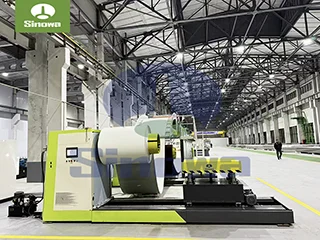
sandwich panel line
The overall structural design of the composite sandwich panel production line follows the logic of sequential industrial production, with all functional modules arranged in a linear and streamlined layout to ensure the smooth transmission and processing of materials. The entire production system can be divided into multiple interrelated functional units according to the production sequence, including raw material pre-feeding and leveling unit, surface layer processing unit, core material arrangement and shaping unit, automatic gluing and composite pressing unit, constant temperature curing and shaping unit, post-processing trimming and cutting unit, and finished product automatic stacking unit. All units are connected through synchronous conveying structures, and the operating speed, processing temperature, pressing pressure and other core parameters of each link maintain dynamic matching, avoiding material deviation, bonding failure and dimensional errors caused by asynchronous operation of individual equipment. This integrated structural design not only optimizes the production space layout, but also greatly improves the continuity and stability of the production process, laying a solid foundation for large-scale and standardized production of composite panels.
The front-end raw material processing link is the primary guarantee for qualified finished composite panels, and the composite sandwich panel line is equipped with professional pretreatment structures for different surface and core materials. For flexible coil surface materials commonly used in composite panels, the composite board production line adopts automatic uncoiling and leveling structures, which can steadily release coiled raw materials and eliminate the internal stress and surface wrinkles generated during material coiling and storage. The multi-group leveling roller sets carry out multi-stage calibration on the surface materials to ensure the flatness and consistent thickness of the surface layer entering the subsequent composite process. At the same time, the surface pretreatment unit is equipped with fine cleaning structures to remove surface dust, impurities and residual attachments, improving the adhesion between the surface material and the adhesive, and effectively preventing degumming and peeling of the composite panel in subsequent use. For rigid and fibrous core materials, the composite sandwich panel machine is equipped with uniform material arrangement and cutting structures, which can arrange scattered core materials in an orderly and uniform manner, ensure consistent thickness and density of the core layer, and avoid local hollowing and uneven stress of the finished panel caused by uneven core material distribution.
Gluing composite processing is the core link that determines the structural stability and service performance of composite panels, and the composite sandwich panel making machine adopts an automatic quantitative gluing and synchronous composite process. The internal gluing system realizes continuous and stable output of adhesive materials through sealed storage and pipeline conveying structures, and the rolling gluing mode ensures uniform adhesive coverage on the bonding surface of surface materials. The system can automatically adjust the adhesive coating amount according to different material textures and production process requirements, realizing precise control of gluing thickness, which not only ensures sufficient bonding strength between layers, but also avoids excess adhesive overflow and material waste. In the composite assembly stage, the surface materials and core materials are accurately aligned and fitted through the synchronous conveying system, and the multi-layer materials are initially compounded into an integrated plate blank under the action of pre-pressing structures. The whole gluing and composite process is completed in a closed and constant-temperature environment, which avoids the influence of external temperature and humidity changes on adhesive curing effect, and ensures the uniformity and consistency of the bonding state of each position of the plate blank.
Constant temperature curing and pressure shaping is a key process to finalize the structural performance of composite panels. After preliminary composite molding, the plate blank is continuously transported to the constant temperature curing chamber of the composite sandwich panel production machine, and the internal temperature and pressure of the curing area are kept within a stable and accurate range through the intelligent temperature control and pressure regulation system. Different from natural curing in traditional production, the integrated curing structure realizes rapid and uniform curing of the adhesive inside the composite plate, promotes the full combination of surface layer and core layer materials, and forms a stable integrated stress structure. The segmented temperature control design is adopted in the curing process, with different temperature gradients set in the front, middle and rear sections of the curing area according to the curing stage of the adhesive, which realizes gradual curing and avoids plate deformation, warping and cracking caused by one-time high-temperature heating. Meanwhile, the continuous pressure maintaining structure acts on the surface of the plate blank during the curing process, ensuring the flatness of the plate surface and the consistency of the overall thickness, so that the internal structure of the finished panel is compact and uniform, and the overall structural strength and dimensional stability are significantly improved.
The post-processing unit of the composite sandwich panel manufacturing machine undertakes the finishing and sizing work of the cured composite panels, realizing the standardized shaping of finished products. After curing and shaping, the integrated composite panel will pass through the trimming and edge cutting structure of the production line, and the irregular edges on both sides of the plate generated in the composite process are accurately cut off to ensure the straightness and neatness of the plate edges. The fixed-length cutting structure can realize precise cutting according to different production and application requirements, and the cutting process is stable and smooth without burrs and cracks on the plate section. In addition, the post-processing link is also equipped with surface finishing and cleaning structures to remove residual adhesive and tiny impurities on the plate surface, optimize the surface flatness and appearance quality of the finished panel. All post-processing procedures are completed automatically in a continuous flow, which avoids the secondary damage and dimensional deviation of the plate caused by manual secondary processing, and effectively improves the yield and appearance quality of finished products.
The automatic stacking and discharging unit at the end of the composite sandwich panel machinery realizes the intelligent collection and arrangement of finished composite panels. The qualified finished panels after post-processing are stably conveyed to the stacking area through the conveying system, and the automatic stacking structure carries out orderly stacking according to the set number and specification. The buffer protection structure is adopted in the stacking process to avoid collision and friction damage between plates, ensuring the integrity of the surface and structure of finished products. The integrated design of stacking and discharging simplifies the subsequent packaging and handling procedures, realizes seamless connection between production and finished product storage, and greatly improves the overall operational efficiency of the production line. Meanwhile, the composite sandwich panel production machinery is equipped with a real-time monitoring system in the whole process, which can track and record the operating state of each functional unit, production parameters and product processing quality in real time. Once abnormal parameters such as uneven gluing, temperature deviation and conveying asynchrony occur, the system will trigger automatic adjustment and prompt reminder, realizing intelligent fault early warning and process correction, and further ensuring the stability and consistency of production quality.
The outstanding advantages of composite panel manufacturing lines in modern manufacturing are mainly reflected in high automation, strong production adaptability and stable product performance. In terms of automation, the whole production process from raw material feeding to finished product stacking basically realizes unmanned automatic operation, which greatly reduces the dependence on manual operation, lowers the labor cost in the production process, and eliminates the quality fluctuation caused by manual operation differences. In terms of production adaptability, the production line can adapt to the production of composite panels with different core materials and surface materials by adjusting process parameters such as gluing amount, curing temperature and pressing pressure, covering multiple product specifications required by different application scenarios. Whether it is lightweight insulation composite panels used for building exterior walls, rigid structural composite panels used for industrial equipment enclosure, or fire-proof and heat-insulating composite panels used for special buildings, the composite board manufacturing line can complete efficient and standardized production through simple parameter adjustment.
In terms of production efficiency, the continuous cyclic operation mode of the composite insulation panel production line breaks through the bottleneck of intermittent production of traditional equipment. The synchronous operation of each functional unit realizes uninterrupted continuous feeding, processing and discharging, and the single-line production capacity is greatly improved compared with traditional production modes. The standardized and modular production process makes the performance parameters of each batch of finished panels highly consistent, with stable indicators such as bonding strength, overall flatness, thermal insulation performance and structural toughness, which effectively avoids the performance differences of products produced by traditional manual and semi-automatic equipment. In addition, the production line adopts energy-saving and environmentally friendly structural design in the operation process, with closed adhesive conveying and curing structures reducing volatile substance diffusion, and optimized power operation logic reducing energy consumption in the production process, which meets the development requirements of green and low-carbon industrial manufacturing.
With the continuous upgrading of new material manufacturing technology and the continuous expansion of market application demand, the technical level of composite insulation board production line is also constantly improving and iterating. Modern composite panel production lines are gradually developing towards higher intelligence, higher precision and stronger integration. The introduction of intelligent parameter matching system enables the production line to independently optimize process parameters according to different raw material characteristics and product production standards, realizing adaptive production of multiple products. The high-precision transmission and detection structures further improve the dimensional accuracy and surface quality of finished panels, making the products more adaptable to high-standard engineering and industrial application scenarios. At the same time, the integrated modular design of the production line simplifies equipment maintenance and later upgrading work, reduces the operation and maintenance cost of production equipment, and improves the overall service life and operation stability of the production line.
In the industrial layout of new building materials and industrial composite materials, composite sandwich panel equipment occupy an important core position, providing reliable equipment support for the large-scale popularization and application of composite panel products. Composite panels produced by automated production lines have the advantages of light weight, high strength, good thermal insulation, sound insulation and weather resistance, and are widely used in building energy-saving transformation, industrial plant construction, cold storage insulation, municipal engineering decoration and other fields. The standardized and efficient production mode of the production line not only meets the market's huge demand for composite panel products, but also promotes the standardized development of the entire composite panel manufacturing industry, eliminates backward production processes with low efficiency and unstable quality, and drives the overall upgrading of the industry's manufacturing level.
In practical industrial production applications, the stable operation of the composite panel production line depends on the coordination and matching of all functional links. The precise cooperation of raw material pretreatment, gluing composite, constant temperature curing and post-processing ensures that each production link is closely connected without dead ends, forming a complete closed-loop production system. The systematic process control logic makes the production process have strong anti-interference ability, and can maintain stable production efficiency and product quality under different production environments and raw material conditions. With the continuous progress of industrial manufacturing technology, the composite sandwich panel production equipment will further integrate digital management and intelligent control technology, realize more refined production process control and more efficient production operation, and continue to inject strong power into the high-quality development of the new composite material manufacturing industry.
https://www.cnsinowa.com/sandwich-panel-machines/composite-panel-production-line.html