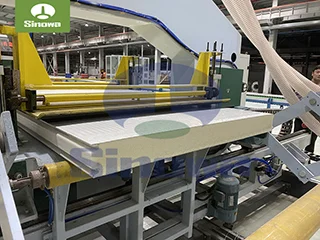
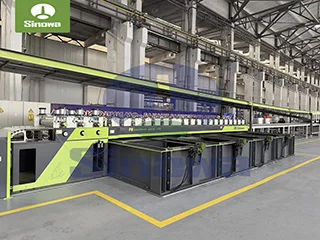
sandwich panel line
The most fundamental and widely adopted classification standard for sandwich panel line is based on production continuity, which divides the equipment into continuous sandwich panel production line and discontinuous intermittent production line. This classification directly determines the production efficiency, product uniformity, automation level, and production cost of sandwich panels, and also lays the foundation for other refined classifications in the industry. Continuous sandwich panel line represent the advanced and mainstream production mode in the modern sandwich panel manufacturing industry. This type of production line integrates all production procedures from raw material feeding, surface material unwinding, core material filling, glue coating, composite pressing, heating curing, fixed-length cutting to finished product output into an automated and uninterrupted production flow. The entire production process operates on a continuous linear transmission mode, with each production unit synchronized in speed and rhythm, realizing seamless connection between front and rear processes.
In the operation of continuous sandwich panel line, metal coil materials for upper and lower surface layers are continuously unwound and leveled through automatic unwinding and leveling systems, eliminating the dimensional errors caused by intermittent feeding. The core material raw materials, including polyurethane foam materials, rock wool, glass wool, and other thermal insulation fillers, are accurately metered and evenly distributed on the moving lower surface layer through automatic batching and spreading systems. For foam core materials, the raw materials undergo high-pressure mixing and continuous foaming in a closed system, forming a uniform and dense foam layer that closely fits with the surface materials. Subsequently, the upper surface layer is automatically laminated, and the composite plate body enters the constant-temperature curing and pressing area. Through precise temperature control and pressure maintaining treatment, the bonding strength between the surface layer and the core material is fully guaranteed, and the overall structural flatness and stability of the plate are optimized. Finally, the continuous plate strip is cut into standard fixed-length plates by an automatic tracking cutting device, and the finished products are output through the conveying system.
The prominent advantages of continuous sandwich panel line is reflected in high production efficiency, stable product quality, and low labor dependence. Since the entire production process realizes full-process automation and continuous operation, there is no shutdown waiting time between processes, and the production speed can be stably maintained at a high level suitable for large-scale orders. The unified transmission speed, constant curing temperature, and precise raw material ratio control enable the produced sandwich panels to have extremely high dimensional consistency, uniform core material density, and stable bonding performance, effectively avoiding quality differences between different batches of products. In terms of labor cost control, continuous line only require a small number of personnel to monitor equipment operation, adjust process parameters, and conduct finished product inspection, greatly reducing manual operation errors and labor input. This type of production line is mainly suitable for large manufacturing enterprises that focus on standardized mass production, and its products are widely used in large industrial factory buildings, commercial building exterior walls, large-span stadiums, and standardized cold storage projects with high demand for product consistency and supply stability.
Intermittent sandwich panel production line, also known as batch production line, are another important basic type of sandwich panel manufacturing equipment, which is completely different from continuous line in production mode and process logic. This type of production line adopts a segmented and batch-type production mode, where each production cycle is relatively independent, and the equipment will suspend operation after completing the production of a single or a group of plates before starting the next production cycle. The process flow of intermittent line is relatively decentralized, with independent completion of raw material preparation, plate pressing, curing, cutting, and forming processes, without synchronous continuous transmission linkage. In actual operation, workers or semi-automatic mechanical devices complete the laying of surface materials and the filling of core materials on a fixed mold or processing platform. After the manual or semi-automatic completion of glue coating and composite assembly, the plate body is sent to the pressing and curing equipment for pressure maintaining and heating treatment. After the curing process is completed, the plate is taken out and transported to the cutting and finishing link to complete the final forming.
Although the production efficiency of intermittent sandwich panel line is far lower than that of continuous line, they have unique flexibility and cost advantages in small-batch and customized production scenarios. The structural design of intermittent line is relatively simple, with low equipment investment and low site space requirements, and the operation and maintenance thresholds are friendly for small and medium-sized manufacturing enterprises. The biggest feature of this type of production line is strong process adjustability, which can quickly adapt to non-standard customized requirements such as special plate thicknesses, irregular sizes, special surface treatments, and personalized structural designs. For some special engineering projects that require a small number of special-sized sandwich panels, intermittent line can complete production flexibly without being restricted by the fixed parameter settings of continuous production equipment. In addition, intermittent line have lower requirements for raw material batch consistency, and can adapt to various types of core materials and surface materials with small usage, making them very suitable for small-scale processing enterprises, engineering supporting production, and customized order production with scattered demands and diverse specifications.
In addition to the core classification based on production continuity, sandwich panel line can also be finely divided according to the types of core materials processed by the equipment, which is a key classification method that directly corresponds to product performance and application fields. Different core materials determine the thermal insulation performance, fire resistance, sound insulation effect, and structural strength of sandwich panels, and the matching production line have targeted process designs and structural configurations to adapt to the physical and chemical characteristics of different core materials. Polyurethane sandwich panel production line is one of the most common types of core material dedicated line. Polyurethane foam has the advantages of low thermal conductivity, lightweight, good adhesion, and excellent overall thermal insulation performance, so the supporting production line focus on precise foaming control and high-strength composite bonding technology.
Polyurethane sandwich panel line is equipped with special high-pressure foaming and metering systems, which can accurately control the mixing ratio of polyurethane raw materials and foaming speed, ensuring that the foam fills the entire plate body uniformly without voids or uneven density. The equipment is designed with a closed constant-temperature curing system to adapt to the foaming and curing reaction characteristics of polyurethane materials, so that the foam can form a dense and stable cellular structure, and achieve seamless bonding with metal or non-metal surface layers. The production line for polyurethane sandwich panels are mostly continuous automated line, which can efficiently produce high-precision thermal insulation panels. The products are widely used in cold storage insulation, building exterior wall energy-saving insulation, roof waterproof insulation, and other scenarios that require high thermal insulation efficiency. With the improvement of building fire protection requirements, many polyurethane sandwich panel production line have added micro-fire-retardant process links, which optimize the foaming formula and curing process to improve the fire resistance of products while maintaining thermal insulation performance.
Rock wool sandwich panel production line is professional production equipment targeting inorganic fireproof core materials, and their process design is completely different from that of polyurethane foam line due to the fibrous and porous structural characteristics of rock wool materials. Rock wool has excellent fire resistance, high-temperature resistance, and sound absorption and insulation performance, but its bulk density is higher, and the material is loose and fibrous, which puts forward higher requirements for the spreading, fixing, and composite pressing process of production line. Rock wool sandwich panel production line is equipped with special rock wool automatic feeding and arranging systems, which can neatly arrange rock wool strips or rock wool felt layers to avoid material scattered gaps and ensure the overall flatness and compactness of the core material. In the composite pressing link, the equipment adopts segmented uniform pressure control technology to prevent the fibrous rock wool core material from being deformed or displaced by excessive pressure, and ensure the stable combination of the core material and the upper and lower surface layers.
In addition, rock wool sandwich panel line is equipped with targeted edge sealing treatment devices. Since rock wool is an inorganic fibrous material with poor self-adhesion, the edge sealing process is essential to improve the overall structural tightness and waterproof performance of the plate. The edge sealing system can realize the integral sealing of the plate edges, effectively preventing water vapor penetration and fiber falling off, and improving the durability of the rock wool sandwich panel. The products produced by rock wool sandwich panel line have outstanding fireproof and sound insulation effects, and are mainly used in high-fire-protection industrial workshops, public building partition walls, factory fireproof isolation belts, and sound insulation wall projects. At present, most high-end rock wool production line adopt continuous composite molding technology, which solves the problems of low efficiency and poor consistency of traditional intermittent rock wool plate production, and realizes large-scale production of high-quality fireproof sandwich panels.
Glass wool sandwich panel production line is another important category of inorganic core material production equipment, which is similar to rock wool line in fire resistance and sound insulation orientation but has more optimized design for lightweight and low-density characteristics of glass wool materials. Glass wool has lower bulk density, better flexibility, and lighter weight than rock wool, and has excellent thermal insulation and sound absorption performance, but its structural compression resistance is weaker. Therefore, the supporting production line adopt low-pressure gentle pressing and uniform spreading processes to avoid crushing the glass wool fiber structure and damaging the thermal insulation pores during the composite molding process. Glass wool sandwich panel line is equipped with precise material spreading and shaping systems, which can make the loose glass wool fiber layer evenly distributed and fixed, ensuring the uniform thickness and stable structure of the plate body. The products of glass wool sandwich panel line is extremely lightweight, which can effectively reduce the overall load of buildings, and are widely used in indoor partition walls, ceiling insulation, and light steel structure building enclosure systems with low load-bearing requirements.
Expanded polystyrene and extruded polystyrene sandwich panel production line is dedicated equipment for processing organic plastic foam core materials. Polystyrene foam materials have the advantages of low price, lightweight, good thermal insulation, and stable chemical properties, and are the most cost-effective thermal insulation core materials in the building insulation field. The corresponding production line have simple and efficient process design, with low requirements for equipment precision and curing conditions. This type of production line mainly completes the fixed-length cutting, automatic laying, glue coating composite, and pressure fixing of polystyrene foam boards. Since the molding of polystyrene foam is completed in advance, the production line focuses on the precise fitting and firm bonding of the core material and the surface layer. The equipment runs stably with low failure rate and high production efficiency, and the produced polystyrene sandwich panels are widely used in ordinary industrial and civil building insulation, temporary building enclosure, and low-cost thermal insulation projects.
According to the difference of surface layer materials processed by production line, sandwich panel line can also be divided into metal surface sandwich panel line and non-metal surface sandwich panel line, which further enriches the classification system of sandwich panel production equipment. Metal surface sandwich panel line is the most widely used production equipment in the industry, mainly processing color steel plates, aluminum alloy plates, and other metal surface materials. This type of production line is equipped with professional metal plate unwinding, leveling, embossing, and bending preprocessing devices, which can realize one-time molding of metal surface layer forming and composite lamination. The production process is highly integrated, and the metal surface layer after precision processing has flat surface, uniform texture, and strong weather resistance. The produced metal surface sandwich panels have high structural strength, good impact resistance, and convenient installation, which are suitable for various outdoor building enclosure structures and industrial equipment insulation facilities.
Non-metal surface sandwich panel line target non-metal surface materials such as fiberglass plates, cement fiber boards, and decorative fireproof boards. Different from metal processing line, this type of production line cancels the metal rolling and embossing process, and is equipped with flexible feeding and protective pressing devices to adapt to the brittle and non-deformable characteristics of non-metal plates. The equipment focuses on flat positioning and uniform glue coating to avoid surface damage and deformation of non-metal plates during production. The non-metal surface sandwich panels produced by such line have excellent fire resistance, decorative performance, and corrosion resistance, and are mostly used for indoor high-grade decoration partitions, clean workshop enclosure walls, and special anti-corrosion engineering projects.
With the refinement of market demand and the upgrading of industrial manufacturing standards, many specialized customized sandwich panel line have emerged in the industry, which are designed for specific application scenarios and special plate performance requirements, filling the production gap of conventional universal production line. Cold storage special sandwich panel line is a typical type of specialized production equipment. Aiming at the low-temperature resistance, anti-freezing, and high-airtightness requirements of cold storage insulation panels, this type of production line optimizes the foaming density, bonding process, and edge sealing structure of the plates. The production line adopts high-density closed-cell foaming technology and integral seamless composite process, which makes the cold storage sandwich panels have extremely low water absorption and excellent low-temperature dimensional stability, avoiding foaming shrinkage, cracking, and thermal bridge phenomena in low-temperature environments. The plate edge sealing structure produced by the special line is more compact, which can effectively improve the airtightness of the cold storage enclosure structure and reduce cold air loss, fully adapting to the long-term low-temperature operation environment of cold storage.
Clean room sandwich panel line is professional production equipment for dust-free and sterile workshop enclosure panels, with extremely high requirements for plate surface flatness, antibacterial performance, and seam tightness. This type of production line adopts ultra-precision leveling and composite molding technology, and the production process is optimized to avoid surface scratches, uneven glue line, and internal gaps of the plates. The produced clean room panels have smooth and seamless surfaces, no dust accumulation dead ends, and good corrosion resistance and antibacterial properties, which meet the strict environmental requirements of pharmaceutical workshops, electronic dust-free workshops, and medical sterile spaces. In addition, the production line can realize customized processing of special structures such as plate wire grooves and window openings, improving the on-site installation efficiency of clean engineering.
Vehicle-mounted sandwich panel line is special production equipment for logistics refrigerated vehicles, RV carriages, and special engineering vehicle carriage plates. Different from building sandwich panels, vehicle-mounted panels have higher requirements for lightweight, impact resistance, and bending resistance. The supporting production line adopt high-strength composite formulas and integrated molding processes, which can produce thin-wall, high-strength, and tough sandwich panels. The equipment can realize the production of special-shaped plates with curved surfaces and variable cross-sections according to vehicle body structure requirements, meeting the personalized structural design needs of different vehicle models. The vehicle-mounted sandwich panels produced by this type of line have light weight and high strength, which can reduce the self-weight of vehicles while ensuring thermal insulation and structural stability, helping to improve the load capacity and energy-saving effect of special vehicles.
In terms of automation degree, sandwich panel line can be divided into fully automatic production line, semi-automatic production line, and manual auxiliary production line, which correspond to different production scales and enterprise investment budgets respectively. Fully automatic sandwich panel line realize full-process unmanned operation from raw material feeding to finished product output. The entire production process is controlled by a centralized control system, which can automatically adjust process parameters such as production speed, raw material ratio, curing temperature, and pressing pressure according to product specifications. The equipment is equipped with automatic detection and fault early warning functions, which can monitor product thickness, flatness, and bonding quality in real time, realizing intelligent production and quality self-inspection. This type of production line has high production efficiency and stable product quality, and is the mainstream equipment for large-scale modern sandwich panel manufacturing enterprises.
Semi-automatic sandwich panel line retain part of the automated production links such as automatic feeding and automatic cutting, while relying on manual assistance for core material laying, glue coating adjustment, and finished product sorting. This type of equipment balances production efficiency and equipment investment cost, with moderate operation difficulty and flexible parameter adjustment. It is suitable for medium-sized enterprises with certain production scale and diversified product types, and can meet the production needs of both conventional standardized plates and small-batch customized products. Manual auxiliary production line have a high degree of manual participation, with simple equipment structure and low investment cost. They are mainly composed of basic pressing, cutting, and auxiliary feeding equipment, relying on manual completion of most process links. Although the production efficiency is low and product quality stability is relatively general, it has strong flexibility and ultra-low operation cost, which is very suitable for small processing workshops and temporary engineering supporting production scenarios.
In the context of green manufacturing and industrial upgrading, modern sandwich panel line is also evolving towards energy saving, environmental protection, and intelligent upgrading, and the technical differences between different types of line is gradually expanding in terms of energy consumption control and environmental performance. New continuous sandwich panel line is equipped with circulating heating systems and waste gas recovery devices, which can effectively reduce energy consumption in the curing process and realize harmless treatment of volatile gases generated during foaming and bonding, meeting environmental protection production standards. Some optimized intermittent production line also adopt energy-saving variable-frequency control technology, which can automatically adjust equipment power according to the operating state, avoiding energy waste caused by no-load operation. In addition, various types of sandwich panel line is gradually adding intelligent data monitoring functions, which can record production parameters in real time, facilitate production data analysis and process optimization, and help enterprises realize refined production management.
The selection of different types of sandwich panel manufacturing line needs to be comprehensively judged based on enterprise production positioning, order characteristics, product application fields, and investment scale. Large-scale enterprises focusing on long-term standardized mass production prefer fully automatic continuous line with high efficiency and stable quality. Small and medium-sized enterprises with diversified customized orders mostly choose semi-automatic intermittent line with strong flexibility. For enterprises focusing on segmented professional fields such as cold storage engineering, clean engineering, and special vehicle manufacturing, professional and customized sandwich panel line is the best choice to improve product competitiveness. Each type of sandwich panel line has its own unique technical advantages and applicable scenarios, and there is no absolute distinction between superior and inferior. The reasonable matching of production line type and production demand is the key to realize efficient production, cost control, and quality optimization.
In conclusion, the diversified types of sandwich panel production line form a complete manufacturing system covering different production modes, core materials, surface materials, application scenarios, and automation levels. From traditional intermittent batch production to modern intelligent continuous production, from universal conventional production equipment to professional customized special line, the continuous enrichment and upgrading of sandwich panel line types have strongly supported the innovative development and widespread application of sandwich panel materials. With the continuous progress of building energy-saving technology, environmental protection standards, and intelligent manufacturing technology, various types of sandwich panel line will continue to iterate and upgrade towards higher efficiency, lower energy consumption, stronger customization ability, and more intelligent operation, providing more reliable equipment support for the high-quality development of the modern building materials industry and related industrial fields.
https://www.cnsinowa.com/sandwich-panel-machines/types-of-sandwich-panel-lines.html