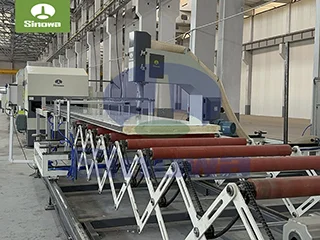
sandwich panel line
The overall structural composition of the composite PU sandwich panel production line follows a sequential production logic, with each functional unit arranged in accordance with the material processing sequence to ensure unobstructed material transportation and smooth technological conversion. At the initial stage of the production line lies the surface material unwinding and pretreatment unit, which serves as the starting point of the entire production process. This unit is equipped with multi-group roller unwinding structures to carry coiled surface materials of different textures and thicknesses, including metal sheets, color-coated plates, and non-metal decorative plates. During operation, the unwinding mechanism maintains constant tension control to avoid material deviation, wrinkling, or stretching deformation during feeding. Additionally, surface pretreatment devices are embedded within this unit to conduct micro-treatment on the inner surface of surface materials, eliminating surface dust, oil stains, and oxide layers. Such subtle surface optimization effectively enhances the bonding adhesion between surface materials and polyurethane foam core layers, laying a solid foundation for the long-term structural stability of finished panels.
Following the pretreatment unit is the raw material metering and mixing system, the core functional module that determines the foaming quality of polyurethane core materials. Polyurethane foam is formed by the chemical reaction between two primary liquid raw materials, and this system adopts precision metering components to control the flow rate and proportion of each raw material strictly. Under the drive of servo power structures, the liquid raw materials are transported to the high-pressure mixing chamber at a stable and controllable flow speed. Inside the sealed mixing chamber, raw materials undergo intense turbulent mixing to achieve uniform molecular fusion, avoiding uneven density, local voids, or inconsistent foaming multiples caused by inadequate mixing. The fully mixed liquid composite materials are then evenly sprayed onto the horizontally moving lower surface material through specially designed discharge nozzles. The spraying range and material thickness can be adjusted dynamically according to production demands to adapt to customized processing requirements for panels with different core layer thicknesses.
The composite molding unit constitutes the intermediate core section of the composite sandwich panel line, undertaking the key processes of material lamination, pressurization, and primary shaping. After the liquid polyurethane material is laid on the lower surface material, the upper surface material is gradually covered and bonded through the upper roller conveying mechanism. The sandwiched composite structure composed of upper and lower surface materials and intermediate foaming raw materials then enters the pressing roller group. This group consists of multiple sets of high-precision pressure rollers with adjustable spacing and pressure parameters. During the pressing process, appropriate mechanical pressure is applied to eliminate tiny air bubbles between layers, ensure the tight fitting of surface materials and core materials, and control the overall flatness and thickness tolerance of the composite board. The internal temperature of the pressing roller group is kept within a reasonable range through a circulating temperature control system, which can activate the initial curing reaction of polyurethane materials and accelerate the bonding speed between different material layers.
Subsequently, the initially shaped composite plates are sent to the constant-temperature curing channel for deep solidification and structural stabilization. The internal space of the curing channel adopts a segmented temperature control design, forming a gradual temperature gradient environment. In the early stage of curing, a moderate temperature promotes the continuous foaming and molecular cross-linking reaction of polyurethane materials, enabling the foam structure to form a dense and uniform porous framework. In the middle and later stages, the temperature is slightly adjusted to slow down the reaction rate, releasing internal stress generated during foaming and molding and preventing panel deformation or warping caused by excessive internal tension. The length of the curing channel and the walking speed of materials are matched with the foaming reaction cycle of polyurethane to ensure that each plate stays in the constant-temperature environment long enough to complete sufficient curing. After curing, the bonding strength between the core layer and surface materials reaches the predetermined standard, and the overall structural rigidity and thermal insulation performance of the panel tend to be stable.
The cooling and shaping unit is arranged behind the curing channel, responsible for reducing the surface and internal temperature of cured panels to room temperature steadily. High-temperature cured panels retain residual internal heat, and rapid temperature drop may lead to inconsistent thermal expansion and contraction coefficients between dissimilar materials, resulting in subtle gaps at the bonding interface. Therefore, this unit adopts a gradual cooling method combining natural heat dissipation and low-speed air circulation. The circulating air flow uniformly takes away surface heat to ensure synchronous temperature reduction inside and outside the panels. During the cooling process, the panels maintain a horizontal conveying state without external pressure interference, allowing the internal molecular structure to complete natural stabilization and further consolidate the composite bonding state. Panels after cooling treatment feature smooth surfaces, stable sizes, and no residual internal stress, meeting the basic conditions for fixed-size cutting and finished product processing.
The fixed-size cutting and trimming unit acts as the final processing link of the composite sandwich panel production line, realizing dimensional shaping and edge finishing of finished panels. This unit is equipped with intelligent induction positioning components, which automatically identify the conveying position of panels and record processing length data in real time. When the panels reach the preset cutting position, high-speed cutting tools start to perform flat and neat cutting without generating rough burrs or material chipping. In addition to length cutting, edge trimming mechanisms on both sides can trim the uneven edges of panels to ensure consistent width specifications of each finished product. The cutting and trimming parameters support flexible adjustment, enabling the production line to process panels of diverse length and width specifications and meet the personalized size demands of different application scenarios. The processed finished panels are then transported to the stacking area through the terminal conveying platform for orderly arrangement and temporary storage.
In terms of working performance, the composite PU sandwich panel production line boasts prominent advantages in production efficiency and product consistency. The continuous conveying structure enables non-stop cyclic production, effectively shortening the single-panel processing cycle and realizing large-scale batch output. All key production parameters, including raw material proportioning, spraying volume, pressing pressure, curing temperature, and conveying speed, are regulated by a centralized control system. The system records and optimizes parameter data in real time to avoid performance fluctuations caused by manual operation errors. Mechanized and automated production significantly reduces labor demand, lowers the labor cost input in the production process, and improves the utilization rate of raw materials. The sealed production environment also reduces the volatilization of chemical raw materials and the generation of processing waste, conforming to the basic requirements of modern energy-saving and environmentally friendly manufacturing modes.
The polyurethane sandwich panels manufactured by this production line integrate multiple excellent physical properties, deriving from the rational matching of production processes and structural design. The closed-cell porous structure of the polyurethane core layer endows the panels with outstanding thermal insulation and heat preservation capabilities, effectively blocking heat conduction and reducing energy consumption for temperature regulation in buildings and storage spaces. The composite structure formed by the outer dense surface materials and the inner foam core layer gives the panels good compressive resistance and bending resistance, enabling them to withstand external mechanical loads without permanent deformation. Meanwhile, the integrated composite molding process enhances the overall structural integrity of the panels, with stable interlayer bonding that is not prone to delamination and peeling during long-term use. In addition, the panels have favorable sound insulation, moisture resistance, and corrosion resistance, adapting to complex and changeable usage environments such as high humidity, low temperature, and chemical corrosion.
This polyurethane sandwich panel production line features strong production compatibility and can complete the manufacturing of diversified sandwich panel products by replacing surface materials and adjusting process parameters. When matched with metal color-coated plates, the produced panels are suitable for factory workshops, warehouse enclosures, and large-scale public building roofs and walls, providing durable and weather-resistant building enclosure materials. When adopting anti-corrosion and antibacterial non-metal plates as surface layers, the panels can be applied to sterile purification workshops and constant-temperature storage spaces. For special scenarios such as transportation refrigeration compartments, the production line can adjust the foaming density and curing time to enhance the thermal insulation and impact resistance of panels, meeting the lightweight and high-strength usage requirements of mobile cold chain equipment. The flexible production compatibility enables a single production line to cover multiple industry application needs and expand the economic benefits of production equipment.
In terms of equipment operation and maintenance, the composite PU sandwich panel line adopts a modular structural design, with each functional unit relatively independent and interconnected through standardized connecting components. This design facilitates daily inspection, part replacement, and equipment maintenance for operators. The centralized control interface simplifies the operation logic, with intuitive data display and one-click parameter adjustment functions, reducing the professional threshold for equipment operation. The key moving parts are equipped with dust-proof and wear-resistant protective structures to adapt to long-term continuous industrial operation and extend the service life of mechanical components. Moreover, the production line is embedded with abnormal condition monitoring modules. When parameters such as raw material pressure, equipment temperature, and conveying speed deviate from the normal range, the system will automatically trigger prompt feedback to help staff eliminate potential equipment faults in a timely manner and ensure the continuity and stability of production work.
With the continuous upgrading of industrial manufacturing technology and the growing market demand for energy-saving composite building materials, the composite PU sandwich panel manufacturing line is evolving toward higher automation, intelligent control, and energy-saving optimization. The introduction of intelligent sensing and data analysis technology enables the production line to automatically optimize process parameters according to raw material changes and production environments, further improving product qualification rates. The optimized structural design of the foaming system reduces raw material consumption and chemical energy waste during the reaction process. The improved circulating temperature control system lowers the energy consumption of heating and cooling links, realizing low-carbon and environmentally friendly production. In the future, with the continuous expansion of application scenarios such as prefabricated buildings, cold chain transportation, and new energy facilities, this polyurethane sandwich panel machine will receive broader market application space and continuously iterate and upgrade in combination with emerging industrial technologies to adapt to higher-standard production and manufacturing requirements.
https://www.cnsinowa.com/sandwich-panel-machines/composite-pu-sandwich-panel-production-line.html