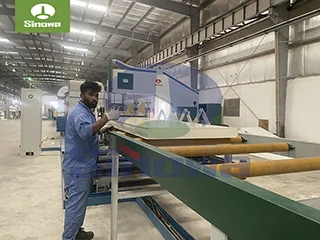
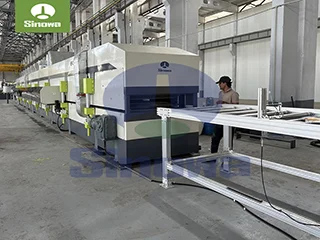
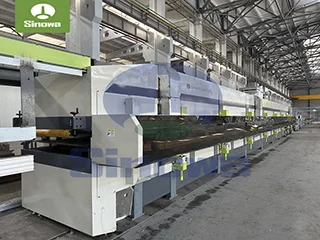
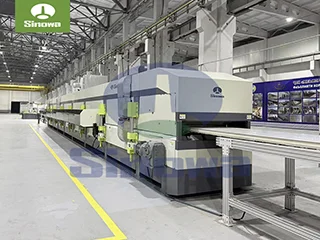
sandwich panel machine
The fundamental design logic of PIR sandwich panel machine originates from the physical and chemical characteristics of polyisocyanurate foam, a polymer material with dense closed-cell structure, low thermal conductivity, and excellent temperature resistance. Unlike ordinary polyurethane foam processing equipment, PIR panel machines are optimized for the special polymerization reaction of isocyanate under specific temperature and pressure conditions, ensuring that the foamed core material forms a stable molecular structure with superior heat insulation and flame retardant properties. The overall structure of a complete PIR panel production line follows a modular integrated layout, where each functional module is logically arranged to realize uninterrupted continuous production. The main body of the machine consists of raw material feeding units, precise metering and mixing systems, material distributing mechanisms, continuous molding and pressing assemblies, temperature control systems, cutting and trimming devices, as well as finished product conveying and stacking components. Every module is closely connected through synchronous transmission systems, enabling coordinated operation and minimizing manual intervention throughout the production process.
Raw material feeding constitutes the initial operational stage of the PIR sandwich panel making machine, laying a solid foundation for subsequent stable production. This part is mainly composed of raw material storage tanks, filter devices, and preliminary conveying pipelines, which are specially designed to store two primary liquid raw materials required for foam synthesis. The internal structure of the storage tanks adopts an anti-corrosion integrated lining to prevent chemical corrosion caused by long-term contact with polymer raw materials, while equipped with constant temperature auxiliary devices to maintain the raw materials at a stable viscosity state suitable for transmission and mixing. In addition to liquid foam raw materials, the feeding system also includes coil feeding mechanisms for surface base materials. Metal or non-metal coiled substrates are placed on automatic unwinding racks, which are equipped with tension adjustment structures to avoid wrinkles, deviations, or uneven stretching of the substrates during the continuous conveying process. The synchronization adjustment function of the unwinding racks can match the operating speed of the subsequent molding system, ensuring that the surface substrates are steadily transported to the composite molding area at a uniform rate.
The precise metering and mixing system is regarded as the core functional component of the PIR sandwich panel manufacturing machine, directly determining the foaming quality and physical properties of the finished panels. This system is equipped with independent variable frequency drive metering pump units for different liquid raw materials, and each pump body operates under independent power control to achieve accurate flow regulation of raw materials. During operation, the system automatically calculates the raw material delivery ratio according to the preset production parameters, and the high-sensitivity sensing elements monitor the real-time flow of each raw material in the pipeline. Once flow deviation is detected, the system can instantly adjust the operating frequency of the metering pumps to correct the feeding amount, ensuring that the proportion of different chemical components remains within the optimal reaction range. After precise metering, all raw materials are transported to a high-efficiency mixing chamber, where internal turbulent flow structures accelerate the fusion of liquid components. The mixing process strictly controls the mixing speed and stirring time to avoid insufficient mixing that leads to uneven foam pores or excessive stirring that causes molecular structure damage. The uniformly mixed composite liquid is then transported to the material distributing mechanism through sealed pipelines, completing the preparation before foaming.
The mobile material distributing mechanism undertakes the key task of evenly spreading the mixed liquid raw materials on the surface of the lower substrate. Installed above the continuous conveying substrate, this mechanism can perform reciprocating linear movements along the horizontal direction of the production line. Different from fixed-point feeding structures, the mobile distributing design effectively solves the problem of uneven material accumulation in local areas, enabling the liquid raw materials to form a uniform thin layer between the upper and lower substrates. The internal flow channel of the distributor adopts a streamlined structural design to reduce material residue and flow resistance, and the detachable nozzle structure facilitates daily cleaning and maintenance. During the distributing process, the real-time monitoring system synchronizes the moving speed of the distributor with the conveying speed of the substrate. When the production line speed is adjusted, the walking frequency of the distributor will automatically change accordingly to maintain a consistent material spreading density. This precise distributing mode ensures that the thickness of the foamed core material remains uniform in the subsequent molding process, eliminating quality defects such as local hollowing and uneven density of the panels.
Continuous molding and pressing assembly is the molding core of the PIR sandwich panel production machine, responsible for completing foam curing, composite bonding and panel shaping. This component consists of upper and lower circular pressing belts, driving transmission rollers, and hydraulic pressure regulation structures. After the raw materials are spread between the two layers of substrates, the composite materials enter the closed pressing area with the operation of the conveying system. The pressing belts are made of high-temperature resistant and wear-resistant composite materials, which can maintain stable surface flatness under long-term high-temperature and pressure working conditions. The hydraulic system provides continuous and stable molding pressure, and the pressure value can be dynamically adjusted according to the preset panel thickness and material hardness requirements. Inside the pressing assembly, an integrated circulating temperature control system is embedded to keep the molding temperature within the optimal range required for polyisocyanurate polymerization reaction. Moderate high temperature accelerates the cross-linking reaction of internal molecules of the raw materials, prompting the liquid mixture to complete foaming, solidification and molding in a short time. During the continuous pressing process, the synchronous transmission structure ensures that the operating speed of the upper and lower pressing belts is completely consistent, avoiding relative sliding between the substrates to prevent panel deformation or surface scratches.
Temperature control system runs through all production links of the PIR sandwich panel production line and is an indispensable auxiliary system to ensure production stability. The chemical foaming reaction of polyisocyanurate has extremely strict requirements on ambient temperature and material temperature. Excessively low temperature will slow down the molecular reaction rate, resulting in insufficient foaming, increased panel density, and reduced thermal insulation performance; excessively high temperature will cause rapid expansion of internal bubbles, leading to enlarged pore gaps, decreased structural strength, and even local cracking of the panel. The temperature control system adopts segmented intelligent temperature regulation, with independent temperature sensing and heating or cooling components installed in the raw material storage area, mixing chamber, distributing area, and molding pressing area. All temperature monitoring points transmit real-time data to the central control terminal. When the temperature deviates from the preset threshold, the system automatically starts the temperature adjustment device to realize constant temperature control. The circulating water cooling structure is adopted in the high-temperature heating section to achieve rapid temperature stabilization, avoiding temperature fluctuation caused by long-term continuous operation of the equipment.
After the composite panels complete foaming and curing molding, they enter the cutting and trimming stage. The cutting system of the PIR sandwich panel line includes fixed-length transverse cutting equipment and edge trimming devices on both sides. Driven by high-precision servo motors, the cutting equipment can accurately locate the cutting position according to the preset panel size parameters. The transverse cutting tool adopts a high-hardness integral blade structure, which can complete smooth cutting of composite materials with metal or non-metal surfaces without burrs or indentations. The edge trimming devices are responsible for removing the irregular residual materials on both sides of the panels generated in the molding process, ensuring that the edge size of each panel is neat and consistent. All cutting actions are automatically completed under the control of the central system, and the cutting speed is synchronized with the production line operation speed to avoid production stagnation. Meanwhile, the cutting system is equipped with waste recycling and collecting structures to uniformly store the trimmed leftover materials, which is convenient for subsequent centralized treatment and resource recycling.
The final stage of the production process is finished product conveying and automatic stacking. The qualified panels after cutting and trimming are transported to the stacking area through the low-noise conveying roller table. The stacking mechanism is equipped with intelligent sensing elements, which can identify the position and quantity of finished products, and complete automatic grabbing, lifting and stacking of panels through mechanical transmission structures. The stacking mode can be adjusted according to the panel specifications and storage requirements, realizing orderly arrangement of finished products. This automatic stacking design replaces manual handling, effectively reducing the risk of panel surface damage caused by human operation, while improving the neatness of finished product storage and facilitating subsequent transportation and packaging. The entire production flow from raw material feeding to finished product stacking forms an uninterrupted closed-loop production chain, realizing fully automated continuous processing of PIR panels.
In terms of material adaptability, modern PIR sandwich panel machine have strong compatibility with various surface base materials and foaming raw materials. For surface substrates, the equipment can adapt to metal coil materials with different thicknesses and surface treatments, as well as various non-metal inorganic composite plates. The adjustable tension and flattening structures in the feeding system can perform preliminary shaping on substrates with different hardness and ductility, ensuring the flatness of composite bonding. In terms of foaming raw materials, the metering system has a wide range of flow adjustment capabilities, which can match raw material formulas with different chemical ratios. By adjusting operating parameters such as mixing speed, molding pressure, and curing temperature, the machine can produce PIR panels with different density, thickness, and thermal insulation coefficients to meet the usage requirements of diverse industrial scenarios. In addition, the equipment can add auxiliary feeding modules for functional additives according to production demands, so as to prepare composite panels with enhanced fire resistance, sound insulation, or anti-corrosion performance.
The daily operation and maintenance management of PIR panel machines is crucial to extend the service life of the equipment and maintain stable production quality. Before starting the equipment, operators need to conduct comprehensive inspection of key components, including checking whether the raw material pipeline is unobstructed, whether the metering pump operates sensitively, whether the temperature sensing elements are accurate, and whether the cutting blade is intact. After confirming that all parts are normal, the idle running test shall be carried out to preheat the equipment and adjust the operating parameters to the optimal production state. During the formal production process, the central control system displays real-time data such as raw material consumption, operating speed, molding temperature, and system pressure. Operators only need to monitor the data changes and make minor adjustments to individual parameters according to the production batch requirements. It is strictly prohibited to modify the core operation parameters arbitrarily to avoid abnormal chemical reactions of raw materials leading to batch unqualified products.
Daily maintenance work includes regular cleaning, lubrication, and component inspection. The material distributing nozzle and mixing chamber are cleaned regularly to prevent raw material residue from solidifying and blocking the pipeline, which may affect the mixing uniformity of subsequent raw materials. The transmission gears, roller bearings and other moving parts are regularly coated with high-temperature resistant lubricating oil to reduce mechanical wear and reduce operating noise. The wearing parts such as cutting blades and sealing gaskets are inspected at fixed cycles, and replaced in a timely manner when aging or wear is found. In addition, the heat dissipation and dust removal system of the equipment should be kept unobstructed to avoid dust accumulation affecting the heat dissipation efficiency of the temperature control system and the sensitivity of sensing components. After the daily production work is completed, the equipment needs to be shut down in accordance with the standard shutdown procedure, and the residual raw materials in the pipeline should be cleaned to prevent pipeline corrosion caused by long-term retention of chemical raw materials.
Compared with other types of insulation panel production equipment, PIR panel machines have prominent industrial production advantages in structural design and performance configuration. In terms of production efficiency, the continuous assembly line design realizes uninterrupted feeding, molding and cutting, with a stable and controllable production cycle. The synchronous coordination of all functional modules avoids waiting time between processes, greatly improving the unit time output. In terms of product quality stability, the intelligent metering and temperature control system minimizes the interference of human factors on the production process. The physical indicators such as thickness, density and compressive strength of each batch of finished panels maintain low deviation, which is convenient for standardized application in engineering construction. In terms of operation cost, the integrated compact structure reduces the floor area of the equipment, and the optimized pipeline design reduces the residual waste of raw materials. The energy-saving temperature control structure effectively reduces energy consumption during long-term operation, helping production enterprises control comprehensive production costs.
In addition, the safety protection design of modern PIR panel machines is increasingly optimized to meet the stringent safety standards of industrial production. The equipment is equipped with emergency stop sensing devices at multiple key positions. Once abnormal conditions such as material blockage, equipment jamming, and parameter overload occur, the system will automatically trigger the emergency stop mechanism to cut off the power supply and stop raw material transmission, so as to avoid equipment damage and safety accidents. The closed raw material transmission pipeline reduces the volatilization of chemical raw materials, and the internal sealed reaction space avoids the overflow of harmful gases generated during the foaming process. The mechanical moving parts are wrapped with protective shells to prevent accidental contact and injury to operators. The human-computer interaction interface adopts an intuitive display mode, and the system will automatically pop up fault prompts when parameters are abnormal, providing clear troubleshooting directions for maintenance personnel.
PIR panels produced by high-performance PIR panel machines are widely used in multiple industrial fields, covering construction engineering, cold chain logistics, industrial manufacturing and other sectors. In the building construction industry, such panels serve as wall and roof insulation materials for industrial plants, public buildings and civil residences. Their low thermal conductivity effectively reduces indoor and outdoor heat exchange, realizing energy conservation and consumption reduction of buildings. The excellent structural compressive strength enables the panels to adapt to complex building installation environments, and the stable chemical structure avoids performance degradation caused by long-term temperature and humidity changes. In the cold chain logistics industry, PIR panels are used to manufacture thermal insulation compartments and cold storage enclosure structures. Their low-temperature resistance ensures that the internal temperature of the cold storage remains stable, reducing the energy consumption of refrigeration equipment.
In the field of industrial manufacturing, PIR composite panels can be applied to the thermal insulation and anti-corrosion lining of industrial equipment, as well as the isolation and protection of special production workshops. In addition, with the continuous improvement of environmental protection requirements in various industries, the environmental-friendly characteristics of PIR panels have become an important advantage for their popularization. The raw materials used in qualified production formulas do not contain harmful volatile substances, and the closed-cell structure will not cause moisture absorption and mildew after long-term use. The waste materials generated during production can be recycled and reused after centralized treatment, which conforms to the sustainable development concept of modern green manufacturing. Driven by market demand, the application scenarios of PIR panels are still expanding, which in turn promotes the continuous technological upgrading of supporting production equipment.
From the perspective of technological evolution, PIR panel machines are constantly developing towards intelligence, high efficiency and environmental protection. In terms of intelligent upgrading, more advanced data collection and analysis modules are being integrated into the equipment. The system can record all operation data in the production process, including raw material consumption, parameter adjustment records, and product quality detection data. By analyzing historical data, the equipment can automatically optimize production parameters, realize adaptive adjustment according to different raw material formulas and production specifications, and reduce manual debugging frequency. The remote monitoring function enables technical personnel to view the operating status of the equipment in real time through terminal devices, realizing remote fault diagnosis and parameter optimization.
In terms of high-efficiency optimization, researchers are committed to improving the foaming reaction efficiency and transmission synchronization performance of the equipment. The upgraded mixing structure can realize more rapid and uniform fusion of raw materials, shortening the curing and molding cycle of panels. The optimized transmission roller arrangement reduces the resistance in the material conveying process, improves the running stability of the production line, and further increases the continuous production speed. At the same time, the lightweight and integrated design of mechanical components reduces the overall weight of the equipment, simplifies the disassembly and assembly process, and facilitates equipment transportation, installation and later maintenance.
In terms of environmental protection improvement, modern PIR panel machines focus on reducing energy consumption and pollutant emission during operation. The regenerative temperature control system can recycle the waste heat generated in the molding process for raw material preheating, reducing the energy loss of heating equipment. The optimized raw material sealing transmission structure further suppresses the volatilization of chemical substances, and the waste gas generated in the production process is collected and processed through the integrated purification device to meet environmental protection emission standards. In addition, the equipment is compatible with degradable and low-carbon raw material formulas, providing technical support for the production of green and low-carbon composite panels, and adapting to the global energy-saving and emission-reduction development trend.
Despite the mature application of current PIR panel machine technology, the equipment still faces some technical bottlenecks in the production of ultra-thick panels, special-shaped composite plates and ultra-wide specification products. In the production of ultra-thick panels, it is difficult for the internal temperature and pressure of the foam layer to maintain uniform distribution, which may lead to inconsistent curing degree inside and outside the panel and affect the overall structural stability. For special-shaped composite panels, the flexibility of the traditional linear pressing structure is insufficient, and it is difficult to complete one-time integrated molding of irregular structures. In view of these technical pain points, the industry is carrying out targeted technological research and development, such as designing multi-stage segmented pressing structures to realize gradient pressure regulation in the molding process, developing flexible mold components to adapt to special-shaped product processing, and optimizing the internal temperature field distribution mode to improve the molding quality of thick plates.
In the future, with the continuous progress of new material technology and intelligent manufacturing technology, the comprehensive performance of PIR panel machines will be further improved. The deep integration of artificial intelligence and mechanical equipment will realize full-automatic unmanned production, and the equipment can independently complete raw material proportioning, parameter debugging, quality detection and fault early warning. The application of new high-strength and corrosion-resistant materials will extend the service life of equipment components and reduce the frequency of replacement and maintenance. Meanwhile, under the background of the booming new energy and building energy conservation industries, the market demand for high-performance PIR insulation panels will continue to grow, which will drive the iterative upgrading of production equipment and promote the standardized and customized development of the PIR panel manufacturing industry.
In conclusion, PIR panel machine is a highly integrated and sophisticated industrial production equipment covering machinery, chemical industry, automation and other multidisciplinary technologies. Its complete production process realizes the efficient preparation of high-quality polyisocyanurate composite panels through the coordinated operation of multiple functional modules. With excellent material adaptability, stable production performance and broad application value, this kind of equipment has become an important supporting facility in the field of modern building insulation composite materials. Through standardized operation and scientific maintenance, the service efficiency of the equipment can be maximized, and stable and high-quality panel products can be continuously provided for various industries. In the context of global emphasis on energy conservation and green construction, the technological innovation and performance optimization of PIR panel machines will surely inject lasting impetus into the high-quality development of the composite material manufacturing industry, and create greater economic and social value for the industrial chain.
https://www.cnsinowa.com/sandwich-panel-machines/pir-panel-machine.html