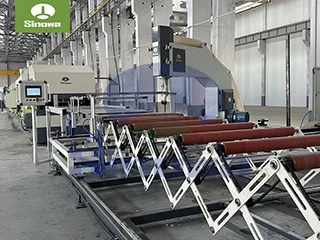
sandwich panel machine
The overall structural design of a complete PUF sandwich panel production line follows the logic of sequential processing, and all functional units are closely connected through an intelligent conveying system to ensure the continuity and synchronization of each production link. The whole equipment can be divided into multiple core functional modules according to processing procedures, including raw material unwinding and pretreatment unit, high-precision foaming and batching unit, material distribution and laying unit, constant temperature pressing and composite unit, curing and shaping unit, fixed-size cutting and trimming unit, as well as finished product conveying and stacking unit. Each module has independent mechanical execution components and collaborative control programs, and the operating parameters of all modules are uniformly regulated by the central control system, which effectively avoids production fluctuations caused by manual operation errors and ensures the consistency of panel quality in batch production.
The raw material unwinding and pretreatment unit is the starting part of the entire sandwich panel production line, undertaking the task of continuously supplying surface base materials for panel molding. Common surface base materials include color-coated metal sheets, stainless steel sheets and fiber-reinforced non-metal plates, all of which are stored in a roll-shaped structure to adapt to continuous rolling production. This unit is mainly composed of unwinding racks, tension control assemblies and automatic deviation correction devices. The unwinding rack adopts a welded rigid structure with strong load-bearing capacity, which can stably fix raw material rolls of different specifications and realize slow and uniform discharging through a servo driving motor. The tension control system is a key component to maintain the flatness of base materials; it monitors the tension data of materials in real time through high-sensitivity sensing components and dynamically adjusts the operating speed of the unwinding motor to prevent the surface materials from wrinkling, stretching or breaking during the conveying process. The deviation correction device can identify the lateral offset of base materials through optical sensing technology, and complete automatic position correction in a short time to ensure that the upper and lower surface materials are accurately aligned in the subsequent composite process, avoiding the quality defect of uneven edges of finished panels. In addition, this unit is equipped with a surface dust removal mechanism, which uses high-pressure air flow and static elimination components to remove dust, debris and static attachments on the surface of base materials, optimizing the bonding condition between surface materials and foam core layers.
The foaming and batching unit is the core functional component that determines the physical properties of PUF panel core layers, responsible for the precise proportioning and uniform mixing of polyurethane chemical raw materials. Polyurethane foam is formed by the chemical reaction between two main liquid raw materials, and the entire batching system is equipped with independent sealed storage tanks to store different liquid raw materials respectively. Each storage tank is matched with a dedicated frequency conversion metering pump, which is driven by an independent servo motor to realize quantitative output of raw materials. In the production process, the central control system automatically adjusts the rotating speed of the metering pump according to the preset formula parameters, so as to accurately control the output flow of different raw materials and ensure that the raw materials are mixed in the optimal reaction ratio. The mixed raw materials enter the high-pressure mixing chamber, where the turbulent flow technology is used to realize rapid and uniform blending of liquid materials. The internal structure of the mixing chamber adopts a streamlined anti-residue design, which can reduce the adhesion of viscous raw materials and avoid material waste and mixing impurities. Meanwhile, this unit is equipped with a constant temperature heat preservation structure for raw material pipelines. Since the reaction activity of polyurethane raw materials is highly sensitive to temperature changes, the constant temperature system can maintain the raw material temperature within a stable range, ensuring the stability of the foaming reaction speed and the uniformity of foam pore structure. The scientifically designed batching and foaming system makes the foam core layer have fine and dense internal pores, and endows the panel with excellent heat insulation, sound insulation and shock resistance.
The material distribution and laying unit undertakes the key task of evenly covering the mixed foaming materials on the surface base materials. After the foaming raw materials are uniformly mixed, they are transported to the mobile material distribution mechanism through sealed pipelines. The material distribution mechanism is installed above the conveying track of the lower base material, and can perform reciprocating linear movement along the horizontal direction. During the movement, the liquid foaming materials are continuously sprayed on the surface of the lower base material through multiple groups of evenly arranged discharge ports. The spraying flow rate and movement speed of the material distributor are synchronously matched with the production line speed, so that the liquid foaming materials can cover the base material without dead angles and accumulation. The internal flow channel of the material distributor adopts an optimized shunt structure, which can balance the material pressure of each discharge port and ensure the consistent thickness of the foaming material in the transverse direction. In order to adapt to panels of different thickness specifications, the vertical height of the material distribution mechanism can be electrically adjusted, and the spraying gap can be accurately controlled to meet the laying requirements of foaming materials with different thicknesses. After the completion of material laying, the upper base material is automatically covered on the surface of the foaming material through the overturning and pressing assembly, forming a three-layer composite structure of upper surface material, middle foaming core layer and lower surface material, laying a structural foundation for subsequent pressing and curing molding.
The constant temperature pressing and composite unit is an important link to realize the tight bonding of composite structures and shape the mechanical strength of panels. This unit is mainly composed of a multi-group composite pressing roller set and an intelligent temperature control system. The pressing roller set is made of high-strength alloy materials with smooth and wear-resistant surface, and the vertical gap between the upper and lower pressing rollers can be accurately adjusted through a hydraulic transmission system to adapt to the production requirements of panels with different thicknesses. In the composite process, the three-layer composite materials pass through the pressing roller set at a constant speed, and the hydraulic system provides stable and uniform pressing force. Appropriate pressure can eliminate the tiny air gaps between the base material and the foam core layer, enhance the bonding tightness of each layer structure, and avoid the delamination defect of finished panels. The internal circulation constant temperature oil heating technology is adopted inside the pressing roller; the heating system realizes regional precise temperature control, and the temperature difference of different areas on the roller surface is kept within a tiny range. Reasonable pressing temperature can accelerate the curing reaction of polyurethane foam, improve the bonding activity between raw materials and base materials, and shorten the composite molding cycle. For different types of surface materials and foam formulas, the system can store multiple sets of temperature and pressure parameter schemes, and operators can switch parameters with one key according to production requirements, which greatly improves the production flexibility of the equipment.
The curing and shaping unit is used to complete the complete chemical reaction of polyurethane foam and stabilize the internal structural state of the panel. After hot pressing and composite molding, the internal foaming reaction of the panel has not been completely completed, and the foam structure is in a soft and unstable state. The curing unit is equipped with an extended heat preservation curing channel, and the internal space of the channel maintains a constant temperature and dry environment through a circulating heating system. The conveying speed of the curing channel is synchronized with the front-end production rhythm, ensuring that each panel stays in the heat preservation space for sufficient curing time. During the curing process, the polyurethane foam continues to complete the foaming and cross-linking reaction, the internal pore structure tends to be stable, and the bonding force between the core layer and the surface material is further enhanced. At the same time, the slow heat dissipation environment can reduce the internal temperature difference stress of the panel, effectively avoid the deformation, warping and cracking of the panel caused by rapid temperature change, and improve the flatness and dimensional stability of the finished panel. The length of the curing channel can be matched according to the production speed; high-speed production lines are usually equipped with extended curing sections to ensure that the curing quality is not affected by the improvement of production efficiency.
The fixed-size cutting and trimming unit realizes the fixed-length cutting and edge finishing of continuous long-strip panels, which is the final processing link of panel molding. After curing and shaping, the panels are transported to the cutting station at a constant speed. This unit adopts servo-driven flying cutting technology, which can complete accurate cutting without stopping the production line, realizing the integration of continuous conveying and dynamic cutting. The cutting tool is made of high-hardness alloy materials, with sharp cutting edge and wear resistance, which can ensure smooth and burr-free cutting sections of metal and non-metal surface panels. The central control system can set arbitrary cutting length parameters, and the high-precision sensing components track the conveying distance of the panels in real time to control the cutting action accurately, with extremely low dimensional error of finished products. In addition to fixed-length cutting, this unit is also equipped with an edge trimming mechanism, which can trim the redundant foaming materials and irregular edges on both sides of the panels to ensure that the transverse width of the panels is consistent and the edges are neat. The trimmed waste materials are automatically collected through the sealed waste discharge channel, which is convenient for centralized recycling and treatment, reducing material waste and environmental pollution in the production process.
The finished product conveying and stacking unit is responsible for the automatic transportation, temporary storage and stacking of processed qualified panels. After cutting and trimming, the finished panels fall onto the roller conveying table, and the conveying motor drives the roller to rotate stably to transport the panels to the stacking station. The stacking mechanism adopts a mechanical arm grabbing structure, which is equipped with a flexible anti-slip clamping assembly to avoid scratching or extruding the surface of the panels during the grabbing process. The mechanical arm can automatically adjust the grabbing position and stacking spacing according to the size and weight of the panels, and complete layered and orderly stacking of finished products. The entire stacking process does not require manual intervention, which reduces the labor cost of finished product handling and avoids the panel damage caused by manual carrying. At the same time, this unit is equipped with a simple quality detection auxiliary system, which uses optical sensing components to preliminarily identify the surface defects such as scratches, depressions and uneven thickness of the panels, and automatically screen out unqualified products to prevent defective products from entering the finished product storage area.
The intelligent central control system runs through all functional modules of the PUF sandwich panel machine, which is the brain to realize automatic and intelligent production of the equipment. The system takes the programmable logic controller as the core control component, and connects the sensing elements, driving motors, hydraulic components and heating systems of each unit through signal lines. The human-computer interaction interface adopts a touch screen design, and operators can intuitively view the real-time operating parameters of the equipment, including raw material flow, heating temperature, pressing pressure, conveying speed and cutting size. All production parameters can be manually set and stored in the system database, and the stored parameter formulas can be called directly when producing panels of the same specification again, which simplifies the production debugging process. In terms of safety control, the system is equipped with multiple fault monitoring modules. When abnormal conditions such as raw material shortage, pipeline blockage, temperature overload and mechanical jamming occur during the operation of the equipment, the system will automatically trigger an alarm prompt and perform emergency shutdown actions to avoid equipment damage and production safety accidents. In addition, the system has a data statistical function, which can automatically record the daily output, material consumption and equipment operating status, providing data support for production management and equipment maintenance.
PUF sandwich panel manufacturing machine have significant technical characteristics in structural design and production logic, which endow the equipment with excellent production performance and product adaptability. In terms of production continuity, the whole production line realizes uninterrupted feeding, foaming, composite molding and cutting processing, and the linkage operation of each module avoids the waiting time of intermediate processes, effectively improving the production efficiency. In terms of processing accuracy, the equipment adopts full servo driving and high-precision sensing detection technology, and the error of panel thickness, length and width is controlled within a tiny range, which meets the high-precision size requirements of industrial building materials. In terms of material adaptability, by adjusting the batching formula, pressing temperature and mechanical gap parameters, the equipment can produce panels with different foam densities and different surface materials, which can meet the usage needs of different application scenarios. In terms of energy consumption control, the equipment adopts an optimized circulating heating system and frequency conversion driving technology, which can automatically adjust the operating power according to the production load, effectively reducing the invalid energy consumption in the production process. In terms of structural stability, the main frame of the equipment is made of thickened steel structure through integral welding and stress relief treatment, which can maintain stable operating state under long-term high-load working conditions and reduce the failure rate of mechanical vibration.
Scientific daily operation and standardized maintenance are key measures to ensure the long-term stable operation of PUF panel production machine and extend the service life of equipment. Before the equipment is started, operators need to complete pre-production inspection work, including checking the storage capacity of chemical raw materials, the tightness of raw material transmission pipelines, the flexibility of mechanical transmission components and the sensitivity of sensing elements. It is necessary to discharge the residual air in the mixing chamber and pipelines to avoid the uneven foaming quality caused by air mixing. During the formal production process, the operating state of each module should be monitored in real time, and the parameter fluctuation should be adjusted dynamically to ensure the consistency of panel quality. The running speed of the production line should not be adjusted arbitrarily, and sudden acceleration or deceleration should be avoided to prevent the unstable bonding of the composite structure. After the daily production is completed, the residual raw materials in the foaming pipeline and mixing chamber should be cleaned thoroughly to prevent the chemical raw materials from solidifying and blocking the pipeline. For the rotating parts such as conveying rollers and transmission gears, regular lubricating oil injection is required to reduce mechanical friction and wear. The hydraulic system needs to regularly check the oil liquid level and oil quality, and replace the deteriorated hydraulic oil in time to ensure the stability of pressing pressure. The electrical control components should be kept dry and dust-proof, and the dust on the surface of the electrical cabinet should be cleaned regularly to avoid circuit failure caused by dust accumulation.
With the continuous progress of industrial technology, the manufacturing technology of PUF panel manufacturing machines is also constantly iterating and upgrading. The early equipment adopted semi-automatic production mode, which relied heavily on manual assistance in material feeding, parameter adjustment and finished product sorting, with low production efficiency and unstable product quality. With the popularization of servo control technology and intelligent sensing technology, modern production lines have realized full-process automatic control, and the degree of production intelligence has been greatly improved. In terms of foaming technology, the traditional low-pressure mixing mode is gradually replaced by high-pressure turbulent mixing technology, which improves the mixing uniformity of raw materials and reduces the generation of foam internal defects. In terms of energy saving optimization, the waste heat generated by the heating system is recycled and reused through the heat exchange device, which reduces the energy consumption of the equipment. In terms of structural optimization, the modular combined design is adopted for the equipment, which facilitates the disassembly, transportation and maintenance of the production line, and improves the flexibility of equipment layout. At the same time, in response to the environmental protection requirements of the industry, the new generation of equipment is equipped with sealed waste gas collection and waste material recovery devices, which reduces the emission of harmful gases and the waste of raw materials in the production process, realizing the green and environmentally friendly production mode.
Driven by the market demand for energy-saving building materials, the application scope of panels produced by PUF panel manufacturing machines continues to expand, covering multiple industrial fields. In the construction industry, such panels are widely used in the construction of temporary buildings, factory workshops, warehouse enclosures and building insulation layers. Their light weight, high strength and excellent heat insulation performance can reduce the building energy consumption and shorten the construction cycle. In the cold chain logistics industry, the panels are used to make the compartment plates of refrigerated transport vehicles and the enclosure plates of constant temperature warehouses. The closed-cell foam structure can effectively block heat transfer and maintain the internal low-temperature environment. In the industrial manufacturing field, the panels can be used for equipment insulation covers and production workshop sound insulation partitions, relying on their good sound absorption and heat resistance to optimize the production working environment. In addition, with the development of new energy industry, such panels are also applied to the enclosure structure of photovoltaic power stations and energy storage equipment, providing stable heat insulation and weather resistance protection for new energy facilities.
In the future development process, PUF sandwich panel making machine will further develop in the direction of high intelligence, high efficiency, low energy consumption and strong customization. With the deep integration of industrial internet and mechanical manufacturing technology, the equipment will realize remote monitoring and fault intelligent diagnosis. The background system can analyze the historical operating data of the equipment, predict the potential failure risks of mechanical components in advance, and carry out predictive maintenance to reduce the downtime loss. In terms of production efficiency, the optimized mechanical transmission structure and faster chemical foaming formula will further improve the operating speed of the production line, and realize large-scale and high-volume production. In terms of customization capability, the equipment will be equipped with more flexible parameter adjustment modules, which can quickly adapt to the production requirements of special-shaped panels and multi-functional composite panels, and meet the personalized customization needs of different industries. At the same time, under the background of increasingly strict environmental protection policies, the equipment will continuously optimize the environmental protection process, adopt low-toxic and low-pollution raw material conveying systems, and improve the waste recycling rate, so as to realize the coordinated development of production efficiency and environmental protection performance.
In conclusion, PUF panel manufacturing machines, as professional integrated production equipment for polyurethane foam composite panels, have complete and scientific structural composition and mature and stable production principles. Each functional module cooperates efficiently to complete the whole process from raw material processing to finished product molding, and produces composite panels with excellent physical and chemical properties. With the continuous upgrading of manufacturing technology, the automation degree, production accuracy and environmental protection performance of such equipment have been continuously improved, providing reliable equipment support for the development of the energy-saving building materials industry. In the context of the global emphasis on energy conservation, emission reduction and green construction, PUF panel manufacturing machines will occupy a more important position in the industrial manufacturing field. Continuous technological innovation and process optimization will further release the application potential of the equipment, promote the high-quality development of the composite panel industry, and create greater economic and social value for downstream industrial fields.
https://www.cnsinowa.com/sandwich-panel-machines/puf-panel-manufacturing-machine.html