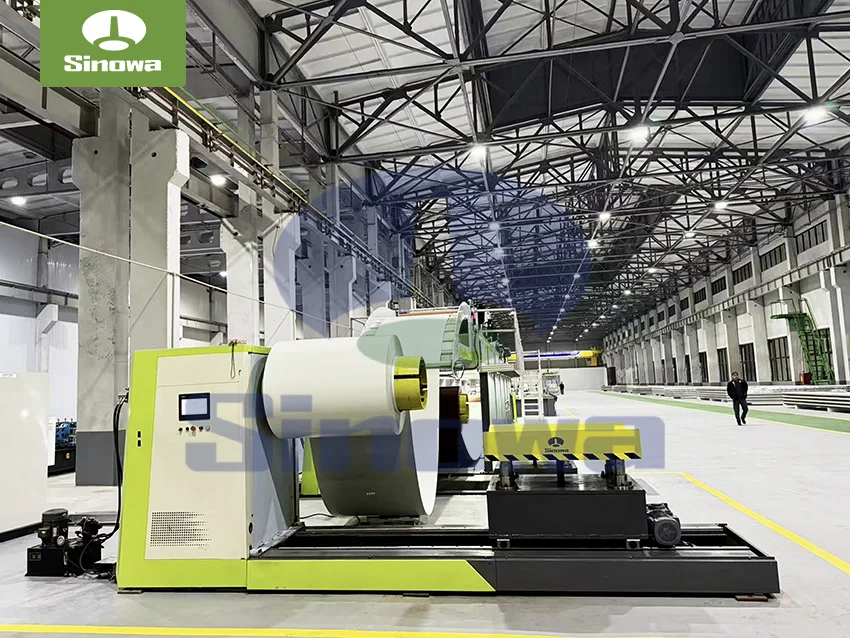
 sandwich panel line
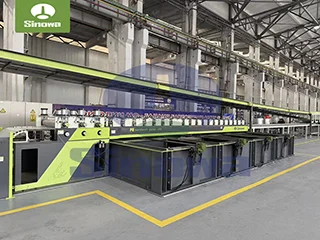
The overall structural design of the color steel foam core sandwich panel line follows the sequential logic of raw material processing to finished product output, and the whole equipment is divided into multiple interlocked functional sections without independent operation interference between each module. The front-end raw material unwinding and pretreatment section serves as the starting point of the entire production flow, which undertakes the storage, automatic discharging and surface conditioning of upper and lower color steel coil substrates. Raw color steel coils stored on unwinding frames are released at a constant linear speed matching the overall operating rhythm of the production line, and built-in deviation correction devices keep steel plates moving along a fixed horizontal track all the time to avoid lateral offset that may cause irregular panel edges in subsequent composite processes. After unwinding, flat color steel plates will go through multi-stage leveling rollers to eliminate inherent bending stress, surface wrinkles and minor deformation generated during coil rolling and long-term storage. This leveling process is indispensable because uneven steel surfaces will lead to inconsistent bonding gaps between steel plates and foam core layers, resulting in local delamination, uneven foam thickness and poor overall flatness of finished panels. Following leveling, surface cleaning modules remove dust, oil stains and residual oxide layers attached to the inner side of color steel plates. Clean and dry inner surfaces can significantly enhance the adhesive force between steel substrates and foam core materials, avoiding quality defects such as core layer peeling and hollowing that often appear in low-quality sandwich panels during long-term outdoor use.
The roll forming section comes after steel plate pretreatment, which endows flat color steel plates with customized structural profiles suitable for actual construction scenarios. Roof-use sandwich panels require trapezoidal rib structures on surface steel plates to improve overall bending resistance and rainwater drainage performance, while wall panels adopt flat or subtle wave structures to ensure smooth and aesthetic building exterior walls. The roll forming unit consists of dozens of groups of precision arranged forming rollers with gradual profile change, which bend and shape color steel plates step by step instead of one-time forced extrusion. This gradual forming method prevents coating cracking on the surface of color steel plates and avoids metal fatigue damage inside steel substrates, maintaining the original anti-corrosion and weather resistance performance of color steel plates. All forming rollers operate at synchronous speed linked with front-end unwinding equipment, ensuring no tensile deformation or stacking extrusion of steel plates during high-speed transmission. After profile forming, upper and lower color steel plates are transmitted separately to the intermediate composite station, forming a stable closed cavity reserved for continuous foam injection and filling, which lays a structural foundation for synchronous compounding of steel plates and foam core layers.
The foam injection and continuous composite pressing section is the core functional module of the color steel sandwich panel line, which determines the comprehensive physical performance of finished sandwich panels. Most mainstream production lines adopt on-site continuous foaming technology instead of prefabricated foam board splicing, which effectively solves poor overall integrity and easy air leakage of panels caused by spliced core layers. Raw liquid foam materials are transported to a high-precision mixing unit through independent delivery pipelines, where two or more liquid components are fully blended according to fixed dynamic proportions under constant temperature and pressure conditions. Well-mixed liquid foam is evenly sprayed into the closed cavity between upper and lower color steel plates through distributed injection nozzles arranged along the width direction of the sandwich panel production line. The liquid material undergoes rapid chemical reaction inside the confined cavity, expands steadily and fills the entire gap between two steel plates completely without manual auxiliary filling. The whole foaming process is controlled by real-time temperature and flow monitoring systems to stabilize foam density, pore structure uniformity and curing speed. Uniform and fine closed pore structures inside foam core layers can maximize thermal insulation and sound insulation effects, while stable foam density guarantees consistent compression resistance of panels in different positions.
Immediately after foam injection, the semi-finished panels enter the constant-temperature laminating pressing area. Multi-group upper and lower pressing conveyor belts apply balanced and continuous vertical pressure to composite panels, making color steel plates closely fit with foam core layers during the initial curing stage of foam materials. The internal temperature of the laminating tunnel is maintained within a stable constant-temperature range to match the optimal curing reaction condition of foam materials. Appropriate pressing pressure prevents excessive expansion of foam materials from causing surface bulging of steel plates, and also ensures that micro interfaces between foam and steel plates form tight molecular bonding without gaps. The length of the laminating tunnel is designed according to the conventional production speed of the sandwich panel line, ensuring that foam materials complete primary curing inside the tunnel and maintain stable composite structure before leaving the pressing section. Compared with batch hot pressing equipment used in small-scale production, continuous roller pressing adopted by this sandwich panel making machine realizes non-stop panel transmission, greatly improving hourly production output while maintaining consistent pressing effect for every meter of panels.
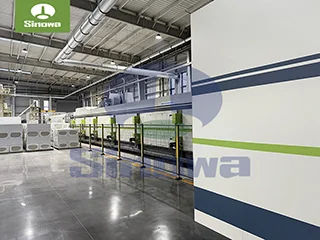
Subsequent natural curing and edge trimming sections further optimize the overall appearance and structural stability of composite panels. After leaving the laminating pressing tunnel, panels enter a long-distance natural cooling and curing channel, where residual reaction heat inside foam core layers is released slowly, and internal molecular structure of foam is fully stabilized. This slow secondary curing process reduces internal stress generated during rapid foaming and pressing, effectively preventing finished panels from warping, bending or core layer cracking after long-term placement. Edge trimming devices installed at the end of the curing channel cut off excess foam and irregular steel edges on both sides of panels synchronously, ensuring unified width specifications of all finished panels. The trimming process synchronously polishes cutting cross-sections to obtain neat and smooth panel edges, which facilitates seamless splicing installation of panels on construction sites and reduces on-site secondary processing workload for construction teams.
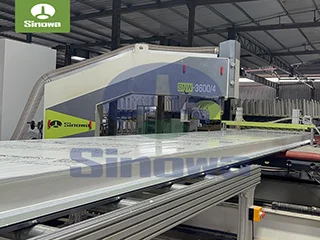
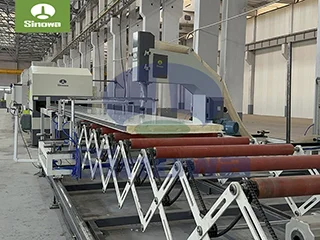
The fixed-length cutting and finished product output section is the final processing link of the whole sandwich panel manufacturing line. Integrated intelligent cutting systems record real-time transmission length of panels through high-precision encoder sensors, and automatically trigger cutting actions once panels reach preset customized lengths. The cutting tool adopts vertical synchronous cutting mode matching panel moving speed, which avoids panel surface scratch, section deformation and foam core layer fragmentation caused by static cutting. After cutting, qualified single-piece sandwich panels are automatically conveyed to the rear finished product stacking platform through roller conveyors. The stacking mechanism arranges panels neatly in layers according to fixed stacking height, realizing automatic stacking without manual carrying. The whole production process from steel coil feeding to finished panel stacking is fully automated, with no manual participation required in intermediate processing links, which reduces human error interference and lowers labor input in workshop production.
The centralized intelligent control system runs through all functional sections of the color steel foam core sandwich panel machine and acts as the brain coordinating overall equipment operation. All operating parameters including unwinding speed, roller forming pressure, foam material flow, laminating temperature, pressing pressure and cutting length are uniformly set and adjusted through a central control interactive interface. The system supports synchronous linkage of all front and rear equipment modules: once the operating speed of the front unwinding unit changes, the transmission speed, foam injection volume and cutting frequency of all subsequent units will automatically adapt synchronously to avoid material accumulation or production disconnection. Meanwhile, real-time monitoring modules collect operating data of key components and abnormal working conditions such as equipment stalling, material blockage and temperature deviation can be automatically alarmed and positioned. This intelligent control mode simplifies daily equipment operation difficulty, reduces professional skill requirements for on-site operators, and realizes visualized and refined management of the whole production process.
Compared with traditional intermittent sandwich panel production equipment, continuous color steel foam core sandwich panel line has prominent advantages in production efficiency, product quality consistency and production cost control. In terms of production efficiency, continuous non-stop production mode makes its daily output several times higher than that of semi-automatic equipment, which can well meet large and urgent bulk orders from prefabricated building projects. In terms of product quality, unified parameter settings and fully automated processing eliminate quality differences between different batches of products caused by manual operation differences. All finished panels have consistent thickness, stable bonding strength, uniform foam pore structure and accurate dimensional tolerance, which is critical for standardized prefabricated building construction. In terms of production cost, centralized automated production reduces labor cost, lowers material waste rate during foaming and cutting processes, and improves overall workshop space utilization thanks to compact integrated layout of the whole line.
Correspondingly, products manufactured by this professional continuous sandwich panel production line also deliver superior comprehensive performance adapting to diverse complex application environments. The composite structure of double-sided color steel and middle foam core layer combines the high mechanical strength and impact resistance of metal materials with excellent thermal insulation, sound insulation and heat preservation performance of foam materials. The outer color steel layers provide reliable waterproof, windproof and anti-external impact protection for building envelopes, while the closed-cell foam core layer blocks heat conduction effectively, reducing heating and cooling energy consumption of buildings throughout the year. In high-temperature summer environments, the foam core can isolate external solar heat radiation to keep indoor space cool; in low-temperature winter environments, it prevents indoor internal heat from escaping outward efficiently. Besides, the integrated composite structure has good airtight performance, avoiding cold air penetration and condensation inside building envelopes, which makes these panels especially suitable for cold storage, constant-temperature workshops and other buildings with strict requirements for indoor temperature stability. In addition, the lightweight feature of sandwich panels reduces overall dead load of building main structures, lowering foundation construction cost and structural design difficulty of prefabricated buildings.
Looking into the future development trend of color steel foam core sandwich panel production machine, technological upgrading of such production lines will focus on three core directions: higher production flexibility, greener production process and smarter fault self-diagnosis and maintenance. First, future optimized production lines will realize faster switching between different panel specifications including thickness, width and surface profile without manual replacement of large-scale molds, which can meet customized small-batch order demands while maintaining high-speed continuous production capacity. Second, production lines will be equipped with foam material recovery and waste gas treatment auxiliary units to recycle excess foam materials generated during edge trimming, reduce raw material consumption and minimize environmental impact of the whole manufacturing process. Third, built-in big data operation analysis modules will record long-term operating data of the production line, predict component wear failure risks in advance, and realize predictive maintenance instead of regular passive maintenance, further improving overall equipment operation rate and reducing unexpected production downtime.
As indispensable core manufacturing equipment supporting the prefabricated building industry, color steel foam core sandwich panel lines promote the standardized, automated and low-cost development of sandwich panel manufacturing industry. With the global construction industry accelerating transformation towards energy conservation, emission reduction and modular prefabrication, market demand for high-performance color steel foam core sandwich panels will keep growing steadily, which in turn drives continuous technical iteration and functional optimization of matching production lines. By optimizing every production process link from raw material processing to finished product output, this automated sandwich panel machinery will continue to provide reliable and efficient manufacturing support for green energy-saving buildings, temporary engineering facilities, cold storage systems and various industrial enclosure projects worldwide, and play a more important role in advancing the high-quality development of the global prefabricated construction sector.
https://www.cnsinowa.com/sandwich-panel-machines/color-steel-foam-core-sandwich-panel-line.html