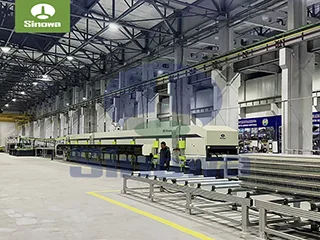
sandwich panel line
The basic structural composition of an insulated sandwich panel line covers multiple interdependent functional sections, each undertaking exclusive production tasks while maintaining synchronous operation rhythm to ensure the continuity of the entire manufacturing process. The front-end part of the production line is mainly composed of raw material unwinding and surface pretreatment mechanisms, which are responsible for the orderly release and surface conditioning of metal sheet raw materials used as panel outer layers. Metal coiled materials are fixed on stable unwinding brackets, and with the traction power provided by servo transmission structures, the sheet materials are continuously and evenly conveyed to subsequent processing stations. During the conveying process, professional surface treatment components sequentially complete surface dust removal, oil stain elimination, and subtle flatness correction for metal sheets, effectively removing impurities that may affect the bonding tightness between surface layers and core materials. This pretreatment procedure is an essential prerequisite for avoiding delamination, bubbling, and uneven adhesion of finished panels, as clean and smooth metal surfaces can significantly enhance the interfacial bonding force between heterogeneous materials and extend the service life of composite panels in complex service environments.
Following the surface pretreatment section, the raw material metering and mixing system serves as the core functional unit for preparing thermal insulation core materials, exerting a decisive influence on the thermal insulation, fire resistance, and density uniformity of sandwich panel cores. This system adopts fully automatic quantitative feeding structures to transport different chemical raw materials required for foaming core materials into sealed mixing containers at stable flow rates. Internal stirring components with optimized blade structures carry out high-speed and uniform mixing of raw materials, realizing microscopic fusion of multiple chemical components and ensuring the stability of subsequent foaming reactions. The entire mixing process is carried out in a closed space to avoid external air interference and impurity contamination, and the internal temperature and stirring speed of the mixing tank are dynamically adjusted through intelligent sensing components according to real-time material viscosity and reaction activity. Reasonable raw material proportioning and precise mixing control can effectively balance the pore structure density and thermal conductivity of foamed cores, preventing local over-foaming or under-foaming defects that may cause inconsistent thermal insulation performance and mechanical strength of panels. For production lines compatible with inorganic fibrous core materials, this section is equipped with special fiber loosening and uniform distributing equipment to disperse aggregated fiber raw materials into continuous and fluffy fiber layers, laying a morphological foundation for subsequent composite pressing.
The continuous composite lamination mechanism is the central processing section of the entire insulated sandwich panel line, completing the core technological process of combining upper and lower metal surface layers with thermal insulation core materials into an integrated composite structure. After pretreatment, the lower metal sheet is horizontally laid on the circulating conveying platform and moves forward at a constant linear speed. The uniformly mixed foaming raw materials are quantitatively sprayed onto the surface of the lower sheet through precision pouring devices, while the fiber core materials are evenly paved by automatic spreading equipment to form continuous core material layers with consistent thickness. With the gradual advancement of the conveying platform, the upper metal sheet is synchronously laid on the top of the core material layer through an overturning and pressing structure, forming a preliminary three-layer composite structure integrating upper surface layer, intermediate core layer, and lower surface layer. The interior of the composite lamination mechanism is equipped with multi-group adjustable pressing rollers, which apply uniform and stable vertical pressure to the composite raw materials. This pressure can eliminate tiny gaps between layers, discharge residual air at material interfaces, and promote the preliminary bonding and shaping of composite structures. The spacing between pressing rollers can be mechanically adjusted according to the customized thickness requirements of finished panels, realizing flexible production of panels with different specification parameters and meeting the diversified thickness demands of different application scenarios.
The constant temperature curing and shaping section undertakes the key task of stabilizing the composite structure and solidifying the bonding state of sandwich panels, which is an indispensable link to convert preliminary composite blanks into structurally stable finished semi-products. The curing section adopts an insulated closed box structure with multi-stage temperature gradient control, and the internal heating components distribute heat evenly in the curing cavity to avoid local temperature deviation. After lamination, the composite panel blanks are continuously transported into the curing box and move forward slowly along the designated track. Within the set temperature range, the chemical foaming reaction of organic core materials is thoroughly completed, and the adhesive molecules between layers undergo cross-linking and curing reactions to form stable bonding interfaces. For inorganic core panels, constant temperature treatment can optimize the adhesion state of bonding adhesives and enhance the integration degree between fibers and metal surfaces. The length of the curing box and the running speed of the internal conveying track are matched with the reaction characteristics of core materials; longer curing spaces are configured for materials requiring slow solidification to ensure sufficient reaction time. Scientific temperature control and curing time setting can effectively reduce internal stress generated during material compounding, avoid warping deformation and structural cracking of panels after molding, and improve the overall flatness and dimensional stability of finished products.
The precision cutting and edge trimming module is located in the middle and rear section of the production line, responsible for cutting continuously molded long-strip panel blanks into standard fixed-length finished panels and trimming irregular burrs on panel edges. This module is equipped with high-speed numerical control cutting components, which can automatically identify the conveying position of panel blanks through sensing elements and trigger cutting actions at precise positions. The cutting tool adopts high-hardness alloy structures to ensure smooth and neat cutting sections without metal burrs and core material shedding. In addition to fixed-length transverse cutting, the edge trimming mechanism on both sides of the production line longitudinally cuts the two side edges of panels to eliminate irregular edge deformation generated during the lamination process, ensuring that the width dimension of each panel maintains high consistency. Some advanced production lines are also equipped with automatic grooving and punching components in this section, which can process assembly connecting grooves and reserved mounting holes on panel edges according to engineering installation requirements. The integrated setting of cutting, trimming, and grooving processes realizes one-time forming of panel appearance and installation structures, reducing secondary processing procedures for finished panels and improving the overall production efficiency of the industrial chain.
The post-production inspection and automatic packaging system constitutes the final processing link of the insulated sandwich panel line, undertaking product quality screening and standardized storage protection tasks. The inspection components adopt a combination of visual sensing detection and physical parameter monitoring technologies to conduct comprehensive quality inspection on molded panels. The visual detection system captures surface images of panels through high-definition cameras to identify surface scratches, coating peeling, local depressions, and other appearance defects of metal sheets. The thickness detection device uses contact sensing probes to sample and measure panel thickness at multiple points, feeding back thickness deviation data to the control system in real time to realize dynamic parameter correction of the front-end pressing mechanism. Meanwhile, the system randomly detects the bonding firmness between panel layers to eliminate unqualified products with hidden delamination risks. Panels that pass quality inspection are automatically conveyed to the packaging station, where protective films are covered on metal surfaces to prevent scratch damage during transportation and stacking. Multi-layer stacking and bundling operations are completed by mechanical arms, and the neatly stacked finished panels are fixed with strapping structures to ensure transportation stability. The integrated design of inspection and packaging realizes seamless connection between finished product molding and warehousing, reducing manual contact links and avoiding secondary pollution and damage to panels caused by human operation.
From the perspective of overall operation characteristics, modern insulated sandwich panel lines have obvious advantages in automation integration, production continuity, and processing precision. The entire production process from raw material feeding to finished product packaging can realize unattended automatic operation, and the central control system uniformly regulates the operating parameters of each functional section. Operators only need to set production specifications such as panel thickness, length, and raw material ratio on the human-computer interaction interface, and the system can independently complete parameter adjustment and synchronous matching of each mechanical unit. Highly automated operation modes greatly reduce labor input in the production process, lower human operation errors caused by manual intervention, and maintain stable product quality consistency in long-term continuous production. In terms of production efficiency, the continuous assembly line structure cancels intermediate material transferring and waiting links between processes, realizing uninterrupted feeding, processing, and output of materials. Compared with intermittent single-machine production equipment, the continuous production mode significantly improves unit time output and shortens the production cycle of a single batch of panels, which is more suitable for large-scale order production demands.
In terms of mechanical performance optimization, the structural design of insulated sandwich panel lines fully considers the long-term stable operation requirements of industrial production environments. The main frame of the production line is welded with high-strength metal profiles, which have good compression resistance and deformation resistance and can maintain structural stability under long-term heavy-load operation. The transmission parts are equipped with wear-resistant and shock-absorbing accessories to reduce vibration amplitude during mechanical operation, effectively avoiding panel position offset and thickness deviation caused by equipment vibration. The temperature control components in the curing section adopt heat insulation and heat preservation structures to reduce internal and external heat exchange, not only ensuring the stability of internal curing temperature but also reducing energy consumption loss in the production process. In addition, the production line is equipped with perfect dust removal and waste collection structures, which can collect residual powder generated by edge cutting and redundant foaming materials produced in the mixing process, realizing centralized treatment of production waste and reducing material waste and environmental pollution. These humanized and optimized structural designs enhance the operational durability, energy-saving performance, and environmental friendliness of the entire production line.
The production line has strong product compatibility and can adapt to the manufacturing demands of sandwich panels with different core materials and surface layer types by replacing individual functional modules and adjusting operating parameters. When producing organic foam core panels, the raw material metering system is matched with multi-component liquid feeding pumps to meet the precise proportioning demand of chemical foaming raw materials; when producing inorganic fiber core panels, the foaming pouring device is replaced with a fiber uniform spreading mechanism to realize flat laying of fiber materials. In terms of surface layer adaptation, the production line can process metal sheets of different thicknesses and surface treatment processes, and the pressing roller spacing and conveying tension can be adjusted according to the hardness and ductility of sheet materials to avoid surface deformation and coating damage of metal sheets. This flexible compatibility enables a single production line to meet the diversified production needs of multiple types of insulated panels, effectively reducing the equipment purchase cost of manufacturing enterprises and improving the comprehensive utilization rate of production equipment.
In actual industrial production application scenarios, the operation and maintenance management of insulated sandwich panel lines directly affects production efficiency and service life of equipment. Daily maintenance work mainly includes regular lubrication of transmission bearings, cleaning of residual materials on the surface of conveying rollers, and inspection of the tightness of connecting bolts of each structural component. Regular cleaning of the raw material mixing pipeline and pouring nozzle can prevent raw material residue from solidifying and blocking the pipeline, ensuring the accuracy of subsequent material conveying. The temperature sensing elements and pressure detection components in key sections need to be calibrated periodically to avoid parameter deviation caused by long-term use, so as to maintain the precision control level of the production process. During the shutdown interval of the production line, the internal dust and residual debris of the curing box and cutting mechanism should be thoroughly cleaned to prevent hard impurities from scratching the surface of panels in the next production process. Scientific daily maintenance can effectively reduce equipment failure probability, extend the service cycle of mechanical components, and ensure that the production line maintains a stable operating state for a long time.
Reasonable production parameter debugging is the key to giving full play to the performance advantages of insulated sandwich panel lines and manufacturing high-quality composite panels. Before formal batch production, staff need to conduct trial production debugging according to raw material characteristics and product specification requirements. The feeding speed of metal sheets should be matched with the foaming reaction speed of core materials to ensure that the foaming process is completed within the effective composite time and avoid insufficient bonding caused by premature compaction. The curing temperature and walking speed of the curing box need to be adjusted according to the thermal stability of core materials; excessively high temperature will cause core material aging and performance degradation, while excessively low temperature will lead to incomplete curing and reduced structural strength. The pressure of the pressing rollers should be reasonably set according to the panel thickness to prevent excessive pressure from crushing the internal pore structure of the core material or insufficient pressure from causing interlayer gaps. Through repeated trial production and parameter optimization, the production line can form a standardized parameter database for different products, realizing rapid switching of production specifications and shortening the debugging preparation time between different batches of products.
With the continuous progress of industrial manufacturing technology, the intelligent upgrading direction of insulated sandwich panel lines has become increasingly clear, and digital and automated technological innovations are constantly empowering the panel manufacturing industry. Modern production lines have begun to introduce intelligent monitoring systems to collect real-time operating data such as equipment operating speed, internal curing temperature, material feeding flow, and panel processing dimensions. The cloud data analysis platform sorts and analyzes the collected production data, automatically judges abnormal fluctuations in production parameters, and triggers early warning prompts for potential equipment failures and product quality risks. Some upgraded production lines are equipped with automatic material recycling devices, which can crush and reprocess defective panels generated in the production process, realizing secondary utilization of raw materials and further improving resource utilization efficiency. In addition, the human-computer interaction interface of the production line is continuously optimized, with simpler and more intuitive operation logic, reducing the professional threshold for equipment operators and improving the overall operational convenience of the production line.
In the entire industrial chain of insulated sandwich panel manufacturing, the insulated sandwich panel line undertakes the core manufacturing link, and its technical level and production capacity profoundly affect the development rhythm of the downstream building materials application industry. The high-efficiency and standardized production mode of the production line ensures that sandwich panels have stable thermal insulation, sound insulation, compression resistance, and weather resistance. The manufactured panels are widely used in the enclosure structures of industrial plants, the thermal insulation walls of cold storage facilities, the temporary construction of mobile buildings, the purification decoration of medical and pharmaceutical workshops, and the thermal insulation engineering of agricultural breeding greenhouses. In different application scenarios, sandwich panels produced by high-precision production lines can adapt to complex natural environments such as low temperature, high humidity, and strong wind, and maintain stable structural performance and thermal insulation effects for a long time. With the continuous improvement of social requirements for building energy conservation, environmental protection, and construction efficiency, the market demand for high-quality insulated sandwich panels will continue to grow, which in turn promotes the continuous technological iteration and structural optimization of insulated sandwich panel lines.
Looking ahead to the future development trend, insulated sandwich panel production line will further develop in the directions of higher intelligence, lower energy consumption, stronger compatibility, and greener production. Intelligent sensing and automatic control technologies will be more deeply integrated into all links of the production line to realize fully unmanned intelligent production and reduce human intervention in the production process. The energy-saving optimization of heating structures and transmission systems will effectively reduce the energy consumption of unit product production, realizing low-carbon and environmentally friendly manufacturing. The modular structural design will enable the production line to quickly replace functional modules, adapt to the production of new environmentally friendly core materials and high-performance surface materials, and expand the product coverage of a single production line. At the same time, the waste recycling and purification treatment system of the production line will be further improved to realize zero discharge of production pollutants and meet the increasingly stringent industrial environmental protection standards. As an important processing equipment in the field of energy-saving building materials, the insulated sandwich panel line will continuously leverage technological innovation to promote the high-quality development of the composite panel manufacturing industry and provide more reliable and efficient material processing solutions for the modern construction industry.
https://www.cnsinowa.com/sandwich-panel-machines/insulated-sandwich-panel-line.html