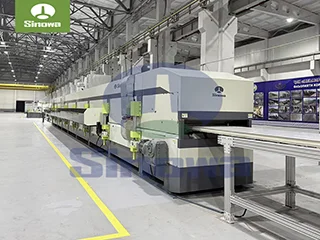
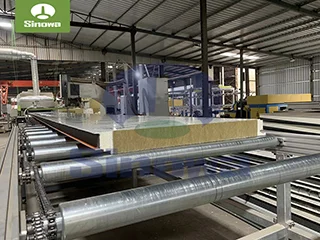
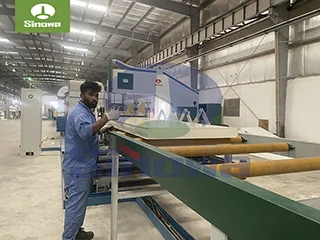
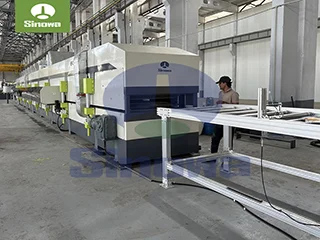
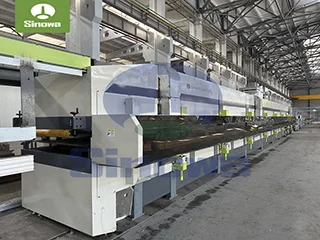
sandwich panel machine
The entire operational logic of the warehouse PU sandwich panel line centers on continuous automated production, which unifies multiple independent manufacturing procedures into a seamless closed-loop workflow, effectively eliminating the inconsistencies caused by manual intervention and segmented production. The production process starts with raw material feeding and pretreatment, a foundational stage that determines the flatness and structural accuracy of the final panel products. Metal coil materials used for panel surface layers are loaded onto hydraulic unwinding units, which deliver steady and tension-controlled material feeding to avoid wrinkling, stretching, or uneven stress on the surface sheets. After unwinding, the metal sheets pass through multi-stage leveling and roll forming structures, where precision roller sets gradually calibrate the flatness and shape the edge profiles of the sheets. This pretreatment process is critical for warehouse panels, as precise surface forming ensures tight assembly and seamless splicing during on-site installation, preventing air leakage and thermal bridging that could compromise the insulation performance of warehouse buildings. Meanwhile, polyurethane raw materials stored in temperature-stabilized tanks are transported through sealed pipeline systems to the mixing station, where environmental parameters such as material temperature and flow rate are dynamically regulated to maintain the stability of the foaming reaction foundation.
Foam mixing and uniform dispensing represent the core technological links of the warehouse PU sandwich panel production line, directly defining the thermal insulation performance, structural density, and overall durability of finished panels. The equipment adopts high-pressure dynamic mixing structures to fully blend different polyurethane components, triggering a controlled chemical reaction that generates uniform and fine foam materials. Unlike traditional low-efficiency mixing methods that easily cause uneven foam density, local hollow areas, or inconsistent expansion ratios, the precision mixing system of this machine ensures every batch of foam maintains stable viscosity and fluidity. During the dispensing process, the foam mixture is evenly sprayed on the surface of the lower metal sheet through multi-point synchronous discharge ports. With precise flow control, the foam can fill the entire intermediate layer space evenly without accumulation or sparse areas. This uniform foaming effect enables warehouse panels to achieve consistent thermal resistance across the entire surface, which is essential for warehouses that require constant temperature storage, moisture prevention, and energy consumption reduction. The foam expansion speed and curing state are dynamically matched with the operating speed of the entire production line, realizing synchronous progress of foaming and composite forming and avoiding quality defects such as insufficient bonding or foam collapse.
Lamination, pressing and integral curing processes further consolidate the structural integrity and stability of PU sandwich panels, forming the reliable composite structure required for long-term warehouse use. After the foam material is laid, the upper and lower metal surface sheets and the intermediate PU foam layer enter the constant-pressure composite pressing system together. The precision roller group and flexible pressure belt structure apply uniform and stable pressure on the composite materials, ensuring tight fitting between layers without damaging the surface metal sheets or extruding excessive foam. The pressure distribution is scientifically calibrated according to different panel thickness specifications, effectively solving the problems of partial delamination and uneven bonding strength that often occur in ordinary panel production equipment. Subsequently, the initially formed panels enter the segmented temperature-controlled curing channel, where gradient temperature adjustment is adopted to promote thorough chemical reaction and stable molding of the PU foam core. The staged curing mode avoids quality problems such as internal stress concentration, foam shrinkage, and surface deformation caused by rapid temperature changes. After full curing, the bonding strength between the foam core and metal surface layers reaches a stable state, enabling the panels to withstand long-term wind pressure, temperature changes, and structural loads in complex warehouse operating environments.
The final stage of production involves fixed-length cutting, finishing and automatic stacking, completing the standardized manufacturing of warehouse-specific PU sandwich panels. The polyurethane sandwich panel production line intelligent cutting system achieves precise fixed-length cutting according to customized dimensional requirements, with stable cutting accuracy that ensures consistent panel size and neat, burr-free cutting sections. This high-precision processing greatly improves the on-site assembly efficiency of warehouse panels, reducing secondary trimming work during construction and ensuring the flatness and tightness of overall warehouse enclosure structures. After cutting, the finished panels are automatically conveyed to the stacking platform, where orderly stacking is completed through mechanical transmission, facilitating subsequent packaging, transportation and storage. The entire process from raw material input to finished product output is continuously automated, with minimal manual operation participation, which not only greatly improves production efficiency but also maintains the uniformity and stability of product quality in large-scale batch production.
The core advantages of the warehouse polyurethane sandwich panel line are fully reflected in its targeted adaptability to warehouse building scenarios and long-term production stability. In terms of performance adaptation, the panels produced by this equipment have excellent thermal insulation, heat preservation and moisture resistance. The dense and closed-cell structure of the PU foam core effectively blocks heat transfer, helping warehouses reduce the energy consumption of temperature control equipment and maintain stable internal temperature and humidity environments. This performance is particularly critical for modern logistics warehouses, cold chain storage warehouses and industrial storage warehouses, which have strict requirements for environmental stability. In terms of structural performance, the composite structure formed by metal sheets and high-density PU foam has good compression resistance, bending resistance and impact resistance, enabling the panels to resist external wind load, rain erosion and daily mechanical collision during long-term use in warehouse buildings, extending the service life of warehouse enclosure structures.
In terms of production flexibility, this polyurethane sandwich panel machine supports the production of panels with different thickness specifications and surface profile types, which can meet the diverse construction needs of warehouse walls, roofs, internal partitions and auxiliary structures. By adjusting the operating parameters of the foaming system, pressing pressure and cutting dimensions, the equipment can quickly switch production modes without complex mechanical modification, realizing flexible response to different project requirements. This flexible production feature allows manufacturers to provide targeted panel solutions for small-batch customized warehouse projects and large-scale standardized warehouse construction projects, greatly improving the market adaptability of production lines. In addition, the equipment is designed with operational stability and energy-saving optimization in mind. The sealed material transmission system reduces raw material waste, while the optimized power operation structure reduces invalid energy consumption in the production process, achieving efficient and low-consumption production operation.
From the perspective of industrial application value, the warehouse continuous PU sandwich panel production line provides solid technical and equipment support for the standardized and lightweight development of modern warehouse construction. Traditional warehouse building materials have problems such as complex construction procedures, long construction cycles, poor thermal insulation performance and high later maintenance costs. In contrast, the PU sandwich panels produced by professional automated equipment have the advantages of light weight, convenient installation, stable performance and strong environmental adaptability. The lightweight feature of the panels reduces the load-bearing pressure on the warehouse main steel structure, lowering the overall construction cost and structural safety risk of the building. The excellent thermal insulation and sealing performance of the panels effectively improves the energy-saving level of warehouse buildings, reduces long-term operation and maintenance costs, and conforms to the development trend of green and low-carbon industrial construction. At the same time, the stable production quality guaranteed by professional equipment makes the panel structure more durable, effectively resisting aging, deformation and performance attenuation caused by long-term exposure to outdoor and industrial environments, ensuring the long-term safe and stable operation of warehouse buildings.
With the continuous upgrading of industrial construction standards and the rapid development of the modern logistics industry, the market demand for high-quality warehouse PU sandwich panels is constantly escalating, which in turn drives the continuous technological iteration of supporting production equipment. Modern warehouse PU sandwich panel machine is gradually developing towards higher automation intelligence, more precise process control and stronger operational stability. The optimized material metering and mixing system further improves the uniformity of foam reaction, the upgraded pressure control structure realizes more accurate composite molding, and the intelligent parameter adjustment system can automatically match the optimal production parameters according to different raw material characteristics and product specifications. These technological improvements not only further improve production efficiency and product qualification rate, but also enhance the overall performance of finished panels, making them more adaptable to the increasingly complex and diversified construction requirements of modern warehouses.
In practical industrial production, the stable operation of the warehouse continuous PU sandwich panel line also depends on reasonable daily operation specifications and routine maintenance management. The automated production system integrates multiple mechanical transmission, fluid control and temperature regulation components, and regular inspection and maintenance of key parts such as mixing components, pressure rollers, transmission belts and temperature control sensors can effectively avoid equipment failure and quality fluctuation. Maintaining clean and stable raw material supply, standardizing parameter adjustment operations, and doing a good job in equipment daily lubrication and dust removal can maximize the service life of the production line and ensure long-term stable and high-efficiency production. Standardized equipment operation and maintenance not only reduce production downtime and maintenance costs, but also provide continuous and reliable quality assurance for mass production of warehouse-specific PU sandwich panels.
In conclusion, the warehouse PU sandwich panel production machine is a core piece of professional equipment connecting raw material processing and high-performance warehouse building material manufacturing. Through integrated automated processes including precise feeding, uniform foaming, stable composite pressing, gradient curing and precise fixed-length cutting, it realizes efficient, standardized and stable production of PU sandwich panels for warehouse scenarios. The panels produced by this equipment have outstanding advantages in structural stability, thermal insulation performance, environmental adaptability and installation convenience, which can effectively meet the construction and use needs of various modern warehouses. With the continuous progress of industrial building technology and the continuous upgrading of logistics storage infrastructure, this type of production equipment will continue to play an important role in the field of industrial building materials production, providing reliable equipment support for the lightweight, energy-saving, standardized and high-quality development of modern warehouse construction, and promoting the continuous optimization and upgrading of the entire industrial building enclosure system.
https://www.cnsinowa.com/sandwich-panel-machines/warehouse-pu-sandwich-panel-machine.html