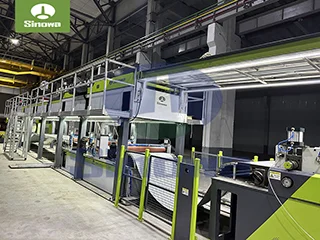
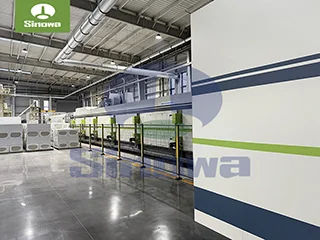
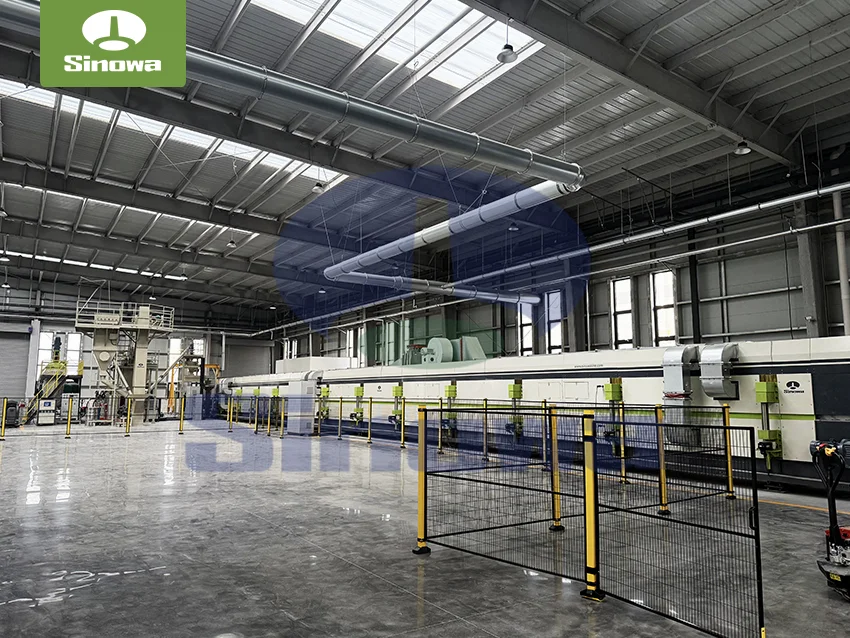
 sandwich panel machine
The overall operation logic of the PU sandwich panel machine follows a systematic and continuous production concept, with all functional modules operating in precise synchronization to ensure the continuity and stability of the entire production link. The whole production process starts with the feeding and pretreatment of surface and core layer raw materials. The equipment is equipped with a stable material conveying structure, which can stably output different types of surface materials including metal plates and non-metal decorative plates. Before formal molding, the surface materials will go through leveling and shaping processes to eliminate surface wrinkles, uneven bending, and dimensional deviations, laying a foundation for the flatness and structural uniformity of the final finished panel. At the same time, the polyurethane raw materials for the core insulation layer are transported to the precision mixing unit through a closed conveying system. The core advantage of this unit lies in its ability to realize proportional mixing and high-speed stirring of multi-component raw materials, ensuring that the liquid polyurethane materials are fully fused without local uneven mixing or material residue. The uniformly mixed liquid foam materials are evenly sprayed between the upper and lower surface materials through a precise injection system, which is the key link to determine the thermal insulation performance of the panel core layer.
After the completion of material spraying and preliminary fitting, the semi-finished panels enter the core lamination and constant-pressure curing stage, which directly determines the bonding strength and overall structural stability of PU sandwich panels. The PU sandwich panel equipment adopts a double-belt constant-pressure pressing structure, which can form a stable and uniform pressure environment in the whole width range of the panel. Different from the traditional roller single-point pressing mode, the integral pressing structure avoids local pressure difference, effectively preventing problems such as unbalanced foam expansion, hollow layers, and uneven bonding between the core layer and the surface layer. During the pressing process, the matching constant-temperature curing system provides a stable thermal environment for the foaming and polymerization reaction of polyurethane materials. With the help of adjustable temperature control parameters, the equipment can adapt to the foaming characteristics of different polyurethane formulas, so that the liquid foam can fully expand, fill the entire gap between the upper and lower surface materials, and complete tight bonding and solidification molding in a stable state. This process enables the polyurethane core layer to form a closed-cell uniform structure, which endows the finished panel with excellent thermal insulation, sound insulation, and pressure resistance, and also ensures that the combination interface between the core layer and the surface layer has no gaps or degumming risks.
The automated control system runs through the entire operation process of the PU sandwich panel line, realizing intelligent regulation and precise control of each production link. The system can independently adjust operating parameters such as material conveying speed, raw material mixing ratio, foam injection volume, pressing pressure, curing temperature, and cutting length according to different production requirements and panel specifications. All parameter adjustments are completed through integrated program setting, which avoids errors caused by manual operation and greatly improves the consistency of batch products. In the actual production process, the equipment can realize continuous uninterrupted operation, and the coordinated operation of each functional module effectively shortens the production cycle of a single panel. At the same time, the built-in operation monitoring function can track the operating state of each component in real time, identify abnormal fluctuations in material supply, temperature and pressure parameters, and equipment operation status, and feed back abnormal information in a timely manner, which is convenient for operators to carry out inspection and maintenance, ensuring the continuity and safety of production work.
The structural design of the PU sandwich panel production line fully considers the diversity of market application demands and the flexibility of production. The equipment has strong compatibility and can adapt to surface materials of different thicknesses and textures. Whether it is rigid metal plates or flexible decorative composite plates, it can complete stable molding and firm bonding matching. In terms of product specification adjustment, the equipment can flexibly switch the production of panels with different thicknesses and widths by adjusting the spacing of the pressing structure and the program parameters, meeting the customized production demands of different application scenarios. In addition, the equipment adopts an integrated modular design, and each functional unit is independently arranged and reasonably connected, which not only ensures the compactness of the overall equipment structure and saves production workshop space, but also facilitates daily maintenance and later functional upgrading. The key moving parts are equipped with wear-resistant and stable structures, which reduce equipment loss during long-term high-intensity operation, extend the overall service life of the equipment, and reduce the operating cost of enterprise production.
The finished PU sandwich panels produced by this equipment have outstanding comprehensive performance, which is closely related to the precise process control of the production machine itself. The uniform closed-cell structure of the polyurethane core layer gives the panels ultra-low thermal conductivity, which can effectively block the transmission of external heat and achieve excellent building thermal insulation and energy-saving effects. At the same time, the integrated molding process enables the core layer and the surface layer to form an integral structure with high bonding strength, so the panels have good overall rigidity and impact resistance, and are not easy to deform or crack during transportation, installation, and long-term use. In terms of functional performance, the finished panels also have good moisture-proof, waterproof, and sound absorption effects. The dense closed-cell structure can prevent moisture from penetrating into the core layer, avoiding the problem of reduced thermal insulation performance caused by moisture absorption of the insulation layer. The internal porous structure of the foam core layer can effectively absorb noise and reduce sound transmission, which can meet the sound insulation and noise reduction needs of industrial workshops, public buildings, and cold storage spaces.
In practical industrial production and engineering applications, the insulation sandwich panel machine shows significant production advantages compared with traditional panel production equipment. First of all, the highly automated production mode greatly reduces the dependence on manual labor. From raw material feeding to finished product output, most processes are completed by equipment linkage operation, which reduces manual operation links, lowers labor intensity and human resource investment, and significantly improves production efficiency. Secondly, the precise parameter control system realizes fine control of each production link, effectively avoids product quality differences caused by human factors, and greatly improves the yield and qualification rate of finished products. The panels produced by continuous molding process have uniform thickness, flat surface, consistent internal structure, and stable overall performance, which can meet the high-standard construction requirements of modern engineering projects.
In addition to the improvement of production efficiency and product quality, the insulated sandwich panel production line also has good energy-saving and environmental protection characteristics in the production process. The closed raw material conveying and mixing system avoids the volatilization and waste of polyurethane raw materials, improves the utilization rate of raw materials, and reduces the generation of production waste. The adjustable constant-temperature curing system can accurately control the heat supply according to the production demand, avoid excessive energy consumption caused by blind heating, and reduce the energy consumption of unit products. At the same time, the stable molding process reduces the defective rate of products, thereby reducing the resource waste and environmental pollution caused by rework and scrap products, which is in line with the green production development trend of the modern building materials industry.
With the continuous development of building energy-saving policies and industrial upgrading, the market demand for high-performance PU sandwich insulation panels is constantly growing, which also promotes the continuous technological iteration of polyurethane sandwich panel production line. Modern equipment is gradually developing towards higher automation, smarter operation, stronger compatibility, and lower energy consumption. The upgraded intelligent control system can realize remote parameter monitoring, automatic fault diagnosis, and production data statistics, helping enterprises realize refined production management. The optimized mechanical structure further improves the production stability and equipment operation accuracy, enabling the produced panels to have more stable structural performance and longer service life. At the same time, the equipment is constantly optimizing the production process for new polyurethane environmental protection formulas and new decorative surface materials, adapting to the diversified and high-end development trend of the thermal insulation building materials market.
The application fields of panels produced by polyurethane sandwich panel line covers multiple important industries. In the building construction industry, such panels are widely used in the thermal insulation and exterior wall decoration of industrial plants, office buildings, residential buildings, and public facilities, realizing the integration of building thermal insulation and decoration, simplifying the construction process and shortening the construction cycle. In the cold chain storage and logistics industry, the excellent thermal insulation performance of the panels can maintain the stable low-temperature environment inside cold storage and insulation warehouses, reduce the energy consumption of refrigeration equipment, and ensure the storage quality of goods. In addition, the panels are also applicable to special scenarios such as clean workshops, windproof and thermal insulation enclosures, and temporary building facilities, relying on their lightweight, high strength, convenient installation and excellent thermal insulation performance.
In terms of production practicability, the insulation polyurethane sandwich panel machine has strong production flexibility and market adaptability. It can not only meet the large-scale batch production demands of standardized panels, but also adapt to the small-batch and multi-specification customized production needs of the market. The simple and efficient parameter switching mode enables enterprises to quickly respond to different order demands and improve market competitiveness. The stable operation performance and convenient maintenance characteristics of the equipment also reduce the difficulty of enterprise production management, enabling production enterprises to maintain stable production capacity and product quality in long-term operation.
In conclusion, the PU sandwich panel insulation board machine as a professional and efficient production equipment for thermal insulation composite panels, relies on its integrated automated production process, precise control technology, stable molding performance and flexible production capacity, and has become an important driving force for the development of the modern thermal insulation building materials industry. It not only improves the production efficiency and product quality of PU sandwich insulation panels, but also promotes the popularization and application of high-performance energy-saving building materials. With the continuous progress of industrial technology and the continuous improvement of building energy-saving standards, this type of insulation sandwich panel production equipment will continue to carry out technological innovation and performance optimization, provide more reliable and efficient production solutions for the building materials industry, and make greater contributions to the development of green energy-saving buildings and the upgrading of industrial thermal insulation systems.
https://www.cnsinowa.com/sandwich-panel-machines/pu-sandwich-panel-insulation-board-machine.html