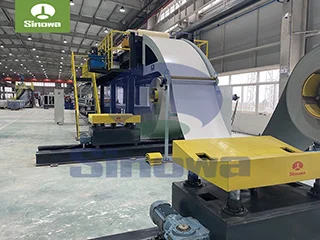
sandwich panel line
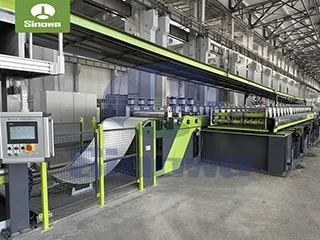
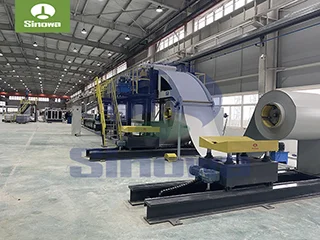
The overall structure of a polyurethane sandwich panel production line consists of multiple interconnected functional modules, each undertaking independent and collaborative processing tasks to complete the full transformation from raw materials to finished panels. The front-end feeding and forming system serves as the initial processing unit of the entire line, mainly responsible for the unwinding, flattening, shaping, and surface pretreatment of upper and lower surface materials. Common surface materials processed by the line include various metal sheets and flexible composite fabrics, all of which are supplied in coiled forms to support continuous feeding. The unwinding device maintains stable tension control during material release to avoid material deviation, wrinkling, or stretching deformation, which is essential for ensuring the flatness and dimensional accuracy of subsequent composite processing. After unwinding, the raw materials pass through a multi-stage flattening mechanism to eliminate internal stress generated during coil winding, followed by precise roll forming treatment. The roll forming system adopts multi-group forming roller sets to carry out gradual cold bending shaping according to preset structural parameters, realizing the processing of different edge profiles and structural shapes of panels to meet the assembly and installation requirements of different engineering projects. In addition, the front-end system is equipped with a surface cleaning and preheating unit, which removes surface dust and impurities through air circulation and physical wiping, and raises the surface temperature of the materials to a stable range through uniform heating. This pretreatment process effectively enhances the bonding performance between the surface material and the polyurethane foam core layer, avoiding hollowing, delamination, and poor adhesion defects in finished products.
The core functional part of the polyurethane sandwich panel line lies in the polyurethane foaming and composite lamination system, which determines the thermal insulation performance, structural strength, and overall stability of the final sandwich panels. Polyurethane composite panels adopt a three-layer composite structure, with the upper and lower layers being rigid surface materials and the middle layer being a high-density closed-cell polyurethane foam core. The foaming system uses two-component chemical raw materials, which are stored in independent sealed storage tanks with constant temperature and pressure control to maintain the stability of raw material activity and chemical properties during production. Before processing, the system automatically detects and adjusts the proportion of the two raw materials through high-precision metering pumps, ensuring accurate mixing ratios to guarantee the uniformity and compactness of the foaming reaction. The mixed raw materials are transported to a high-pressure mixing head for instantaneous and full stirring, forming a homogeneous liquid mixture without particle agglomeration or component stratification. The stirred liquid polyurethane raw materials are evenly sprayed on the surface of the preheated lower surface material through a reciprocating spraying mechanism, which can adjust the spraying width, thickness, and moving speed according to the preset panel specifications to ensure consistent material distribution in the horizontal and vertical directions of the panel.
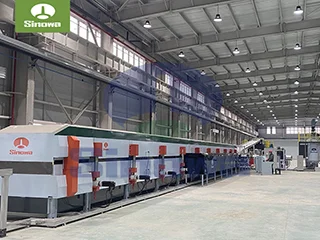
After the completion of raw material spraying, the upper surface material is accurately aligned and covered with the lower material through an automatic positioning and pressing device, forming a closed composite structure. The assembled semi-finished product is then continuously transported to the double-belt pressing and curing system, the key equipment for realizing foam molding and structural composite forming. The double-belt press provides stable and continuous pressure and constant temperature heating environment, creating optimal reaction conditions for polyurethane foaming and curing. Inside the closed pressing cavity, the liquid polyurethane mixture undergoes rapid chemical reaction, gradual foaming, expansion, and gelation, and finally completes solidification and molding. The closed-cell structure formed during this process endows the panel core with excellent thermal insulation and pressure resistance, while the self-adhesive characteristics of polyurethane enable tight integration with the upper and lower surface materials, forming an integrated composite structure with strong overall bonding force. The temperature and pressure parameters of the pressing system can be dynamically adjusted according to different panel thicknesses, material types, and performance requirements, realizing flexible production of diversified products. The whole curing process is completed in continuous transportation, avoiding intermittent production interruption and greatly improving production continuity and efficiency.
Following the curing and composite molding process, the PU sandwich panel production line enters the cooling and shaping stage to further stabilize the internal structure of the panels. Newly molded composite panels still retain residual temperature and slight internal stress, which may cause subtle deformation, post-expansion, or dimensional deviation if directly cut and processed. The automatic cooling system adopts combined air cooling and circulating cooling mode, with uniform cooling units arranged along the conveying track to gradually reduce the panel temperature to the ambient stable range. Slow and uniform cooling can effectively eliminate internal stress generated during high-temperature curing, fix the closed-cell structure of the polyurethane core layer, and prevent structural loosening or performance attenuation caused by rapid temperature change. This process ensures the long-term dimensional stability and structural durability of the finished panels, avoiding warping, bending, and other quality problems in subsequent use and storage.
The subsequent cutting, trimming and finishing system realizes the fixed-length forming and edge finishing of semi-finished panels. The high-precision tracking cutting device automatically identifies the conveying speed and panel length, completing synchronous fixed-length cutting without shutdown, ensuring flat and smooth cutting sections without burrs, cracks or deformation. For the edge parts of the panels, the automatic trimming mechanism carries out precise trimming and shaping to standardize the overall dimensions of the panels and ensure the consistency of product specifications. Meanwhile, the system is equipped with an online inspection function, which preliminarily detects the surface flatness, thickness uniformity, and composite integrity of the panels during operation, automatically identifying and eliminating unqualified products with defects such as delamination, hollowing, and uneven foaming. This real-time online quality control effectively reduces the rate of defective products and ensures the stability of batch product quality.
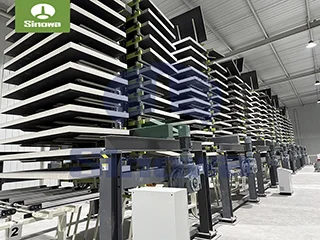
The final stage of the production process includes automatic stacking and auxiliary finishing work. The qualified finished panels are stably transported to the stacking platform through the conveying system, and the automatic stacking device neatly arranges the panels according to fixed layers and specifications, realizing orderly collection of finished products. The whole stacking process is stable and efficient, avoiding surface scratches, collision deformation and other damage caused by manual handling. In addition, the PU sandwich panel line can be equipped with auxiliary functions such as surface film covering and edge protection according to production needs, which can protect the panel surface from scratches, dust and corrosion during transportation and storage, further improving the appearance quality and service life of the products. All links from feeding, forming, foaming, curing, cooling to cutting and stacking are seamlessly connected, forming a fully automated closed-loop production process with minimal manual intervention in the whole process.
The advanced performance of the polyurethane composite sandwich panel production line is reflected in its high automation level, flexible production capacity and excellent product quality control ability. The whole production process is controlled by an integrated intelligent control system, which centrally regulates the operating parameters of each functional module, including feeding speed, forming parameters, raw material ratio, foaming temperature, pressing pressure, curing time and cutting size. The system can store multiple sets of production parameter programs corresponding to different panel specifications, realizing rapid switching between different products and greatly improving production flexibility. Manufacturers can adjust production parameters according to different application needs to produce panels with different thicknesses, densities and structural strengths, meeting the personalized demands of different fields such as high-insulation cold storage panels, fire-resistant decorative panels, and industrial enclosure panels.
In terms of production efficiency, the continuous operation mode of the polyurethane sandwich panel machine completely breaks through the limitations of traditional intermittent production equipment. The coordinated operation of all modules enables uninterrupted batch production, with stable production rhythm and high output efficiency. At the same time, the precise raw material metering and spraying system effectively reduces the waste of chemical raw materials, and the optimized mechanical transmission structure reduces equipment operation energy consumption and mechanical loss, realizing energy-saving and efficient production. Compared with traditional production equipment, the integrated production line has higher raw material utilization rate, lower comprehensive production cost and more stable product batch consistency, which brings significant economic benefits for large-scale industrial production.
In terms of product performance guarantee, the standardized and precise processing technology of the PU sandwich panel machine endows polyurethane composite sandwich panels with superior comprehensive performance. The uniformly formed closed-cell polyurethane core layer has low thermal conductivity, excellent thermal insulation and heat preservation effect, which can effectively reduce energy consumption in building temperature regulation and industrial temperature control. The integrated composite structure formed by high-pressure curing has high overall structural strength, good compression resistance, bending resistance and impact resistance, and can adapt to complex installation and use environments. In addition, the compact closed-cell structure also gives the panels good waterproof, moisture-proof and sound insulation effects, while the stable bonding structure avoids delamination and peeling after long-term use, ensuring long-term service stability.
With the continuous upgrading of industrial manufacturing technology and the increasing market demand for high-performance energy-saving materials, polyurethane composite sandwich panel line is also constantly optimized and iterated in structural design and technical performance. Modern production lines pay more attention to intelligent and refined production, realizing real-time monitoring and feedback adjustment of production data, automatic early warning of equipment operation faults, and remote parameter debugging, which further improves production stability and intelligent level. At the same time, the equipment structure is optimized for environmental protection and low consumption, adopting low-noise operation design and closed raw material circulation system to reduce production noise and volatile material emission, meeting the development requirements of green industrial production.
The wide application of polyurethane composite sandwich panel production line has strongly promoted the development of the modern new material manufacturing industry. As a core production equipment for energy-saving and environmental protection composite materials, it provides reliable technical and equipment support for the popularization and application of polyurethane sandwich panels in construction engineering, cold chain logistics, industrial manufacturing, environmental protection facilities and other fields. Its efficient, stable and flexible production characteristics not only improve the industrialization level of composite panel production, but also promote the continuous upgrading of product performance, making polyurethane composite sandwich panels occupy an increasingly important position in the field of modern energy-saving building materials and industrial functional materials. In the future, with the continuous progress of material technology and intelligent manufacturing technology, polyurethane composite sandwich panel machinery will develop towards higher intelligence, higher efficiency, lower energy consumption and stronger customization, continuously empowering the high-quality development of the new composite material industry.
https://www.cnsinowa.com/sandwich-panel-machines/polyurethane-composite-sandwich-panel-production-line.html