 sandwich panel line
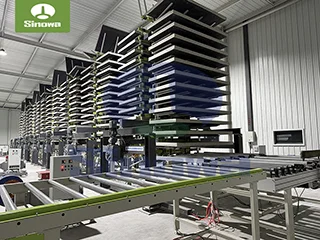
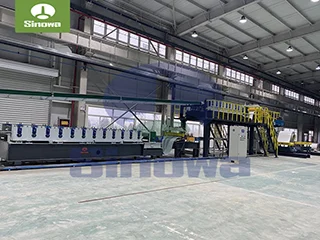
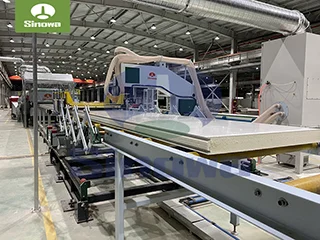
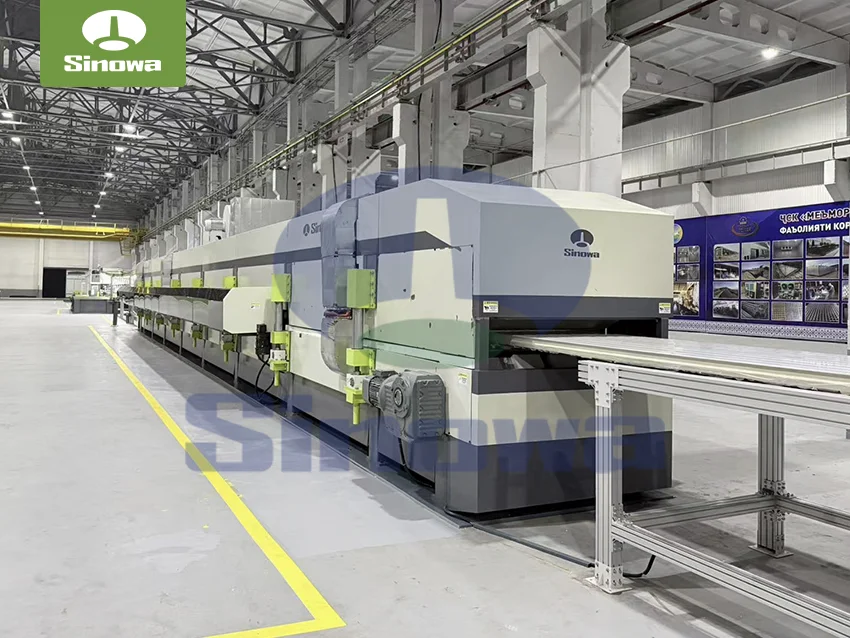
The overall structural design of the edge sealed PU sandwich panel line follows modular and synchronized operation principles, with each functional unit closely connected and operating in a coordinated manner to maintain the continuity and stability of the entire production process. The complete production system is composed of multiple core functional modules, including surface material unwinding and leveling unit, surface pretreatment unit, high-precision batching and foaming unit, continuous lamination and pressing unit, integrated edge sealing forming unit, constant-temperature curing unit, fixed-length cutting and trimming unit, as well as finished product conveying and stacking auxiliary units. Each module is independently responsible for its professional process links while maintaining precise speed and parameter synchronization through the central control system, avoiding production discontinuity and product quality fluctuations caused by asynchronous operation of individual equipment.
The front-end process of the polyurethane sandwich panel production line starts with the feeding and pretreatment of surface materials. In actual production, coiled metal or composite surface materials are placed on the unwinding equipment, which realizes automatic and stable material release through mechanical tension control devices. The released surface materials will first pass through a multi-group leveling mechanism, which eliminates subtle wrinkles, bending deformation and surface unevenness generated during coil storage and unwinding, ensuring the flatness and dimensional uniformity of the base material for subsequent composite processing. After leveling, the surface materials will go through surface cleaning and micro-treatment procedures to remove dust, oil stains and oxide layers on the material surface. This pretreatment process is crucial to enhance the bonding force between the surface material and the polyurethane foam core layer, laying a solid foundation for the overall structural firmness of the finished panel and avoiding delamination and peeling problems in long-term use.
After the surface material pretreatment is completed, the production process enters the core foaming and composite laying stage. The polyurethane foam raw materials required for the core layer are transported to the high-pressure mixing system through precision metering equipment. The system can accurately control the proportion of different foam components according to the set process parameters, ensuring the uniformity and stability of the foam reaction effect. After full high-pressure mixing, the homogeneous foam liquid is evenly sprayed on the surface of the lower layer surface material that is stably conveyed forward. Different from traditional manual or semi-automatic pouring methods, the automatic spraying and distributing structure of the PU sandwich panel production line can realize full coverage and uniform thickness distribution of the foam material, effectively avoiding hollow holes, uneven density and local insufficient filling inside the core layer.
While the lower core foam is laid, the upper surface material is synchronously conveyed to the lamination station through the track conveying mechanism to form a closed composite structure with the lower material and the middle foam layer. The double-track synchronous conveying design ensures that the upper and lower surface materials maintain consistent speed and position accuracy during the lamination process, preventing offset and dislocation which affect the dimensional accuracy of finished products. In the initial composite stage, the foam material begins to undergo chemical reaction and gradual expansion, and the preliminary bonding between the foam core and the upper and lower surface materials is completed under the action of slight pressure, forming a preliminary sandwich panel structure.
The edge sealing process, as the core technological advantage of polyurethane sandwich panel line, is carried out synchronously in the early stage of foam curing and forming, which is also the key difference from ordinary polyurethane sandwich panel production line. Traditional sandwich panel production usually forms the panel first and then performs simple edge trimming, resulting in the exposure of the porous foam core at the panel edge. This structure is prone to water absorption, moisture penetration, dust accumulation and aging damage in complex service environments, which greatly shortens the service life of the panel and reduces its insulation and structural stability. The edge sealed production process adopts integrated in-situ edge forming technology. Before the foam is completely cured, special edge sealing materials are applied and compounded on the four sides of the preliminary formed panel. Through secondary compression and shaping, the edge sealing layer and the main panel structure are tightly integrated into a unified whole.
The integrated edge sealing structure can completely wrap the exposed foam core layer at the panel edge, effectively blocking the penetration channel of water vapor, humid air and external impurities. This structural optimization significantly improves the waterproof, moisture-proof and anti-aging performance of the sandwich panel, and also enhances the edge structural strength of the panel, avoiding edge deformation, cracking and core layer falling off during transportation, installation and long-term use. In addition, the integrated edge sealing process makes the panel edge more flat and neat, eliminating the rough burrs generated by post-trimming, which greatly improves the overall appearance quality and installation convenience of the product, and can realize seamless docking and assembly between panels during construction.
After the completion of lamination and edge sealing forming, the semi-finished panel enters the constant-temperature continuous curing unit for sufficient curing and shaping. The curing unit adopts segmented temperature control design, which can adjust the internal temperature and conveying speed according to the characteristics of raw materials, panel thickness and production speed. The stable constant-temperature environment enables the polyurethane foam to complete full expansion, chemical cross-linking reaction and solidification molding, so that the core layer forms a uniform and compact porous thermal insulation structure. At the same time, the bonding interface between the core layer and the surface materials, as well as between the edge sealing layer and the main panel, realizes high-strength integrated bonding under constant temperature and pressure conditions, effectively improving the overall structural compactness, bonding firmness and mechanical stability of the panel.
The scientific curing process is crucial to the core performance of the finished panel. Insufficient curing will lead to incomplete foam reaction, low core density, poor structural strength and easy deformation of the panel; excessive curing will cause material performance attenuation and increased production energy consumption. The automated control system of the polyurethane sandwich panel machine can realize real-time monitoring and dynamic adjustment of curing parameters, maintaining the optimal curing state throughout the production process, ensuring that each batch of panels has consistent thermal insulation performance, compressive resistance and structural stability.
After curing and molding, the continuous long-strip panel is transported to the precision cutting and trimming station. The flying saw cutting device equipped by the PU sandwich panel machine can realize fixed-length precision cutting according to the preset dimensional parameters, and the cutting process does not need to stop the production line, realizing uninterrupted continuous production. The high-precision cutting mechanism ensures that the cutting section is flat and vertical with no burrs or irregular notches, which further cooperates with the edge sealing structure to maintain the complete and neat edge structure of the panel. After cutting, the auxiliary trimming and finishing device conducts fine finishing on the panel edges and surfaces to remove tiny residual materials generated in the production process, ensuring the flatness and finish of the finished panel surface and edges.
The final stage of production includes finished product conveying, quality inspection and automatic stacking. The qualified panels after cutting and finishing are stably conveyed to the inspection area through the roller conveying system. Professional inspectors and automatic detection equipment check the panel surface flatness, dimensional accuracy, edge sealing integrity, core compactness and bonding quality to screen out unqualified products and ensure that all delivered products meet production standards. The qualified finished products are automatically stacked by the stacking device, realizing orderly arrangement and temporary storage of finished products, which is convenient for subsequent packaging, transportation and factory delivery.
In terms of production performance and technological advantages, the edge sealed PU sandwich panel manufacturing line has significant improvements over traditional production equipment in terms of production efficiency, product quality stability and product application adaptability. In terms of production efficiency, the fully automated continuous production mode realizes the integration of multiple processes, greatly reducing manual intervention links. The synchronized operation of each functional module avoids waiting and stagnation between processes, effectively improving the overall production efficiency and realizing large-scale and batch standardized production.
In terms of product quality control, the entire production process adopts automated parameter control, and key parameters such as raw material ratio, foaming temperature, lamination pressure, curing time and cutting size are precisely controlled by the system, eliminating quality fluctuations caused by manual operation errors. The integrated edge sealing and integrated curing molding process make the structural consistency of finished panels far higher than that of products produced by traditional processes. The finished panels have the characteristics of uniform density, stable thermal insulation performance, high bonding strength and excellent edge sealing tightness, and can maintain stable comprehensive performance in different temperature and humidity environments for a long time.
In terms of product application performance optimization, the edge-sealed structure greatly expands the application scenarios of polyurethane sandwich panels. Traditional sandwich panels with exposed edges are mostly used in indoor dry environments, while edge-sealed panels can adapt to humid, rainy, dusty and other harsh outdoor and semi-outdoor environments. The excellent waterproof and moisture-proof performance effectively prevents the internal foam core from absorbing water and mildewing, avoids the reduction of thermal insulation performance and structural damage caused by moisture absorption, and significantly extends the service life of the panels. At the same time, the enhanced edge structural strength makes the panels have stronger impact resistance and compression resistance, which can adapt to higher load-bearing and anti-collision use requirements.
In addition, the polyurethane sandwich panel production machine has good production flexibility and can adapt to the production of sandwich panels of different thicknesses, widths and specifications by adjusting equipment parameters and replacing simple auxiliary molds. It can meet the personalized production needs of different application scenarios, whether it is thin decorative insulation panels for building interior decoration or thick load-bearing insulation panels for industrial workshop enclosure, cold storage insulation and special engineering thermal insulation. The modular equipment structure also facilitates daily maintenance and later equipment upgrading, reducing the operation and maintenance cost of the production line in the long-term use process.
From the perspective of industrial development and market demand, with the continuous improvement of building energy-saving requirements and the continuous expansion of the prefabricated building industry, high-quality, high-durability and high-stability sandwich panel products have become the mainstream demand of the market. The edge sealed PU sandwich panel making machine as a high-efficiency and high-quality manufacturing equipment, solves the pain points of traditional sandwich panel products such as poor weather resistance, short service life and easy structural damage. The produced edge-sealed polyurethane sandwich panels have excellent thermal insulation, weather resistance, structural stability and assembly performance, and are widely used in prefabricated building enclosure structures, cold storage thermal insulation engineering, industrial plant decoration, commercial building energy-saving transformation, special facility insulation and other fields.
In the actual production and application process, the stable operation of the polyurethane sandwich panel manufacturing machine also brings good economic and environmental benefits for production enterprises. The precise raw material batching and uniform foaming technology effectively reduce the waste of raw materials and improve the utilization rate of production materials. The efficient continuous production mode reduces unit energy consumption and labor cost, and the stable product quality reduces the defective rate and after-sales maintenance cost. At the same time, the high-performance insulation panels produced by the line can effectively reduce the energy consumption of building heating and cooling, and play a positive role in building energy conservation and emission reduction, which is in line with the development trend of green and low-carbon construction industry.
In conclusion, the edge sealed PU sandwich panel production line, with its integrated automated process, unique edge sealing molding technology, stable production performance and flexible production capacity, has become an indispensable core equipment in the field of high-end polyurethane sandwich panel manufacturing. Its advanced technological design optimizes the structural performance and service quality of sandwich panel products, makes up for the performance defects of traditional products, and provides reliable equipment support for the standardized, high-quality and large-scale production of building insulation enclosure materials. With the continuous innovation of manufacturing technology and the continuous upgrading of market demand, this sandwich panel line will continue to be optimized and upgraded in terms of automation level, production efficiency and product adaptability, and play a more important role in promoting the high-quality development of the prefabricated building and building energy-saving industries.
https://www.cnsinowa.com/sandwich-panel-machines/edge-sealed-pu-sandwich-panel-line.html