sandwich panel line
The core advantage of integrating a PLC control system into a PIR sandwich panel production line lies in its ability to automate and synchronize every stage of the manufacturing process, from raw material handling to final packaging. Unlike traditional manual or semi-automated lines, which are prone to human error, inconsistent processing parameters, and low production efficiency, PLC-controlled lines operate with high precision and repeatability. A PLC functions as the "brain" of the production line, processing input signals from various sensors and devices, executing pre-programmed logic, and sending output commands to regulate the operation of motors, pumps, heaters, conveyors, and other equipment. This centralized control ensures that all production stages work in harmony, maintaining optimal process parameters and minimizing deviations that could affect product quality.
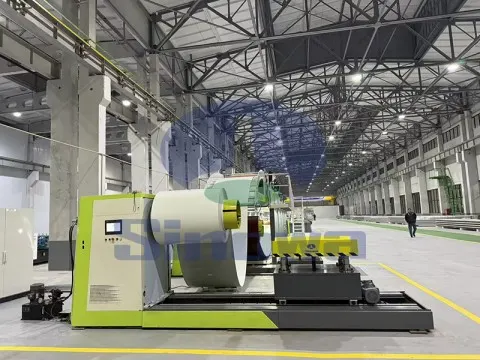
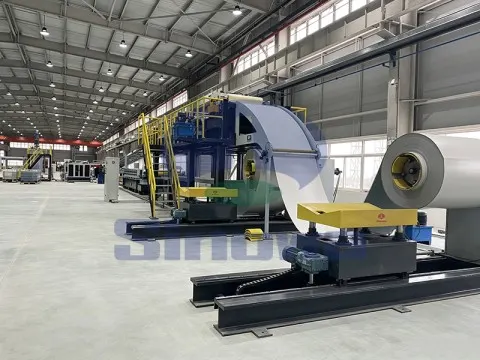
The production process of PIR sandwich panels begins with the handling and preparation of facing materials. Coiled metal sheets, which serve as the outer and inner facings of the panels, are first loaded onto decoilers. These decoilers unwind the coils smoothly, and the PLC control system regulates the unwinding speed to match the overall production line pace, preventing material slack or tension that could cause deformation. After unwinding, the metal sheets pass through leveling devices to eliminate any curvature or irregularities, ensuring a flat surface for subsequent processing. The PLC monitors the leveling process through position and pressure sensors, adjusting the device settings automatically to maintain consistent flatness across the entire width and length of the sheets. In some configurations, protective films may be applied to the surface of the metal sheets to prevent scratches or contamination during production and transportation; the PLC controls the film application unit to ensure uniform coverage and proper adhesion, synchronizing the film feeding speed with the movement of the metal sheets.
Following surface preparation, the metal sheets undergo roll forming, a process that shapes the sheets into the desired profile for wall, roof, or floor panels. The roll forming system consists of a series of sequential rollers that gradually bend the metal sheets into specific cross-sectional shapes, such as corrugated, trapezoidal, or ribbed profiles. The PLC plays a critical role in this stage by precisely controlling the speed of each roller set and adjusting the roller positions to accommodate different panel dimensions. This flexibility allows the production line to switch between different panel profiles with minimal downtime, as the PLC can recall pre-stored program settings for various product specifications. Sensors installed along the roll forming line continuously feed data to the PLC, which checks for dimensional accuracy and makes real-time adjustments to correct any deviations, ensuring that each panel meets the required shape and size tolerances.
Once the facing materials are formed, the production line moves to the foaming stage, which is arguably the most critical part of PIR sandwich panel manufacturing. The PIR foam core is produced by mixing two main chemical components: isocyanates and polyols, along with additives such as foaming agents, catalysts, and flame retardants. The PLC control system governs the high-pressure foaming machine, which is responsible for the precise metering, mixing, and dispensing of these chemicals. Accurate ratio control of the isocyanate and polyol components is essential to ensure the desired foam properties, including density, thermal conductivity, and mechanical strength. The PLC regulates the flow rates of each component using flow sensors and adjustable pumps, maintaining the optimal mixing ratio within tight tolerances. It also controls the temperature of the chemical components and the mixing chamber, as temperature stability directly affects the foaming reaction rate and the final quality of the foam core.
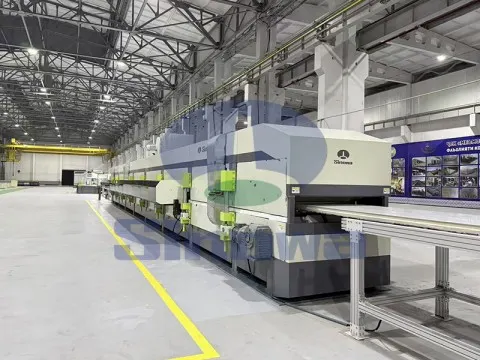
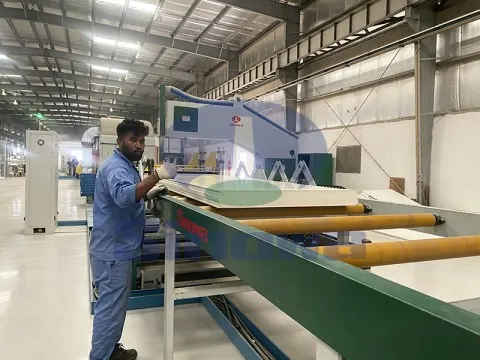
The foaming agent, which determines the cell structure of the PIR foam, is also controlled by the PLC. Modern production lines often use environmentally friendly foaming agents, and the PLC ensures that the foaming agent is injected in the correct quantity to achieve the desired foam density. After mixing, the chemical mixture is dispensed onto the surface of one of the formed metal facings, which is moving along a conveyor system. The PLC synchronizes the dispensing rate with the conveyor speed to ensure uniform foam coverage across the entire surface of the facing. The second metal facing is then placed on top of the foam mixture, and the assembly enters a double belt press. This press consists of two parallel, heated conveyor belts that apply consistent pressure and temperature to the sandwich structure as it moves through the press. The PLC controls the pressure applied by the belts, the temperature of the heating elements, and the speed of the press, creating the ideal conditions for the foam to expand, cure, and bond firmly to the metal facings.
The curing process of the PIR foam is a thermosetting reaction, meaning that once cured, the foam retains its shape and properties permanently. The PLC monitors the curing process through temperature and pressure sensors installed within the double belt press, adjusting the heating and pressure parameters as needed to ensure complete curing. The length of the double belt press and the conveyor speed, both controlled by the PLC, determine the residence time of the sandwich panels in the press, which is critical for achieving full cure. Insufficient curing can lead to poor foam adhesion and reduced structural integrity, while over-curing may cause brittleness in the foam core. By maintaining precise control over these parameters, the PLC ensures that each panel exits the press with a fully cured foam core that exhibits optimal thermal and mechanical performance.
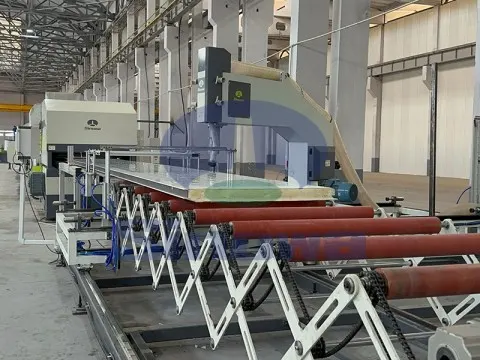
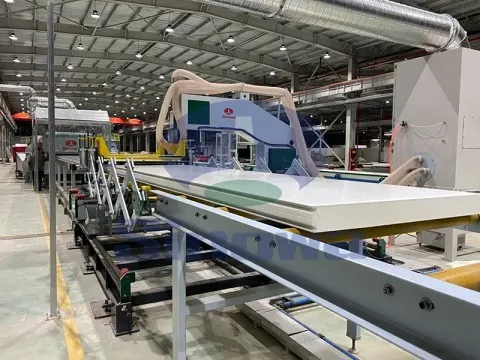
After curing, the continuous sandwich panel sheet moves to the cutting stage. A flying saw or band saw cutting machine, controlled by the PLC, trims the continuous sheet into individual panels of the desired length. The PLC uses encoder signals from the conveyor system to track the position of the panel sheet accurately, triggering the cutting mechanism at the precise moment to ensure clean, straight cuts without damaging the foam core or the metal facings. The cutting speed is synchronized with the conveyor speed to avoid material drag or deformation, and the PLC can be programmed to produce panels of different lengths in a single production run, switching between lengths automatically based on pre-set instructions. Some advanced systems also include dust collection units, which the PLC controls to maintain a clean working environment and prevent dust accumulation on the panels.
Following cutting, the finished panels undergo a cooling process to stabilize their temperature and ensure dimensional stability. The cooling station typically consists of a conveyor system with forced air or water cooling mechanisms, and the PLC regulates the cooling time and air/water flow rate to achieve the optimal cooling effect. Sensors monitor the panel temperature, and the PLC adjusts the cooling parameters to ensure that the panels reach room temperature before proceeding to the next stage. Once cooled, the panels are transferred to a handling system, which may include turning stations to orient the panels correctly and stacking units to arrange the panels in neat bundles. The PLC controls the stacking process, ensuring that the panels are stacked evenly and securely, with protective layers inserted between each panel to prevent scratches or damage. The stacking unit can be programmed to handle different panel sizes and stack heights, adapting to varying production requirements.
The final stage of the production process is packaging, where the stacked panels are wrapped in protective materials such as plastic film or waterproof paper to shield them from moisture, dust, and physical damage during transportation and storage. The PLC controls the packaging machine, regulating the wrapping speed, film tension, and sealing process to ensure secure and uniform packaging. It also coordinates with the stacking unit to ensure a continuous flow of panels into the packaging station, minimizing bottlenecks in the production line. Throughout the entire production process, the PLC collects and processes data from various sensors and devices, providing real-time monitoring of key performance indicators such as production speed, panel dimensions, foam density, and machine status.
One of the key benefits of a PLC-controlled PIR sandwich panel production line is its ability to provide comprehensive data logging and diagnostic capabilities. The PLC stores production data, including process parameters, output quantities, and any detected errors, in its memory or a connected computer system. This data can be accessed by operators and maintenance personnel for quality control analysis, production planning, and troubleshooting. For example, if a batch of panels exhibits inconsistent foam density, the stored data can be reviewed to identify deviations in the foaming machine parameters, allowing for targeted adjustments to prevent future issues. The PLC also features self-diagnostic functions, which monitor the status of all connected equipment and detect faults such as motor failures, sensor malfunctions, or pressure drops. When a fault is detected, the PLC triggers an alarm, displays a fault message on the operator interface, and may automatically shut down the affected part of the production line to prevent further damage. This rapid fault detection and diagnosis minimize downtime and reduce maintenance costs, ensuring maximum productivity.
Flexibility and scalability are additional advantages of PLC-controlled production lines. As market demands change, manufacturers may need to produce panels of different sizes, thicknesses, or profiles, or adjust the foam properties to meet specific application requirements. The PLC’s programmable nature allows for easy modification of production parameters without the need for extensive mechanical reconfiguration. New product specifications can be programmed into the PLC, and the system will automatically adjust the operation of all connected equipment to accommodate the changes. This flexibility enables manufacturers to respond quickly to customer orders and adapt to evolving industry standards. Furthermore, PLC systems can be easily expanded with additional input/output modules, allowing for the integration of new equipment or processes as the production line is upgraded. For example, a manufacturer may add a surface treatment unit to improve the adhesion of the foam to the metal facings, and the PLC can be extended to control this new unit seamlessly.
The environmental performance of PIR sandwich panel production lines is also enhanced by PLC control. The precise regulation of chemical usage, heating, and energy consumption by the PLC minimizes waste and reduces energy costs. For instance, the PLC ensures that only the required amount of chemicals is used in the foaming process, reducing material waste, while the accurate control of heating elements in the double belt press optimizes energy efficiency. Additionally, the use of environmentally friendly foaming agents is facilitated by the PLC’s precise metering capabilities, ensuring that these agents are used effectively to produce low-emission, sustainable panels. The reduction in waste and energy consumption not only lowers production costs but also aligns with global efforts to promote eco-friendly manufacturing practices.
Operator safety is another critical aspect addressed by PLC-controlled production lines. The PLC integrates safety interlocks that prevent dangerous machine operations when safety doors are open, guards are removed, or operators are in hazardous areas. It also monitors equipment temperatures, pressures, and speeds to prevent overloading or malfunctions that could pose safety risks. In the event of an emergency, the PLC responds immediately to stop the production line and activate safety alarms, protecting operators from injury. The operator interface, typically a touchscreen panel connected to the PLC, provides a user-friendly platform for monitoring and controlling the production process. Operators can view real-time production data, adjust parameters (within pre-set limits), and access diagnostic information, all from a safe, centralized location. This intuitive interface reduces the risk of human error and ensures that operators can respond quickly to any changes or issues in the production process.
In industrial and construction applications, the quality consistency of PIR sandwich panels is paramount. Panels used in cold storage facilities, for example, require exceptional thermal insulation to maintain low temperatures efficiently, while panels used in high-rise buildings or industrial warehouses must meet strict structural and fire safety requirements. A PLC-controlled production line ensures that every panel produced adheres to the same high standards, with minimal variation in foam density, panel dimensions, and bonding strength. This consistency eliminates the need for extensive post-production inspection and reduces the risk of defective panels reaching the market, enhancing customer satisfaction and reducing warranty claims. The ability to maintain consistent quality also makes PLC-controlled lines ideal for large-scale production, where even small deviations can have significant cost implications.
The integration of PLC control systems into PIR sandwich panel production lines has also facilitated the implementation of remote monitoring and control capabilities. Many modern PLC systems can be connected to a local network or the internet, allowing operators and managers to monitor the production line from off-site locations. This remote access enables real-time production tracking, parameter adjustments, and fault diagnosis, providing greater flexibility in production management. For example, if a production line experiences a minor fault during non-working hours, a technician can access the PLC remotely to diagnose the issue and potentially resolve it without being physically present, minimizing downtime. Remote monitoring also allows for data analysis and reporting, helping manufacturers identify trends, optimize production processes, and make informed business decisions.
As technology continues to advance, PLC control systems for PIR sandwich panel production lines are becoming increasingly sophisticated. The integration of artificial intelligence (AI) and machine learning algorithms into PLC systems is enabling predictive maintenance, where the PLC analyzes historical data to identify potential equipment failures before they occur. This proactive approach to maintenance reduces unplanned downtime and extends the lifespan of production equipment. Additionally, the use of industrial internet of things (IIoT) devices is enhancing data collection and analysis, providing deeper insights into the production process and enabling further optimization of efficiency and quality. These technological advancements are driving continuous improvement in PIR sandwich panel manufacturing, making PLC-controlled lines an essential investment for manufacturers looking to remain competitive in the global market.
In conclusion, a PIR sandwich panel production line with PLC control system represents the pinnacle of modern manufacturing technology for these essential construction materials. The PLC’s ability to automate, synchronize, and optimize every stage of the production process ensures high efficiency, consistent quality, and operational reliability. From raw material handling and roll forming to foaming, curing, cutting, and packaging, the PLC serves as the central control hub, minimizing human error, reducing waste, and enhancing safety. The flexibility, scalability, and data-driven capabilities of PLC systems make them adaptable to changing market demands and supportive of continuous improvement. As the demand for high-performance, energy-efficient PIR sandwich panels continues to grow across construction, industrial, and cold storage sectors, the role of PLC control systems in ensuring the production of high-quality panels will only become more critical. Manufacturers who invest in PLC-controlled production lines are better positioned to meet customer needs, reduce costs, and maintain a competitive edge in an increasingly demanding market.
Sinowa is a professional manufacturer of sandwich panel machine in china, we provide diversified and high-performance sandwich panel production lines, including fully automatic continuous PU sandwich panel line and customized special lines to meet mass production and personalized order demands. These sandwich panel lines support processing multiple foam core materials, such as PU, PIR, mineral wool, rock wool and glass wool, covering different insulation and fireproof standards.
Featuring stable operation, high efficiency, energy saving and easy maintenance, our PU sandwich panel line deliver sandwich panels with excellent thermal insulation, fire resistance, sound insulation and lightweight durability. The finished panels are widely applied in industrial workshops, warehouse roofing and wall cladding, cold storage insulation, serving global construction and industrial insulation markets.
https://www.cnsinowa.com/sandwich-panel-machines/pir-sandwich-panel-production-line-with-plc-control-system.html