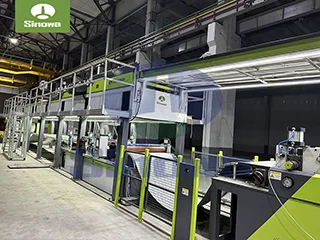
sandwich panel line
The fundamental strength of the PU sandwich panel lies in the synergy between its components. The outer metal facers provide structural rigidity, impact resistance, and protection against environmental elements such as moisture, wind, and UV radiation, while the inner PU foam core delivers superior thermal insulation by minimizing heat transfer. This combination not only enhances the energy efficiency of buildings but also reduces construction time and labor costs, as the panels are prefabricated and ready for installation. To achieve this optimal synergy, the production line must ensure precise control over every stage of manufacturing, from raw material preparation to the final cutting and finishing of the panels. Each component of the line is designed to work in harmony, ensuring continuous production, consistent quality, and the flexibility to adapt to varying panel specifications, including different thicknesses, widths, and surface profiles.
The production process of PU sandwich panels begins with the preparation and feeding of raw materials, a critical stage that lays the foundation for the quality of the final product. The primary raw materials include metal coils (for the facer sheets) and PU chemicals (polyol and polyisocyanate, along with additives such as flame retardants, stabilizers, and foaming agents). The metal coils, which may be pre-coated or pre-printed to enhance aesthetic appeal and corrosion resistance, are first loaded onto decoilers. Decoilers are designed to unwind the coils smoothly and continuously, ensuring a steady supply of metal sheets to the subsequent forming process. Tension control mechanisms integrated into the decoilers prevent the metal sheets from wrinkling or stretching, maintaining their flatness and structural integrity. This is particularly important because any irregularities in the metal sheets can affect the precision of the forming process and the bonding with the PU foam core.
After decoiling, the metal sheets are fed into the roll forming section, a key component of the production line that shapes the flat metal sheets into the desired profile. The roll forming process involves passing the metal sheets through a series of tandem rolling stands, each equipped with precision-engineered rollers and gears. Each stand progressively bends the metal sheet, guiding it into the specific cross-sectional profile required for the panel—such as corrugated, trapezoidal, or flat profiles, depending on the application. Some production lines are equipped with double-layer roll forming machines, which can form both the upper and lower facer sheets simultaneously, increasing production efficiency. The number of rolling stands varies depending on the complexity of the profile, with more intricate designs requiring a greater number of passes to achieve the desired shape. Advanced roll forming systems incorporate adjustable rollers, allowing manufacturers to switch between different profile designs with minimal downtime, enhancing the line's flexibility to meet diverse customer requirements.
Once the metal facer sheets are formed, they move to the PU foam injection station, where the core material is introduced between the two sheets. This stage is critical to achieving the thermal insulation performance and bonding strength of the sandwich panel. The PU foam is created through a chemical reaction between polyol and polyisocyanate, which are mixed with additives to control the foaming process, density, and fire resistance of the core. These chemicals are stored in specialized tanks maintained at a stable temperature to ensure consistent viscosity and reaction properties. High-precision dosing pumps transport the chemicals from the storage tanks to the foaming head, ensuring the correct ratio of polyol to polyisocyanate is maintained. The accuracy of this ratio is paramount, as any deviation can affect the foam's density, thermal conductivity, and bonding ability with the metal facers.
The foaming head, a critical component of the injection system, mixes the PU chemicals at high pressure and ejects the mixture between the two moving metal facer sheets. The high-pressure mixing ensures thorough homogenization of the chemicals, promoting a uniform reaction and foam structure. The foam is injected continuously as the metal sheets move forward, filling the entire gap between them. As the foam expands, it adheres tightly to the inner surfaces of the metal facers, creating a strong bond that eliminates the need for additional adhesives. The expansion rate of the foam is carefully controlled by adjusting the temperature, pressure, and additives, ensuring that it fills the gap completely without causing excessive pressure that could deform the metal sheets. This stage requires precise synchronization with the speed of the production line, as any mismatch can result in uneven foam distribution or incomplete bonding.
Following the injection of the PU foam, the panels enter the cooling and curing section, where the foam undergoes a chemical reaction to solidify and achieve its final properties. The curing process is essential for developing the foam's thermal insulation, compressive strength, and dimensional stability. The panels move through a cooling tunnel or along a double belt conveyor system, which maintains a controlled environment to facilitate proper curing. The conveyor system applies uniform pressure to the panels, ensuring that the foam core remains evenly distributed and that the bond between the foam and metal facers is strengthened. The temperature and duration of the curing process are carefully regulated—typically between 30 to 60 degrees Celsius—depending on the type of PU chemicals used and the desired properties of the foam. Proper curing ensures that the panels do not deform or lose their insulation properties over time, enhancing their long-term durability and performance.
Once the foam is fully cured, the continuous panel web moves to the cutting section, where it is cut into individual panels of the required length. The cutting process must be precise to ensure that the panels meet the exact dimensions specified by the application, with minimal tolerance. Most modern production lines use tracking flying saw cutting machines, which move synchronously with the continuous panel web to make clean, accurate cuts without stopping the production process. This synchronous cutting ensures high production efficiency and prevents damage to the panel edges, which could compromise the structural integrity and water resistance of the finished product. The cutting length can be easily adjusted through the line's control system, allowing for flexibility in panel sizes to meet diverse customer needs, from small panels for residential applications to large panels for industrial warehouses.
The control system is the nerve center of the entire PU sandwich panel production line, integrating all components and processes to ensure smooth operation and consistent quality. Modern production lines utilize programmable logic controller (PLC) systems, which automate and monitor every stage of the production process, including decoiling speed, roll forming parameters, PU chemical dosing, foam injection, curing temperature, and cutting length. The PLC system collects real-time data from sensors placed throughout the line, allowing for immediate adjustments to any parameters that deviate from the set standards. This automated control minimizes human error, improves production efficiency, and ensures that each panel meets the same quality standards. Additionally, the control system often includes a user-friendly interface that allows operators to set parameters, monitor production progress, and troubleshoot any issues that may arise during operation.
Beyond the core production processes, the PU sandwich panel production line may include additional components to enhance the functionality and aesthetic appeal of the finished panels. For example, some lines incorporate embossing machines that create decorative patterns—such as brick, marble, or wood textures—on the surface of the metal facers, adding visual appeal to the panels for architectural applications. Other optional components include laminating systems for bonding additional layers to the panels, such as protective films to prevent scratches during transportation and installation, or specialized coatings to enhance corrosion resistance in harsh environments. These additional processes are integrated seamlessly into the production line, ensuring that the panels meet the specific requirements of their intended application without compromising production efficiency.
The efficiency and performance of a PU sandwich panel production line are influenced by several factors, including the speed of production, the precision of the components, and the quality of the raw materials. Production speeds typically range from 0 to 20 meters per minute, depending on the complexity of the panel profile and the curing requirements of the PU foam. Higher production speeds are achievable with advanced lines that feature optimized curing systems and high-performance components, allowing manufacturers to meet large-volume orders efficiently. However, speed must be balanced with quality, as excessive speed can compromise the accuracy of the roll forming process, the uniformity of the foam injection, or the completeness of the curing process.
Quality control is an integral part of the production process, ensuring that every panel meets the required performance standards. This involves regular inspections of the raw materials, including testing the metal coils for thickness, tensile strength, and coating quality, and verifying the chemical properties of the PU materials. During production, in-process inspections are conducted to check the panel thickness, foam density, bonding strength, and profile accuracy. Finished panels are also tested for thermal conductivity, compressive strength, sound insulation, and resistance to environmental factors such as moisture and UV radiation. These quality control measures ensure that the panels are durable, energy-efficient, and suitable for their intended application, whether it be a cold storage facility requiring maximum thermal insulation or a commercial building requiring both insulation and aesthetic appeal.
The versatility of the PU sandwich panel production line is one of its key advantages, allowing manufacturers to produce panels tailored to a wide range of applications. For cold storage facilities, panels with a high-density PU foam core are produced to minimize heat transfer and maintain stable internal temperatures. For industrial warehouses and roofing applications, panels with a lightweight yet structurally strong design are preferred, reducing the load on the building's foundation and structural framework. The line can also be adjusted to produce panels of varying thicknesses—typically ranging from 10mm to 150mm—and widths, with common widths ranging from 1000mm to 1500mm or more. This flexibility allows manufacturers to cater to the specific needs of different projects, from small-scale residential constructions to large industrial complexes.
Environmental considerations have also influenced the evolution of PU sandwich panel production lines. Modern lines are designed to minimize waste and reduce environmental impact, with features such as closed-loop systems for chemical handling and recycling mechanisms for excess materials. The PU foam used in the panels is increasingly formulated to be free of chlorofluorocarbons (CFCs) and other ozone-depleting substances, aligning with global environmental regulations. Additionally, the energy efficiency of the production line itself has been improved, with optimized heating and cooling systems that reduce energy consumption. These environmental initiatives not only help manufacturers comply with regulatory requirements but also enhance the sustainability of the finished panels, making them a more attractive choice for eco-conscious construction projects.
Maintenance of the PU sandwich panel production line is essential to ensure long-term reliability, efficiency, and consistent quality. Regular maintenance includes inspecting and lubricating the roll forming rollers, checking the accuracy of the dosing pumps, cleaning the foaming head to prevent clogging, and calibrating the control system sensors. Proper maintenance of the metal processing components is particularly important to prevent wear and tear, which can affect the precision of the panel profiles. The PU chemical storage and handling systems also require regular inspection to ensure that the chemicals are stored at the correct temperature and that there are no leaks or contamination. By implementing a proactive maintenance schedule, manufacturers can minimize downtime, extend the lifespan of the equipment, and avoid costly repairs, ensuring that the production line operates at peak efficiency.
In conclusion, the PU sandwich panel production line is a sophisticated, integrated system that plays a vital role in meeting the growing demand for high-quality, energy-efficient insulation panels. By combining precise raw material handling, advanced roll forming, controlled PU foam injection, and automated quality control, the line produces panels that offer exceptional thermal insulation, structural integrity, and versatility. The continuous evolution of these production lines—driven by advancements in automation, material science, and environmental sustainability—has made them more efficient, flexible, and environmentally friendly. As the construction industry continues to prioritize energy efficiency and sustainability, the PU sandwich panel production line will remain a key enabler, providing manufacturers with the ability to produce panels that meet the diverse needs of modern construction projects. Whether for cold storage, industrial warehouses, commercial buildings, or residential applications, the panels produced by these lines offer a reliable, cost-effective solution that enhances the performance and efficiency of buildings while reducing their environmental footprint.
https://www.cnsinowa.com/sandwich-panel-machines/pu-sandwich-panel-production-line-for-insulation-panels.html