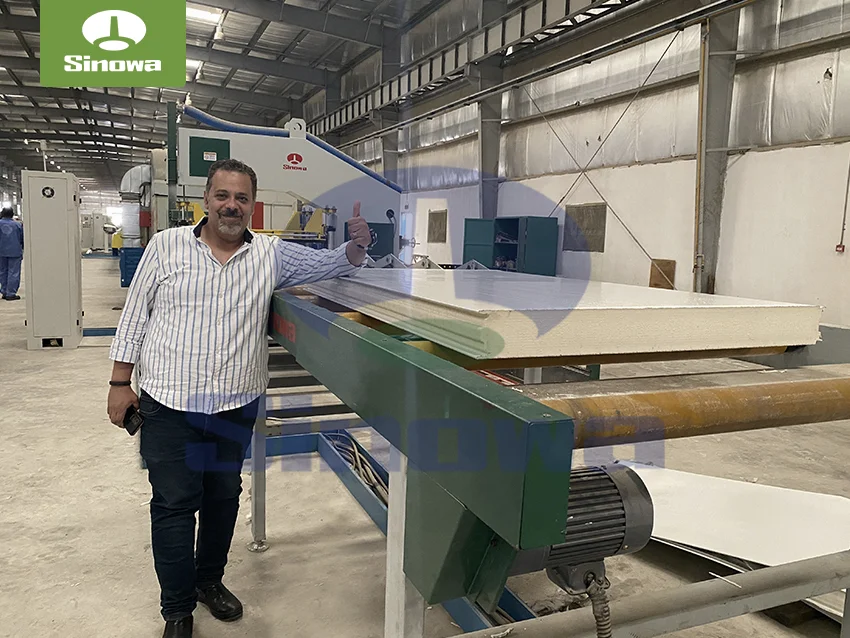
 sandwich panel machine
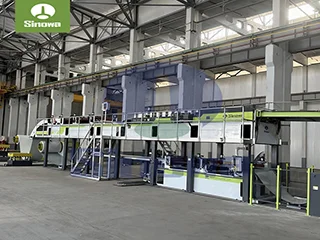
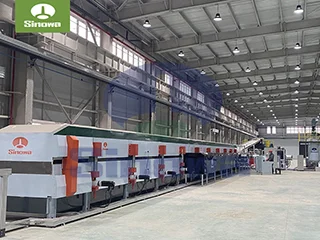
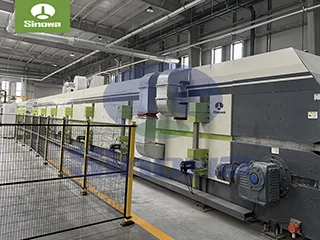
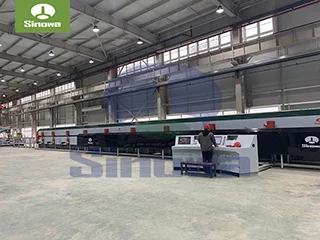
A complete composite sandwich panel machine adopts a highly integrated modular mechanical design, with all functional units operating in synchronous linkage to avoid production pause caused by mismatched operating speed between front and rear processes. Each independent module undertakes targeted processing tasks while matching running parameters dynamically through a central control system, ensuring overall production continuity and finished product uniformity. The whole production line can be divided into eight core functional modules according to the material processing sequence, namely raw material unwinding and deviation correction module, surface plate leveling and roll forming module, automatic adhesive coating module, core material conveying and positioning module, constant-pressure composite pressing module, constant-temperature curing shaping module, flying saw fixed-length cutting module and finished product sorting and conveying module. Every module is optimized in mechanical structure and operating logic to adapt to different types of surface plates and core materials, expanding the equipment’s compatibility with diversified production demands.
The raw material unwinding and deviation correction module serves as the starting point of the entire production line, mainly responsible for stable feeding of upper and lower surface coiled materials. Most mainstream production lines are compatible with metal coiled materials and non-metal flexible plate materials commonly used in building enclosure engineering. This module is equipped with passive tension adjustment structures and real-time visual deviation correction components, which can automatically identify lateral offset of coiled materials during high-speed unwinding and fine-tune the feeding track within milliseconds. This design effectively eliminates common defects such as surface wrinkles, edge warping and unilateral material deviation in subsequent composite processes, which are mainly caused by unstable feeding tension and material offset. Compared with traditional manual feeding equipment, the automatic unwinding unit reduces manual intervention in the front-end process, maintains consistent feeding speed matching with the rear forming process, and lays a foundation for overall stable operation of the whole line.
After stable feeding, the surface plate enters the leveling and roll forming module to complete surface pretreatment and profile shaping. The leveling unit adopts multi-group staggered precision rollers to eliminate internal stress generated during coiling and storage of raw plates, restoring the flatness of surface plates and preventing plate rebound after composite molding. The rear roll forming unit processes flat surface plates into customized profiles including trapezoidal waves, rectangular ribs and flat plates according to actual engineering usage requirements. The spacing, height and radian of forming rollers can be mechanically adjusted to meet customized profile production needs for building wall panels, roof panels and special industrial enclosure panels. All roller sets are processed with high-precision surface treatment to reduce friction loss during plate transmission, avoid surface scratch damage on finished panels, and prolong the service life of mechanical transmission components.
Uniform and stable adhesive bonding is the core link determining the overall structural strength and delamination resistance of finished sandwich panels, and the automatic adhesive coating module undertakes this key processing procedure. Different from manual gluing or semi-automatic gluing equipment with uneven glue output, the gluing system of modern composite sandwich panel making machine adopts full-spray and roller-coating dual gluing modes, which can switch flexibly according to core material types and bonding strength requirements. The central control system can accurately adjust glue output, coating thickness and coating coverage in real time based on production speed, ensuring that adhesive is evenly distributed on the bonding surface of upper and lower surface plates without missing coating, glue accumulation or thin coating areas. Reasonable glue coating control not only improves the bonding firmness between surface plates and core materials, preventing interlayer delamination in long-term service of panels, but also avoids excessive adhesive waste, optimizing overall production cost control in the manufacturing process.
The core material conveying and positioning module is responsible for orderly laying of intermediate thermal insulation and support core materials between two layers of glued surface plates. Common matching core materials include foam thermal insulation materials, rock wool inorganic fireproof materials and other mainstream building thermal insulation substrates. This module is equipped with quantitative cutting and automatic positioning functions for bulk core materials, which can cut continuous core material strips into matched sizes synchronously according to the width and running speed of surface plates, and accurately place core materials in the middle of double-layer surface plates without lateral deviation. For fibrous core materials with loose texture, the module adds light pre-compression structures to compact loose core materials moderately, reducing internal gaps inside finished panels and improving the overall thermal insulation performance and structural compactness of composite plates. The linkage design between core material conveying speed and surface plate transmission speed realizes zero-gap matching between multi-layer materials before composite pressing.
The constant-pressure composite pressing module is the key unit to realize integrated bonding of three-layer materials. This module adopts upper and lower symmetric pressing roller sets with controllable pressure, and the overall pressing pressure can be steplessly adjusted according to surface plate thickness, core material hardness and adhesive curing characteristics. The closed-loop pressure control system maintains constant pressure output in the whole pressing process, avoiding local insufficient bonding caused by pressure fluctuation or core material crushing caused by excessive pressure. Meanwhile, the pressing section is equipped with synchronous speed tracking function to ensure that the running speed of pressing rollers is completely consistent with the front material transmission speed, preventing relative sliding between surface plates and core materials during pressing which leads to dislocation and finished product scrappage. After continuous constant-pressure extrusion, the double-layer surface plates and intermediate core materials are closely fitted preliminarily, forming an integrated sandwich plate semi-finished product with stable overall structure.
Subsequently, semi-finished panels enter the constant-temperature curing shaping module to complete adhesive curing and final structural shaping. The curing section adopts sealed constant-temperature heating channels with evenly distributed internal heating units, which provide stable and uniform ambient temperature matching with the curing requirements of selected adhesives. Gradient temperature control is adopted along the material transmission direction: the front section maintains medium temperature to accelerate adhesive infiltration between material layers, the middle section maintains constant high temperature to complete cross-linking curing of adhesives, and the rear section carries out slow cooling treatment to eliminate thermal stress generated by high-temperature curing. This segmented temperature control mode effectively prevents finished panel deformation, warping and internal stress concentration caused by one-time high-temperature heating or rapid cooling. After curing treatment, the interlayer bonding strength of composite panels reaches the design standard, and the overall structural stability can adapt to complex external force changes in actual engineering application scenarios.
The final processing links include fixed-length cutting and finished product automatic conveying and sorting. The flying saw cutting unit tracks the real-time running speed of panels dynamically, realizing synchronous follow-up cutting without stopping production. Compared with static cutting equipment that needs line shutdown, dynamic follow-up cutting greatly improves overall production efficiency and avoids production efficiency loss caused by frequent start and stop of mechanical equipment. The cutting tool adopts high-hardness integral molding structure to ensure smooth and burr-free cutting edges of panels, eliminating secondary edge trimming procedures. After cutting, finished panels with unified specifications are automatically transmitted to the rear sorting platform, and the system completes automatic stacking and separation of qualified products and slightly defective products through sensor identification, reducing manual sorting workload and improving overall production automation level.
Compared with traditional manual assembly and semi-automatic intermittent sandwich panel production equipment, modern full-automatic composite sandwich panel production machine has prominent comprehensive advantages in production efficiency, finished product quality stability, labor cost saving and production safety. Firstly, in terms of production efficiency, continuous uninterrupted production mode breaks the efficiency bottleneck of intermittent processing, realizing long-term stable operation of the production line and greatly improving daily output of finished panels. Secondly, in terms of product quality consistency, the full-process digital parameter control unifies processing parameters including feeding speed, gluing amount, pressing pressure and curing temperature in each production batch, eliminating quality differences of finished products caused by human operation errors in semi-automatic production modes. Thirdly, in terms of labor configuration, the highly automated production line only requires a small number of operators to monitor operating parameters and conduct routine equipment maintenance, realizing unmanned operation of the main production process and cutting long-term labor input costs for panel manufacturers. In addition, the fully closed mechanical processing structure reduces manual contact with operating mechanical components and chemical adhesives in the production process, improving overall on-site production safety and reducing potential occupational health risks for front-line workers.
Driven by the performance characteristics of lightweight, high structural strength, excellent thermal insulation, sound insulation and fire resistance of finished composite sandwich panels, matching production machines are widely applied to support manufacturing demands in multiple downstream industries. The largest application scenario is prefabricated steel structure construction industry, where sandwich panels produced by such machines are used as wall and roof enclosure materials for industrial workshops, logistics warehouses, large exhibition halls and stadiums, meeting the requirements of rapid construction, light building dead load and energy-saving thermal insulation for modern prefabricated buildings. In cold chain engineering, composite sandwich panels with high-efficiency thermal insulation core materials are applied to cold storage and constant-temperature logistics container walls, and the integrated composite structure processed by professional machines reduces cold air leakage effectively and improves long-term energy-saving operation effect of cold chain facilities. In temporary emergency construction fields including disaster relief shelters and temporary construction site offices, the rapid production characteristic of composite sandwich panel manufacturing machine supports rapid batch supply of standardized panels, realizing fast assembly and putting into use of temporary buildings. Besides, such equipment also serves special industrial fields such as clean workshop enclosure, pharmaceutical factory dust-free space partition and agricultural intelligent greenhouse enclosure, meeting differentiated performance requirements of panels in different working environments by adjusting equipment processing parameters.
Despite mature overall technology and wide market application of current composite sandwich panel machinery, the equipment still faces prominent technical bottlenecks restricting further upgrading in actual industrial production. First of all, the adaptability of equipment to new environmentally friendly core materials needs to be improved. With the global promotion of carbon neutrality policies, recycled thermal insulation core materials and biodegradable composite core materials are gradually popularized, but most existing production lines have fixed mechanical structure parameters, making it difficult to adapt to physical characteristic changes of new environmentally friendly materials such as elasticity, compression resistance and water absorption, requiring frequent manual debugging and affecting continuous production efficiency. Secondly, the intelligent fault diagnosis capability of the equipment is insufficient. Most existing production lines only have simple overcurrent and overload protection functions, and cannot predict potential mechanical wear, glue pipeline blockage and temperature control deviation in advance. Most equipment faults can only be found after production defects appear, leading to certain material waste and production line downtime loss. Thirdly, the overall energy consumption of the curing heating section remains high. Long-term constant-temperature operation of the curing channel leads to large power energy consumption, and the lack of waste heat recovery and reuse system increases the overall carbon emission and production energy consumption of panel production enterprises.
Combined with global industrial intelligent upgrading trends and dual-carbon strategic requirements, the future development of composite sandwich panel production machinery will focus on three core directions: full-process intelligent linkage optimization, green low-carbon energy-saving transformation and multi-material universal adaptive upgrading. In terms of intelligent upgrading, the next-generation equipment will be equipped with big data cloud monitoring and artificial intelligence real-time optimization systems. The system can automatically collect operating data of all modules in real time, independently optimize matching parameters of feeding speed, gluing volume and pressing pressure according to raw material batch differences, and realize active early warning and automatic troubleshooting of potential equipment faults without manual intervention. Meanwhile, digital twin technology will be applied to equipment operation monitoring, restoring the whole production process in virtual space to realize remote visual debugging and unmanned management of production lines.
In terms of green and low-carbon transformation, future composite sandwich panel line will add waste heat circulation recovery systems in the curing heating module, recycling waste heat generated by high-temperature curing to preheat surface plates and core materials in the front process, reducing additional heating energy input. Besides, the equipment will match low-carbon water-based environmentally friendly adhesive supply systems, optimizing the internal structure of glue spraying pipelines to further reduce adhesive volatilization and material waste in the production process, lowering the overall carbon footprint of the whole panel production process. In terms of multi-material adaptive upgrading, mechanical adjustment structures of key modules such as pressing rollers and core material conveyors will adopt electric automatic adjustment instead of traditional manual adjustment, enabling one-click switching of production parameters for different core materials and surface plates, realizing flexible switching of multiple panel production specifications on one single production line and improving equipment utilization rate for manufacturers.
In conclusion, composite sandwich panel production line is a core integrated processing equipment connecting mechanical manufacturing technology and new building material production industry. Its operational logic covers mechanical transmission, automatic control, chemical adhesive curing and material structure composite multidisciplinary technical theories, and its technical iteration progress directly determines the production efficiency, product performance and application boundary of composite sandwich panels. With the continuous expansion of global prefabricated building market scale and the increasingly stringent requirements for building energy conservation and environmental protection, the market demand for high-precision, low-energy-consumption and highly intelligent composite sandwich panel machines will keep growing continuously. Breaking through existing technical bottlenecks, promoting intelligent and green upgrading of equipment, and improving the adaptive capacity of production lines for new environmentally friendly materials will become the core development direction of this machinery industry in the next decade. Driven by continuous mechanical innovation and digital technology integration, composite sandwich panel machines will further empower the high-speed and low-carbon development of global construction, cold chain, emergency engineering and other downstream industries, and play a more important supporting role in the upgrading of modern industrial manufacturing and green building systems.
https://www.cnsinowa.com/sandwich-panel-machines/composite-sandwich-panel-machine.html