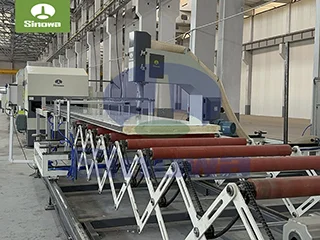
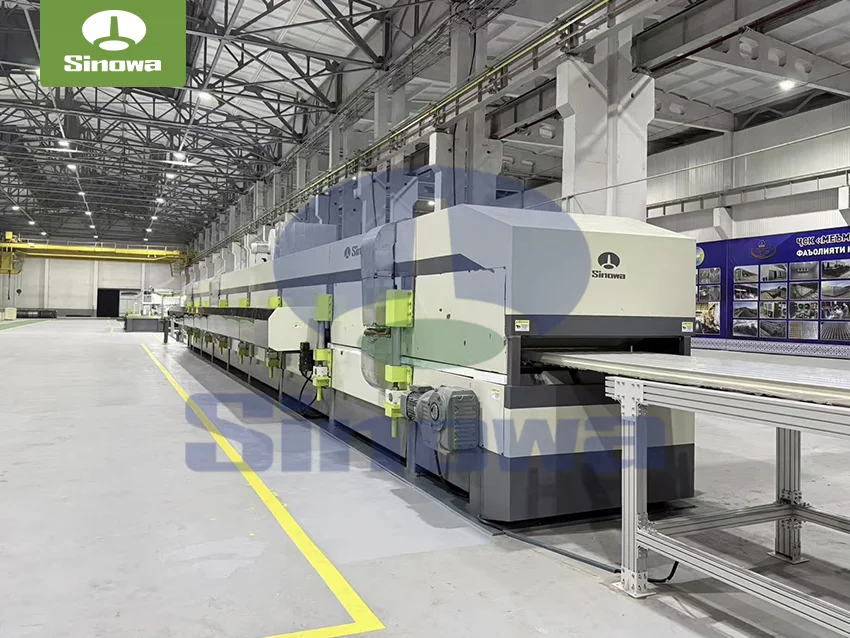
 sandwich panel line
The overall structural composition of an automatic PU sandwich panel line follows a streamlined production logic, and each functional module is closely connected to form an integrated and closed-loop production system. Every component in the production line has clear functional positioning, and the coordination and matching between modules determine the overall operating efficiency and product processing accuracy of the equipment. The front-end part of the production line is mainly composed of raw material unwinding devices, which are responsible for storing and continuously releasing sheet substrates such as metal color steel plates, aluminum alloy plates and non-metal decorative plates. These unwinding devices adopt hydraulic or mechanical expansion structures to firmly fix the coiled raw materials, avoiding lateral displacement and material loosening during high-speed transmission. Equipped with an independent tension adjustment mechanism, the devices can dynamically control the feeding tension of substrates according to the production speed and material thickness, ensuring that the surface of the raw sheet remains flat without wrinkles or deformation during the conveying process. In addition, the unwinding area is equipped with an automatic deviation correction structure, which can monitor the substrate transmission track in real time and fine-tune the conveying position to prevent material deviation caused by mechanical vibration or raw material coil errors, laying a foundation for the accurate lamination of subsequent processes.
Following the unwinding link, the surface pretreatment module undertakes the key task of optimizing the substrate surface state. During the storage and transportation of coiled substrates, dust, oil stains and fine impurities often adhere to the surface, which will seriously affect the bonding firmness between the substrate and the polyurethane foam layer. The pretreatment module is equipped with efficient dust removal and cleaning components, which use physical adsorption and air blowing technology to thoroughly remove surface attachments. For substrates with high surface smoothness requirements, auxiliary surface polishing and roughening processes are added to increase the surface roughness of the substrate, thereby enhancing the mechanical adhesion between the substrate and the foam material. Some production lines are also equipped with constant temperature preheating devices in this link. The low-temperature preheating treatment can eliminate the internal stress of the substrate, stabilize the physical properties of the material, and avoid structural warping of the finished panel caused by temperature differences in the subsequent high-temperature curing process. The entire pretreatment process operates in a fully automatic closed state, which not only improves the cleaning effect but also prevents dust from spreading to pollute the production environment, meeting the basic requirements of modern industrial clean production.
The foaming and material distribution system is the core functional unit of the entire automatic PU sandwich panel production line, directly determining the thermal insulation performance, density uniformity and structural stability of the polyurethane foam interlayer. This system mainly consists of raw material storage tanks, precision metering pumps, mixing components and mobile material distribution mechanisms. Two independent storage tanks are used to store polyurethane resin and curing agent raw materials respectively, with sealed heat preservation structures installed on the tank bodies to isolate external temperature interference and maintain the activity and stability of chemical raw materials. The metering pumps are driven by variable frequency servo motors, which can accurately adjust the material output flow according to the preset production parameters. The flow control accuracy can reach a very high level, ensuring that the two raw materials are mixed in an optimal chemical ratio. After being quantitatively transported to the mixing chamber, the raw materials are fully stirred and blended through a high-speed turbulence structure to form a homogeneous foaming liquid without particle agglomeration and layered separation.
The mixed foaming liquid is evenly sprayed on the surface of the lower substrate through the mobile material distribution machine. The material distribution mechanism is equipped with a multi-axis transmission structure, which can perform reciprocating linear movement along the width direction of the substrate. The spraying flow rate and movement speed are synchronously matched with the production line transmission speed, so that the foaming liquid can cover the substrate surface uniformly without material accumulation or blank gaps. Different from the fixed-point spraying mode of traditional equipment, the mobile material distribution structure adapts to the production requirements of sandwich panels with different width specifications. By adjusting the movement stroke and spraying range, it can complete material distribution processing for panels of various sizes. In the spraying process, the system dynamically monitors the liquid pressure and flow state in real time. Once abnormal fluctuations occur, the intelligent control unit will automatically fine-tune the operating parameters of the metering pump to ensure the continuous stability of the material distribution process.
After the completion of raw material spraying, the substrate carrying the foaming liquid enters the composite lamination module, which realizes the fitting and pressing of the upper and lower substrates and the foaming intermediate layer. The composite lamination unit is composed of multi-group precision pressing rollers and hydraulic pressure regulation components. According to the hardness and thickness characteristics of different substrates, the system automatically adjusts the pressing pressure value. For rigid metal substrates, medium and high pressure is applied to eliminate tiny bubbles generated during foaming and squeeze out excess redundant materials, so that the foam layer is closely bonded to the substrates. For flexible lightweight substrates, low-pressure slow pressing is adopted to avoid permanent deformation and structural damage of the sheet caused by excessive pressure. All pressing rollers are processed with high-precision surface polishing and anti-corrosion treatment, and the parallelism between the rollers is strictly calibrated to ensure uniform pressure distribution on the entire width of the panel during lamination, preventing local hollowing and delamination of the finished product.
The constant temperature curing and shaping tunnel is an indispensable functional area for the chemical foaming and structural molding of polyurethane materials. The internal space of the curing tunnel is a fully closed thermal insulation structure, which is equipped with a circulating heating system and an air circulation device. The heating system adopts a stable heat conduction mode to maintain a constant temperature environment inside the tunnel, providing suitable temperature conditions for the foaming reaction, curing molding and molecular cross-linking of polyurethane raw materials. The air circulation structure can realize uniform heat distribution in the tunnel, avoid local temperature difference, and ensure that the foaming reaction speed of each part of the panel remains consistent. With the gradual progress of the chemical reaction, the foaming liquid expands steadily to form a microporous closed-cell structure, and completes curing and shaping under the dual action of constant temperature and continuous pressure. The length of the curing tunnel and the internal temperature parameters can be adjusted according to the production speed and panel thickness. Thickened sandwich panels need to extend the curing time appropriately to ensure complete internal reaction and sufficient structural stability, while thin panels can shorten the curing cycle to improve production efficiency.
After curing and shaping, the integrated sandwich panel enters the trimming and fixed-length cutting module. This module is equipped with high-precision laser positioning sensors and intelligent cutting execution components. The system pre-sets the cutting size parameters according to the production order, and the positioning sensors monitor the conveying distance of the panel in real time. When the panel reaches the preset cutting position, the transmission mechanism automatically performs speed reduction and positioning locking to avoid position deviation during cutting. The cutting tool adopts high-hardness alloy materials, which has the characteristics of wear resistance and high cutting flatness. It can complete one-time cutting and trimming of the panel edge, remove redundant leftover materials on both sides, and ensure that the section of the finished panel is smooth and flat without burrs and cracks. In addition, the trimming mechanism can adjust the cutting width according to production requirements to meet the processing standards of panels with different dimensional specifications. All cutting waste materials are automatically collected through the conveying pipeline, which is convenient for centralized recycling and treatment, reducing material waste and environmental pollution.
The final stage of the polyurethane sandwich panel production line is the finished product sorting and stacking module. The processed qualified sandwich panels are transported to the finished product platform through the conveyor belt. The intelligent identification system automatically detects the surface flatness, edge cutting quality and overall dimensional error of the panels. Qualified products are transported to the stacking area, while individual defective products with minor defects are automatically sorted out to avoid mixing defective products into the finished product batch. The stacking mechanism adopts mechanical arm and vacuum adsorption structure, which can stably pick up single panels without causing surface scratches and structural damage to the panels. According to the storage and transportation requirements, the equipment automatically completes layered stacking and spacing placement of finished products, and the stacked finished products are neat in arrangement and stable in structure, which is convenient for subsequent packaging, transportation and storage. The entire stacking process does not require manual auxiliary operation, realizing unmanned automatic finishing of finished products.
The intelligent control system runs through all functional modules of the automatic polyurethane sandwich panel line and is the core brain to coordinate the stable operation of the entire equipment. The system adopts a programmable logic controller matched with a touch human-computer interaction interface. All production parameters including transmission speed, raw material mixing ratio, curing temperature, pressing pressure and cutting size can be set and adjusted through the touch terminal. The system has a built-in parameter storage function, which can store the production parameter formulas of panels with different specifications. When switching production varieties, workers can call the preset formulas with one click to complete rapid parameter switching, greatly shortening the mold change and debugging time. In the production process, multiple sensors distributed in various modules collect real-time data such as temperature, pressure, flow rate and operating speed, and feed the data back to the control unit for intelligent analysis and judgment.
Once abnormal operating conditions such as excessive temperature, insufficient material supply and mechanical jamming occur in a certain link, the control system will immediately trigger an early warning mechanism, display the fault location and abnormal data on the interaction interface, and simultaneously perform automatic power-off and stop protection to prevent equipment damage and product quality problems caused by faults. In addition, the control system supports remote data transmission and equipment monitoring. Production managers can view the real-time operating status, production output and parameter change data of the production line through remote terminals, realizing remote management and unattended monitoring of the production equipment. The optimized human-computer interaction logic simplifies the operation steps, and workers can master the equipment operation methods through simple training, effectively reducing the technical threshold of equipment use and the labor cost of enterprise production.
Compared with traditional semi-automatic and manual production equipment, the automatic PU sandwich panel line has prominent comprehensive advantages in production efficiency, product quality, resource utilization and production safety. In terms of production efficiency, the integrated streamlined processing mode eliminates the intermediate handling and waiting links between processes. The continuous uninterrupted production mode greatly improves the hourly output of panels, and can realize long-term stable operation without frequent shutdown debugging. The efficient linkage of all modules shortens the single-panel processing cycle, which is several times the production efficiency of traditional equipment. In terms of product quality control, the full-process mechanical intelligent processing replaces manual operation errors. The precise metering system ensures the uniformity of the foam material ratio, the constant temperature curing system stabilizes the internal pore structure of the foam layer, and the precise pressing technology avoids delamination and hollowing defects. The dimensional error rate and surface defect rate of finished products are maintained at an extremely low level, and the product quality consistency is significantly improved.
In terms of resource utilization optimization, the automatic metering and spraying system can accurately control the usage of polyurethane raw materials, avoid excessive raw material consumption caused by manual feeding, and reduce the waste of chemical materials. The automatic recycling device collects cutting leftover materials and unqualified foaming materials, which can be reused after centralized treatment, realizing the secondary utilization of resources. The closed production structure reduces the volatilization of chemical raw materials, not only saves raw material costs but also reduces the emission of harmful gases. In terms of production safety, the fully enclosed processing space isolates the contact between workers and chemical raw materials, avoiding physical damage caused by direct contact with corrosive and volatile raw materials. The multiple safety protection mechanisms such as anti-jamming, over-temperature protection and emergency stop effectively reduce the failure rate and safety accident risk of mechanical equipment, creating a safe and standardized operating environment for production workers.
PU sandwich panels produced by automatic production lines have excellent physical and chemical properties, making them widely applicable in multiple industrial fields. In the building construction industry, such panels are used for the construction of thermal insulation walls, roof ceilings and partition walls of industrial plants, cold storage warehouses and temporary buildings. The low thermal conductivity of polyurethane foam materials can effectively block heat transfer, reduce the energy consumption of building heating and refrigeration, and meet the energy-saving design standards of modern buildings. The lightweight structural characteristics reduce the self-weight of the building body, lower the bearing requirements of the building foundation, and shorten the construction cycle. In the transportation industry, sandwich panels are applied to the carriage plates of refrigerated trucks, insulation containers and special transport vehicles. The good sealing and thermal insulation performance ensures the constant temperature transportation of fresh food, medical supplies and chemical raw materials, while the high mechanical strength can resist external impact and reduce cargo vibration damage during transportation.
In addition, such composite panels also play an important role in the fields of industrial purification workshops, environmental protection equipment and outdoor decorative facilities. The smooth and flat surface of the panel is not easy to accumulate dust, and it is convenient for daily cleaning and maintenance, which meets the high cleanliness requirements of pharmaceutical workshops and electronic processing workshops. The anti-corrosion and weather resistance of the panel enable it to maintain stable structural performance in harsh environments such as high humidity, low temperature and strong ultraviolet radiation, and prolong the service life of the equipment and facilities. With the continuous diversification of market demand, the production line can adjust raw material formulas and processing technologies to produce sandwich panels with fire resistance, sound insulation, anti-static and antibacterial functions, expanding the application boundary of polyurethane composite panels.
In the actual production and application process, the daily maintenance and scientific operation management of the automatic PU sandwich panel line are crucial to extending the service life of the equipment and maintaining stable production efficiency. Daily maintenance work includes surface cleaning of mechanical components, inspection of transmission parts, lubrication of rotating bearings and calibration of sensing components. After the daily production is completed, the residual foaming raw materials in the mixing cavity and spraying pipeline need to be thoroughly cleaned to prevent the raw materials from solidifying and blocking the pipeline and affecting the next use. The transmission rollers and guide rails shall be regularly cleaned of dust and sundries to ensure the smooth transmission of substrates. The vulnerable parts such as cutting tools and sealing gaskets need to be inspected regularly, and the aging and damaged parts shall be replaced in a timely manner to avoid affecting the processing accuracy and sealing performance of the equipment.
In terms of equipment operation management, production enterprises need to formulate standardized operation procedures to regulate the startup, parameter adjustment, shutdown and maintenance steps of the production line. Before the official production, the equipment shall be preheated and debugged to check whether the temperature control system, metering system and transmission system can operate normally. During the production process, the staff shall monitor the operating state of the equipment in real time, record the production parameter data, and summarize and analyze the parameter changes regularly to optimize the production process. For the chemical raw materials used in production, sealed storage and classified management shall be carried out to control the storage temperature and humidity, prevent raw material deterioration and failure caused by environmental changes, and ensure the stability of raw material chemical properties. In addition, the enterprise needs to regularly carry out professional skill training for operators to improve their fault judgment and emergency response capabilities, ensuring that potential equipment faults can be eliminated in the initial stage.
Driven by the continuous progress of industrial manufacturing technology and the upgrading of environmental protection policies, the automatic PU sandwich panel line is evolving towards the development direction of high intelligence, green environmental protection, flexible production and energy conservation and consumption reduction. In terms of intelligent upgrading, more advanced visual detection technology and artificial intelligence algorithms are applied to the quality detection link. The high-definition camera identifies tiny defects such as surface scratches, internal bubbles and uneven bonding of panels through image recognition technology, with higher detection accuracy and faster recognition speed than traditional sensor detection. The equipment is equipped with an intelligent data analysis module, which can automatically count production output, material consumption and fault frequency, provide data support for enterprise production scheduling and cost accounting, and realize refined production management.
In terms of green environmental protection optimization, the new generation of production lines adopts low-carbon and low-volatile polyurethane raw material formulas, and optimizes the internal circulation structure of the equipment to reduce the escape of harmful gases during the foaming reaction. The waste gas generated in the production process is purified and filtered by the environmental protection treatment device and then discharged up to the standard. The waste leftover materials are crushed and recycled to realize the recycling of resources and reduce the production of industrial solid waste. In terms of energy conservation and consumption reduction, the production line adopts frequency conversion energy-saving motors and intelligent temperature control modules. The equipment automatically adjusts the operating power according to the production load, avoiding energy waste caused by long-term high-power operation of idle equipment. The thermal insulation structure of the curing tunnel is optimized to reduce heat loss and improve the utilization rate of heat energy.
In terms of flexible production performance, the upgraded automatic production line strengthens the adaptive adjustment ability of the equipment. It can quickly switch between substrates of different materials and thicknesses, and complete the production of multi-specification and multi-functional sandwich panels without replacing a large number of molds. The modular structural design facilitates the disassembly, transportation and transformation of the production line, and enterprises can adjust the equipment layout and functional modules according to the production scale expansion demand. In addition, the production line is gradually integrated with the industrial Internet system to realize data interconnection between production equipment, enterprise management terminals and market demand terminals. According to market order changes, the production line automatically adjusts production parameters and output, realizing intelligent production mode integrating order receiving, production processing and finished product delivery.
From the perspective of industrial development, the automatic PU sandwich panel line is an important carrier to promote the iterative upgrading of the building thermal insulation material industry. With the continuous improvement of global energy conservation and emission reduction requirements, the market demand for high-efficiency thermal insulation, low-carbon environmental protection and durable composite panels will continue to rise. The traditional backward production equipment has problems such as low automation, high energy consumption and unstable product quality, which can no longer adapt to the large-scale and high-standard market demand. The automatic production line optimizes the entire production process from raw material processing to finished product output, promotes the standardized production of polyurethane sandwich panels, and improves the overall industrial production level. At the same time, the popularization and application of automated production equipment reduce the production cost of high-performance composite panels, make energy-saving building materials more popular, and play a positive role in promoting the upgrading of the construction industry and the realization of green building goals.
In conclusion, the automatic PU sandwich panel line integrates multiple advanced industrial technologies, and realizes efficient, stable and standardized production of polyurethane sandwich panels through the coordinated operation of multiple functional modules. Its unique structural design and intelligent control system endow the equipment with outstanding advantages in production efficiency, product quality and resource utilization. The produced sandwich panels have excellent comprehensive performance and are widely used in many fields such as construction, transportation and industrial manufacturing. With the continuous innovation of science and technology and the continuous optimization of industrial policies, the automation level, environmental protection performance and flexible production capacity of PU sandwich panel production line will be further improved. In the future, such automated production equipment will continue to play an important role in the field of composite material manufacturing, provide high-quality thermal insulation composite materials for various industries, and contribute to the sustainable development of the global manufacturing industry and green construction industry.
https://www.cnsinowa.com/sandwich-panel-machines/automatic-pu-sandwich-panel-line.html