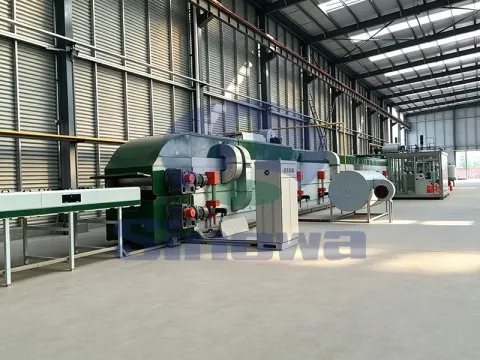
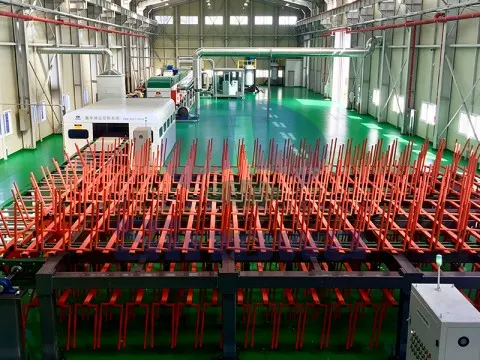
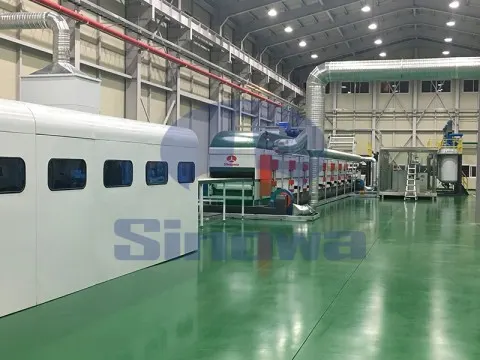
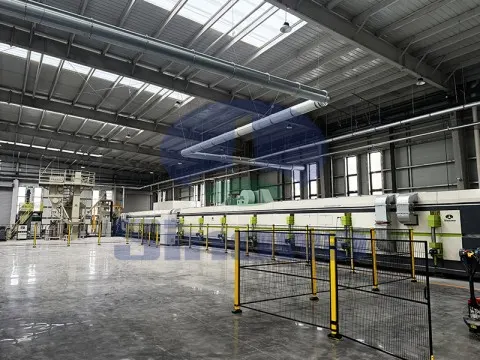
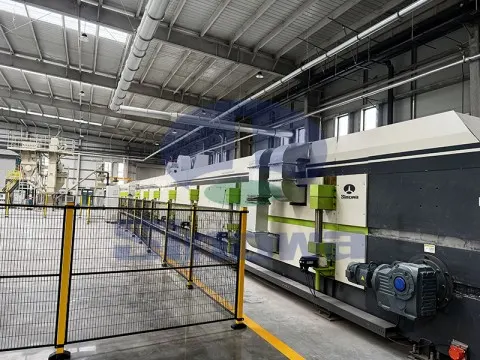
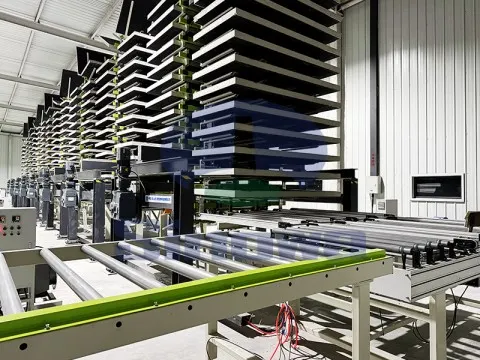
sandwich panel line
Raw material pretreatment constitutes the initial and fundamental stage of the entire production workflow of the phenolic foam core sandwich panel line, laying a solid foundation for subsequent foaming and compounding processes. The raw materials required for production are divided into two main categories: core layer raw materials and surface layer raw materials. The core layer mainly relies on phenolic resin as the base material, supplemented by foaming agents, curing agents, and auxiliary additives. These raw materials need to undergo precise proportioning and uniform mixing in a sealed stirring device inside the production line. During the mixing process, the built-in temperature sensing components of the stirring equipment dynamically adjust the mixing temperature to ensure that the molecular activity of phenolic resin remains within a reasonable range, avoiding premature curing or uneven foaming caused by excessive temperature fluctuation. For surface layer raw materials, common sheet materials with flat surfaces and high structural toughness are adopted, and the production line is equipped with special surface treatment structures to remove surface dust, oil stains, and subtle burrs. This surface treatment process can enhance the adhesion between the surface sheet and the foam core layer, preventing delamination and peeling during the long-term service of the panels. All raw material transportation links in the pretreatment stage adopt fully enclosed pipeline transmission, which not only reduces material waste but also avoids the impact of external dust and impurities on the purity of raw materials, maintaining the consistency of raw material properties in each production batch.
Foaming and forming is the core technological link of the phenolic foam core sandwich panel line, determining the internal pore structure, density, and thermal insulation performance of the foam core layer. After the proportioned phenolic mixed raw materials are transported to the foaming station, the production line adopts a graded temperature rise foaming method to control the foaming reaction rate stably. In the initial foaming stage, low-temperature heating is used to trigger the chemical reaction of the foaming agent, generating tiny and uniform bubbles inside the resin raw materials. With the gradual increase of temperature and the adjustment of internal pressure in the foaming cavity, the bubbles expand steadily, and the phenolic resin undergoes cross-linking and curing reactions synchronously to form a closed-cell foam structure. The internal space of the foaming equipment is designed with an equalizing flow channel, which can make the raw materials spread evenly in the molding area and avoid local density deviation of the foam caused by uneven material accumulation. During the entire foaming process, the intelligent control system of the production line monitors key indicators such as foaming temperature, internal pressure, and material flow in real time, and automatically fine-tunes operating parameters according to the feedback data. This intelligent adjustment mode effectively solves the problems of uneven pore size and inconsistent hardness existing in traditional manual foaming processes, ensuring that the foam core layer has a compact and uniform internal structure and excellent physical stability.
The continuous compounding and pressing module is an indispensable part of the phenolic foam core sandwich panel line, responsible for tightly combining the surface sheets with the initially molded phenolic foam core layer. After the foam core layer is preliminarily shaped, it is horizontally transported to the compounding station through a synchronous traction device. At this station, the production line is equipped with an automatic gluing system that evenly coats high-performance adhesive on the joint surfaces of the upper and lower surface sheets. The gluing system adopts a micro-spray gluing mode, which can accurately control the adhesive coating amount and coating range, avoiding quality defects such as excessive glue overflow or insufficient local adhesion. Subsequently, the surface sheets and the foam core layer enter the pressing device together. The pressing structure adopts a multi-group roller pressing design, with adjustable pressing gap and pressing pressure. The graded pressing method is adopted in the pressing process: low-pressure preliminary fitting is carried out first to discharge the tiny air gaps between layers, and then constant-pressure compact molding is performed to strengthen the bonding tightness between the sheets and the core layer. The internal temperature of the pressing device is kept within a constant range to accelerate the curing reaction of the adhesive and shorten the composite molding cycle. The synchronous operating speed of each roller in the pressing device ensures that there is no relative displacement between the surface sheets and the foam core layer during the pressing process, maintaining the flatness and overall regularity of the composite panels.
Constant-temperature curing and aging treatment further optimize the structural stability and service durability of the sandwich panels in the production flow. After compound pressing, the preliminary molded panels are transported to the independent curing chamber of the production line for continuous constant-temperature maintenance. The internal space of the curing chamber is insulated with high-efficiency thermal insulation materials, forming a stable temperature and humidity environment. In this environment, the adhesive between layers is completely cured, and the molecular structure of the phenolic foam is further stabilized, which effectively reduces the internal stress generated during the foaming and compounding process. The aging treatment process is carried out following the curing stage, simulating the temperature changes and air circulation conditions in the natural use environment to eliminate potential structural instability factors inside the panels. Panels that have completed aging treatment will have lower shrinkage rates and stronger deformation resistance in subsequent long-term use. The curing and aging area of the production line is designed with an intelligent ventilation system, which can discharge the trace gas generated during the curing reaction in time and keep the internal air circulation smooth, creating a safe and environmentally friendly production environment while ensuring the curing effect.
Precision cutting and trimming processes endow the finished phenolic foam core sandwich panels with standardized dimensions and neat appearances. After curing and aging, the continuous long-strip panels are sent to the cutting station through a high-precision traction mechanism. The production line is equipped with numerical control cutting components, which can set the cutting length and width according to production requirements. The cutting tool adopts high-hardness alloy materials, which can complete smooth cutting without generating rough burrs or crushing the foam core layer. Before formal cutting, the edge trimming device of the production line first polishes and cuts the uneven edges on both sides of the panels to ensure the consistency of the panel width. In the cutting process, the intelligent system automatically counts the number of cut panels and records production data. Meanwhile, the dust collection device matched with the cutting station collects the foam debris and sheet residues generated during cutting in real time, which not only keeps the production environment clean but also realizes the centralized recovery and reuse of residual materials. The cutting speed and traction speed maintain synchronous coordination to avoid panel displacement and dimensional deviation caused by speed mismatch, ensuring that the dimensional error of each finished panel is controlled within a tiny range.
Intelligent control and auxiliary supporting systems serve as the operational brain of the entire phenolic foam core sandwich panel line, realizing automated and streamlined production management. The production line adopts a centralized integrated control mode, with a human-computer interaction interface to uniformly monitor and adjust the operating status of each functional module. Operators can view real-time data such as raw material mixing ratio, foaming temperature, pressing pressure, and cutting size through the interface, and modify parameter settings according to production demands. The system is equipped with an abnormal condition sensing function; when parameters such as temperature, pressure, and flow exceed the preset safe range, the device will automatically issue a prompt and perform self-protection shutdown to avoid equipment failure and product quality problems. In terms of power transmission, the production line uses low-energy-consumption transmission motors, and each transmission node is equipped with shock-absorbing and noise-reducing structures to reduce mechanical vibration and operating noise during production. In addition, the circulating cooling system inside the production line can quickly dissipate the heat generated by mechanical operation and chemical reactions, maintaining the long-term stable operation of the equipment and extending the service life of mechanical components.
Compared with manufacturing equipment for other types of sandwich panels, the phenolic foam core sandwich panel line has unique technical advantages in structural design and production performance. In terms of raw material adaptability, this production line can match multiple types of surface sheet materials and adjust the foaming density of the core layer according to usage scenarios, realizing the diversified production of composite panels. In terms of product performance control, the precise temperature and pressure regulation system makes the phenolic foam core layer have excellent closed-cell structure, endowing the panels with low thermal conductivity, good heat preservation effect, and outstanding smoke suppression performance. During the production process, the production line has a high degree of integration, which can complete all processes from raw material processing to finished product output in a single continuous production line, greatly shortening the production cycle and improving production efficiency. Moreover, the sealed production structure reduces the leakage of raw materials and harmful gases in the production process, conforming to the development trend of energy conservation and environmental protection in the modern building material industry. The mechanical structure of the production line is designed for easy disassembly and maintenance; key wearing parts are equipped with quick replacement structures, which reduce the difficulty of daily equipment maintenance and lower the long-term operating cost of the production line.
The application scope of panels produced by the phenolic foam core sandwich panel line covers multiple industrial and civil fields, and the excellent production performance of the production line lays a foundation for the wide popularization of such panels. In the building enclosure field, these panels are used for wall partitions, roof thermal insulation layers, and suspended ceilings of public buildings and industrial plants, relying on their lightweight characteristics to reduce the load of building structures and optimize the overall energy-saving effect of buildings. In the cold chain storage industry, the panels serve as the enclosure materials of constant-temperature warehouses, maintaining stable internal temperature and reducing energy consumption caused by heat exchange. In addition, the panels are also applicable to temporary engineering buildings, transportation facility decoration, and industrial anti-corrosion insulation projects. With the continuous improvement of market requirements for building material safety and energy-saving performance, the market demand for phenolic foam core sandwich panels is steadily increasing, which also promotes the continuous upgrading and optimization of supporting production lines. The future development direction of the phenolic foam core sandwich panel line will focus on higher automation intelligence, lower energy consumption, and stronger raw material compatibility, continuously improving production efficiency and product quality to adapt to the increasingly complex market application scenarios.
In conclusion, the phenolic foam core sandwich panel line is a comprehensive and efficient industrial manufacturing system integrating raw material treatment, foaming molding, composite pressing, curing shaping, and precision cutting. Each functional module of the production line cooperates closely with each other, and the intelligent control system ensures the stability and controllability of the entire production process. Relying on advanced foaming technology and composite molding technology, the production line can stably produce sandwich panels with excellent thermal insulation, flame retardancy, structural stability, and environmental protection properties. With the continuous progress of building material manufacturing technology and the upgrading of industry energy-saving standards, this type of production line will be further optimized in structural design and technical performance, providing more reliable manufacturing support for the production of high-performance composite panels. It will also occupy an increasingly important position in the modern building material manufacturing industry and continuously create higher application value for diverse industrial and civil construction fields.
Sinowa is a professional manufacturer of sandwich panel machine in china, we provide diversified and high-performance sandwich panel production lines, including fully automatic continuous PU sandwich panel line and customized special lines to meet mass production and personalized order demands. These sandwich panel lines support processing multiple foam core materials, such as PU, PIR, mineral wool, rock wool and glass wool, covering different insulation and fireproof standards.
Featuring stable operation, high efficiency, energy saving and easy maintenance, our PU sandwich panel line deliver sandwich panels with excellent thermal insulation, fire resistance, sound insulation and lightweight durability. The finished panels are widely applied in industrial workshops, warehouse roofing and wall cladding, cold storage insulation, serving global construction and industrial insulation markets.
https://www.cnsinowa.com/sandwich-panel-machines/phenolic-foam-core-sandwich-panel-line.html