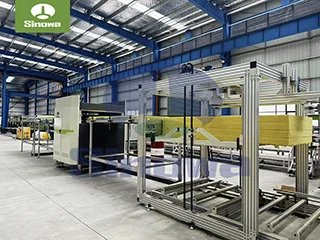
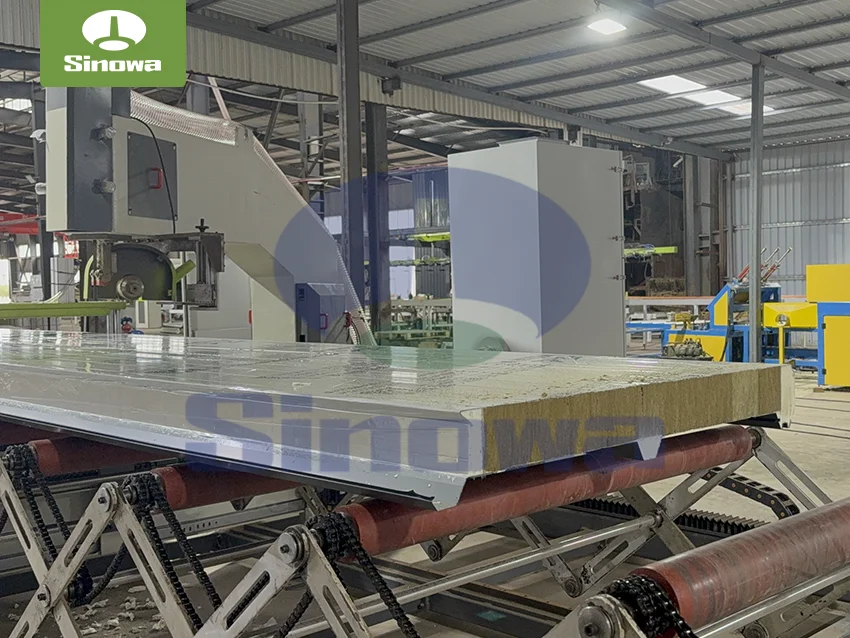
 sandwich panel line
The operational logic of the automatic rock wool sandwich panel line follows a continuous and streamlined production mode, with all processing links closely connected to form an uninterrupted production chain. The entire production process starts with the feeding and pretreatment of raw materials, which mainly includes metal coil materials for panel surface layers and rock wool core materials for thermal insulation and fire resistance. In the initial stage, the metal coil is steadily unwound by professional unwinding equipment, eliminating manual stretching and positioning errors. The unwound metal sheet undergoes a series of precision treatments including surface cleaning, protective film lamination, leveling, and trimming. The film lamination process effectively avoids surface scratches, oxidation, and other defects during subsequent high-pressure pressing and transmission, ensuring the flatness and aesthetic integrity of the final panel surface. The leveling and trimming procedures correct the irregular edges and surface tension differences of the metal sheet, laying a foundation for precise composite assembly in later stages.
Parallel to the surface layer processing, the rock wool core material undergoes independent specialized pretreatment to adapt to composite molding requirements. Raw rock wool materials are processed through proportional mixing, high-temperature fiber forming, and uniform carding procedures, which disperse clustered rock wool fibers and form a fluffy, evenly distributed fiber structure. This treatment eliminates local density differences inside the rock wool layer, ensuring consistent thermal insulation and fireproof performance across the entire panel. Meanwhile, the production system is equipped with targeted dust collection and fiber recovery devices near the core material processing area, which collect floating fine fibers generated during rock wool handling and carding. This design not only maintains the cleanliness of the internal production environment and prevents fiber accumulation from affecting the normal operation of mechanical components but also realizes the recycling of excess raw materials, reducing material waste and improving the overall environmental friendliness of production.
Gluing and pre-composite treatment is a critical intermediate link that determines the bonding performance and structural stability of sandwich panels. The automatic sandwich panel production line adopts a full-automatic uniform gluing system, which quantitatively coats high-performance environmentally friendly polymer adhesives on the inner surfaces of upper and lower metal sheets and the contact surface of rock wool core materials. Different from manual gluing and semi-automatic gluing modes, the automated gluing equipment can precisely control the glue application thickness, coverage range, and gluing speed according to the set parameters, completely avoiding uneven glue distribution, excessive glue accumulation, or local missing glue problems. The selected adhesive features fast curing speed, strong adhesion, and excellent aging resistance, which can form a tight molecular bond with both metal materials and rock wool fibers. After gluing, the system completes preliminary fitting and positioning of the upper metal sheet, rock wool core layer, and lower metal sheet through automatic conveying and alignment devices, ensuring the overall offset error of the multi-layer structure is controlled within a tiny range, which is a key prerequisite for high-quality composite molding.
Composite pressing and heating curing constitute the core molding stage of the entire production process. The pre-assembled semi-finished panels are stably transported to the continuous double-belt pressing equipment, where uniform and continuous high-pressure treatment is applied. The pressing process can fully discharge the air gap between the metal surface layer and the rock wool core layer, enabling the adhesive to fully infiltrate the fiber gaps of the rock wool and fit closely with the metal plate surface. Equipped with a circulating heating system inside the pressing equipment, it provides a stable and controllable constant temperature environment for the curing reaction of the adhesive. Moderate and continuous heating accelerates the chemical cross-linking reaction of the polymer adhesive, rapidly improving the bonding strength between layers and forming an integrated composite structure with strong integrity. The whole pressing and curing process maintains dynamic balance of pressure and temperature, avoiding panel deformation, core material collapse, or degumming problems caused by uneven pressure or excessive temperature fluctuation. The duration of hot pressing and curing can be adaptively adjusted according to the thickness of the rock wool core material and the specifications of the finished panel, ensuring that panels of different specifications can achieve optimal molding effects.
After completing hot pressing and curing, the integrated panel structure enters the cooling and shaping stage. The high-temperature panels discharged from the pressing equipment are gradually cooled through a circulating air cooling system, which slowly releases the internal stress generated during high-pressure and high-temperature processing. This gradual cooling mode effectively prevents the finished panels from warping, bending, or cracking due to rapid temperature change, further improving the flatness and dimensional stability of the products. After full cooling and shaping, the panels are transported to the automatic cutting unit through a precise roller conveying system. The intelligent cutting system supports free setting of cutting length according to production requirements, and the high-speed precision cutting tool completes fixed-length cutting and edge trimming of continuous long panels. The cutting process features smooth incision without burrs or deformation, ensuring the dimensional accuracy and edge regularity of each finished panel. Meanwhile, the equipment can automatically clean excess adhesive and residual fibers on the panel edges after cutting, improving the overall finish of the products.
The final stage of production covers automatic conveying, stacking, and finished product arrangement. The cut qualified panels are automatically sorted and conveyed by the transmission system, and the intelligent stacking device neatly stacks the panels according to fixed specifications and quantities. The automated stacking operation replaces manual carrying and stacking, not only greatly improving production efficiency but also avoiding panel surface damage and stacking irregularities caused by manual operation. After stacking, the finished panels can enter the subsequent packaging and warehousing links through the sandwich panel assembly line, realizing a fully closed-loop production process from raw material input to finished product output. The entire production process operates continuously and cyclically, with all mechanical actions and parameter adjustments controlled by the central intelligent control system, realizing real-time monitoring and automatic adjustment of production status.
Compared with traditional semi-automatic and manual production modes, the automatic rock wool sandwich panel production line has prominent comprehensive advantages in production efficiency, product quality stability, and operational cost control. In terms of production efficiency, the continuous streamlined operation eliminates intermediate waiting and manual transfer links, realizing uninterrupted mass production. The coordinated operation of all functional units greatly improves the single-unit output of panels, meeting the large-scale market demand for building insulation materials. In terms of product quality, the full-process automated control avoids human operation errors, realizing unified standards for panel thickness, density, bonding strength, and overall flatness. The rock wool core material inside the finished panel is evenly distributed, with stable thermal insulation, sound insulation, and fireproof performance, and the overall structural integrity is strong, not easy to delaminate or deform during long-term use.
In terms of production safety and environmental protection, the optimized structural design of the automatic rock wool sandwich panel machine effectively improves the production operating environment. The closed processing design and matching dust recovery devices effectively control the diffusion of rock wool fibers and production dust, reducing environmental pollution and improving the operating safety of production personnel. At the same time, the precise quantitative gluing system reduces adhesive consumption, avoids raw material waste caused by excessive gluing, and the recycled use of residual rock wool materials further improves the utilization rate of raw materials, realizing energy-saving and environmentally friendly production. In addition, the intelligent control system has built-in abnormal operation monitoring and automatic protection functions. When equipment operation deviation, parameter abnormality, or material blockage occurs, the system will automatically trigger early warning and protective shutdown, effectively avoiding equipment failure and production safety accidents, and reducing production loss and maintenance costs.
The finished rock wool sandwich panels produced by the automatic line have excellent comprehensive performance, with outstanding thermal insulation, fire resistance, sound absorption, and structural durability. The unique fiber porous structure of rock wool core material endows the panels with excellent thermal insulation performance, which can effectively block indoor and outdoor heat transfer, reduce building energy consumption, and meet the energy-saving design requirements of modern buildings. Meanwhile, rock wool materials have good fire resistance and high-temperature resistance, which can effectively prevent the spread of flames and improve the overall fire safety of buildings. In terms of sound insulation and noise reduction, the porous fiber structure can absorb and isolate sound waves, reducing the impact of external noise on the indoor environment. In addition, the integrated composite structure formed by automated pressing has strong compression resistance and bending resistance, with stable performance in different temperature and humidity environments, not easy to age, deform or degum, and has a long service life.
Benefiting from superior product performance and standardized production quality, rock wool sandwich panels produced by automatic production lines are widely used in multiple fields of modern construction engineering. They are commonly applied to the exterior and interior wall insulation, roof insulation, and partition structures of industrial plants, commercial buildings, and public facilities. In special building scenarios with high requirements for fire prevention and environmental sanitation, such as clean rooms, cold storage buildings, and municipal public buildings, these panels also show strong application adaptability. With the continuous upgrading of building energy-saving standards and the increasing demand for high-performance fireproof insulation materials in the construction industry, the market demand for standardized and high-quality rock wool sandwich panels is continuously growing, which further drives the technical upgrading and popularization of automatic rockwool sandwich panel production line.
In the context of the continuous development of intelligent manufacturing in the building materials industry, the automatic rock wool board production line is also evolving towards higher intelligence, higher precision, and stronger flexibility. Modern production lines are gradually equipped with more refined parameter adjustment systems and remote monitoring functions, which can realize real-time collection and analysis of production data, accurately optimize production parameters according to different raw material characteristics and product specifications, and further improve product qualification rate and production efficiency. At the same time, the modular design of the production line enables flexible adjustment of production processes, which can meet the production needs of panels with different thicknesses, sizes, and structural types, greatly improving the versatility and flexibility of the equipment. The continuous technological iteration makes the automatic rock wool sandwich panel line more adaptable to the diversified and high-quality development needs of the modern building materials market.
In conclusion, the automatic rock wool sandwich panel manufacturing line is a highly efficient, stable, and environmentally friendly intelligent production system, which integrates advanced mechanical manufacturing technology, intelligent control technology, and new material processing technology. It completely changes the shortcomings of low efficiency, inconsistent quality, and high resource consumption in traditional panel production, provides reliable technical and equipment support for large-scale, standardized, and high-quality production of rock wool sandwich panels. With the continuous progress of construction industrialization and the increasing emphasis on building energy conservation and safety worldwide, this automated production line will continue to play an important role in the building materials manufacturing industry, promoting the upgrading of the overall production level of thermal insulation and fireproof sandwich panels, and injecting continuous power into the high-quality development of the modern construction industry.
https://www.cnsinowa.com/sandwich-panel-machines/automatic-rock-wool-sandwich-panel-line.html