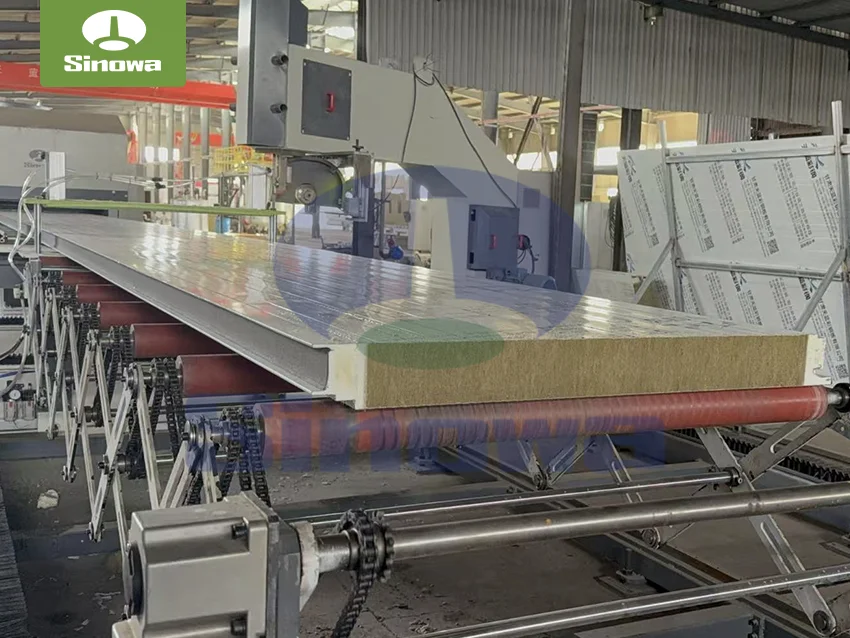
 sandwich panel machine
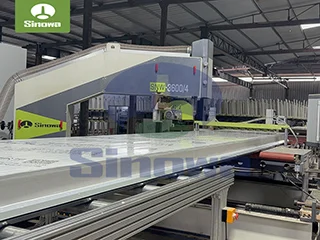
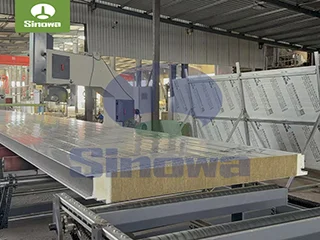
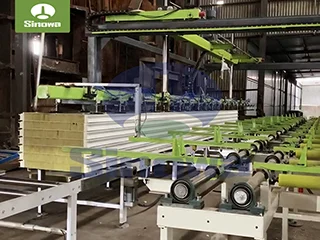
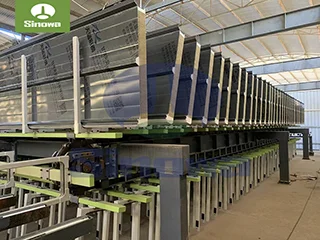
The overall structural layout of steel structure rock wool sandwich panel machine follows a linear continuous production mode, with all functional modules closely connected in sequence without redundant intermediate turnover links, which effectively avoids panel surface scratches, core material displacement and bonding layer damage caused by multiple manual transfers in segmented production lines. The complete equipment set can be divided into six core functional units according to production procedures: metal coil uncoiling and leveling unit, steel plate roll forming unit, rock wool core material sorting and paving unit, automatic adhesive spraying and composite pressing unit, constant temperature heating curing and cooling shaping unit, as well as fixed-length cutting and automatic stacking unit. All units are coordinated and controlled by a unified centralized intelligent control system, which realizes synchronous operation of feeding, forming, bonding, pressing, cooling and cutting processes, and ensures matching operating speed among all links to eliminate production stagnation and material waste. Unlike flexible organic core materials such as polyurethane foam that can be foamed and formed on site, rock wool is a rigid inorganic fiber material with fixed thickness and density after factory preliminary processing, so the mechanical structure of this production machine adds exclusive anti-deviation conveying devices and fiber dust removal structures in the core material processing section, which is the most prominent structural difference from other sandwich panel production equipment in the building materials machinery industry.
The entire production process launched by steel structure rock wool sandwich panel production line starts with the pretreatment of upper and lower metal steel surface plates. Raw metal steel coils are stably installed on hydraulic uncoiling frames at the front end of the production line, and the uncoiling system is equipped with closed-loop tension adjustment modules to release steel plates at a constant speed throughout the operation process. This design effectively prevents common problems such as steel plate wrinkling, edge warping and uneven stress caused by excessive or insufficient unwinding tension during high-speed continuous production. After uncoiling, the original steel plates enter the multi-group roller leveling device to eliminate internal stress generated during coil winding, restoring complete flatness to the steel plates and laying a foundation for subsequent accurate roll forming and tight composite bonding. Then the flat steel plates are sent to the roll forming unit composed of dozens of precision profiling rollers. By adjusting the gap and radian of different forming rollers, the equipment can process flat steel plates into various commonly used building plate profiles including hidden buckle type, V-shaped rib type and micro-corrugated type without replacing the whole roller set, meeting the diversified profile requirements of building exterior walls, roofs and internal partition walls in different engineering scenarios.
While the steel surface plates complete forming and forward conveying, the rock wool core material processing unit operates synchronously in parallel to realize automatic matching feeding of intermediate sandwich materials. Bulk rock wool raw materials are firstly sent to the longitudinal and transverse slitting mechanism inside the machine, which cuts integral rock wool blocks into strip materials with uniform width consistent with formed steel plates. More importantly, the sandwich panel equipment adjusts the fiber arrangement direction of rock wool through internal flipping and arranging structures, making rock wool fibers perpendicular to the stress direction of the finished sandwich board. This targeted structural adjustment greatly improves the overall compressive strength and shear resistance of the final composite panel, avoiding core material collapse and panel bending deformation when the sandwich board bears external pressure during building installation and use. In view of the characteristic that loose rock wool fibers are easy to float and scatter during mechanical conveying, the machine is equipped with integrated negative pressure dust collection devices around the core material conveying and paving area. The system collects floating fine fibers generated in real time during production, maintains a clean internal operating environment of the production line, prevents fiber impurities from adhering to the bonding interface between steel plates and rock wool, and ensures the stability of interlayer bonding effect. All treated rock wool strips are evenly and seamlessly paved between upper and lower formed steel plates through servo-controlled synchronous conveying belts, with no gaps or overlapping areas between adjacent rock wool strips, ensuring consistent overall thermal insulation and fireproof performance of the whole sandwich panel.
Adhesive coating and integrated composite pressing are the core processes determining the service life and overall structural stability of finished sandwich boards, and also the key technological optimization parts of steel structure rock wool sandwich panel line compared with traditional backward production equipment. The machine adopts a full-automatic precision glue spraying system instead of manual glue brushing or fixed simple roller coating modes used in early production lines. The intelligent metering pump in the glue spraying unit can automatically adjust glue output, spraying width and coating thickness in real time according to production line operating speed, rock wool core material density and steel plate specification changes, realizing uniform and seamless adhesive covering on the inner surfaces of upper and lower steel plates. The matched environmental-friendly polymer adhesive selected for the production line features fast curing speed, excellent aging resistance and no corrosion to metal steel plates and inorganic rock wool fibers. The equipment also optimizes the glue spraying depth aiming at the porous structure of rock wool fibers: it allows appropriate penetration of adhesive into the surface pores of rock wool to enhance interlayer adhesion, while avoiding excessive glue penetration leading to reduced internal air porosity of rock wool and decreased thermal insulation performance of the panel. After uniform glue spraying, upper steel plate, rock wool core material and lower steel plate are accurately aligned and sent to the pre-pressing area synchronously, where soft pressure rollers discharge residual air between three layers of materials gently to eliminate bubbles inside the composite structure and prevent interlayer hollowing after finished board molding.
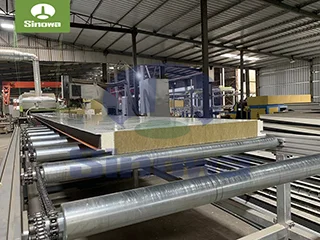
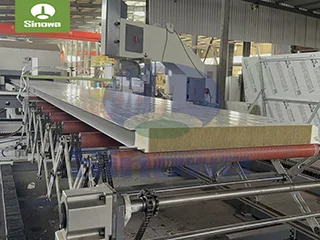
Subsequently, the preliminarily compounded semi-finished panels enter the constant temperature heating and high-pressure curing integrated pressing section, which is the core functional area to realize permanent bonding of sandwich structures. The pressing section adopts a long double-layer circulating conveyor belt pressing structure, and the upper and lower circulating belts are made of high-temperature resistant and non-stick special materials, which can stably maintain operating state under long-term dual effects of constant temperature heating and uniform mechanical pressure. The built-in digital temperature control module and hydraulic pressure regulation system independently adjust curing temperature and composite pressure according to rock wool core material thickness and production line speed. Compared with organic core materials, rock wool needs higher and more stable composite pressure to achieve tight fitting with steel plates without crushing internal fiber structures; therefore, the hydraulic system of this machine supports stepless pressure regulation in a wide range, maintaining consistent pressure across the whole pressing area to avoid local insufficient bonding or core material compression damage. The integrated heating system accelerates the chemical curing reaction of the adhesive, realizing rapid forming of the integral composite structure without prolonged natural air drying. After high-temperature curing, the continuous long-size sandwich panels enter the forced air cooling zone, where uniform and stable cold air flow reduces panel temperature to room temperature evenly. The cooling process eliminates internal thermal stress generated by high-temperature curing, effectively preventing finished boards from warping, bending and dimensional deviation after cutting and placement.
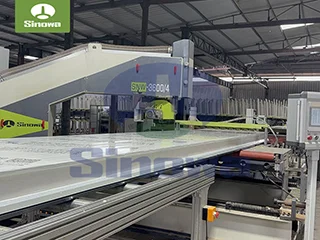
In the final post-processing stage, the continuous integrated sandwich panels are sent to the servo fixed-length cutting unit for accurate sizing treatment. The cutting system is linked with the overall operating speed of the production line to realize non-stop dynamic cutting, which will not interrupt continuous production of the front-end process and greatly improve overall production efficiency compared with intermittent cutting equipment that needs to stop the line. Operators can freely set cutting length parameters through the human-computer interaction interface according to actual engineering order demands, and the servo cutting tool ensures smooth cutting sections without burrs, cracks or edge layering. After cutting, finished rock wool sandwich boards are automatically conveyed to the tail stacking unit, which realizes orderly layered stacking of finished products and automatically places protective isolation gaskets between adjacent boards to prevent surface coating abrasion during storage and transportation. Some advanced configured production lines are also equipped with automatic edge trimming structures to polish panel edges, further optimizing the overall appearance and on-site installation matching degree of finished boards. The whole production process only requires a small number of on-site operators to monitor the operating state of the central control system and supplement raw materials regularly, realizing unmanned operation of the core production process and greatly cutting labor input and manual operation errors.
The intelligent control system equipped with steel structure rock wool sandwich panel machinery acts as the central brain coordinating all production modules, bringing remarkable improvements in production stability and operation convenience. The whole system adopts programmable logic controller core control components, with a visualized touch screen human-computer interface that supports one-key startup of the whole line, parameter memory and one-click parameter calling for common board specifications. All core production data including line speed, glue spraying volume, pressing pressure, curing temperature and cutting size are displayed in real time on the control screen, with automatic data recording and curve generation functions to facilitate later production quality tracing and process optimization. Besides real-time parameter monitoring, the system integrates complete fault self-inspection and early warning functions. Once abnormal conditions such as steel plate feeding deviation, insufficient glue supply, core material position offset and overheating of curing area occur during operation, the equipment will send audible and visual alarms immediately and lock corresponding operating modules to avoid equipment collision and finished product mass scrappage. More importantly, the control system realizes linkage matching of all process parameters: when operators adjust the overall production speed, the system will automatically synchronously modify glue spraying flow, heating power and cutting synchronization frequency without manual repeated debugging of each single unit, lowering the operation threshold and reducing human operation errors effectively.
From the perspective of practical production value and market application, steel structure rock wool board production line solve multiple industry pain points in traditional sandwich panel production. In terms of product performance, panels produced by this integrated continuous production line have overall uniform stress, stable interlayer bonding strength, and no delamination after long-term use in high-temperature, low-temperature and humid environments. The inorganic rock wool core material retains complete fiber structure, so finished panels maintain excellent non-combustible fireproof performance, low thermal conductivity thermal insulation effect and high-efficiency sound absorption function, fully meeting strict building safety and energy-saving design standards. In terms of production economy, the high integration and high automation design reduce material loss rate in the whole production process to a very low level; recycled collected rock wool fibers and leftover steel plate materials can be reused after centralized recovery, conforming to lean production requirements. The continuous operating mode supports long-time non-stop production, effectively meeting large-scale centralized material supply demands for large prefabricated building projects. In terms of construction application scenarios, matched finished rock wool sandwich panels are widely applicable to outer wall thermal insulation and fire isolation belts of high-rise buildings, roof enclosure and internal partition walls of industrial workshops, constant temperature insulation structures of cold storage and logistics warehouses, as well as rapid enclosure construction of temporary prefabricated buildings, covering mainstream demands of civil construction, industrial engineering and cold chain infrastructure industries.
In addition to production efficiency and product quality advantages, steel structure rockwool sandwich panel making machine have outstanding environmental protection performance, fitting the global development trend of green manufacturing and low-carbon buildings. Firstly, the whole production line adopts closed dust removal and adhesive recovery structures, with no floating fiber pollution and no waste gas discharge during normal operation, and the used adhesives contain low volatile organic compounds, which will not cause harm to on-site operators and the surrounding production environment. Secondly, raw materials matched with the equipment are environmentally friendly: rock wool core materials are processed from natural basalt and industrial mineral slag, realizing secondary utilization of industrial solid waste, while surface steel plates can be completely recycled after the service life of sandwich panels. The production process does not generate solid waste that is difficult to degrade, and all residual materials can be classified and recycled. Moreover, the optimized heating circulation system and high-efficiency servo motors adopted by the equipment reduce overall energy consumption per unit of finished board compared with old-generation production lines, lowering carbon emission in the panel manufacturing process and forming a complete low-carbon closed loop from equipment production, panel manufacturing, building application to material recycling.
Looking forward to the future development direction of steel structure rock wool insulation board production line, technological upgrading will focus on deeper intelligent linkage, wider material adaptability and higher energy-saving efficiency. With the popularization of industrial Internet of Things technology, the next generation of such production machines will support remote cloud monitoring and remote parameter debugging, allowing manufacturers to view real-time production data, analyze equipment operating status and handle simple fault debugging without arriving at the production site. Artificial intelligence algorithms will be embedded into the control system to realize autonomous optimization of production parameters: the equipment can automatically identify subtle differences in raw material density and thickness, and actively adjust pressing pressure and glue spraying volume without manual intervention to further stabilize product quality. Meanwhile, the equipment will develop towards modular rapid disassembly and assembly, making the production line adaptable to more diversified composite core materials while retaining the original rock wool production advantages, realizing flexible switching between rock wool composite structure and other inorganic insulation core structures on one production line. In terms of energy conservation, waste heat recovery modules will be added to the curing heating section to reuse residual heat generated by high-temperature curing for preheating raw materials, further reducing overall production energy consumption.
In conclusion, steel structure sandwich rock wool board machines are highly specialized automated building material manufacturing equipment tailored for fireproof and thermal insulation sandwich panel demands of modern steel structure buildings. Through optimized mechanical structure design, precise hydraulic composite technology and intelligent full-process control system, this equipment achieves efficient, stable and environmentally friendly batch production of rock wool sandwich panels. Driven by the global acceleration of prefabricated construction, increasingly stringent building fire safety codes and continuous promotion of green low-carbon buildings, the market demand for high-performance rock wool sandwich panels will keep rising steadily, which in turn promotes continuous technological iteration and functional upgrading of supporting production machinery. As a key link connecting building material manufacturing and prefabricated construction engineering, steel structure rockwool sandwich panel production machine will continue to play an irreplaceable role in promoting standardized construction process, improving building safety performance and advancing the sustainable development of the whole construction industry in the future.
https://www.cnsinowa.com/sandwich-panel-machines/steel-structure-sandwich-rock-wool-board-machine.html