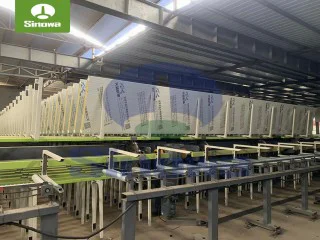
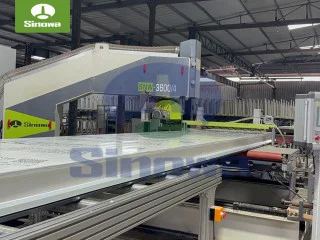
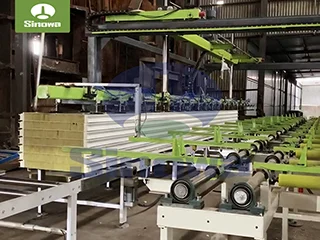
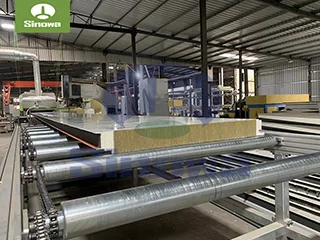
sandwich panel line
The stable operation of the rockwool sandwich panel production line starts with scientific raw material pretreatment and batching processing. The main raw materials adopted by the production line are natural silicate minerals such as basalt, dolomite and slag, which have stable physical properties and excellent high-temperature resistance. Before entering the melting link, all raw materials need to go through strict pretreatment procedures. Large-particle raw ores are crushed into uniform small particles through professional crushing equipment, and then vibrating screening equipment is used to screen out unqualified particles and impurity substances mixed in the raw materials. Meanwhile, magnetic separation devices are configured in the pretreatment link to thoroughly remove metal impurities, which effectively avoids equipment abrasion and product performance defects caused by foreign matter. After pretreatment, various raw materials are proportioned according to fixed process parameters, and the fully automatic batching system realizes accurate metering and uniform mixing of materials. This automated batching mode replaces traditional manual operation, ensuring the consistency of raw material components in each production batch and laying a solid foundation for the stability of subsequent product quality. In addition, for raw materials with excessive moisture content, the rock wool sandwich panel production line is equipped with supporting drying equipment to control the moisture index within the process-specified range, preventing steam volatilization from affecting the high-temperature melting effect and fiber forming quality.
High-temperature melting is the key link to realize the physical transformation of raw materials and determine the basic performance of rock wool fibers. The proportioned mixed raw materials are continuously and quantitatively sent to the closed high-temperature melting furnace through an automatic feeding system. The melting furnace adopts an efficient heating mode, which can form a stable high-temperature environment inside the equipment to fully heat and melt the solid mineral raw materials. In the high-temperature furnace, the crystal structure of natural minerals is completely destroyed, and the solid raw materials are gradually converted into uniform and viscous molten liquid. The rock wool sandwich panel line is equipped with real-time temperature monitoring and melt state sensing devices, which can dynamically adjust the heating power and feeding speed according to the melting state of materials. This real-time regulation mechanism ensures that the melt always maintains the best viscosity and fluidity, avoids insufficient melting leading to residual solid particles or excessive high-temperature burning leading to material performance degradation. Moreover, the closed furnace body design effectively reduces heat loss, and the supporting waste heat recovery system can recycle and reuse the waste heat generated in the melting process, improving the overall energy utilization efficiency of the production line and reducing unnecessary energy consumption in the production process.
Centrifugal fibrillation is the core process of converting molten mineral liquid into fibrous raw materials, which directly determines the fineness, uniformity and toughness of rock wool fibers. The high-temperature molten liquid flowing out of the melting furnace is stably delivered to the high-speed centrifugal fibrillation equipment. Under the action of high-speed rotating centrifugal rollers, the viscous molten liquid is continuously thrown out and stretched by strong centrifugal force, gradually splitting into countless slender and uniform inorganic fibers. In the process of fiber forming, the rock wool sandwich panel machine adopts precise atomization spraying technology, and evenly sprays a small amount of thermosetting adhesive and water-repellent auxiliary agent on the surface of newly formed fibers. These auxiliary agents will not change the basic inorganic characteristics of rock wool fibers, but can effectively enhance the bonding force between fibers, improve the overall structural stability of the material, and endow the finished product with excellent water resistance. After fibrillation treatment, the scattered fibers are collected by the cotton collection system to form fluffy and uniform inorganic cotton raw materials. The whole fibrillation process is carried out in a closed environment, which not only ensures the uniformity of fiber forming, but also avoids fiber floating and environmental pollution, realizing clean production operation.
Cotton laying and pre-pressing molding are important links to shape the loose fiber cotton into primary board blank structure. The inorganic cotton collected by the cotton collection system is sent to the pendulum cotton laying equipment, which adopts the reciprocating pendulum laying method to spread the fluffy fibers evenly in the conveying direction. Different from the single-layer flat laying mode, the pendulum laying process can form a three-dimensional staggered fiber structure, which significantly improves the overall structural density uniformity and mechanical strength of the rock wool board. By adjusting the pendulum frequency, laying speed and material thickness parameters, the rockwool board production line can flexibly control the density and thickness of the primary cotton layer to meet the production requirements of different specification products. After the completion of cotton laying, the loose cotton layer enters the pre-pressing equipment for preliminary compression shaping. The pre-pressing process slowly extrudes the fluffy fiber layer through graded pressure, discharges the excess air inside the fiber gap, makes the fibers closely arranged, and forms a flat and compact primary board blank. This step eliminates the loose and uneven state of the initial fiber layer, prevents the deformation and warping of the finished product in the subsequent curing process, and ensures the dimensional stability of the semi-finished board blank.
Thermal curing is a key process to fix the board structure and stabilize product performance, which realizes the permanent bonding and shaping of fibers through high-temperature heating. The pre-pressed primary board blank is continuously sent to the constant-temperature curing furnace through the conveying system. Inside the curing furnace, the stable high-temperature environment activates the thermosetting adhesive attached to the fiber surface, so that the adjacent fibers are firmly bonded together to form an integrated stable structure. The internal temperature and air circulation system of the curing furnace are precisely calibrated to ensure uniform heating of all parts of the board blank, avoiding local incomplete curing or excessive curing aging. The curing time and temperature can be intelligently adjusted according to the product density and thickness specifications, so as to ensure that the adhesive fully exerts its bonding effect while maintaining the original toughness and elasticity of the rock wool fibers. After high-temperature curing, the loose fiber assembly is completely solidified into a rigid board structure with stable shape, uniform density and excellent overall performance, and the semi-finished rock wool board with preliminary molding is obtained.
Cooling and fixed-size cutting are the finishing processes to realize product standardization and specification differentiation. The high-temperature semi-finished board coming out of the curing furnace has a certain residual temperature, and it needs to go through the automatic cooling conveying system for gradual cooling treatment. The layered cooling mode is adopted to avoid rapid temperature change causing internal stress of the board, effectively preventing product cracking and deformation, and ensuring the flatness and structural stability of the board surface. After cooling to room temperature, the rock wool board enters the precise cutting unit. The rockwool insulation board production line is equipped with multi-dimensional automatic cutting equipment, which can complete longitudinal slitting and transverse cutting according to preset specification parameters. The high-precision cutting tool ensures smooth and neat cutting sections without burrs or fiber falling off. The intelligent cutting system can flexibly switch product specifications, realize continuous cutting of boards of different lengths and widths, and meet the diversified market demand for product sizes. In the cutting process, the automatic waste recovery device synchronously collects the leftover materials generated by cutting, and the recycled waste materials can be reprocessed and put into production after crushing and screening, which realizes the recycling of resources and reduces production waste.
The final stage of the rockwool insulation panel production line operation involves finished product sorting, finishing and stacking. The cut rock wool boards are transmitted to the sorting platform through the conveying equipment, and the intelligent detection system conducts online inspection on the flatness, dimensional accuracy, surface integrity and structural uniformity of the finished products. Unqualified products with dimensional deviation or surface defects are automatically screened out for rework treatment, while qualified products enter the finishing process. The finishing link carries out fine trimming and surface cleaning on the boards to remove residual floating fibers on the surface and ensure the neat appearance of the products. Finally, the qualified finished rock wool boards are automatically stacked by the stacking equipment in an orderly manner according to fixed stacking specifications, which is convenient for subsequent storage and transportation.
The overall structural design of the rock wool panel production line has obvious advantages of integration and intelligence. All functional modules from raw material feeding to finished product stacking are connected in a seamless and continuous manner, realizing assembly line uninterrupted production. The whole production process basically realizes automatic operation, and the central control system uniformly regulates the operating parameters of each equipment module. Workers only need to complete parameter setting, equipment monitoring and routine maintenance work, which greatly reduces manual intervention, improves production efficiency and reduces the error rate caused by manual operation. In terms of structural performance, the production line adopts modular design, and each functional unit can operate independently or cooperate synchronously, which is convenient for daily equipment maintenance, fault detection and later process upgrading. At the same time, the production line is equipped with perfect safety protection and environmental protection treatment devices. The closed production structure effectively controls fiber dust overflow, and the supporting dust removal system purifies the production flue gas and dust, meeting the requirements of clean production and environmental protection operation.
The technological characteristics of the rockwool sandwich panel production line determine the excellent comprehensive performance of the finished rock wool boards. The high-temperature melting and uniform fibrillation process endow the product with excellent fire resistance and high-temperature stability, enabling it to maintain stable structural performance in high-temperature environments without combustion or deformation. The three-dimensional staggered fiber structure formed by pendulum cotton laying makes the product have good thermal insulation and sound absorption performance, which can effectively block heat transfer and reduce noise transmission. The high-efficiency curing and bonding process improves the mechanical strength and structural durability of the product, making the rock wool board not easy to deform or damage during use, and it can adapt to complex and changeable application environments. In addition, the whole production process does not produce harmful substances, and the finished product has the characteristics of environmental protection, no pollution and long service life, which is in line with the development trend of green building materials and industrial energy conservation.
With the continuous upgrading of industrial manufacturing technology and the increasing demand for energy-saving and environmental protection materials in the construction and industrial fields, the rock wool board production line is also constantly optimizing and innovating in process technology and equipment performance. Modern production lines are developing towards higher automation, more precise parameter control, lower energy consumption and more environmentally friendly production modes. Through continuous optimization of raw material proportioning, melting temperature control, fiber forming process and curing parameters, the performance of rock wool products is further improved, and the production cost is effectively reduced. As a key equipment for the production of high-performance inorganic thermal insulation and fireproof materials, the rockwool sandwich panel making machine plays an irreplaceable role in promoting the development of green building industry, industrial energy conservation and emission reduction, and will continue to provide reliable technical support and product guarantee for the downstream market in the future development.
https://www.cnsinowa.com/sandwich-panel-machines/rock-wool-production-line.html