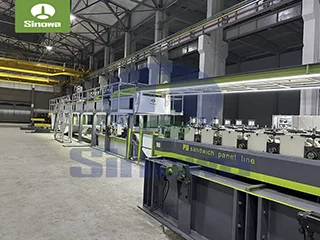
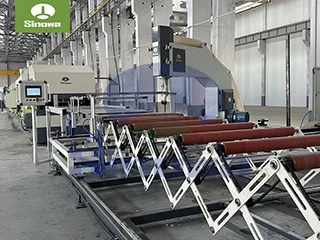
sandwich panel line
To understand the practical value and operational characteristics of a continuous PU sandwich panel line in depth, it is first necessary to clarify the basic structural composition and matching raw material application logic of PU sandwich panels, as the entire production line’s process flow and equipment configuration are all designed around the structural characteristics and performance requirements of the final finished panels. A standard PU sandwich panel is a three-layer composite structure composed of two outer surface protective layers and a middle polyurethane foam core layer, where the outer surface layers are mostly made of metal coil materials with good toughness, corrosion resistance and surface flatness, and can also be adjusted to other suitable sheet materials according to different usage scenarios and environmental requirements. The middle core layer is formed by the foaming and curing reaction of liquid polyurethane raw materials, which possesses outstanding thermal insulation, sound absorption, shock buffering and structural bonding functions, firmly connecting the upper and lower outer surface layers into an integrated whole and endowing the entire panel with light weight and high strength comprehensive characteristics. The core design goal of the PU sandwich panel line is to ensure that the bonding strength between the outer surface layers and the inner core layer meets long-term use requirements, the foaming density and internal pore structure of the polyurethane core layer are uniform and stable, the overall dimensional specification of each panel is accurate and consistent, and the surface of the outer layer remains flat and smooth without obvious deformation, scratches or structural defects during the entire continuous production process. All equipment units on the production line operate in a coordinated and sequential manner, with each process link setting reasonable parameter adjustment ranges and operation coordination mechanisms to avoid product quality fluctuations caused by uncoordinated process rhythm, unstable raw material mixing or unreasonable temperature and pressure control, and to ensure that the produced panels can adapt to complex outdoor and indoor use environments and meet the long-term service needs of different engineering projects.

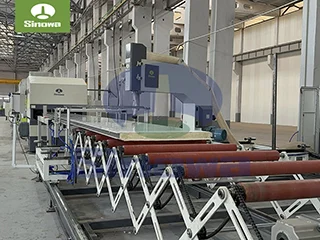
The initial operation stage of the entire fully automatic PU sandwich panel line starts with the raw material unwinding and feeding link, which is the primary foundation to ensure the continuity and stability of subsequent production processes. This part of the production line is mainly composed of multi-group unwinding and material conveying auxiliary structures, which are responsible for stably placing the coiled outer surface raw materials and realizing continuous and orderly material output without intermittent material breakage or material deviation during operation. The coiled raw materials used for the outer surface layers are usually wound into compact coil structures in advance, and need to be steadily installed on the unwinding support equipment of the production line before production starts. With the start of the overall production line operation, the unwinding equipment slowly and evenly releases the coiled materials according to the preset production speed, and the released sheet materials are initially conveyed to the subsequent processing link through the material guiding and conveying rollers installed on the production line. In this process, the production line is equipped with basic material correction and deviation adjustment structures, which can timely fine-tune the conveying position of the sheet materials to prevent the outer surface materials from shifting left and right during the conveying process, avoid subsequent roll forming deviation and inconsistent composite specifications, and ensure that the upper and lower outer surface materials can be accurately aligned in the follow-up composite pressing stage. The continuity of material supply in this link is extremely critical for the overall production work of the PU sandwich panel line; any short-term material supply interruption or unstable conveying speed will directly affect the foaming reaction cycle of the polyurethane core layer and the composite bonding effect of the panels, leading to inconsistent product quality of the front and rear sections of the same batch of production, and even causing unqualified products that need to be reprocessed or scrapped. Therefore, the unwinding and feeding part of the production line is designed with stable speed regulation and buffer material storage structures, which can adapt to the speed matching requirements of subsequent different processing links and ensure that the material feeding rhythm always maintains synchronous coordination with the overall production beat of the entire line.

After completing the unwinding and preliminary feeding conveying of the outer surface materials, the sheet materials will enter the roll forming and edge processing link of the PU sandwich panel production line, which is a key process link to shape the outer surface materials into the required panel profile specifications and standardize the edge structure of the panels. The roll forming part is composed of multiple groups of precision arranged rolling roller sets, and each group of rollers is processed and treated with high-strength materials to ensure long-term stable operation without deformation or wear, maintaining consistent rolling and forming effects for a long time. When the flat sheet materials pass through the sequential rolling roller sets, the rollers gradually apply uniform pressure to the sheet materials, slowly bending and shaping the flat raw materials into the required panel cross-sectional profiles, such as trapezoidal structures, corrugated structures or flat straight structures, and the specific forming shapes can be adjusted and replaced according to different production and application needs. Each rolling process is carried out step by step, avoiding excessive one-time bending pressure that causes surface damage, internal stress concentration or structural deformation of the sheet materials, effectively ensuring the flatness of the outer surface of the panels and the stability of the formed structural size. After the completion of roll forming, the sheet materials will go through the edge slitting and trimming process on the production line, where the professional cutting structures trim the two side edges of the formed sheet materials to ensure that the width specifications of all panels produced in the same batch are completely consistent, and the edges are neat and smooth without burrs, uneven cutting or edge warping phenomena. The neat edge processing not only improves the overall appearance quality of the finished PU sandwich panels, but also facilitates the seamless docking and installation of panels in subsequent engineering construction, avoiding installation gaps or structural instability caused by irregular panel edges. The entire roll forming and edge processing process operates in a fully automatic continuous state, with no need for manual repeated measurement and adjustment, and all forming and trimming parameters are uniformly controlled by the central control system of the production line, realizing standardized and unified processing of each sheet material.

Subsequent to roll forming and edge trimming, the outer surface materials of the upper and lower layers will enter the preheating treatment link set on the PU sandwich panel making line, a preparatory process that plays a vital role in enhancing the bonding firmness between the outer surface layers and the polyurethane foam core layer. The preheating system of the production line adopts a uniform and stable temperature heating mode, which can raise the surface temperature of the formed sheet materials to a reasonable and fixed temperature range without causing overheating damage or surface color change to the outer materials. The reason why preheating treatment is essential in the production process is that the liquid polyurethane raw materials need to undergo a rapid chemical foaming and curing reaction after being injected between the upper and lower surface layers, and the surface temperature of the outer sheet materials directly affects the reaction speed, foaming uniformity and initial bonding effect of the polyurethane materials. If the surface temperature of the sheet materials is too low, the polyurethane foaming reaction speed will slow down, the foaming expansion will be uneven, and the initial bonding force between the core layer and the outer surface layers will be insufficient, which may lead to delamination and separation between the core layer and the surface layers of the finished panels after long-term use. If the temperature is too high, the polyurethane reaction will be too fast, resulting in excessive local foaming, unbalanced internal pore structure of the core layer, and even affecting the overall structural flatness of the composite panels. The preheating structure of the production line can realize real-time monitoring and fine adjustment of temperature, keep the temperature of each part of the upper and lower sheet materials consistent, create a stable temperature environment for the subsequent polyurethane raw material mixing, injection and foaming reaction, and lay a good foundation for the firm composite bonding of the three-layer structure of the sandwich panels.

The polyurethane raw material mixing and high-pressure injection link is the core functional part of the entire PU sandwich panel manufacturing line, and it is also the key process that determines the thermal insulation performance, structural strength and overall quality stability of the sandwich panel core layer. This part of the production line is equipped with a professional raw material storage, conveying, metering and high-pressure mixing and injection integrated device, which is specially used for accurately proportioning different liquid polyurethane raw materials and rapidly mixing them evenly before injecting them between the preheated upper and lower outer surface layers. The production process requires multiple liquid chemical raw materials to be proportioned according to a fixed formula ratio, and the production line is equipped with a precision metering structure to accurately control the conveying amount of each raw material, avoiding quality problems such as unqualified foaming degree, insufficient curing strength or poor thermal insulation effect of the core layer caused by unreasonable raw material proportioning. After accurate metering, all raw materials are transported to the high-pressure mixing head of the production line, where the raw materials are fully and rapidly mixed under high-pressure action to ensure that all components are evenly blended without local uneven mixing or raw material precipitation. The uniformly mixed liquid polyurethane materials are continuously and stably injected between the upper and lower formed and preheated outer surface layers through the mixing head, and the injection position and injection flow rate are always kept matched with the running speed of the production line to ensure that the polyurethane raw materials can be evenly covered in the entire middle interlayer space without local accumulation or material shortage.

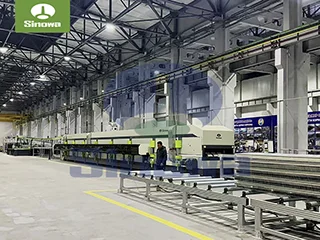
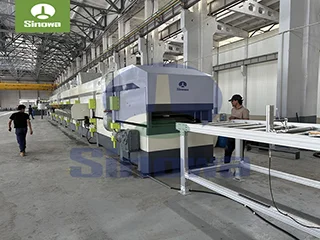
Immediately after the completion of polyurethane raw material injection, the upper and lower outer surface layers with the liquid raw materials in the middle will enter the double-belt laminating and continuous curing forming area of the polyurethane sandwich panel line, which is the key stage to complete the composite pressing and foaming curing of the three-layer structure of the sandwich panels. The double-belt laminating system of the production line consists of upper and lower circulating conveyor belts with stable pressure bearing capacity and smooth surface, which can apply uniform and constant pressure to the composite panels in the process of forward conveying, and maintain a stable closed curing space inside the equipment. After the liquid polyurethane raw materials enter this space, they begin to undergo chemical foaming and cross-linking curing reactions gradually, expanding uniformly to fill the entire gap between the upper and lower surface layers, and at the same time forming a firm bonding connection with the inner surfaces of the outer sheet materials. The internal environment of the laminating and curing area maintains a constant temperature and pressure state, and the production line can adjust the temperature, pressure and conveying speed of this area according to different panel thickness specifications and production requirements, ensuring that the polyurethane foaming reaction proceeds stably and sufficiently. During the conveying and curing process, the upper and lower conveyor belts always keep the panels in a flat and pressed state, effectively preventing panel surface bulging, local depression or overall structural deformation caused by uneven foaming expansion of the polyurethane materials. As the panels move forward with the conveyor belts, the polyurethane core layer gradually completes the foaming and curing reaction, forming a high-density, uniform-pore and high-bonding-strength integral core structure, and the three-layer structure of the outer surface layers and the inner core layer is firmly compounded into an inseparable integral panel structure. The length of the curing area and the conveying speed are scientifically matched to ensure that the polyurethane core layer reaches the basic structural strength required for subsequent processing when the panels exit the curing area, avoiding structural damage or core layer deformation in the subsequent cutting and conveying process.

After completing composite pressing and curing forming in the double-belt laminating area, the initially formed continuous long-size PU sandwich panels will be transported to the fixed-length cutting processing link of the production line, which is responsible for cutting the continuous integral panels into finished panels of standard customized lengths according to actual use and delivery requirements. The cutting part of the polyurethane sandwich panel production line adopts an automatic precision cutting structure, which can preset various required cutting length parameters through the central control system in advance, and the equipment can automatically sense the conveying position of the panels and complete accurate fixed-length cutting without manual measurement and positioning. In the cutting process, the cutting tool runs smoothly and stably, with neat cutting sections and no damage to the outer surface layers and the internal polyurethane core layer, avoiding problems such as core layer fragmentation, surface sheet warping or cutting edge unevenness that affect the appearance and use quality of the finished panels. The entire cutting process is synchronized with the running speed of the front-end production line, realizing non-stop continuous cutting operation, which will not cause the front-end production process to stop or slow down, effectively ensuring the overall production efficiency of the entire line. After cutting, the separated single finished panels are continuously transported to the subsequent cooling and shaping link through the discharge conveyor structure of the production line, and the cutting waste and edge materials generated in the cutting process are automatically collected and processed by the supporting waste recovery device of the production line, maintaining the cleanliness and tidiness of the entire production workshop environment and reducing the waste of raw materials.

The cooling shaping and automatic stacking link is the final finishing stage of the entire polyurethane sandwich panel manufacturing line production process, playing an important role in stabilizing the internal structure and surface state of the finished panels and facilitating subsequent storage, transportation and delivery. The panels just cut by the cutting equipment still retain a certain temperature after the previous curing reaction, and the internal structural strength of the polyurethane core layer needs a period of natural cooling and standing to be further stabilized and consolidated. The cooling conveying structure of the production line extends the conveying distance of the finished panels, allowing the panels to gradually dissipate heat naturally during the conveying process, so that the internal temperature of the core layer and the surface temperature of the outer layers drop to the normal ambient temperature, effectively preventing the panels from being stacked at high temperature causing internal heat accumulation, local deformation or bonding between adjacent panels. After the completion of cooling and shaping, the qualified finished panels will be automatically transported to the stacking area of the production line, and the automatic stacking equipment neatly stacks the panels one by one according to the set stacking quantity and stacking specifications. The stacking process runs stably and orderly, avoiding panel collision, surface scratch or stacking inclination, ensuring that the stacked finished panels are neat in overall arrangement and stable in structure, convenient for subsequent overall packaging, warehouse storage and transportation and delivery to the project site. The entire stacking process does not require a large amount of manual handling and arrangement, which reduces the labor input in the production link, improves the overall automation level of production, and also avoids product quality problems caused by manual handling errors.
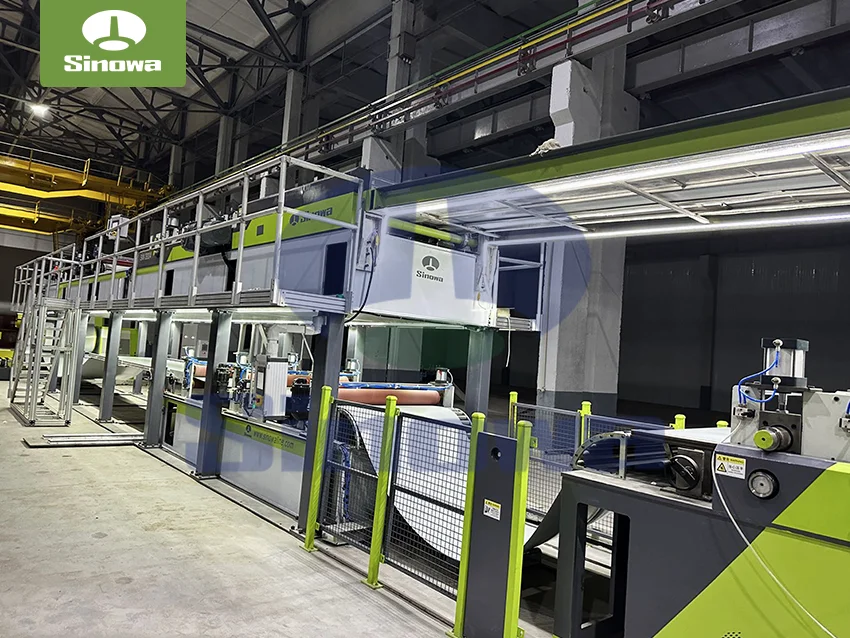
The central automatic control system runs through all operation links of the entire polyurethane sandwich panel making line and is the core command center to coordinate the synchronous operation of all equipment units and stabilize product production quality. The control system integrates the operation parameter monitoring, running speed coordination, temperature and pressure adjustment, fault early warning and automatic operation control functions of each production link, and can uniformly manage and adjust all mechanical actions and process parameters of the production line through a simple and intuitive operation interface. Production operators only need to set the required panel thickness, width, length, production speed and other basic parameters in advance according to production orders and product requirements, and the control system can automatically match the operating parameters of unwinding feeding, roll forming, preheating heating, raw material injection, laminating curing, fixed-length cutting and automatic stacking links to realize the fully automatic continuous operation of the entire production line. During the production process, the control system can monitor the real-time operating state and parameter changes of each equipment unit in real time, and automatically fine-tune the relevant process parameters once slight parameter fluctuations are found, ensuring that all production links are always in a stable and reasonable operating state. In case of abnormal equipment operation or parameter deviation beyond the normal range, the system will send out timely fault reminder information and automatically adjust the operating state of the equipment according to the preset protection procedures, effectively avoiding equipment failure expansion and large-scale production of unqualified products, improving the overall operational safety and production stability of the production line, and reducing the downtime maintenance time and production loss caused by equipment faults.

The practical application advantages of a well-operated PU sandwich panel continuous production line are reflected in many aspects of production operation and product follow-up application, and its continuous integrated production mode brings remarkable improvement effects on production efficiency, product quality consistency and production operation cost control compared with traditional intermittent panel production equipment. In terms of production efficiency, the continuous operation mode of the production line realizes uninterrupted production from raw material input to finished product output, with no need for frequent equipment start-stop, manual material handling and process switching, greatly improving the daily production capacity of sandwich panels and meeting the large-scale material supply needs of large-scale construction projects and industrial supporting facilities. In terms of product quality control, all production process parameters are uniformly controlled and automatically adjusted by the central system, and the processing standards of each production link are consistent and stable, avoiding product quality differences caused by manual operation differences and human errors, making the structural performance, dimensional specification and surface quality of each batch of finished panels maintain high consistency, and the panels have better stability and reliability in long-term engineering application. In terms of production cost control, the high degree of automation of the production line reduces the number of on-site production operators, reduces labor management and manual operation costs, and the precise raw material metering and conveying structure reduces the waste of polyurethane raw materials and surface sheet materials in the production process, effectively optimizing the overall production and operation cost of panel manufacturing enterprises.

With the continuous upgrading of construction industry standards and the continuous expansion of application scenarios for energy-saving and thermal insulation building materials, the market demand for PU sandwich panels with stable performance and diverse specifications is constantly upgrading, which also puts forward higher requirements for the structural design, process matching and operation stability of polyurethane sandwich panel continuous production line. Modern production line design and manufacturing concepts pay more attention to the flexibility and adaptability of equipment operation, enabling the same production line to adjust process parameters and simple equipment structures according to different production needs, and produce sandwich panels for wall use, roof use, industrial workshop enclosure use and cold storage thermal insulation use, realizing the multi-functional and multi-scenario production of one line. At the same time, the continuous optimization of the production line’s internal temperature control, pressure adjustment and raw material mixing technology further improves the utilization rate of polyurethane raw materials and the thermal insulation and structural performance of finished panels, making the produced PU sandwich panels more adaptable to harsh environmental conditions such as low temperature, high temperature and strong corrosion, and expanding the application scope of the products in construction, industrial manufacturing, cold chain logistics and other fields. The long-term stable operation of the PU sandwich panel line not only provides reliable equipment support for the standardized production of composite thermal insulation panels, but also promotes the steady development of the entire energy-saving building materials industry, and provides high-quality basic material guarantee for the construction of energy-saving, efficient and durable modern construction projects.
In the actual production and operation management process of the PU sandwich panel automatic production line, daily equipment maintenance and regular process parameter calibration work are also important prerequisites to ensure long-term efficient and stable operation of the production line and continuous production of high-quality finished panels. Daily maintenance work mainly includes regular cleaning of material conveying rollers, rolling forming rollers and cutting tool structures of the production line, timely inspection and lubrication of mechanical transmission parts, and real-time sorting and cleaning of raw material conveying pipelines to avoid pipeline blockage and equipment wear affecting production operation and product quality. Regular parameter calibration work needs to regularly detect and calibrate the temperature control accuracy, pressure control stability, raw material metering accuracy and cutting length precision of each link of the production line, ensure that all process parameters are always maintained within the standard required range, and avoid product quality deviation caused by parameter drift after long-term operation of the equipment. Scientific and standardized equipment maintenance and parameter management can effectively extend the service life of the polyurethane sandwich panel automatic production line, reduce the frequency of equipment failure and downtime maintenance, ensure the continuity and stability of production work, and enable the production line to maintain good production efficiency and product quality level in long-term continuous production operation.
https://www.cnsinowa.com/sandwich-panel-machines/pu-sandwich-panel-line.html