sandwich panel line
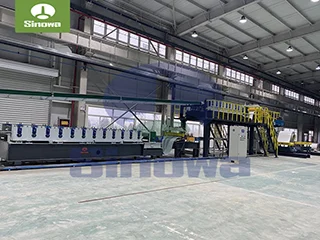
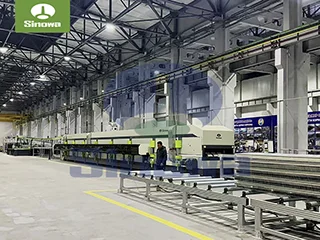
The core of large-scale PU sandwich panel line lies in realizing the continuous and automated production of PU sandwich panels through a series of closely linked processes and advanced technical configurations. PU sandwich panels are typical composite materials composed of two outer facing layers and a middle PU foam core layer. The outer layers are usually made of galvanized steel, galvalume, or aluminum sheets, which provide excellent structural strength and weather resistance, while the middle PU foam layer, with its low thermal conductivity and high density, endows the panels with superior thermal insulation and sound insulation performance. The large-scale production line integrates multiple functional modules such as raw material pretreatment, foam mixing and pouring, composite lamination, cooling and shaping, and precision cutting, forming a closed-loop production system that minimizes manual intervention and ensures the consistency and stability of product quality.
One of the most prominent technical characteristics of large-scale PU sandwich panel production line is their high degree of automation and integration. The entire production process, from the uncoiling of facing materials to the final cutting of finished products, is controlled by a centralized control system. The control system can realize real-time monitoring and precise adjustment of key parameters such as production speed, foam mixing ratio, lamination pressure, and curing temperature, ensuring that each production link is in the optimal state. For example, in the foam mixing stage, the high-pressure foaming machine can accurately control the proportion of isocyanate and polyol components according to the preset formula, and uniformly mix them through a high-speed mixing head to ensure the uniformity of the PU foam core's density and performance. In the lamination stage, the double-track laminating conveyor adopts a servo lifting mechanism to flexibly adjust the thickness of the panels, which can meet the production needs of panels with different thickness specifications ranging from 20mm to 150mm without frequent mechanical adjustments. This high degree of automation not only improves production efficiency but also reduces the impact of human factors on product quality, laying a solid foundation for mass production.
Modular design is another important technical feature of large-scale PU sandwich panel machine. The entire production line is composed of multiple independent functional modules, such as uncoiling modules, pretreatment modules, foaming modules, lamination modules, cooling modules, and cutting modules. These modules are connected by standardized interfaces, which facilitates quick assembly, disassembly, and replacement. This design not only shortens the installation and commissioning cycle of the production line but also enhances its adaptability. By replacing or adjusting relevant modules, the production line can not only produce PU sandwich panels but also flexibly switch to the production of other types of sandwich panels such as PIR or rock wool sandwich panels. At the same time, the modular design also simplifies the maintenance and repair of the production line. When a certain module fails, it can be independently disassembled and maintained without affecting the operation of other modules, reducing production downtime and improving the overall operational efficiency of the production line.
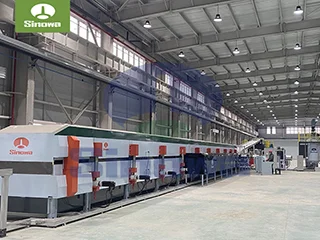
Energy conservation and environmental protection are also important considerations in the design of modern large-scale polyurethane sandwich panel production line. In the production process of PU sandwich panels, the foaming and curing stages require a certain amount of energy input. To reduce energy consumption, large-scale production lines usually adopt a full enclosed thermal insulation design. For example, the body of the laminating conveyor is covered with thermal insulation materials to reduce heat loss. At the same time, high-power and low-energy-consuming motors and electrical components are selected to minimize the overall energy consumption of the production line. Some advanced production lines also adopt a heat recovery system, which recycles the waste heat generated during the production process for preheating raw materials or heating the production workshop, further improving energy utilization efficiency. In terms of environmental protection, the production line adopts non-fluorinated foaming technology, which avoids the emission of harmful gases that damage the ozone layer. At the same time, the excess materials and edge trimmings generated during the production process can be recycled and reused, reducing environmental pollution and resource waste.
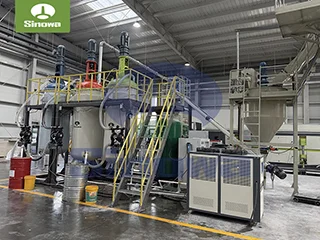
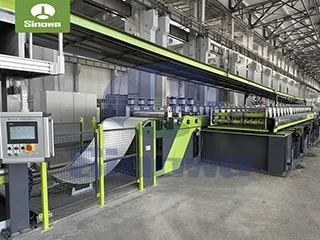
The production process of large-scale polyurethane sandwich panel line is a highly sophisticated and continuous operation process, which can be roughly divided into several key stages. The first stage is raw material preparation. The facing materials (such as galvanized steel coils) are uncoiled by the uncoiling machine, and then leveled and trimmed through the leveling device to ensure the flatness and dimensional accuracy of the facing materials. The PU raw materials (isocyanate, polyol, catalyst, etc.) are stored in special storage tanks, and their temperature and viscosity are pre-adjusted to meet the foaming requirements. The second stage is pretreatment of facing materials. The leveled facing materials are preheated by the preheating device to improve the bonding performance between the facing materials and the PU foam core. Some production lines also perform profiling treatment on the facing materials according to the product requirements, such as pressing corrugated or trapezoidal patterns to enhance the structural strength of the panels.
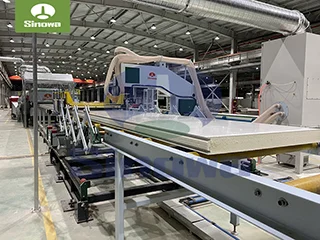
The third stage is foam mixing and pouring, which is the core link in the production of PU sandwich panels. The pre-adjusted PU raw materials are transported to the high-pressure foaming machine through pipelines. The foaming machine accurately meters and mixes the various components according to the preset ratio, and then uniformly sprays the mixed foam material onto the lower facing material through the distributing trolley. The fourth stage is composite lamination. The upper facing material and the lower facing material with the foam material are simultaneously transported to the double-track laminating conveyor. Under the action of a certain temperature, pressure, and time, the foam material undergoes a chemical reaction and foams, filling the entire space between the two facing materials, and firmly bonding with the facing materials to form an integrated sandwich panel. The laminating conveyor adopts a continuous operation mode, which ensures the continuity of the production process and improves production efficiency. The fifth stage is cooling and shaping. The composite sandwich panel coming out of the laminating conveyor has a high temperature and needs to enter the cooling zone for rapid cooling and shaping. The cooling zone usually adopts air cooling or water cooling methods to ensure that the panel's temperature drops to room temperature quickly, preventing deformation of the panel due to uneven cooling.
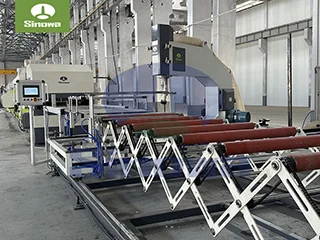
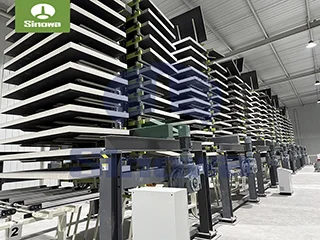
The sixth stage is precision cutting. The cooled and shaped sandwich panel is transported to the automatic tracking cutting machine, which cuts the panel into finished products of the required length according to the preset dimensions. The cutting machine adopts high-precision cutting tools and automatic tracking technology to ensure the flatness and dimensional accuracy of the cutting surface. The last stage is quality inspection and packaging. The cut finished products are inspected for appearance, dimensional accuracy, bonding strength, thermal conductivity, and other performance indicators. The qualified products are packaged with protective films and corner protectors to prevent scratches and collisions during transportation and storage. The entire production process is continuous and efficient, with a production speed that can reach 3-10m/min, which can meet the needs of mass production.
The large-scale polyurethane sandwich panel machine has important application value in promoting the development of the construction industry and related fields. Firstly, in terms of improving production efficiency and reducing production costs, the large-scale production line can realize continuous and automated production, which greatly improves the output of PU sandwich panels. Compared with traditional manual or semi-automatic production methods, the production efficiency is increased by several times or even dozens of times. At the same time, the reduction of manual intervention not only reduces labor costs but also reduces the waste of raw materials, further reducing the overall production cost. Secondly, in terms of ensuring product quality, the precise control system and standardized production process of the large-scale production line ensure the consistency and stability of product performance. The produced PU sandwich panels have uniform density, excellent bonding strength, and stable thermal insulation performance, which can better meet the quality requirements of various construction projects.
In terms of expanding the application fields of PU sandwich panels, the large-scale production line provides a reliable guarantee for the mass supply of high-quality PU sandwich panels. With the advantages of lightweight, high strength, and excellent thermal insulation performance, PU sandwich panels are widely used in industrial warehouses, cold storage facilities, commercial buildings, logistics centers, agricultural greenhouses, and other fields. In cold storage facilities, the excellent thermal insulation performance of PU sandwich panels can effectively reduce energy consumption and ensure the stability of the storage environment; in industrial warehouses, the lightweight and high-strength characteristics of PU sandwich panels can reduce the load on the building structure and shorten the construction cycle. In addition, PU sandwich panels can also be used in the fields of ship interior partitions, highway sound insulation walls, and mobile houses, showing a wide application prospect.
From the perspective of the development trend of the industry, large-scale PU sandwich panel line will develop in the direction of higher intelligence, greater energy conservation and environmental protection, and stronger versatility in the future. With the continuous development of artificial intelligence, Internet of Things, and other technologies, the intelligent level of large-scale PU sandwich panel lines will be further improved. The future production line will be able to realize self-diagnosis and self-maintenance of faults through the collection and analysis of real-time production data, and automatically adjust production parameters according to changes in raw materials and production environment to ensure the optimal production state. At the same time, the integration of digital twin technology will enable virtual simulation and optimization of the production process, further improving production efficiency and product quality.
In terms of energy conservation and environmental protection, the future large-scale continuous PU sandwich panel line will adopt more advanced energy-saving technologies and environmentally friendly materials to further reduce energy consumption and pollutant emissions. For example, the application of solar energy and other renewable energy sources will reduce the dependence on traditional energy sources; the development and application of bio-based PU raw materials will reduce the consumption of petrochemical resources and improve the environmental friendliness of products. In terms of versatility, the production line will have a stronger ability to produce multiple types of products. By optimizing the modular design and improving the compatibility of modules, it can realize the production of various composite panels with different core materials and facing materials, meeting the diverse needs of the market.
In conclusion, the large-scale continuous PU sandwich panel production line is an important symbol of the modernization of the composite material production industry. With its high degree of automation, modular design, energy conservation and environmental protection, and efficient continuous production capacity, it provides a strong guarantee for the mass production of high-quality PU sandwich panels. It not only promotes the development of the construction industry towards industrialization, energy conservation and environmental protection but also plays an important role in promoting the upgrading and transformation of related industries. With the continuous progress of technology, the large-scale PU sandwich panel line will continue to innovate and develop, bringing more new opportunities for the development of the composite material industry and making greater contributions to the sustainable development of the global construction industry.
https://www.cnsinowa.com/sandwich-panel-machines/large-scale-pu-sandwich-panel-line-for-mass-production.html