 sandwich panel line
To understand the significance of PU sandwich panel line, it is first necessary to recognize the unique characteristics of PU sandwich panels for exterior walls. PU, or polyurethane, is a polymer material with outstanding thermal insulation performance, far superior to traditional building materials such as brick, concrete and even other insulation materials like polystyrene. When combined with outer and inner facings (which can be materials like color steel sheets, aluminum alloy sheets or fiber cement boards), the resulting sandwich panels form a composite structure that integrates insulation, load-bearing, waterproofing and decoration functions. This integration not only simplifies the construction process but also enhances the overall performance of the building envelope. However, the production of such high-quality composite panels requires precise and efficient production lines that can control every link of the manufacturing process, from raw material feeding to final product cutting and stacking.
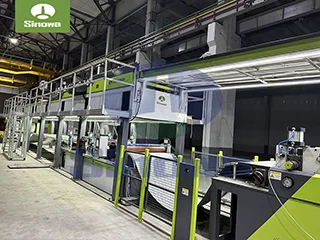
The working principle of a PU sandwich panel production line for exterior wall panels revolves around the continuous composite molding of three main components: the upper facing, the lower facing and the PU core material. The entire production process is a highly automated and continuous operation, which can be divided into several key stages: raw material preparation, facing uncoiling and leveling, PU foam mixing and pouring, composite molding and pressing, curing, cutting and stacking. Each stage is closely linked, and the stability and coordination of the production line directly affect the quality of the final product.
Raw material preparation is the first and fundamental step. For the PU core material, the main raw materials are polyol and isocyanate, which are the two key components that react to form polyurethane foam. These raw materials need to be stored in special tanks with temperature control functions to ensure their viscosity and reactivity meet the production requirements. In addition, auxiliary materials such as foaming agents, catalysts and flame retardants may be added according to the performance requirements of the exterior wall panels (e.g., flame retardancy, density). For the facing materials, color steel coils or other sheet materials are usually used, which need to be inspected for flatness, thickness uniformity and surface quality before entering the production line. The raw material preparation stage also includes the pre-treatment of the facings, such as surface cleaning and coating adhesion promotion, to ensure a firm bond between the facings and the PU core.
After raw material preparation, the facing materials enter the uncoiling and leveling stage. The upper and lower facing coils are uncoiled by uncoiling machines, and then passed through leveling machines to eliminate the internal stress of the sheets caused by coiling, ensuring that the facings are flat and smooth. This step is crucial because any unevenness of the facings will affect the appearance and structural stability of the final sandwich panel. Some advanced production lines are also equipped with edge trimming devices at this stage to trim the edges of the facings to the required width, ensuring consistency in the width of the final product.
The next core stage is PU foam mixing and pouring. The polyol, isocyanate and auxiliary materials are accurately metered by high-precision metering pumps and then transported to the mixing head of the foaming machine. In the mixing head, the raw materials are fully and uniformly mixed under high pressure. The mixed liquid PU material is then continuously poured onto the lower facing material that is moving at a constant speed. The pouring amount and uniformity are strictly controlled by the production line's control system, which adjusts the metering pumps and the movement speed of the facing according to the preset thickness and density of the PU core. This precision ensures that the PU core has uniform density and consistent thermal insulation performance across the entire panel.
Following the pouring stage is composite molding and pressing. The upper facing material is fed onto the poured PU foam, and the three-layer structure (upper facing, PU foam, lower facing) enters the composite molding machine. The molding machine consists of a series of rollers with adjustable pressure and temperature. Under the action of the rollers, the three layers are tightly bonded together, and the PU foam is gradually foamed and shaped. The temperature and pressure during this process are carefully controlled: the temperature promotes the foaming reaction of the PU material, while the pressure ensures that the facings and the core are firmly bonded without gaps. The molding machine also determines the surface texture of the sandwich panel, which can be adjusted according to customer needs (e.g., smooth, embossed).
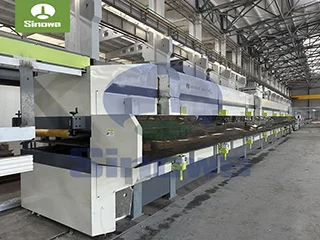
After molding, the continuous sandwich panel enters the curing stage. Curing is the process by which the PU foam completes the chemical reaction and achieves its final performance. The curing can be done naturally or through a heating tunnel. In modern production lines, heating tunnels are usually used to accelerate the curing process, improving production efficiency. The temperature and length of the heating tunnel are set according to the characteristics of the PU material to ensure that the core is fully cured and has sufficient strength before cutting. Insufficient curing may lead to deformation or reduced performance of the panels, while over-curing may affect the flexibility of the core material.
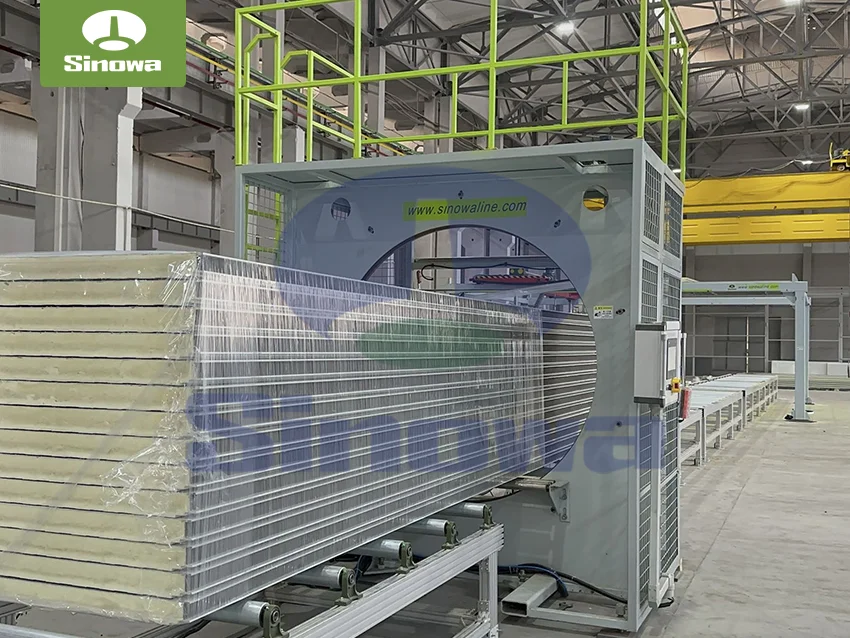
Once the panel is fully cured, it enters the cutting stage. The continuous panel is cut into the required length by a high-precision cutting machine. The cutting machine is usually equipped with a circular saw or a flying saw, which can perform cutting while the panel is moving, ensuring that the cutting surface is flat and free of burrs. The cutting length can be adjusted flexibly through the production line's control system to meet the diverse needs of different construction projects, from standard lengths to custom sizes. After cutting, the panels are conveyed to the stacking stage, where they are automatically stacked by a stacking machine. The stacking machine arranges the panels neatly, which facilitates storage, transportation and subsequent loading and unloading.
The key components of a PU sandwich panel line are designed to ensure the stability, precision and efficiency of the production process. The main components include uncoiling machines, leveling machines, foaming machines, metering systems, composite molding machines, curing tunnels, cutting machines, stacking machines and control systems. Each component has its unique function and technical requirements. For example, the foaming machine's mixing head must ensure uniform mixing of raw materials to avoid local defects in the PU core; the metering system must have high precision to control the ratio of raw materials and the thickness of the core; the control system, which is the "brain" of the production line, uses advanced PLC (Programmable Logic Controller) technology to integrate and coordinate the operation of all components, realizing automated production and real-time monitoring of production parameters.
Compared with traditional production methods or other types of sandwich panel production line, polyurethane sandwich panel production line for exterior wall panels have several significant technological advantages. First, they offer high production efficiency. The continuous automated production mode allows the line to produce panels continuously for a long time, with a production speed that can reach several meters per minute, far higher than manual or semi-automatic production methods. This high efficiency is particularly important for large-scale construction projects that require a large number of exterior wall panels. Second, the production line ensures consistent product quality. The automated control system and precise components minimize human errors, ensuring that each panel has uniform thickness, density, thermal insulation performance and appearance. This consistency is crucial for the overall performance and aesthetic effect of the building envelope. Third, the production line has strong flexibility. It can adjust the thickness of the PU core, the type of facing materials and the length of the panels according to customer needs, realizing the production of customized products. This flexibility enables the production line to meet the diverse requirements of different construction scenarios, such as high-rise buildings, industrial workshops, commercial complexes and residential buildings.
Another important advantage of polyurethane sandwich panel line is their energy-saving and environmental protection performance. In the production process, the precise metering system reduces the waste of raw materials, while the closed production environment reduces the emission of harmful gases. In addition, the PU sandwich panels produced by the line have excellent thermal insulation performance, which can significantly reduce the energy consumption of buildings during operation (e.g., heating in winter and cooling in summer). This aligns with the global trend of sustainable construction and green building, making PU sandwich panels and their production lines an important part of the low-carbon construction industry.
The application scenarios of PU sandwich panels produced by these lines are extensive, covering various types of buildings that require high-performance exterior wall cladding. In industrial and warehouse construction, PU sandwich panels are widely used due to their lightweight, fast construction and excellent thermal insulation properties. Industrial workshops often have large spaces and high requirements for temperature control, and PU sandwich panel exterior walls can effectively maintain the internal temperature, reducing energy consumption for heating and cooling. In commercial construction, such as shopping malls, hotels and office buildings, PU sandwich panels not only provide good thermal insulation and sound insulation performance but also have a beautiful appearance. The variety of facing materials and surface textures allows the panels to match different architectural styles, enhancing the aesthetic appeal of the building. In residential construction, especially in high-rise residential buildings, the lightweight nature of PU sandwich panels reduces the load on the building structure, while their thermal insulation and sound insulation performance improve the living comfort of residents. In addition, PU sandwich panels are also used in prefabricated buildings, which have become increasingly popular in recent years due to their advantages of fast construction, high quality and low environmental impact. The standardized production of PU sandwich panel lines is highly compatible with the prefabrication model, further promoting the development of prefabricated construction.
The development trend of PU sandwich panel machine for exterior wall panels is closely linked to the development of the construction industry and technological progress. In the future, these production lines will tend to be more intelligent, efficient and environmentally friendly. Intelligence will be reflected in the further upgrading of the control system, with the integration of technologies such as the Internet of Things (IoT), big data and artificial intelligence (AI). This will enable real-time monitoring of the entire production process, predictive maintenance of equipment and automatic adjustment of production parameters according to raw material characteristics and product requirements, further improving production efficiency and product quality. For example, IoT sensors can collect data on raw material viscosity, temperature in the curing tunnel and pressure in the molding machine, and the AI system can analyze this data to optimize production parameters and predict potential equipment failures.
Efficiency improvement will focus on optimizing the production process and increasing the production speed. For example, the development of faster curing PU materials will shorten the curing time, thereby increasing the overall production speed of the line. In addition, the integration of multiple functions into a single machine will reduce the number of equipment and the length of the production line, saving factory space and improving production efficiency. Environmental protection will be another key development direction. With the increasing emphasis on environmental protection globally, production lines will adopt more environmentally friendly raw materials and production processes. For example, the use of water-based foaming agents instead of traditional chemical foaming agents will reduce the emission of volatile organic compounds (VOCs), making the production process more environmentally friendly. In addition, the recycling of waste materials generated during production will also be strengthened, reducing resource waste and environmental pollution.
Another trend is the development of production lines that can handle more types of facing materials and core materials. As the demand for building materials becomes more diverse, polyurethane sandwich panel machine will need to be compatible with a wider range of materials, such as recycled materials, natural fiber materials and high-strength alloy materials. This will expand the application scope of PU sandwich panels and meet the increasingly strict performance requirements of different construction projects. For example, the integration of fire-resistant core materials will improve the fire safety performance of PU sandwich panels, making them suitable for buildings with high fire safety requirements.
In conclusion, the PU sandwich panel line for exterior wall panels is an essential piece of equipment in the modern construction industry, which plays a crucial role in producing high-performance, energy-saving and environmentally friendly PU sandwich panels. Its advanced working principle, precise key components and significant technological advantages ensure the efficiency and quality of production, while its extensive application scenarios cover industrial, commercial and residential construction. With the development of intelligent technology, environmental protection requirements and the trend of prefabricated construction, PU sandwich panel lines will continue to evolve towards intelligence, efficiency and diversification. In the future, these production lines will not only contribute to the improvement of building performance and the acceleration of construction progress but also play an important role in promoting the sustainable development of the construction industry, making a positive contribution to the realization of green and low-carbon buildings.
https://www.cnsinowa.com/sandwich-panel-machines/pu-sandwich-panel-line-for-exterior-wall-panels.html