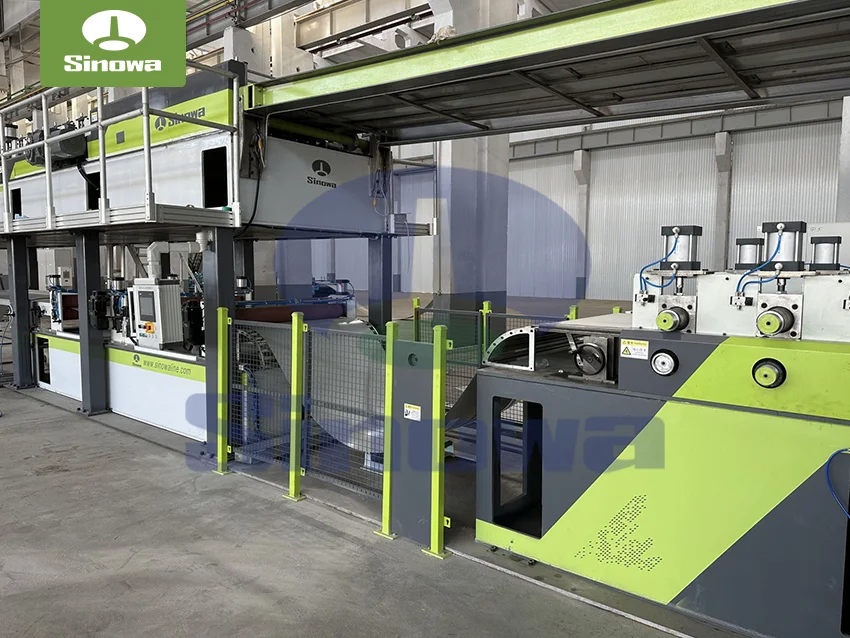
 sandwich panel line
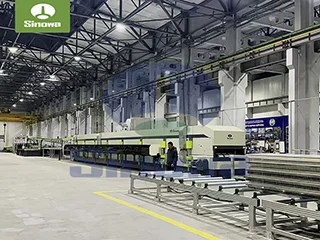
The overall operational logic of the fire-proof PU sandwich panel production line follows a fully continuous integrated manufacturing workflow, covering raw material pretreatment, automated material conveying, precise foam mixing and pouring, composite lamination, constant-temperature curing, cooling shaping, fixed-length cutting, and post-forming finishing. Every procedural link is interconnected and synchronously controlled to ensure that each finished panel maintains consistent fire resistance, uniform structural density, and reliable overall performance. The core design essence of the production line lies in targeted adjustments to the foaming and curing process of PU materials, which fundamentally differentiates it from ordinary sandwich panel production line. ordinary PU panel lines prioritize thermal insulation and lightweight characteristics, while fire-proof panel production systems focus on optimizing the closed-cell structure of PU foam and the uniform distribution of fire-retardant components, preventing local material unevenness that could cause flame penetration or rapid heat conduction in high-temperature fire environments.
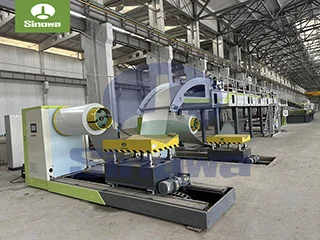
Raw material pretreatment is the primary foundational stage that determines the final fireproof quality of panels, and it is precisely controlled by the front-end module of the production line. The outer facing materials, usually metal sheets or other rigid decorative and protective substrates, undergo comprehensive surface treatment before composite processing. The automated unwinding and leveling system flattens coiled substrates and removes surface wrinkles, scratches, and deformation that may affect subsequent lamination flatness. Meanwhile, professional surface cleaning devices eliminate dust, oil stains, and oxide layers on the substrate surface. These contaminants, if left untreated, would form isolation layers between the outer facing and PU foam core, reducing bonding tightness and creating tiny gaps that accelerate flame spread and heat transfer during fire exposure. Thorough pretreatment ensures seamless integration between the substrate and fire-retardant PU core, maintaining the overall structural integrity of the panel under high-temperature conditions and avoiding performance degradation caused by interfacial separation.
The foam mixing and pouring unit stands as the most critical core component of the entire fire-proof PU sandwich panel line, directly defining the fire resistance and structural stability of finished panels. This unit adopts high-pressure dynamic mixing technology to precisely proportion and blend polyol, isocyanate, and specialized fire-retardant additives according to fixed process ratios. Unlike manual or semi-automatic mixing methods in traditional equipment, the fully automated mixing system achieves micro-level uniform fusion of all raw material components, ensuring that fire-retardant ingredients are evenly distributed in the PU foam matrix without local concentration differences. Uniform component distribution enables the foam core to form a dense and stable closed-cell structure after chemical reaction and foaming. This fine closed-cell structure not only retains excellent thermal insulation performance but also effectively blocks air convection and heat radiation, inhibiting the continuous combustion and flame propagation of the material when exposed to open fire or high temperatures.
During the pouring and laying process, the PU sandwich panel machine realizes dynamic and uniform pouring of mixed PU materials on the horizontally moving lower substrate. The intelligent flow control system adjusts the pouring volume and spraying range in real time according to the preset panel thickness specifications, ensuring consistent foam thickness across the entire panel width and length. After the PU material is evenly laid, the upper substrate is automatically aligned and covered through a precise positioning and pressing mechanism, forming a three-layer composite structure of upper facing, PU foam core, and lower facing. The entire lamination process maintains stable horizontal tension and vertical pressure to avoid offset, wrinkling, or hollowing between layers. Such precise composite processing effectively prevents the formation of internal air gaps in the panel, which are crucial for maintaining fireproof performance, as dense internal structure can delay high-temperature heat penetration and prevent internal combustion caused by air contact in fire scenarios.
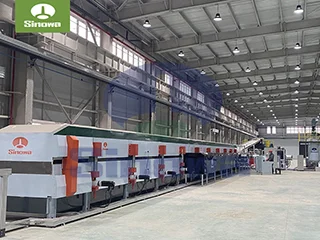
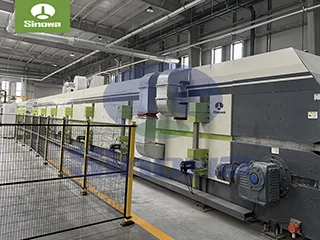
The double-belt laminating and constant-temperature curing system is a key link for shaping fire-proof PU sandwich panels and stabilizing their fire-resistant performance. After composite lamination, the semi-finished panels enter the closed constant-temperature curing channel of the polyurethane sandwich panel production line, where precise temperature and pressure control is implemented throughout the foaming and curing reaction stage. The production line’s closed-loop thermal regulation system maintains a stable temperature range inside the curing channel, providing a constant chemical reaction environment for PU foam foaming and solidification. Reasonable pressure restraint is applied during the curing process to limit excessive expansion of foam materials, ensure accurate and consistent panel thickness, and promote full cross-linking reaction of PU molecular chains. Sufficient and stable curing enables the fire-retardant components to form a firm chemical bond with the PU substrate, significantly improving the high-temperature resistance and structural stability of the foam core. Panels processed by this system will not experience rapid softening, melting, or structural collapse under sustained high-temperature conditions, maintaining basic protective functions for building structures.
After completing high-temperature curing, the panels enter the forced cooling and shaping module of the polyurethane sandwich panel line. The integrated cooling system adopts combined air cooling and heat dissipation structures to uniformly reduce the internal and external temperature of the panels, eliminating internal stress generated during high-temperature curing and foaming. Gradual and balanced cooling prevents panel deformation, warping, and cracking caused by rapid temperature changes, ensuring the flatness and dimensional stability of finished panels. This process also further stabilizes the internal molecular structure of the fire-retardant PU foam, locking in the optimized fire-resistant performance formed during curing and avoiding performance attenuation in long-term use. Fully cooled and shaped continuous panel blanks are then transported to the fixed-length cutting unit for precise sizing processing.
The automated cutting and finishing module of the production line adopts photoelectric intelligent length measurement and positioning technology to achieve high-precision fixed-length cutting of continuous panel blanks. The system can flexibly adapt to different customer specification requirements, realizing free switching of cutting dimensions within the conventional processing range while maintaining extremely high dimensional accuracy of finished products. After cutting, the edge trimming and finishing device automatically polishes and trims the panel edges to remove burrs, uneven foam residues, and edge irregularities, ensuring neat and flat panel sections. Neat edge treatment is essential for the overall fireproof performance of the panel, as smooth and tight splicing sections can avoid gap leakage during on-site installation, preventing flame and high-temperature airflow from penetrating through splicing gaps and improving the overall closed fire protection effect of the building envelope.
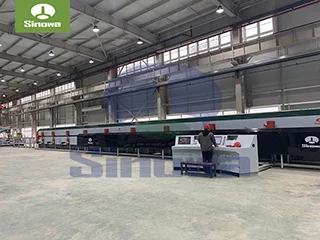
Modern fire-proof polyurethane sandwich panel machine is equipped with comprehensive real-time monitoring and automated quality control systems, which run through the entire production process to ensure stable and reliable product fireproof performance. Multiple high-sensitivity sensors are installed in key links such as raw material mixing ratio, foaming temperature, curing pressure, panel thickness, and surface flatness, collecting operational data in real time and feeding it back to the central control system. Once parameter deviation beyond the preset range is detected, the system will automatically make fine adjustments or issue early warnings to avoid defective products caused by process fluctuations. The material utilization rate of the entire production process is effectively improved through intelligent parameter optimization, while the consistency of fire resistance of each batch of panels is fully guaranteed. Compared with traditional semi-automatic production equipment, the highly integrated automated production mode reduces human intervention errors, eliminates performance differences caused by manual operation instability, and realizes standardized and large-scale production of high-quality fire-proof PU sandwich panels.
The technical advantages of the dedicated fire-proof continuous PU sandwich panel production line are fully reflected in the comprehensive performance of finished panels. First, the optimized foaming and curing process enables the PU foam core to achieve a highly uniform closed-cell structure, giving the panels excellent flame retardancy and self-extinguishing properties. When encountering open fire, the panel surface can quickly form a dense carbonization layer, which isolates oxygen and heat, prevents further spread of flame, and avoids droplet combustion that causes secondary fire hazards. Second, the integrated composite processing technology ensures ultra-high bonding strength between the outer facing and the foam core. The panel will not suffer layer separation or structural damage under high-temperature baking, maintaining the integrity of the building envelope structure and providing lasting fire protection for buildings. Third, while ensuring superior fireproof performance, the panels produced by this line retain the inherent advantages of PU sandwich panels such as light weight, high strength, and excellent thermal insulation, achieving an organic balance of fire safety, energy saving, and structural applicability.
In terms of production applicability, this type of continuous PU sandwich panel line has strong process flexibility and can adapt to the production of fire-proof PU sandwich panels with different thicknesses, surface materials, and performance grades. By adjusting the operating parameters of the mixing system, curing system, and conveying system, the line can produce panels suitable for different application scenarios, including thickened fire-insulation integrated panels for industrial workshops and clean workshops, lightweight fire-proof decorative panels for public buildings, and high-stability fire-proof enclosure panels for cold storage and special industrial environments. The continuous production mode realizes uninterrupted batch processing, greatly improving production efficiency and meeting the large-scale material supply demand of modern construction projects. At the same time, the compact and reasonable structural design of the production line reduces floor space occupancy, simplifies production line layout, and facilitates daily operation and maintenance management.
From the perspective of industrial development and construction safety upgrading, the popularization and technical iteration of fire-proof PU sandwich panel machinery plays an important role in promoting the standardized development of the building energy-saving and fireproof material industry. Traditional building insulation materials often have prominent contradictions between thermal insulation performance and fire resistance, with some materials having good thermal insulation effects but poor fireproof capabilities, while high-fire-resistance materials often have bulky structures and poor energy-saving effects. The optimized production technology of the fire-proof PU sandwich panel production line effectively resolves this industry pain point. Through precise process control and material formula optimization in the production process, the finished panels take into account ultra-low thermal conductivity and excellent fire-retardant and high-temperature-resistant properties, providing high-quality material support for energy-saving transformation and safety upgrading of various buildings.
In practical engineering applications, fire-proof PU sandwich panels produced by professional dedicated lines have shown extremely high application value and environmental adaptability. In industrial building scenarios such as factory workshops, warehouses, and logistics parks, the panels can effectively resist external fire impact and prevent fire spread between building spaces, reducing property safety risks. In public buildings with high crowd density and strict safety requirements, such as shopping malls, office buildings, and exhibition halls, the panels meet the high-standard fire safety design requirements of building envelopes while ensuring beautiful appearance and convenient construction. In special environments such as low-temperature cold storage and constant-temperature workshops, the panels maintain stable fireproof performance in long-term low-temperature and high-humidity environments, avoiding performance degradation caused by environmental changes and ensuring the long-term safe operation of special buildings.
The continuous technological innovation of fire-proof PU sandwich panel production machine is also driving the continuous improvement of the comprehensive performance of fire-proof building materials. With the development of intelligent manufacturing technology, modern production lines are gradually developing towards higher automation, finer process control, and lower energy consumption. The upgraded intelligent control system can realize one-click parameter setting and automatic memory of process schemes for different panel specifications, greatly shortening the mold switching and debugging cycle and improving production flexibility. The optimized energy-saving structure of the curing and cooling system reduces energy consumption in the production process, realizing green and low-carbon manufacturing. In addition, the production line’s adaptive adjustment capability for new fire-retardant materials is constantly enhanced, which can be compatible with more environmentally friendly and efficient fire-retardant formulas, promoting the upgrading and iteration of fire-proof PU sandwich panel products and adapting to the increasingly stringent building safety and environmental protection standards.
In conclusion, the professional PU sandwich panel manufacturing line for fire-proof panels is a core intelligent manufacturing equipment integrating material optimization, precise process control, and automated continuous production. It provides reliable technical guarantees for mass production of high-performance fire-proof PU sandwich panels through systematic optimization of pretreatment, mixing and pouring, composite curing, cooling shaping, and intelligent quality control links. The panels produced by this line break through the performance limitations of traditional building insulation materials, perfectly balancing fire safety, thermal insulation and energy saving, structural stability, and construction convenience. With the continuous improvement of global building safety standards and the rapid development of modular and green building industries, the market demand for high-quality fire-proof PU sandwich panels will continue to grow, and the technical level and application scope of dedicated fire-proof panel production lines will also continue to expand, providing solid technical and equipment support for the high-quality development of the modern construction industry and the improvement of building safety systems.
https://www.cnsinowa.com/sandwich-panel-machines/pu-sandwich-panel-line-for-fire-proof-panels.html