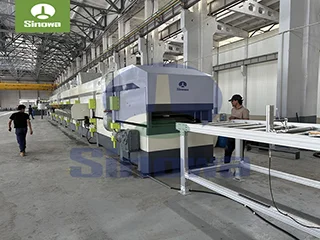
sandwich panel machine
A complete color steel sandwich panel line consists of multiple interconnected functional modules, each undertaking independent processing tasks while maintaining precise synchronous operation to ensure the continuity and stability of the entire production process. The front-end part of the equipment is equipped with an automatic unwinding and pre-processing module, which is responsible for placing and conveying raw color steel coils. In actual operation, the coiled color steel raw material is steadily unfolded through the unwinding device, and then passes through a multi-roller leveling structure to eliminate internal stress generated during coil rolling. This leveling process effectively avoids surface warping, uneven flatness, and dimensional deviation of subsequent molded panels, laying a solid foundation for the precise molding and compounding of finished products. After leveling, the color steel plate will go through surface finishing and guiding positioning procedures to ensure stable feeding speed and accurate conveying trajectory, preventing material deviation during high-speed operation which may affect product yield.
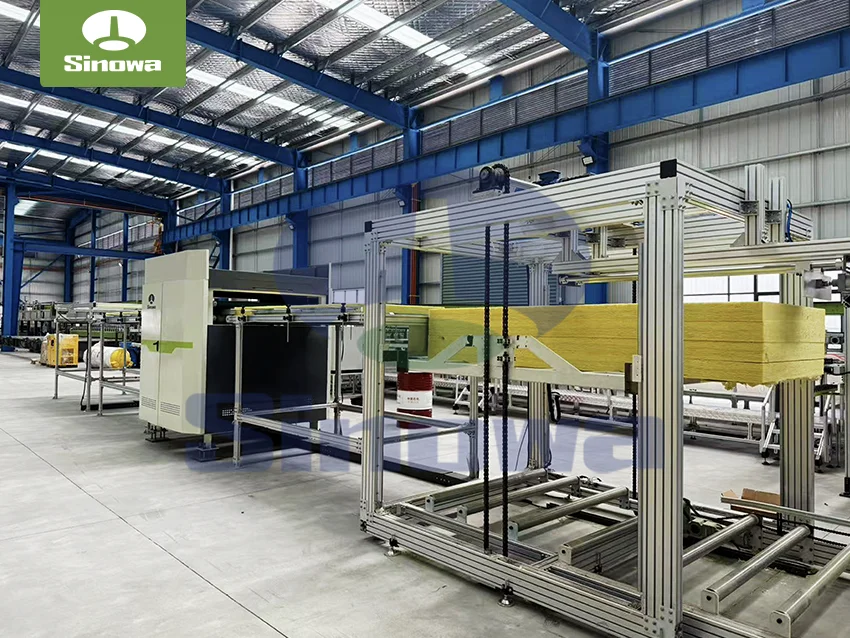
The core material feeding and pretreatment module is another key component of the entire sandwich panel equipment system, which supports the automatic feeding and fixed-size cutting of various common insulation core materials. According to different production requirements, the equipment can adapt to core materials such as polyurethane foam, rock wool, and glass wool, covering the production needs of insulation, fireproof, and sound-insulating sandwich panels. During operation, the bulk core material is automatically arranged and paved by the professional paving device, and the high-precision cutting unit cuts the core material into uniform specifications, ensuring that the size of the core material completely matches the outer color steel plate. The precise matching of core material size avoids empty gaps or excessive extrusion inside the composite panel, effectively guaranteeing the overall structural compactness and uniform thermal insulation performance of the finished product. Meanwhile, the system can adjust the feeding speed and cutting dimensions of core materials in real time according to production parameters, realizing flexible switching of different panel thickness specifications.
The gluing and high-pressure compounding system constitutes the core technical part of the color steel tile sandwich panel machine, directly determining the bonding strength and service durability of the composite panel. For polyurethane composite panels, the equipment adopts high-pressure mixing and online foaming technology, where multiple raw material components are transported to the precision mixing structure through quantitative conveying units. Under high-pressure working conditions, various raw materials undergo intense collision and uniform mixing, and the mixed materials are evenly injected between the upper and lower color steel plates through the precise discharge structure. The entire foaming and material injection process is completed in a closed and temperature-controlled environment, which enables the foaming material to fully expand and fill the gap between the steel plates, forming a dense and uniform insulation core layer. For fiber core materials such as rock wool, the equipment adopts a quantitative gluing and laminating process, with the intelligent glue supply system accurately controlling the glue application amount per unit area to ensure firm adhesion between the steel plate and the core material without excessive glue overflow or insufficient bonding.
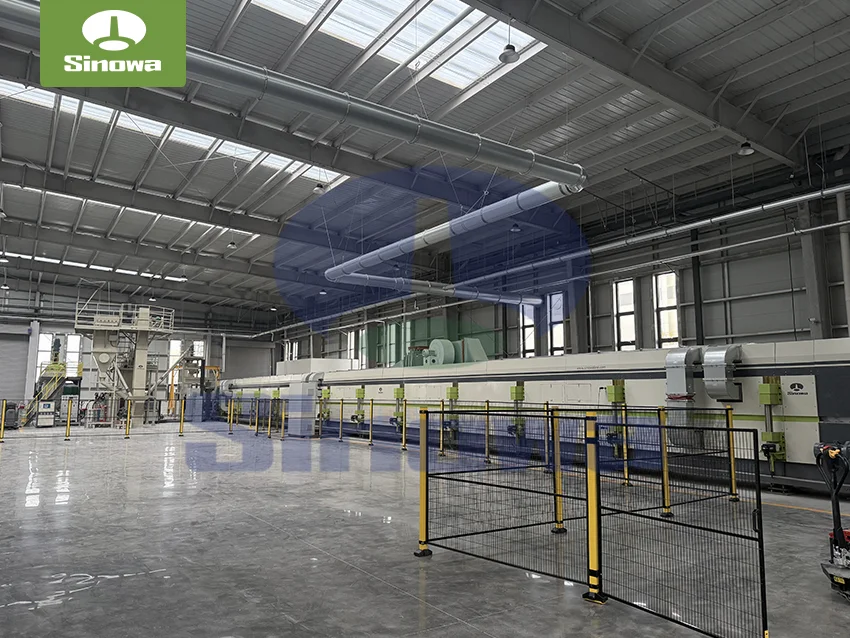
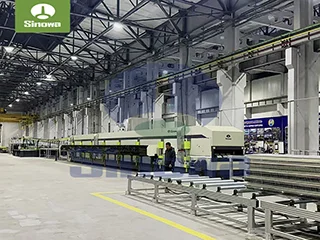
Following the material compounding process, the constant-temperature curing and pressure-setting module undertakes the task of shaping and strengthening the composite panel. The sandwich panel production line is equipped with a fully enclosed temperature control channel, which maintains a stable working temperature through uniform heating components, providing a suitable curing environment for the bonding layer and foaming core layer. During the curing process, the composite plate body is continuously pressed by the multi-group pressure roller structure with constant pressure, which promotes the full integration of the core material and the color steel plate, eliminates internal bubbles and gaps, and enhances the overall structural tightness of the panel. The combination of constant temperature and constant pressure enables the bonding layer to complete rapid curing and forming in a short time, significantly improving production efficiency while ensuring that the bonding strength meets the use standards. The entire curing process adopts real-time temperature and pressure monitoring, and the system can automatically adjust operating parameters according to production speed and product specifications to avoid quality problems such as incomplete curing or excessive deformation caused by parameter fluctuations.
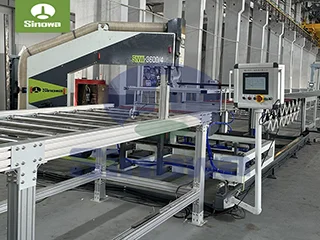
The post-processing part of the sandwich panel production equipment includes fixed-length cutting, edge trimming, and finished product sorting modules, which realize the final finishing and shaping of the sandwich panels. After curing and forming, the continuous composite panel is conveyed to the precision cutting device, which automatically completes fixed-length cutting according to preset dimensional parameters. The cutting structure adopts high-precision transmission and stable cutting components, ensuring flat and smooth cutting sections without burrs or edge collapses, which reduces subsequent secondary processing procedures. The edge trimming device can trim the edges of the panel to make the overall dimensions regular and uniform, and optional edge sealing processing can be carried out according to product needs to enhance the edge sealing performance and structural stability of the panel. After the completion of cutting and trimming, the finished product is automatically conveyed to the stacking platform, realizing orderly stacking and preliminary arrangement of finished panels, which is convenient for subsequent packaging and warehousing operations.
The intelligent control system runs through the entire operation process of the color steel tile sandwich panel line, serving as the brain to coordinate the synchronous operation of all functional modules. The system adopts integrated program control, and operators can set various production parameters such as panel thickness, cutting length, operating speed, and gluing amount through the intuitive operation interface. After parameter setting is completed, the equipment can realize fully automatic continuous operation from raw material feeding, processing and compounding to finished product output, effectively reducing manual intervention and avoiding product quality errors caused by human operation. In addition, the control system is equipped with a real-time monitoring and fault self-diagnosis function, which can track the operating status of each module in real time. Once abnormal conditions such as material jamming, parameter deviation, or equipment failure occur, the system will automatically trigger early warning and protective shutdown, ensuring the safety and stability of production operations and reducing equipment failure loss and production downtime.
In terms of production performance and product quality control, this type of sandwich panel production machine has outstanding advantages in dimensional accuracy and product consistency. The whole production process adopts closed-loop parameter control, and key dimensions such as panel thickness, width, and length are controlled within a tiny tolerance range, ensuring that each batch of finished panels has highly consistent specifications. The uniform foaming and pressing process makes the internal structure of the sandwich panel dense and uniform, so that the product has stable thermal insulation, sound insulation, and mechanical bearing performance. The composite panels produced by this equipment have good overall flatness and neat edges, with excellent surface texture, which can directly meet the decorative and installation requirements of building exterior walls and roofs without additional surface treatment. Meanwhile, the equipment supports the production of various panel types such as flat panels, corrugated panels, and plug-in panels, realizing diversified product production and meeting the personalized construction needs of different engineering scenarios.
The application advantages of color steel tile sandwich panel making machine in industrial production are mainly reflected in high efficiency, energy saving, and low loss. The integrated continuous production mode greatly shortens the production cycle of single-panel products, and the efficient curing and molding process supports long-term uninterrupted operation, effectively improving the unit time output of production lines. The precise quantitative control of raw materials avoids waste of foaming materials, adhesives, and other auxiliary materials, reducing the material consumption per unit of product. The optimized mechanical transmission structure reduces equipment operation resistance and energy consumption during production, achieving good energy-saving effects. In addition, the automated production process reduces manual operation links, lowers the labor cost of production workshops, and the stable product yield greatly reduces the waste rate of raw materials and finished products, bringing significant cost optimization benefits for manufacturing enterprises.
In practical industrial applications, the color steel tile sandwich panel manufacturing machine is widely used in the production of building materials for various construction scenarios. The lightweight and high-strength characteristics of the produced sandwich panels make them very suitable for the construction of large-span industrial plants, logistics warehouses, and clean workshops. The excellent thermal insulation and heat preservation performance can effectively reduce the energy consumption of building temperature regulation, meeting the energy-saving and emission-reduction requirements of modern buildings. At the same time, the product has good fire resistance, wind resistance, and structural stability, adapting to the construction needs of different climatic environments and building grades. In addition, the rapid molding and convenient installation characteristics of color steel sandwich panels also make them the preferred material for temporary construction facilities such as construction site dormitories, emergency shelters, and mobile office buildings, and the efficient production capacity of the equipment can fully meet the short-term large-volume material supply demand of engineering projects.
Daily maintenance and standardized operation are crucial to maintaining the long-term stable performance of the color steel tile sandwich panel machinery. Daily maintenance work mainly includes cleaning the surface of conveying and pressing components to remove residual raw materials and dust, regularly checking the tightness and lubrication status of transmission parts, and ensuring the flexibility and stability of mechanical operation. It is also necessary to regularly calibrate the precision of the cutting device and the accuracy of the gluing system to avoid dimensional deviation and uneven gluing caused by long-term operation wear. The temperature control and pressure control systems need regular parameter detection and calibration to ensure that the curing and compounding environment always meets the production process standards. Standardized operation and regular maintenance can effectively extend the service life of the equipment, maintain stable production accuracy and efficiency, and reduce the failure rate and maintenance cost of the production line in the long-term operation process.
With the continuous upgrading of building energy-saving standards and manufacturing automation technology, the color steel tile sandwich panel production machinery is also developing in the direction of higher intelligence, stronger flexibility, and better environmental performance. The continuous optimization of the control system makes the equipment more adaptable to diverse production needs, realizing faster switching of product specifications and more accurate parameter control. The upgraded material processing technology further improves the bonding firmness and environmental protection performance of composite panels, making the finished products more in line with the green building development concept. In the future, with the in-depth development of the construction industry towards industrialization and modularization, this type of automated panel production equipment will play a more important role in the field of building material manufacturing, providing more efficient and high-quality supporting solutions for modern building construction.
https://www.cnsinowa.com/sandwich-panel-machines/color-steel-tile-sandwich-panel-machine.html