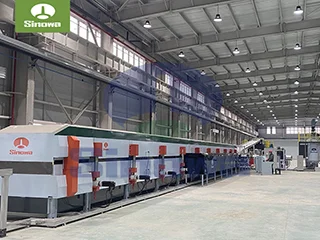
sandwich panel machine
The core working principle of the PU sandwich panel manufacturing machine lies in the precise coordination of multiple sequential processes, from raw material preparation to the final packaging of finished products. Unlike traditional discrete production methods, this machine realizes continuous and automated production, which significantly improves production efficiency and reduces the impact of human factors on product quality. The entire production process can be roughly divided into several key stages: raw material preparation and pretreatment, foam mixing and pouring, composite lamination, continuous curing, precision cutting, and automatic stacking and packaging. Each stage is closely linked, and the parameters of temperature, pressure, and speed must be strictly controlled to ensure the final product meets the required performance indicators.
Raw material preparation is the initial and crucial step in the production process. The main raw materials include surface materials and PU foam raw materials. Surface materials typically come in the form of coiled materials such as color steel plates, aluminum plates, non-woven fabrics, or kraft paper, which need to be uncoiled and pretreated before entering the composite process. The manufacturing machine is equipped with uncoiling systems that can stably unwind the coiled surface materials, and the uncoiling process is equipped with servo correction systems to ensure that the materials move smoothly without deviation, which is essential for maintaining the uniformity of the final panel dimensions. After uncoiling, the surface materials may undergo additional pretreatment processes according to product requirements. For example, metal surface materials often need to be embossed to form corrugated or trapezoidal patterns, which enhance the structural rigidity of the panels. Some surface materials also require preheating to a specific temperature to improve the adhesion with the PU core and promote the subsequent foaming reaction. The pretreatment stage also includes processes such as cutting the surface materials to a preliminary width, ensuring they match the designed specifications of the composite panels.
The preparation of PU foam raw materials is another critical aspect of the raw material stage. PU foam is formed by the chemical reaction of polyol and isocyanate, combined with appropriate additives such as foaming agents, catalysts, and flame retardants. The manufacturing machine is equipped with specialized storage tanks and metering systems for these raw materials. The metering system ensures that the various components are mixed in precise proportions, as any deviation in the ratio will directly affect the density, thermal insulation performance, and mechanical strength of the PU core. High-pressure metering pumps are usually used to transport the raw materials to the mixing head, where they are thoroughly mixed under high pressure. For environmentally friendly production, many modern machines adopt cyclopentane or n-pentane as foaming agents, which are low in environmental impact and meet global environmental protection requirements. The mixing head is designed to ensure uniform mixing of the raw materials, creating a homogeneous foam mixture that is ready for pouring onto the surface material.
After the raw material preparation and pretreatment, the production process moves to the foam mixing and pouring stage. In this stage, the preheated lower surface material is transported to the pouring area by a conveyor system. The mixed PU foam raw materials are then evenly poured onto the lower surface material through a moving pouring小车 (pouring carriage). The pouring carriage moves synchronously with the conveyor system, ensuring that the foam is distributed uniformly across the entire width and length of the surface material. The amount of foam poured is precisely controlled according to the desired thickness of the PU core, which can be adjusted based on different product specifications. This precision pouring is crucial because uneven foam distribution will lead to inconsistent core thickness, affecting the overall performance and appearance of the composite panel. The foam begins to expand immediately after being poured, filling the space between the upper and lower surface materials as it expands.
Following the pouring stage is the composite lamination process. As the foam starts to expand, the upper surface material, which has also undergone pretreatment and preheating, is fed onto the expanding foam. The combination of the upper and lower surface materials and the expanding foam then enters the double-track lamination conveyor, which is the core equipment of the manufacturing machine. The double-track conveyor consists of upper and lower endless tracks, which apply a uniform pressure to the composite structure as it moves forward. The pressure applied is carefully controlled to ensure that the foam expands to the desired thickness while maintaining good adhesion between the foam core and the surface materials. At the same time, the conveyor is equipped with a heating system that maintains a constant temperature environment, which promotes the curing reaction of the PU foam. The temperature in this stage is usually controlled below 80℃, as excessive temperature may affect the properties of the surface materials and the foam core. The double-track lamination conveyor not only provides the necessary pressure and temperature for the composite structure but also ensures that the panel maintains a flat and smooth surface during the curing process.
Continuous curing is an integral part of the lamination process. The composite panel moves through the double-track conveyor, where the PU foam undergoes a complete curing reaction under the combined action of temperature and pressure. The length of the double-track conveyor is designed to provide sufficient time for the foam to cure completely. Typically, the conveyor length is around 24 meters, which allows the foam to fully expand and solidify as the panel moves forward at a constant speed. During the curing process, the foam transforms from a liquid mixture into a solid, lightweight core that bonds firmly with the surface materials. The curing time and temperature are closely monitored and adjusted according to the production speed and product specifications. Proper curing ensures that the composite panel has sufficient structural strength, thermal insulation performance, and dimensional stability. If the curing is incomplete, the panel may experience delamination, deformation, or reduced performance during use.
After the continuous curing stage, the composite panel enters the precision cutting process. At this point, the panel is a continuous, large sheet that needs to be cut into specific lengths according to customer requirements. The manufacturing machine is equipped with automatic tracking cross-cutting saws that can precisely cut the continuous panel into fixed-length products. The cutting saw is synchronized with the conveyor speed to ensure that the cut is straight and accurate, without causing damage to the panel edges. Some advanced machines are also equipped with edge trimming devices that trim the sides of the panel to ensure uniform width and neat edges. The trimming process also removes any excess foam or surface material that may have accumulated on the edges during the lamination and curing stages. The precision of the cutting and trimming processes directly affects the installation efficiency of the finished panels, as accurate dimensions ensure a tight fit during assembly.
The final stages of the production process are automatic stacking and packaging. After cutting and trimming, the finished PU sandwich panels are transported to the stacking area by a roller conveyor system. The automatic stacking device neatly stacks the panels according to a preset pattern, which not only saves storage space but also facilitates subsequent transportation and loading. The stacking process must be gentle to avoid scratching or damaging the panel surfaces, especially for panels with decorative surface coatings. After stacking, the panels are wrapped with protective film or packaging materials to prevent moisture, dust, and damage during transportation and storage. Some advanced production lines also include automatic packaging systems that can bundle multiple stacks into a single package, further improving the efficiency of transportation and handling. The entire stacking and packaging process is automated, reducing labor costs and ensuring consistency in packaging quality.
One of the key advantages of the PU sandwich panel manufacturing machine is its high degree of automation and modular design. The modular design allows different components of the production line to be freely combined and adjusted according to different production requirements, enabling the machine to produce a wide range of PU sandwich panel products. For example, by changing the surface materials and adjusting the foam parameters, the machine can produce wall panels, roof panels, cold storage panels, and soft-faced composite panels. This versatility makes the machine suitable for various application scenarios and meets the diverse needs of customers. Additionally, the integrated control system of the machine allows operators to monitor and adjust all production parameters in real-time through a centralized control panel. The control system is equipped with sensors and monitoring devices that continuously collect data on temperature, pressure, speed, and other key parameters, ensuring that any deviations are detected and corrected promptly. This real-time monitoring and control capability significantly improves the stability and reliability of the production process, reducing the rate of defective products.
Another important feature of the PU sandwich panel manufacturing machine is its energy efficiency and environmental friendliness. Modern machines are designed with advanced insulation systems that reduce heat loss during the curing process, thereby lowering energy consumption. For example, the double-track conveyor is equipped with insulation blocks filled with glass fiber cotton, which have excellent thermal insulation performance and minimize heat loss. Additionally, the adoption of environmentally friendly foaming agents such as cyclopentane and n-pentane reduces the environmental impact of the production process, complying with global environmental protection regulations. The machine is also equipped with dust removal and waste gas treatment devices to ensure that the emissions meet the required environmental standards, making the production process more sustainable.
The performance of the PU sandwich panel manufacturing machine directly determines the quality of the lightweight composite panels. High-quality machines can produce panels with uniform thickness, flat surfaces, and strong adhesion between the core and surface materials. These panels exhibit excellent thermal insulation performance, with a thermal conductivity much lower than that of traditional building materials such as concrete and brick. This makes them ideal for use in cold storage facilities and buildings that require efficient energy conservation. Additionally, the lightweight nature of the panels reduces the overall weight of the building structure, lowering the cost of foundation construction and transportation. The high structural strength of the panels, achieved through the composite structure and precise production process, ensures that they can withstand wind loads, snow loads, and other external forces, making them suitable for use in various harsh environments.
In terms of maintenance and operation, the PU sandwich panel manufacturing machine is designed to be user-friendly. The modular design makes it easy to disassemble and assemble components, simplifying maintenance and repair work. Key components such as the mixing head, metering pumps, and conveyor tracks are made of high-quality materials and processed using CNC machine tools, ensuring durability and reliability. Regular maintenance mainly includes checking the wear of moving parts, cleaning the mixing head, and calibrating the metering system. The integrated control system also provides diagnostic functions that help operators quickly identify and troubleshoot problems, minimizing downtime. Operators only need to receive professional training to master the operation of the machine, which reduces the threshold for use and ensures the stable operation of the production line.
The application scope of the lightweight composite panels produced by the PU sandwich panel manufacturing machine continues to expand. In the construction industry, they are widely used as wall and roof materials for industrial workshops, logistics warehouses, and commercial buildings. Their lightweight and easy-to-install features significantly shorten the construction period, reducing construction costs. In the cold storage industry, the excellent thermal insulation performance of PU sandwich panels makes them the preferred material for cold storage walls and roofs, ensuring stable temperature control and reducing energy consumption. In the field of modular housing, these panels are used to manufacture prefabricated wall panels and roof panels, enabling the rapid assembly of modular houses, which are widely used in temporary housing, field camps, and low-rise residential buildings. Additionally, the panels are also used in the production of air conditioning ducts, subway construction, and agricultural greenhouses, demonstrating their versatility and wide applicability.
Looking to the future, the PU sandwich panel manufacturing machine is expected to undergo further improvements and innovations. With the continuous advancement of technology, the machine will become more intelligent, with the integration of artificial intelligence and Internet of Things (IoT) technologies. This will enable real-time data analysis, predictive maintenance, and remote monitoring of the production process, further improving production efficiency and reducing operational costs. Additionally, there will be a greater focus on environmental protection and energy conservation, with the development of more efficient insulation systems and the adoption of more environmentally friendly raw materials and processes. The machine will also be designed to produce panels with higher performance, such as improved fire resistance, corrosion resistance, and soundproofing, to meet the increasingly stringent requirements of various applications. The development of the PU sandwich panel manufacturing machine will continue to drive the growth of the lightweight composite panel industry, providing more efficient, sustainable, and high-performance solutions for the construction and industrial manufacturing fields.
In conclusion, the PU sandwich panel manufacturing machine is an essential piece of equipment in the production of lightweight composite panels, integrating multiple processes into a continuous, automated production line. Its precise control of the production process, high degree of automation, and modular design ensure the efficiency, consistency, and quality of the produced panels. The lightweight composite panels, with their excellent thermal insulation, soundproofing, and structural performance, have become indispensable materials in various fields, driving the demand for advanced manufacturing machines. As technology continues to advance, the PU sandwich panel manufacturing machine will become more intelligent, energy-efficient, and environmentally friendly, playing an even more important role in promoting the sustainable development of the construction and industrial manufacturing industries.
https://www.cnsinowa.com/sandwich-panel-machines/pu-sandwich-panel-manufacturing-machine-for-lightweight-composite-panel-production.html