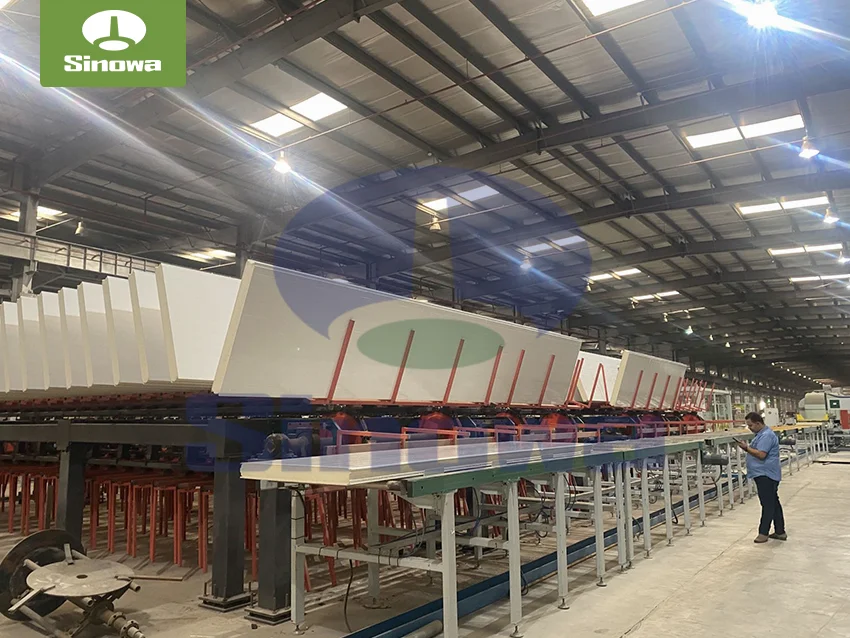
 sandwich panel line
The production of PU foam is based on the chemical reaction between isocyanate and polyol, which is accompanied by the generation of gas to form a porous structure. Before entering the reaction stage, the raw materials need to go through strict pretreatment to ensure their stability and uniformity. The main raw materials include polyisocyanate, polyol, blowing agent, catalyst, and other additives. Polyisocyanate and polyol are the core components that form the polyurethane matrix, and their chemical activity and molecular structure directly determine the basic properties of the foam. Polyisocyanate contains reactive isocyanate groups (-NCO), which can undergo addition polymerization with the hydroxyl groups (-OH) in polyol to form urethane linkages (-NH-CO-O-), constructing the three-dimensional network structure of the foam. The type of polyol, such as polyether polyol or polyester polyol, and its functionality (number of hydroxyl groups per molecule) affect the cross-linking density and flexibility of the foam. For example, polyether polyol is often used to produce flexible foam due to its good flexibility, while polyester polyol contributes to higher hardness and mechanical strength of the foam.
Blowing agents are responsible for generating gas to form the cellular structure of the foam, and there are two main types: chemical blowing agents and physical blowing agents. Chemical blowing agents mainly rely on chemical reactions to produce gas. Water is the most commonly used chemical blowing agent, which reacts with isocyanate to generate unstable carbamic acid, which quickly decomposes into amine and carbon dioxide (CO₂) gas. The generated CO₂ gas expands in the polymerizing system, forming bubbles that gradually grow to form the foam structure. The amine produced in the reaction can further react with isocyanate to form urea linkages, which participate in the construction of the polymer network and enhance the mechanical properties of the foam. Physical blowing agents are volatile liquids with low boiling points. They absorb the heat released by the exothermic polyurethane reaction and vaporize into gas, creating bubbles in the mixture. The selection of blowing agents depends on the required foam density, cell structure (open-cell or closed-cell), and environmental requirements, with the goal of achieving uniform bubble distribution and stable foam structure.
Catalysts play a key role in regulating the reaction rate and balancing the polymerization reaction and foaming reaction. The polyurethane reaction involves two parallel processes: the chain extension reaction between isocyanate and polyol, and the gas generation reaction between isocyanate and water. Catalysts need to accelerate these two reactions appropriately to ensure that the gas generation rate matches the polymer network formation rate. If the reaction rate is too fast, the foam may solidify before sufficient expansion, resulting in low expansion ratio and dense structure; if the reaction rate is too slow, the generated gas may escape before the polymer solidifies, leading to bubble collapse and surface defects. Common catalysts include amine catalysts and metal catalysts, which can be adjusted according to the type of foam and production process to achieve optimal reaction kinetics.
The metering system is the first core link of the PU foam production line, which directly affects the accuracy of raw material proportioning and the stability of product quality. The system mainly consists of metering pumps, storage tanks, and pipeline systems. Each raw material is stored in a dedicated storage tank, and the temperature of the storage tank is controlled to maintain the fluidity and chemical activity of the raw materials. For example, polyol and isocyanate need to be kept at a constant temperature to avoid viscosity changes caused by temperature fluctuations, which would affect the metering accuracy. Metering pumps are used to deliver raw materials to the mixing system at a fixed flow rate, and the type of metering pump varies according to the working pressure of the production line.
Low-pressure foaming production lines usually adopt gear metering pumps or annular piston pumps. Gear metering pumps adjust the discharge volume by changing the rotating speed through frequency conversion or stepless transmission devices, which are suitable for small and medium flow rate scenarios. Annular piston pumps adjust the discharge volume by changing the eccentricity between the annular piston cylinder and the drive shaft, eliminating the need for complex speed regulation systems and making the structure more compact. High-pressure foaming production lines mostly use multi-plunger metering pumps, including vertical plunger pumps and axial plunger pumps, with working pressure generally ranging from 1.0 MPa to 15.0 MPa. Vertical plunger pumps are driven by camshafts to realize vertical movement of plungers, and the discharge volume is adjusted by changing the plunger stroke, usually equipped with 4 to 10 pistons to ensure stable flow with small pulsations. Axial plunger pumps adjust the plunger stroke by changing the axial angle between the rotor and the drive shaft, with 7 plungers commonly used, featuring high metering accuracy, adjustable flow rate, low noise, and long service life. For large-scale production lines with high flow rate requirements, multiple axial plunger pumps can be used in parallel to meet the discharge volume demand of raw materials.
After precise metering, the raw materials are transported to the mixing system, where they are fully mixed to ensure uniform dispersion of each component, laying the foundation for the subsequent chemical reaction and foaming process. The mixing system is mainly composed of a mixing head, agitator, and power device. The mixing head is the core component, consisting of a transmission section, material distribution chamber, mixing chamber, and nozzle. The power of the agitator is usually provided by a variable frequency speed control motor or a hydraulic transmission system, enabling real-time adjustment of the stirring speed to adapt to different raw material formulas and production requirements.
The stirring speed of the mixing head generally ranges from 3,000 r/min to 6,000 r/min. For large-scale production lines, continuous variable transmission systems are used to achieve stepless speed regulation, while small-scale production lines often adopt belt-driven mechanisms for speed adjustment. The mixing chamber is usually cylindrical, and the agitator is designed in a spiked-rod style, with two rows of short rods arranged perpendicularly on the stirring shaft. The high-speed rotation of the agitator generates strong shear force, promoting the uniform mixing of raw materials. The residence time of materials in the mixing chamber is controlled between 0.4 seconds and 1.3 seconds, which is determined by the type of mixing head and the properties of raw materials. If the residence time is too short, the raw materials cannot be fully mixed, leading to uneven reaction and foam defects; if the residence time is too long, premature reaction may occur, affecting the foaming effect.
The mixing mode varies between low-pressure and high-pressure production lines. In low-pressure production lines, raw materials enter the mixing chamber at a lower flow rate, and high-speed stirring and high shear force are used to achieve sufficient mixing. Therefore, the volume of the mixing chamber is relatively large, allowing a longer residence time to ensure mixing efficiency. In high-pressure production lines, raw materials are injected into the mixing chamber at high speed through nozzles under high pressure, relying on the kinetic energy of the material flow to achieve preliminary mixing, so low-shear agitators are usually used, with a smaller mixing chamber volume and shorter residence time. The pressure of the mixing chamber in high-pressure production lines is an important parameter affecting the cell size, which can be adjusted by changing the size of the outlet gap of the mixing chamber. In addition, the nozzle of the mixing head has different types such as straight-tube type, which can be selected according to the mixing effect and production needs.
After thorough mixing, the raw material mixture is injected into the forming system, where chemical reactions and foaming forming occur simultaneously. The forming system mainly includes forming molds, conveyor belts (for continuous production), and temperature and pressure control devices. The choice of forming mode depends on the type of foam product, with two main production methods: batch production and continuous production.
Batch production is suitable for small-batch, customized foam products, such as molded foam parts for automobiles and furniture. The mixed raw materials are poured into a closed mold of a specific shape, and the mold is placed in a constant temperature environment to facilitate the progress of polymerization and foaming reactions. During the reaction process, the generated gas expands to fill the mold cavity, and the polymer network gradually forms and solidifies. The mold design is crucial to the quality of the foam product, as it determines the appearance size, internal structure, and surface quality of the product. The mold needs to have reasonable ventilation and flow guiding structures to ensure uniform distribution of raw materials and smooth discharge of redundant gas, avoiding defects such as bubbles and shrinkage. The material of the mold can be metal, silica gel, resin, etc., and the appropriate material is selected according to factors such as product precision, production cycle, and cost. For example, metal molds have high durability and are suitable for mass production, while silica gel molds are easy to process and are suitable for small-batch trial production.
Continuous production is mainly used for the production of large-area foam slabs, such as foam materials for mattresses and insulation boards. The mixed raw materials are continuously poured onto a moving conveyor belt, and the conveyor belt is equipped with side baffles to limit the width and thickness of the foam. As the conveyor belt moves forward, the raw material mixture undergoes foaming expansion and gradual solidification to form a continuous foam slab. The continuous production line is usually equipped with a three-conveyor system and a PLC control system, which can store and call production formulas, realizing automated control of the production process. At the end of the conveyor belt, a block cutting machine is installed to cut the continuous foam slab into blocks of specified length according to production needs. The key of continuous production lies in maintaining the stability of the foaming process, including the uniform speed of the conveyor belt, the constant temperature of the production environment, and the stable flow rate of raw material injection, to ensure that the density and thickness of the foam slab are consistent along the length direction.
Temperature and pressure control during the forming process is essential to ensure the quality of PU foam. The polyurethane reaction is exothermic, and the heat released affects the reaction rate and foaming effect. Therefore, the forming system needs to be equipped with a temperature control device to maintain the environment at a constant temperature, avoiding uneven foaming caused by sudden temperature changes. For batch production, the mold can be heated or cooled to adjust the reaction temperature; for continuous production, the temperature of the conveyor belt and the surrounding environment is controlled to ensure the stability of the foaming process. Pressure control is mainly applied to high-pressure forming processes. By maintaining a constant pressure in the forming cavity, the size stability and internal structure uniformity of the foam product are ensured. Sudden pressure changes may lead to bubble collapse or uneven cell distribution, affecting the mechanical properties of the foam.
After foaming forming, the PU foam product needs to go through post-processing to improve its performance and stability. The post-processing process mainly includes curing, trimming, and surface treatment. Curing is the key link of post-processing. After demolding or cutting, the foam product still contains unreacted raw materials, and the polymer network structure needs to be further stabilized through curing. The curing process is usually carried out in a constant temperature and humidity curing room, and the curing time varies according to the type of foam and product thickness, generally ranging from several hours to tens of hours. During curing, the residual isocyanate groups and hydroxyl groups continue to react, and the internal stress of the foam is released, improving the mechanical strength, dimensional stability, and durability of the product. If the curing is insufficient, the foam product may experience shrinkage, deformation, or performance degradation during use.
Trimming is to remove the redundant parts of the foam product, such as the flash formed around the mold in batch production and the irregular edges of the foam slab in continuous production. The trimming process can be completed manually or by automatic trimming machines. Automatic trimming machines use cutting tools such as circular saws and band saws, which have high trimming efficiency and precision, suitable for mass production. Surface treatment is carried out according to the application requirements of the product, such as coating, laminating, and punching. Coating can improve the surface wear resistance and chemical resistance of the foam; laminating can compound the foam with fabrics, films, and other materials to enhance the comfort and functionality of the product; punching can increase the air permeability of the foam, making it suitable for applications such as breathable insoles.
The quality control system runs through the entire production process of the PU foam production line, ensuring that each link meets the set standards. The quality control indicators mainly include foam density, cell structure, mechanical properties, thermal insulation performance, and surface quality. Foam density is controlled by adjusting the proportion of blowing agent and the reaction rate. Different application scenarios have different density requirements, and the density is measured by standard testing methods to ensure that it is within the specified range. The cell structure, including cell size, shape, and distribution uniformity, is an important factor affecting the performance of the foam. It can be controlled by adjusting the mixing speed, mixing chamber pressure, and raw material ratio. The cell structure is observed and evaluated through microscopic detection methods to ensure uniform distribution and no obvious defects such as large bubbles and broken cells.
Mechanical properties such as compressive strength, tensile strength, impact toughness, and resilience are tested by universal testing machines to ensure that they meet the application requirements. For example, cushioning foam requires good resilience and impact absorption performance, while insulation foam pays more attention to compressive strength and dimensional stability. Thermal insulation performance and sound absorption performance are tested by professional equipment, and the test results are used to optimize the production process parameters. Surface quality inspection mainly includes visual inspection and touch inspection to check whether the product surface is smooth, whether there are cracks, bubbles, and other defects, and to ensure the appearance quality of the product.
With the development of industrial automation technology, modern PU foam production lines are increasingly integrated with intelligent control systems. The PLC control system is used to realize the automatic control of raw material metering, mixing speed, forming temperature, and curing time, reducing human operation errors and improving production efficiency and product consistency. Some advanced production lines are equipped with robot pouring systems, which can realize automatic pouring of raw materials into multi-station molds, realizing 24-hour continuous production. The robot system has online tracking and automatic mold opening and closing functions, which can adapt to the production of different types of products by adjusting programs, improving the flexibility of the production line.
In addition, environmental protection and energy conservation have become important development directions of PU foam production lines. By optimizing the raw material formula, using environmentally friendly blowing agents and catalysts, reducing the emission of volatile organic compounds (VOCs) during the production process. The heat released by the exothermic reaction is reasonably recycled to heat the raw materials or the curing room, improving energy utilization efficiency. The waste foam generated during the production process is recycled and reused, reducing environmental pollution and resource waste.
In summary, the working principle of the PU foam production line is a complex system that integrates chemical reactions, mechanical transmission, and process control. From the precise metering of raw materials, thorough mixing, and synchronous foaming and forming to the post-processing and quality inspection, each link is closely linked and mutually restrictive. The stability of the chemical reaction determines the basic properties of the foam, the precision of mechanical equipment ensures the uniformity of the product, and the rationality of process control improves the production efficiency and product quality. With the continuous advancement of materials science and automation technology, the PU foam production line will develop towards higher precision, intelligence, and environmental protection, providing more high-quality foam materials for various industries and promoting the sustainable development of the polyurethane industry.
https://www.cnsinowa.com/sandwich-panel-machines/working-principle-of-pu-foam-production-line.html






