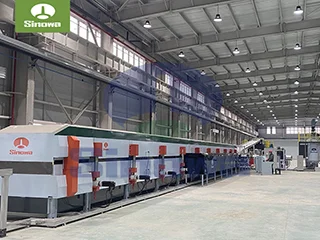
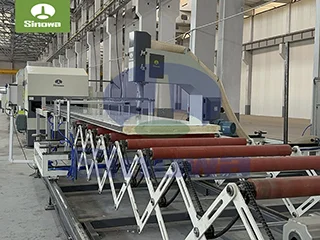
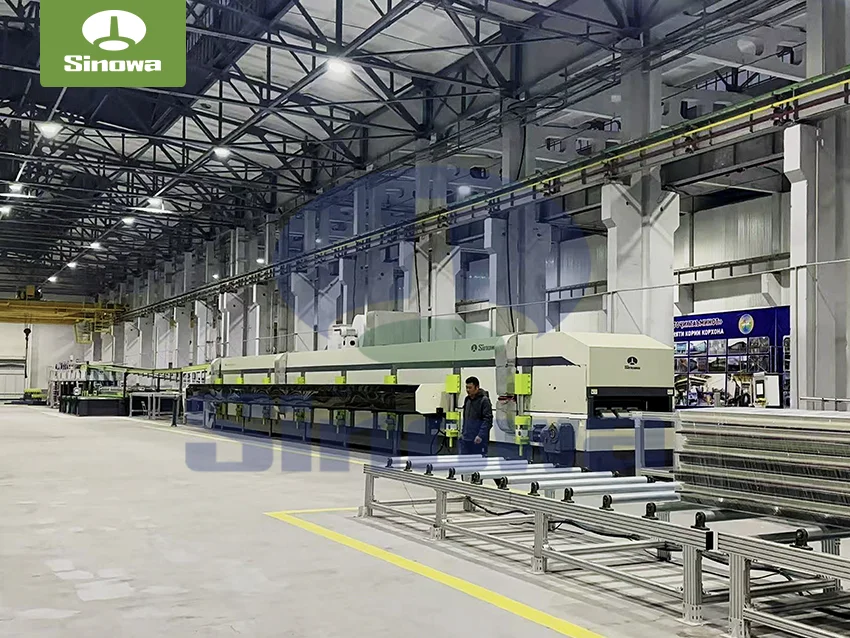
 sandwich panel line
A typical PU sandwich panel manufacturing line is a continuous, integrated system composed of several interconnected stages, each designed to contribute to the final quality and performance of the panels. The process begins with the uncoiling and feeding of metal facings, which serve as the structural and protective outer layers of the sandwich panel. Metal coils—selected based on the intended application, with considerations for thickness, corrosion resistance, and surface finish—are loaded onto decoilers that unwind the material smoothly and feed it into the subsequent stages. Precision is critical at this early phase, as any misalignment or uneven feeding can compromise the integrity of the final panel. Guide rollers and tension control systems ensure that the metal sheets move consistently through the line, maintaining flatness and preventing wrinkles or distortion.
Following uncoiling, the metal sheets undergo roll forming, a process that shapes the panels into their desired cross-sectional profile. A series of tandem rolling stands, each equipped with precision-machined rollers, progressively bends the metal sheets into specific configurations—such as corrugated, ribbed, or flat profiles—depending on the structural requirements of the end product. The roll forming process is highly customizable, allowing manufacturers to produce panels of varying widths and profiles to suit diverse applications, from industrial roofing to cold storage walls. Advanced roll forming systems incorporate adjustable rollers, enabling quick changeovers between different profiles without extensive downtime, a feature that enhances the line’s versatility in response to changing market demands.
Once the metal facings are formed, they move to the foaming station, where the PU core is injected and bonded between the two sheets. The PU foam is created by mixing two primary components—polyol and isocyanate—along with additives that control density, curing time, thermal insulation, and fire resistance. The mixture is injected into the gap between the upper and lower metal facings as they move through the line, and the chemical reaction between the components causes the foam to expand and fill the entire cavity. To ensure uniform foam distribution and proper bonding, the line is equipped with a double belt conveyor system that applies consistent pressure to the panels as the foam cures. This conveyor system also maintains the flatness of the panels during the curing process, preventing warping or uneven thickness. The curing stage is temperature-controlled, with heating or cooling elements integrated into the conveyor to optimize the foam’s curing rate and final properties. Proper curing is essential for achieving the PU core’s characteristic thermal insulation and structural strength, as incomplete curing can lead to reduced performance and durability.
After the foam has fully cured and the sandwich panel is structurally complete, the panels move to the cutting station—the stage where the automatic cutting length setting function plays a pivotal role. In traditional manufacturing lines, cutting was often a manual or semi-automated process, requiring operators to measure and adjust the cutting length for each batch of panels. This approach was not only time-consuming but also prone to human error, resulting in inconsistent panel lengths, increased material waste, and delays in production. The integration of automatic cutting length setting eliminates these challenges by leveraging advanced software and precision mechanical components to deliver accurate, customizable cuts with minimal human intervention.
The automatic cutting length setting system operates through a seamless integration of computerized controls, sensors, and cutting mechanisms. At its core is a programmable logic controller (PLC) that communicates with the line’s central control system, allowing operators to input desired panel lengths via a user-friendly interface. The PLC stores these parameters and coordinates with sensors positioned along the production line to track the movement of the panels in real time. These sensors—typically optical or laser-based—continuously monitor the panel’s position as it moves toward the cutting station, sending data back to the PLC to ensure precise alignment. When the panel reaches the pre-programmed length, the PLC triggers the cutting mechanism, which executes a clean, straight cut through the entire thickness of the sandwich panel.
The cutting mechanism itself is designed to handle the composite nature of PU sandwich panels, which consist of rigid metal facings and a foam core. Common cutting technologies used in these systems include circular saws, guillotine shears, and high-pressure water jets, each selected based on factors such as cutting speed, edge quality, and material compatibility. Circular saws equipped with specialized blades are often preferred for their ability to make smooth cuts through both metal and foam, minimizing fraying of the metal edges and dust generation from the foam core. Guillotine shears, on the other hand, are ideal for high-volume production, offering fast cutting speeds and consistent edge straightness. High-pressure water jets provide a non-thermal cutting option, which is beneficial for applications where heat-induced distortion of the metal facings or foam core must be avoided. Regardless of the cutting technology, the automatic system ensures that each cut is executed with the same precision, eliminating variations caused by manual operation.
One of the key advantages of automatic cutting length setting is its ability to support on-the-fly adjustments, allowing manufacturers to switch between different panel lengths without stopping the production line. This flexibility is particularly valuable in scenarios where small batch orders or custom lengths are required, as it reduces setup time and increases overall production efficiency. For example, a manufacturer producing panels for a modular building project may need multiple lengths to fit different wall sections; with automatic cutting length setting, the line can seamlessly transition between these lengths by updating the parameters in the control system, eliminating the need for manual adjustments and line shutdowns. This level of flexibility not only improves productivity but also enables manufacturers to respond more quickly to customer demands, enhancing their competitiveness in the market.
Another significant benefit of automatic cutting length setting is the reduction in material waste. In manual cutting processes, operator error or imprecise measurements often result in panels that are too long or too short, which must be discarded or reworked. This not only wastes valuable raw materials but also increases production costs and environmental impact. Automatic systems, by contrast, achieve cutting accuracy within tight tolerances—often within a few millimeters—ensuring that each panel meets the exact length requirements. Additionally, advanced software integrated into the system can optimize cutting layouts, taking into account the raw material dimensions and production orders to minimize waste. For instance, the software can calculate the most efficient way to cut multiple panel lengths from a continuous sheet, maximizing material utilization and reducing scrap. This waste reduction not only lowers production costs but also aligns with sustainable manufacturing practices, a growing priority for industries worldwide.
The precision offered by automatic cutting length setting also contributes to the overall quality and performance of the PU sandwich panels. Consistent panel lengths ensure easier installation on construction sites, as panels fit together seamlessly without gaps or modifications. This not only speeds up the installation process but also improves the structural integrity of the final building, as uneven panels can lead to weak points or thermal bridging. Additionally, clean, straight cuts reduce the risk of edge damage to the metal facings or foam core, preserving the panel’s thermal insulation properties and durability. For applications such as cold storage, where thermal efficiency is critical, precise cuts prevent air leakage and ensure that the panels maintain their insulating performance over time. In refrigerated transport vehicles, consistent panel lengths and edge quality are essential for maintaining the structural stability of the vehicle body and ensuring optimal temperature control during transit.
Beyond precision and flexibility, automatic cutting length setting enhances workplace safety by reducing operator involvement in the cutting process. Manual cutting requires operators to be in close proximity to moving parts and sharp tools, increasing the risk of accidents and injuries. Automatic systems minimize this risk by automating the entire cutting sequence, with operators only required to input parameters and monitor the process from a safe distance. The systems are also equipped with safety features such as emergency stop buttons, protective guards, and sensors that detect the presence of foreign objects or personnel near the cutting area, immediately halting operation if a safety hazard is detected. These safety measures not only protect operators but also reduce downtime caused by accidents, further improving overall production efficiency.
The integration of automatic cutting length setting into PU sandwich panel manufacturing lines also enables better production monitoring and quality control. The central control system collects data on cutting parameters, including length accuracy, cutting speed, and material utilization, allowing manufacturers to track performance in real time. This data can be analyzed to identify trends, optimize processes, and troubleshoot issues before they escalate. For example, if the system detects a slight deviation in cutting length, operators can adjust the parameters or inspect the cutting mechanism to resolve the issue, preventing the production of defective panels. Additionally, the data can be used to generate reports for quality assurance, ensuring that each batch of panels meets the required specifications. This level of process visibility is invaluable for maintaining consistent quality and improving operational efficiency over time.
To ensure the reliable operation of the automatic cutting length setting system, regular maintenance and calibration are essential. The cutting mechanism—whether saw, shear, or water jet—requires periodic inspection of blades, blades, or nozzles to ensure sharpness and proper alignment. Sensors must be cleaned and calibrated to maintain accurate position tracking, as dust, foam residue, or metal shavings can interfere with their performance. The PLC and control software should also be updated regularly to address any bugs or improve functionality, ensuring compatibility with new production requirements. Additionally, operators should receive proper training to use the system effectively, including how to input parameters, troubleshoot common issues, and perform basic maintenance tasks. Well-maintained systems not only deliver consistent performance but also have a longer service life, reducing the need for costly repairs or replacements.
The application of PU sandwich panel manufacturing lines with automatic cutting length setting spans a wide range of industries, each benefiting from the technology’s precision, flexibility, and efficiency. In the construction industry, these lines produce panels for walls, roofs, and partitions, supporting the rapid construction of industrial facilities, commercial buildings, and residential structures. Modular construction, in particular, relies on consistent panel lengths to ensure that prefabricated components fit together seamlessly, reducing on-site construction time and costs. In the cold storage and refrigeration sector, the precision of automatic cutting ensures that panels maintain tight seals, critical for preserving temperature-controlled environments and reducing energy consumption. Agricultural applications, such as greenhouses and livestock barns, benefit from customizable panel lengths that adapt to different building designs, while the thermal insulation properties of PU panels help regulate indoor temperatures and improve crop yields or animal welfare. Refrigerated transport vehicles, including trucks and trailers, require panels of exact lengths to fit the vehicle’s dimensions, and automatic cutting ensures that these panels provide structural integrity and thermal efficiency during transport.
As the demand for PU sandwich panels continues to grow, manufacturers are increasingly adopting automated technologies like automatic cutting length setting to stay competitive. The future of these production lines is likely to see further integration of digital technologies, such as artificial intelligence (AI) and machine learning, to optimize cutting processes and predict maintenance needs. AI-powered systems could analyze production data in real time, adjusting cutting parameters to minimize waste and improve accuracy based on material variations or environmental conditions. Additionally, the integration of Internet of Things (IoT) devices could enable remote monitoring and control of the cutting system, allowing operators to manage production from anywhere and respond quickly to issues. These advancements will further enhance the efficiency, precision, and sustainability of PU sandwich panel manufacturing, supporting the industry’s growth and adaptation to evolving market demands.
In conclusion, PU sandwich panel manufacturing lines with automatic cutting length setting represent a significant advancement in composite panel production technology. By combining precision mechanics, advanced software, and seamless integration with the overall production process, these systems deliver consistent, high-quality panels while improving efficiency, reducing waste, and enhancing workplace safety. The flexibility to handle custom lengths and quick changeovers makes them ideal for meeting the diverse needs of modern industries, from construction and cold storage to agriculture and transport. As manufacturers continue to invest in automation and digitalization, automatic cutting length setting will remain a critical component of PU sandwich panel production lines, driving innovation and setting new standards for quality and efficiency. Whether for large-scale industrial projects or small-batch custom orders, these lines provide the reliability and performance needed to produce PU sandwich panels that meet the rigorous demands of today’s applications.
https://www.cnsinowa.com/sandwich-panel-machines/pu-sandwich-panel-manufacturing-line-with-automatic-cutting-length-setting.html