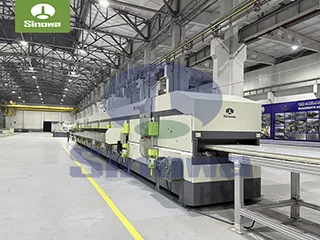
sandwich panel line
The superiority of cold storage dedicated PIR sandwich panels originates from the unique physical and chemical properties of polyisocyanurate foam core materials, and the continuous production process further amplifies these material advantages through precise process control and standardized molding. Different from ordinary thermal insulation panels used in civil buildings and general industrial workshops, cold storage sandwich panels need to maintain stable thermal insulation performance in a long-term low-temperature and high-humidity environment, while resisting structural deformation caused by temperature difference expansion and contraction, and avoiding cold bridge phenomena that affect the overall energy-saving effect of cold storage. The continuous production line realizes the uniform compounding of surface materials and core foam materials through fully automated modular operation, ensuring that each batch of panels has consistent thickness density, uniform foam pore structure, and tight bonding interface, which are the key prerequisites for ensuring the long-term operational efficiency of cold storage facilities. In the whole production process, every link is designed around the low-temperature adaptability, thermal insulation stability and structural firmness of cold storage panels, abandoning redundant process links and focusing on improving the comprehensive performance and service life of finished panels.
The entire operation logic of the continuous PIR sandwich panel production line follows the principle of synchronous matching of material conveying, chemical reaction and mechanical molding, and the whole process is continuous and uninterrupted without manual intervention in the core links. The production process starts with the pretreatment of surface facing materials. Metal sheets used for cold storage panels need to undergo strict leveling, deburring and surface pretreatment before formal compounding. The integrated pretreatment unit of the production line can eliminate surface wrinkles, uneven thickness and edge burrs of raw sheets, ensuring that the surface flatness of the panels meets the installation standards of cold storage enclosure structures. Smooth and flat panel surfaces can effectively reduce the accumulation of water vapor and frost in cold storage environments, avoid local corrosion of panel surfaces caused by long-term humid and low-temperature conditions, and extend the service cycle of cold storage buildings. At the same time, the pretreatment process can optimize the surface adhesion of the sheets, creating a better bonding foundation for the subsequent composite molding of PIR foam core materials, and preventing the delamination and cracking of panels caused by temperature changes during the operation of cold storage.
After the surface material pretreatment is completed, the sheets are continuously and stably conveyed to the composite molding area through the precision conveyor system. Meanwhile, the PIR foam raw material system performs accurate proportioning and high-speed mixing of liquid raw materials. The core foam manufacturing link is the most critical part of the entire production line, which directly determines the thermal insulation performance and structural stability of cold storage panels. The cold storage sandwich panel production line adopts a dynamic metering and mixing mode for polyether polyol, isocyanate and various functional additives, realizing real-time precise matching of raw material ratios. Compared with intermittent production, continuous mixing can make the chemical reaction of foam raw materials more sufficient and uniform, avoid local uneven density, hollow pores and inconsistent reaction degree of foam core materials, and ensure that the internal pore structure of PIR foam is fine and closed. The high closed-cell rate structure formed by continuous foaming can effectively block the transmission of air and water vapor, greatly reduce the thermal conductivity of the panel, and enable the cold storage to maintain a stable low-temperature environment, significantly reducing the energy consumption of refrigeration equipment during long-term operation.
The uniformly mixed PIR liquid raw materials are evenly injected between the upper and lower surface sheets through a high-pressure pouring system. With the continuous advancement of the conveyor, the raw materials gradually expand, react and cure in the closed molding space of the double-belt pressing unit. The double-belt lamination system is equipped with precise temperature and pressure adjustment devices, which can maintain constant molding temperature and uniform pressing pressure in the whole foaming and curing stage. This stable molding environment enables the PIR foam to expand evenly in all directions, form a compact and integrated core structure, and achieve seamless and tight bonding with the upper and lower surface materials. For cold storage panels, the integration degree of the core material and surface material is extremely important. In the low-temperature alternating environment of cold storage, panels with poor bonding performance are prone to interface separation, which will form air gaps and lead to heat leakage, seriously affecting the thermal insulation effect of the cold storage and increasing operational energy consumption. The continuous pressing and curing process of the PIR sandwich panel line can effectively avoid such quality problems, ensuring that the composite structure of the panel remains stable in long-term low-temperature, high-humidity and frequent temperature fluctuation environments.
After the primary curing and composite molding of the panels, the semi-finished products are continuously conveyed to the constant-temperature curing area for secondary shaping and curing. The gradient temperature control mode adopted by the curing area can slowly release the internal stress generated by the foam reaction and mechanical pressing, avoiding panel deformation, warping and size deviation caused by rapid temperature change. The secondary curing process further optimizes the internal molecular structure of the PIR foam, improves the dimensional stability and compression resistance of the panel, and enables the panel to withstand the pressure of external wind load, internal equipment load and structural extrusion during the construction and operation of cold storage. Especially for large-scale high-space cold storage facilities, the overall flatness and structural stability of the enclosure panels directly affect the structural safety and sealing performance of the building, and the secondary curing process of the continuous sandwich panel production line provides reliable quality guarantee for the mechanical properties of finished panels.
After the curing process is completed, the panels enter the automatic finishing and cutting stage. The continuous PIR sandwcih panel machine is equipped with a follow-up cutting system that matches the production speed, which can perform fixed-length cutting and edge trimming according to different cold storage construction specifications. The intelligent cutting unit can ensure smooth and neat panel sections, uniform edge sizes and no burrs, which is conducive to the precise docking and assembly of panels during on-site cold storage construction, improving the installation efficiency and overall sealing effect of the enclosure structure. The neatly cut panel joints can reduce the generation of cold bridge gaps, effectively block heat exchange inside and outside the cold storage, and further optimize the energy-saving performance of the cold storage system. In addition, the production line can realize flexible adjustment of panel thickness and length by adjusting process parameters, meeting the customized production needs of different types of cold storage, including low-temperature frozen storage, constant-temperature fresh storage, and ultra-low-temperature special storage, and adapting to the structural design requirements of different cold storage wall panels, roof panels and partition panels.
Compared with traditional intermittent production equipment, the core advantages of the continuous PIR sandwich panel production line are reflected in production stability, product consistency and resource utilization efficiency. The fully closed and automated continuous production mode reduces manual operation links, avoids product quality fluctuations caused by human operation errors, and makes the performance parameters of each panel in the whole production batch highly consistent. For cold storage engineering construction, standardized and consistent panel quality is the key to ensuring the overall thermal insulation effect of the project. If the performance of individual panels is uneven, local heat leakage points will be formed in the cold storage enclosure structure, resulting in increased refrigeration energy consumption, uneven internal temperature, and even local frosting and icing, which will affect the storage quality of goods. The continuous production process completely solves this industry pain point and provides high-quality standardized building materials for large-scale and standardized cold storage construction.
In terms of material utilization and production cost control, the continuous sandwich panel line has significant optimization effects. The precise metering and pouring system can accurately control the dosage of foam raw materials, avoid raw material waste caused by excessive pouring in intermittent production, and improve the utilization rate of chemical raw materials. At the same time, the continuous molding process reduces defective products generated in the processes of material loading, mold closing and mold opening in intermittent production, and the yield of finished products is greatly improved. In the long-term mass production process, the efficient material utilization rate and low defective rate can effectively reduce the comprehensive production cost of panels, providing cost-effective high-performance thermal insulation materials for cold storage construction projects. In addition, the integrated compact design of the production line occupies a small production space, realizes streamlined operation from raw material input to finished product output, and greatly improves the overall production efficiency, which can meet the large-scale material supply demand of centralized cold storage project construction periods.
The PIR sandwich panels produced by the continuous production line have excellent low-temperature resistance and aging resistance, which are highly compatible with the long-term operation characteristics of cold storage facilities. In a long-term low-temperature environment, ordinary thermal insulation foam materials are prone to molecular structure changes, leading to increased thermal conductivity, shrinkage and deformation, and attenuation of thermal insulation performance. However, the PIR foam formed by continuous high-precision reaction has a stable cross-linked molecular structure, which can maintain stable physical and thermal insulation properties in a low-temperature environment for a long time, without obvious shrinkage, embrittlement or heat conduction attenuation. This long-term stability ensures that the cold storage can maintain a low energy consumption level during the whole service cycle, avoids the performance degradation and frequent maintenance and replacement of thermal insulation materials, and reduces the later operation and maintenance cost of cold storage buildings.
In terms of structural performance, the continuous composite process makes the surface material and core foam material form an integrated stress-bearing structure. The panel has high compressive strength and bending resistance, can adapt to the structural load requirements of cold storage roofs, walls and partitions, and has good wind resistance and seismic performance. The overall rigid structure of the panel can effectively resist structural deformation caused by temperature difference stress and external load, ensuring the structural integrity and sealing performance of the cold storage enclosure system. Good structural stability can prevent cold air leakage and external heat infiltration caused by panel deformation and cracking, and maintain the constant temperature and humidity environment inside the cold storage, which is crucial for the safe storage of food, medicine and other temperature-sensitive goods.
With the continuous upgrading of cold chain industry standards and the increasing awareness of building energy conservation, the market demand for high-performance PIR sandwich panels is constantly improving, which also promotes the continuous technological optimization of continuous production lines. Modern continuous PIR sandwich panel production machine has realized intelligent parameter adjustment and automatic fault monitoring. The whole production process can realize real-time monitoring and fine adjustment of temperature, pressure, material ratio and production speed, ensuring that the production process is always in the optimal state. The intelligent control system can record the production data of each batch of products, which is convenient for product quality tracking and production process optimization, and further improves the standardization level of product production.
In practical engineering applications, continuous-produced PIR sandwich panels show irreplaceable advantages in medium and large-scale cold storage construction. Whether it is a single-layer large-span cold storage or a multi-layer composite cold storage building, the standardized and high-performance panels can perfectly adapt to various structural design schemes. The excellent thermal insulation performance effectively reduces the refrigeration load of the cold storage, realizes the energy-saving and low-carbon operation of the building, and conforms to the current development trend of green building and low-carbon logistics. At the same time, the lightweight characteristic of the sandwich panel reduces the self-weight of the cold storage building structure, reduces the load-bearing pressure of the building foundation and main structure, saves the construction cost of the main project, and shortens the construction cycle of the cold storage.
In conclusion, the continuous PIR sandwich panel manufacturing line, with its integrated, automated and standardized production mode, provides high-quality, high-stability and energy-efficient core materials for cold storage construction. Through precise control of every production link from raw material pretreatment, foaming composite molding to finishing cutting, it ensures that the finished panels have excellent thermal insulation, structural stability and low-temperature aging resistance, fully meeting the harsh operational requirements of cold storage facilities. With the continuous expansion of the cold chain logistics industry and the continuous improvement of building energy-saving standards, this continuous production technology will become the mainstream production mode of cold storage thermal insulation panels, continuously empower the high-quality development of the cold storage construction industry, and provide solid technical and product support for the safe, efficient and low-carbon operation of modern cold chain storage systems.
https://www.cnsinowa.com/sandwich-panel-machines/continuous-pir-sandwich-panel-production-line-for-cold-storage.html