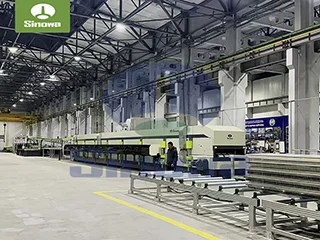
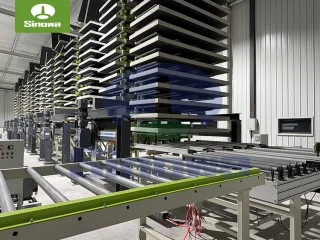
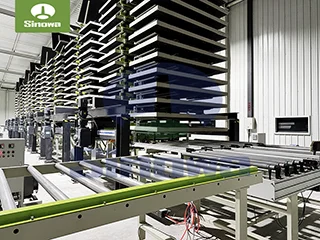
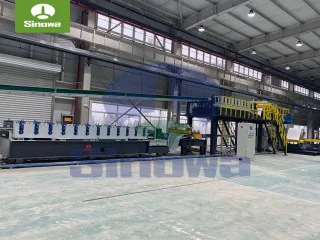
sandwich panel line
The structure of an insulation panel manufacturing line is designed according to the production process of different insulation materials, but it generally consists of several core modules that work together to complete the entire production cycle from raw material processing to finished product packaging. The initial stage of the production line is the raw material handling system, which includes storage equipment, metering devices and conveying components. Raw materials of different types, such as polymers, inorganic fibers, foaming agents, catalysts and flame retardants, are stored in dedicated tanks or silos to avoid moisture absorption and contamination. The metering devices adopt precision control technology to accurately adjust the proportion of each raw material, as the ratio of components directly affects the thermal insulation performance, mechanical strength and durability of the final panels. Conveying components, such as screw conveyors and pipeline systems, transport the measured raw materials to the next process in a closed environment to reduce material loss and environmental pollution.
Following the raw material handling system is the mixing and foaming module, which is the core part of the production line for foam-based insulation panels. This module includes mixing heads, foaming chambers and temperature control devices. The mixing head uses high-pressure or low-pressure mixing technology to fully blend reactive raw materials, such as polyol and isocyanate for polyurethane panels, with additives like foaming agents and catalysts. The mixing process must be fast and uniform to ensure that the foaming reaction proceeds stably. The foaming chamber provides a controlled environment for the mixed materials to expand and solidify. Temperature control devices maintain the chamber at an optimal temperature range, as excessive or insufficient temperature can lead to uneven foaming, reduced thermal insulation performance or structural defects. For fiber-based insulation panels, this stage is replaced by fiber carding and laying equipment, which combs loose fibers into a uniform felt and stacks them to the required thickness, forming the basic structure of the panel core.
The lamination and molding system is another key component, especially for sandwich insulation panels composed of a core layer and surface layers. This system usually includes uncoilers, preheating devices, laminators and shaping tools. Uncoilers feed surface materials, such as metal sheets, paper, films or composite fabrics, into the production line continuously. Preheating devices use infrared lamps or hot air to heat the surface materials to a suitable temperature, which enhances the adhesion between the surface layers and the core layer. The laminator, often a double-belt conveyor, applies uniform pressure and temperature to bond the surface layers with the foamed or fiber core. The double-belt structure ensures that the insulation panel maintains a flat surface and consistent thickness during the molding process. For panels with special shapes, additional shaping tools are integrated into the system to achieve the desired profile without compromising structural integrity.
After molding, the insulation panels enter the cooling and post-processing module. Newly formed panels, especially foam-based ones, have high internal temperatures and need to be cooled to room temperature to stabilize their structure. Cooling devices adopt air cooling or water cooling methods, with temperature sensors monitoring the cooling process to prevent deformation caused by rapid temperature changes. Post-processing equipment includes cutting machines, edge trimming tools and surface treatment components. Cutting machines use precision saws or laser cutting technology to cut the continuous panel into fixed-length pieces according to customer requirements, ensuring high dimensional accuracy. Edge trimming tools remove irregular edges and shape the panel edges to improve installation convenience. Surface treatment components may include sanding, coating or laminating processes to enhance the panel's waterproof, corrosion-resistant or aesthetic properties.
The final part of the manufacturing line is the stacking and packaging system, which realizes automated handling and storage of finished products. This system includes stacking machines, packaging machines and conveying lines. Stacking machines neatly stack the cut insulation panels according to specified quantities, avoiding damage during transportation. Packaging machines use plastic film, waterproof paper or composite materials to wrap the stacked panels, protecting them from moisture, dust and mechanical impact during storage and transportation. Some advanced lines are equipped with intelligent sorting systems that classify panels by size, type or performance parameters, improving logistics efficiency. The entire production line is controlled by a central control system, which integrates PLC controllers, touch screens and sensors to monitor and adjust each process in real time. Operators can set production parameters, track production progress and troubleshoot faults through the control interface, realizing high automation and stability of the production process.
The performance of an insulation panel manufacturing line is reflected in multiple aspects, including production efficiency, product precision, process flexibility and energy consumption control. Production efficiency is determined by the line's speed and continuity, with advanced continuous production lines capable of processing a large area of insulation panels per hour. The stability of the mixing, foaming and lamination processes ensures that the production line maintains a high output without compromising product quality. Product precision mainly refers to the consistency of thickness, size and performance parameters of the insulation panels. Precision control systems in the line minimize dimensional errors, ensuring that each panel meets the design standards. Process flexibility is the ability of the production line to adapt to different types and specifications of insulation panels. Modular design allows quick adjustment of process parameters, replacement of molds or surface materials, enabling the production of various panels to meet diverse market demands.
Energy consumption control is an increasingly important performance indicator of modern manufacturing lines, driven by environmental protection requirements. Advanced lines adopt energy-saving technologies such as heat recovery systems, which recycle waste heat generated during the foaming and cooling processes for preheating raw materials or maintaining the production environment temperature. Variable frequency drives are used in conveyors, mixers and other equipment to adjust power output according to production load, reducing unnecessary energy consumption. In addition, closed-loop material handling systems minimize material waste, while low-pollution additives and dust removal devices reduce the environmental impact of the production process. The reliability and maintainability of the production line are also key performance factors. High-quality components and standardized design reduce the frequency of equipment failures, while easy-to-access maintenance points shorten downtime, ensuring continuous and stable production.
The type of insulation panel produced is closely related to the design and configuration of the manufacturing line, as different materials require specific processes and equipment. Polystyrene (EPS) insulation panels are produced using lines equipped with pre-expansion equipment, mixing systems and molding machines. Raw polystyrene beads are first pre-expanded to a certain volume, then mixed with a foaming agent and heated in a mold to form a uniform foam structure. EPS panels have a thermal conductivity of 0.032-0.042 W/(m·K), light weight and good water resistance, making them suitable for building exterior walls, roofs and floors. The production line for EPS panels emphasizes precise control of pre-expansion temperature and molding pressure to ensure uniform cell structure and stable performance.
Polyurethane (PU) insulation panels are manufactured using lines with high-pressure mixing heads and double-belt laminators, which ensure thorough mixing of reactive components and uniform foaming. PU panels have excellent thermal insulation performance with a thermal conductivity of less than 0.024 W/(m·K), making them one of the most efficient insulation materials available. The production line for PU panels can be adjusted to produce rigid foam panels for refrigeration equipment, building insulation and industrial pipelines. The line's ability to control foam density and cell size allows customization of PU panels with different mechanical strengths and thermal insulation levels.
Extruded polystyrene (XPS) insulation panels are produced using extrusion-based manufacturing lines. Raw materials are melted, mixed with foaming agents and extruded through a die to form a continuous panel with a closed-cell structure. XPS panels have a thermal conductivity of 0.028-0.036 W/(m·K), excellent water resistance and high compressive strength, making them ideal for underground projects, exterior wall insulation and roof insulation. The production line for XPS panels requires precise control of extrusion temperature, pressure and cooling rate to ensure the formation of a dense closed-cell structure and stable dimensional performance.
Inorganic fiber insulation panels, such as rock wool and glass wool panels, are produced using lines with fiber melting, spinning, carding and molding equipment. Rock wool panels are made by melting natural rocks like basalt at high temperatures, spinning the molten material into fibers, and then pressing and curing the fibers into panels. They have a thermal conductivity of 0.035-0.045 W/(m·K) and excellent fire resistance, suitable for industrial workshops, high-rise buildings and fire protection facilities. Glass wool panels are produced from recycled glass, which is melted and spun into fibers, then formed into panels through carding and laminating processes. With a thermal conductivity of 0.030-0.040 W/(m·K), glass wool panels are widely used in air conditioning pipelines, ventilation systems and wall insulation due to their light weight and good sound absorption properties.
Emerging fiber-reinforced composite insulation panels are produced using modified manufacturing lines that integrate fiber mixing, resin impregnation and hot-pressing processes. These panels combine resin matrices, such as polyester or polyurethane, with reinforcing fibers like glass fiber or carbon fiber, resulting in excellent thermal insulation performance and mechanical strength. The production line for composite insulation panels requires precise control of fiber content, resin impregnation rate and hot-pressing parameters to balance thermal insulation and structural performance, making them suitable for special working conditions such as high-pressure or corrosive environments.
The wide range of applications of insulation panels is largely supported by the versatility of their manufacturing lines, which can produce panels tailored to specific application scenarios. In the construction industry, insulation panels are widely used in exterior walls, roofs, floors and interior partitions. EPS, XPS and PU panels are commonly used in residential and commercial buildings to improve energy efficiency, reduce heating and cooling costs and enhance indoor comfort. Rock wool and glass wool panels are preferred in high-rise buildings and industrial workshops due to their fire resistance and sound absorption properties, helping to create safe and quiet indoor environments. The lightweight nature of insulation panels also reduces the overall load of buildings, enabling more flexible architectural designs.
In the refrigeration and cold storage industry, PU and XPS insulation panels are essential materials for manufacturing refrigerators, freezers and cold storage warehouses. Their low thermal conductivity and good airtightness effectively reduce heat transfer, maintaining stable low temperatures inside the equipment while reducing energy consumption. The manufacturing lines can produce panels with different thicknesses and densities to meet the insulation requirements of different refrigeration temperatures, from household refrigerators to large-scale cold storage facilities for food preservation and pharmaceutical storage.
The industrial sector uses insulation panels for thermal insulation of pipelines, boilers and industrial equipment. Rock wool and glass wool panels are widely used in thermal insulation of high-temperature pipelines and boilers due to their high-temperature resistance and thermal stability, reducing heat loss and improving energy efficiency. PU and XPS panels are used for insulation of low-temperature industrial equipment and chemical pipelines, preventing condensation and corrosion. Fiber-reinforced composite insulation panels are increasingly used in special industrial environments, such as offshore platforms and chemical plants, due to their corrosion resistance and mechanical strength.
In the transportation industry, insulation panels are used in the manufacturing of refrigerated trucks, railway carriages and ship cabins. PU insulation panels are commonly used in refrigerated trucks to maintain the temperature of transported goods, such as fresh food and pharmaceuticals, during long-distance transportation. The lightweight and high-strength properties of insulation panels also help reduce the overall weight of transportation vehicles, improving fuel efficiency. In shipbuilding, rock wool panels are used for cabin insulation and fire protection, meeting the strict safety and environmental requirements of the maritime industry.
Public buildings, such as hospitals, schools and leisure facilities, also rely heavily on insulation panels. Hospitals require insulation materials with good fire resistance, sound absorption and hygiene performance, making rock wool and glass wool panels ideal choices for wall and ceiling insulation. Schools and leisure facilities use insulation panels to create comfortable indoor environments with stable temperatures and low noise levels, enhancing the user experience. Additionally, insulation panels can be integrated with renewable energy systems, such as photovoltaic panels on roofs, further improving the sustainability of public buildings.
The continuous development of insulation panel manufacturing lines is driven by the growing demand for energy efficiency and environmental protection. Future lines will focus on higher automation, precision and sustainability, with the integration of intelligent technologies such as artificial intelligence and Internet of Things to optimize production processes in real time. The development of new materials and processes will expand the types of insulation panels, enabling the production of panels with better performance, such as ultra-low thermal conductivity, self-healing properties and environmental friendliness. As the global emphasis on energy conservation and carbon reduction increases, insulation panel manufacturing lines will play an increasingly important role in promoting the development of green buildings, energy-efficient industrial processes and sustainable transportation, contributing to a more environmentally friendly and energy-efficient future.
https://www.cnsinowa.com/sandwich-panel-machines/insulation-panel-manufacturing-line.html