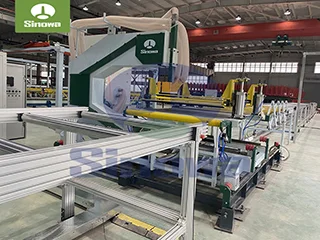
sandwich panel line
The structure of a high efficiency PU foam production line is a sophisticated integration of multiple functional units, each playing a vital role in ensuring the smooth progression of the production process from raw material preparation to finished product processing. At the core of the production line lies the raw material handling and metering system, which serves as the foundation for stable foam quality. This system typically includes storage tanks, preheating devices, agitators, and precision metering pumps. Storage tanks are designed to maintain the stability of raw materials such as polyol, isocyanate, blowing agents, catalysts, and surfactants, with agitators preventing sedimentation and ensuring uniform component distribution. Preheating devices regulate the temperature of raw materials within an optimal range—usually between 25°C and 30°C—to control reaction rate and avoid viscosity fluctuations that could affect mixing uniformity. Precision metering pumps are critical components that deliver each raw material to the mixing unit in strict accordance with preset ratios. The accuracy of these pumps directly influences the chemical reaction equilibrium, as even minor deviations in the ratio of polyol to isocyanate can lead to defects such as uneven cell structure, insufficient expansion, or reduced mechanical strength. Modern high efficiency lines often adopt multi-component metering systems capable of handling up to 12 different raw materials simultaneously, accommodating complex foam formulations with diverse functional additives.
The mixing unit is another key structural component, responsible for achieving homogeneous blending of raw materials to initiate the foaming reaction. Two primary mixing technologies are employed in high efficiency production lines: high-pressure impingement mixing and low-pressure dynamic mixing. High-pressure systems force streams of polyol and isocyanate to collide at high velocity in a confined mixing chamber, creating intense shear forces that ensure instantaneous and uniform dispersion. This technology is particularly suitable for large-scale continuous production, as it minimizes mixing time and prevents premature reaction. Low-pressure dynamic mixing, on the other hand, uses rotating paddles or screws to stir raw materials, offering greater flexibility for small-batch production with frequent formula changes. Both systems are equipped with self-cleaning mechanisms to avoid cross-contamination between different formulations and reduce material waste. The mixing head, a core part of the mixing unit, is designed to maintain precise clearance and mixing speed, with some advanced models featuring automatic adjustment based on real-time process parameters.
Following the mixing unit is the foaming and curing system, which determines the final shape, density, and mechanical properties of the foam. Continuous production lines typically use double-belt conveyors or roller conveyors to transport the mixed raw materials through a controlled environment where foaming and curing occur sequentially. The conveyor system maintains a stable speed to ensure consistent foam thickness and expansion time, with adjustable speed settings to accommodate different foam densities and formulations. The curing zone is divided into multiple temperature-controlled sections, gradually increasing the temperature to promote complete polymerization and cross-linking of the foam. This staged temperature control prevents defects such as cell collapse or surface cracking caused by rapid temperature changes. For molded foam production, the foaming and curing system includes precision molds and heating/cooling devices. Molds are made of materials with excellent thermal conductivity to ensure uniform temperature distribution, while hydraulic or pneumatic systems enable smooth demolding without damaging the foam structure. Post-curing devices may also be integrated to enhance the dimensional stability and mechanical strength of the foam, especially for products requiring high performance in harsh environments.
The final structural component of the production line is the finishing system, which includes cutting, trimming, and quality inspection equipment. Continuous foam blocks produced by slab stock lines are cut into standard sizes using longitudinal and transverse cutting machines equipped with high-precision blades and positioning systems. These cutting machines ensure clean, smooth cuts with minimal material loss, adapting to different foam densities and thicknesses. Quality inspection equipment integrated into the finishing system uses non-destructive testing technologies such as infrared imaging or ultrasonic scanning to detect internal defects like uneven cell distribution, voids, or density variations. Some advanced lines also incorporate automated sorting systems to separate defective products, ensuring only qualified foam enters the packaging process. The entire structure of the high efficiency PU foam production line is connected by an intelligent control system, which coordinates the operation of all units through programmable logic controllers (PLC) and touch screen interfaces, enabling real-time monitoring, parameter adjustment, and data recording.
The performance of high efficiency PU foam production lines is characterized by precision, stability, energy efficiency, and flexibility—key attributes that distinguish them from conventional production equipment. Precision performance is reflected in the accurate control of raw material ratios, temperature, pressure, and mixing speed. Advanced metering pumps achieve flow rate accuracy within ±1%, ensuring consistent chemical reactions and foam quality batch after batch. Temperature control systems maintain raw material and curing environment temperatures with a deviation of less than ±0.5°C, preventing fluctuations that could alter the foam’s cell structure and mechanical properties. Pressure control in the mixing and foaming stages is equally critical, as it regulates the expansion rate of the foam and the formation of closed or open cell structures. High efficiency lines maintain stable pressure levels throughout the production process, ensuring uniform foam density and minimizing defects.
Stability performance refers to the production line’s ability to operate continuously for extended periods without significant downtime or performance degradation. This is achieved through robust mechanical design, high-quality components, and intelligent fault diagnosis systems. Critical components such as metering pumps, mixing heads, and conveyors are built to withstand long-term high-load operation, with wear-resistant materials reducing maintenance frequency. Intelligent fault diagnosis systems monitor key parameters in real time, issuing alerts for potential issues such as pump leakage, temperature anomalies, or motor malfunctions. This proactive monitoring enables timely maintenance, minimizing unplanned downtime and ensuring consistent production output. High efficiency lines can typically operate continuously for 24 hours a day with a reliability rate exceeding 95%, significantly improving production efficiency compared to conventional batch systems.
Energy efficiency is a prominent performance feature of modern high efficiency PU foam production lines, driven by the growing demand for sustainable manufacturing. These lines incorporate multiple energy-saving technologies, such as heat recovery systems that capture waste heat from the curing process and reuse it for raw material preheating. Variable frequency drives (VFD) adjust the speed of motors based on production load, reducing energy consumption during low-output periods. Insulated storage tanks and curing zones minimize heat loss, further optimizing energy usage. Compared to traditional production lines, high efficiency models can reduce energy consumption by 15% to 30%, lowering operational costs and carbon footprint. Additionally, advanced material recovery systems collect and reuse excess foam or raw material residues, reducing waste and improving resource utilization.
Flexibility performance enables the production line to adapt to different foam types, formulations, and production scales with minimal adjustments. Multi-component metering systems support quick formula changes, allowing manufacturers to switch between flexible, rigid, semi-rigid, or integral skin foams without extensive equipment modifications. The modular design of many high efficiency lines facilitates customization and expansion, with additional units such as extra metering pumps or specialized curing zones easily integrated to meet evolving production needs. For small-batch, multi-variety production, some lines offer rapid changeover capabilities, reducing downtime between different product runs to less than 30 minutes. This flexibility is essential for meeting diverse market demands, from mass-produced insulation panels to custom automotive components.
High efficiency PU foam production lines can be classified into several types based on production process, foam type, and operational mode, each tailored to specific application scenarios and production requirements. Continuous slab stock production lines are the most common type for large-scale manufacturing of flexible and semi-rigid foam blocks. These lines operate continuously, producing long foam slabs that are subsequently cut into standard sizes. They are ideal for high-volume production of materials such as mattress cores, furniture cushions, and acoustic insulation foam. Continuous lines offer high production efficiency, consistent quality, and low unit costs, making them suitable for industries with stable, large-scale demand.
Batch foaming lines, also known as box foaming lines, are designed for small-batch or custom production. These lines use insulated boxes or tanks to contain the foam mixture during expansion and curing, allowing for precise control over foam size and shape. Batch lines are highly flexible, capable of producing a wide range of foam densities and formulations, including specialized products such as flame-retardant foam, anti-static foam, and high-resilience foam. They are commonly used in industries where product variety is prioritized over volume, such as custom packaging, medical devices, and small-batch automotive parts. While batch lines have lower production efficiency compared to continuous lines, they offer greater control over the foaming process and are more cost-effective for small-scale operations.
Molded foaming production lines are specialized for manufacturing shaped PU foam products with precise dimensions and surface finishes. These lines use precision molds to define the final product shape, with the foam mixture injected or poured into the molds before expanding and curing. Molded lines can be further categorized into open-mold and closed-mold systems. Open-mold systems are suitable for products with simple shapes and large surface areas, while closed-mold systems produce complex, high-precision parts with uniform density and surface quality. Molded lines are widely used in the automotive industry for seats, headrests, armrests, and interior trim components, as well as in the furniture industry for ergonomic cushions and structural parts. Advanced molded lines integrate robotic systems for automatic mold handling, material injection, and demolding, improving production efficiency and reducing labor costs.
Specialized high efficiency PU foam production lines are designed for specific foam types or applications, such as rigid foam insulation lines, spray foam production lines, and integral skin foam lines. Rigid foam insulation lines are optimized for producing closed-cell foam panels used in building insulation, refrigeration equipment, and pipeline insulation. These lines feature specialized blowing agent injection systems and curing processes to achieve high thermal insulation performance and low thermal conductivity. Spray foam production lines are mobile or stationary systems used for on-site or factory-based spray foam applications, such as building envelope insulation and cavity filling. Integral skin foam lines produce foam with a dense, smooth surface and a foam core, ideal for products requiring both aesthetic appeal and structural integrity, such as steering wheels, tool handles, and cosmetic cases.
The applications of high efficiency PU foam production lines span a wide range of industries, driven by the versatility of PU foam and the ability of these lines to produce high-quality, consistent products. In the construction industry, rigid foam insulation panels produced by high efficiency lines are widely used for wall insulation, roof insulation, and floor heating systems. These panels offer excellent thermal insulation properties, with closed-cell structures reducing heat transfer and improving energy efficiency in buildings. The precision and stability of high efficiency lines ensure that the insulation panels meet strict dimensional and performance requirements, enhancing building durability and comfort. Additionally, spray foam produced by specialized lines is used for sealing gaps, cracks, and cavities in buildings, providing both insulation and moisture resistance.
The automotive industry is another major consumer of PU foam products, with high efficiency production lines playing a critical role in manufacturing interior and exterior components. Molded foam lines produce seats, headrests, armrests, and door panels, offering superior comfort, support, and impact resistance. High-resilience foam produced by these lines enhances passenger comfort, while flame-retardant and sound-absorbing foam improves vehicle safety and noise reduction. Rigid PU foam is used for bumper cores, dashboard substrates, and structural components, reducing vehicle weight and improving fuel efficiency. The flexibility and precision of high efficiency lines enable automotive manufacturers to meet the strict quality and design requirements of modern vehicles, adapting to changes in model designs and material specifications.
In the furniture and bedding industry, continuous slab stock lines and batch lines produce flexible foam for mattresses, sofas, chairs, and other upholstered products. High efficiency lines ensure consistent foam density and resilience, providing long-lasting comfort and support. Memory foam, a type of slow-rebound PU foam, is produced using specialized lines with precise temperature and pressure control, offering contouring support for mattresses and pillows. The ability to adjust foam formulations allows manufacturers to create products with varying firmness levels, catering to diverse consumer preferences. Additionally, integral skin foam produced by specialized lines is used for furniture components such as armrests and table edges, combining aesthetic appeal with durability.
The packaging industry benefits from high efficiency PU foam production lines for manufacturing custom protective packaging solutions. Flexible and semi-rigid foam produced by these lines is used to cushion fragile items such as electronic devices, glassware, and medical equipment during transportation. The ability to produce foam in various densities and shapes allows for tailored packaging designs that absorb shocks and prevent damage. Rigid foam is also used for heavy-duty packaging, providing structural support and moisture resistance. High efficiency lines enable packaging manufacturers to meet tight production deadlines and customize products for different clients, improving supply chain efficiency and product protection.
Other industries utilizing high efficiency PU foam production lines include the medical, aerospace, and footwear industries. In the medical field, PU foam is used for orthopedic cushions, wheelchair seats, and medical device components, with high efficiency lines ensuring biocompatibility and consistent performance. Aerospace applications include lightweight foam components for aircraft interiors, offering both comfort and weight reduction. In the footwear industry, PU foam is used for shoe soles, insoles, and uppers, with specialized lines producing foam with superior cushioning, durability, and breathability.
As industries continue to demand higher performance, greater sustainability, and more diverse foam products, high efficiency PU foam production lines are evolving to incorporate advanced technologies. The integration of artificial intelligence (AI) and machine learning enables predictive maintenance, real-time process optimization, and quality forecasting, further improving production efficiency and reducing defects. The adoption of eco-friendly raw materials and blowing agents, such as bio-based polyols and low-global-warming-potential (GWP) blowing agents, aligns with global sustainability goals, with high efficiency lines optimized to handle these new materials. Additionally, the development of compact, modular production lines caters to the growing demand for small-scale, localized production, enabling manufacturers to reduce transportation costs and respond quickly to regional market needs.
In conclusion, high efficiency PU foam production lines are sophisticated systems that combine precision mechanics, advanced chemical process control, and intelligent management to produce high-quality PU foam products. Their well-designed structure, superior performance characteristics, diverse types, and wide-ranging applications make them indispensable in modern manufacturing. As technology advances and market demands evolve, these production lines will continue to play a pivotal role in driving innovation in PU foam applications, promoting sustainability, and enhancing the competitiveness of manufacturers across industries. Understanding the capabilities and potential of high efficiency PU foam production lines is essential for leveraging the full potential of PU foam as a versatile, high-performance material.
https://www.cnsinowa.com/sandwich-panel-machines/high-efficiency-pu-foam-production-line.html