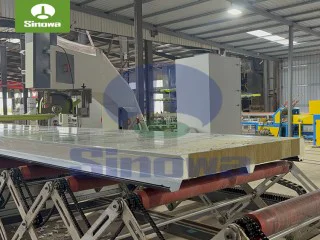
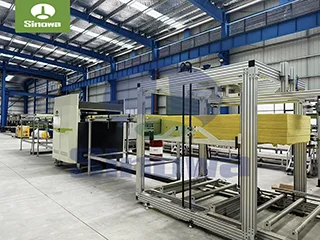
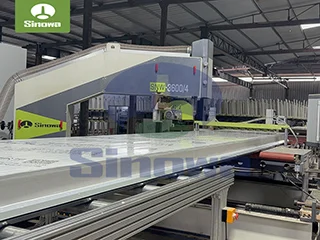
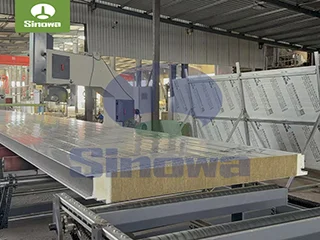
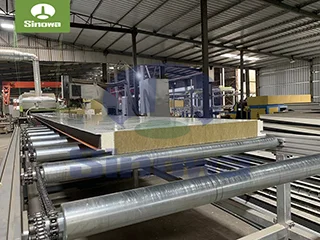
sandwich panel line
The structure of a mineral wool insulation board production line consists of several interconnected systems, each performing a critical function in transforming raw materials into finished boards. The process begins with the raw material handling and batching system, which is designed to ensure precise mixing of primary and secondary materials. Primary raw materials typically include natural rocks such as basalt, diabase, and dolomite, while secondary materials may consist of recycled cullet, blast-furnace slag, and production off-cuts. These materials are stored in enclosed silos to prevent contamination and moisture absorption, then transported via closed conveyors to weighing and batching units. The batching system uses electronic sensors and PLC control to measure exact quantities of each material, as the ratio of raw materials directly affects the thermal, mechanical, and fire-resistant properties of the final product. Recycled materials, which can account for a significant proportion of the input—up to 85% in some glass wool variants—are integrated into the batching process to reduce energy consumption and environmental impact, aligning with sustainable manufacturing practices.
Following batching, the materials are fed into the melting system, the core of the production line. The melting furnace operates at extremely high temperatures, typically between 1,300°C and 1,600°C, to convert the solid raw materials into a homogeneous molten mass. The furnace is equipped with heat recovery systems and exhaust filtration units to minimize energy waste and reduce environmental emissions. Gases produced during melting are cleaned through advanced filtration processes, and water usage is confined to closed-circuit systems to limit freshwater consumption and prevent wastewater discharge. Once fully melted, the molten material is transferred to the fiberization system, where it is transformed into fine mineral fibers. The most common fiberization method involves rotating flywheels or centrifuges, which spin the molten material at high speeds to stretch it into thin fibers with diameters ranging from 2 to 6 micrometers. Alternatively, air or steam blasting techniques may be used to achieve fiberization, depending on the desired fiber structure and density. During this stage, a small amount of thermosetting binder—usually phenolic or acrylic-based—is sprayed onto the fibers to enhance cohesion and mechanical strength.
After fiberization, the fibers are conveyed to the mat formation and curing system. The fibers, coated with binder, are deposited onto a moving conveyor belt to form a loose mat. This mat is then passed through a pendulum spreader and pleating press to ensure uniform thickness and density distribution across the board. The next step is curing, where the mat is introduced into a curing oven operating at approximately 200°C. The curing process activates the binder, bonding the fibers together to form a rigid, stable structure. The duration and temperature of curing are precisely controlled to achieve the desired mechanical properties, as under-curing can result in weak boards while over-curing may reduce flexibility. Following curing, the board enters the cooling zone, where it is gradually cooled to ambient temperature to prevent thermal stress and deformation. The final stages of the production line include cutting, trimming, and recycling. The cooled board is cut into standard or custom sizes using precision cutting equipment, and any waste edges or off-cuts are collected and recycled back into the melting system, further improving material efficiency. The finished boards are then packaged in moisture-resistant film and palletized for storage and transportation, with compression packaging often used to reduce volume and lower transportation-related carbon emissions.
The performance of mineral wool insulation boards is defined by a combination of thermal, mechanical, fire-resistant, acoustic, and moisture-related properties, which make them suitable for a wide range of applications. Thermal insulation performance is a key characteristic, measured by thermal conductivity and thermal resistance values. Mineral wool boards typically exhibit thermal conductivity values between 0.034 and 0.043 W/m·K, with thermal resistance (R-value) ranging from 3.0 to 4.0 per inch. This allows them to effectively reduce heat transfer through building envelopes, industrial equipment, and HVAC systems, contributing to energy efficiency and reduced heating and cooling costs. Unlike some synthetic insulation materials, mineral wool maintains its thermal performance over time, with a service life of 40 to 80 years when installed and maintained properly.
Fire resistance is one of the most outstanding performance features of mineral wool insulation boards. As inorganic materials, they are inherently non-combustible and can withstand temperatures exceeding 1,000°C without igniting, melting, or releasing toxic smoke. Their flame spread index and smoke developed index are both zero, meaning they do not contribute to fire propagation or smoke production in the event of a fire. This property makes them a critical component in fire protection systems, helping to contain fires and protect structural elements, occupants, and property. Mechanically, mineral wool boards offer good dimensional stability and compression strength. They can resist deformation under moderate pressure, with compression strength (at 10% deformation) typically exceeding 40 kPa, and maintain their shape even when exposed to thermal cycling and humidity changes. This stability prevents settling or sagging over time, ensuring long-term insulation effectiveness.
Acoustic performance is another significant advantage of mineral wool insulation boards. The porous structure of the fiber mat traps sound waves, reducing noise transmission and absorption. In partition walls, they can increase sound transmission class (STC) ratings by 5 to 10 points, while in exterior assemblies, they contribute to STC uplift of 5 to 8 points. This makes them ideal for applications requiring noise control, such as residential buildings, commercial offices, schools, and industrial facilities. Moisture resistance is also a key performance attribute. The inorganic fibers are resistant to mold, mildew, and rot, and the hydrophobic binder used in production repels water, with a hydrophobic rate exceeding 99%. Additionally, mineral wool boards are vapor-permeable, allowing building assemblies to dry outward and minimizing the risk of condensation and moisture accumulation, which can lead to structural damage and poor indoor air quality. They also exhibit low moisture absorption, with weight gain from moisture typically less than 0.5%.
Mineral wool insulation boards are classified into various types based on density, material composition, and intended application, each tailored to meet specific performance requirements. Density-based classification includes low-density, medium-density, and high-density boards. Low-density boards (50 to 80 kg/m³) are lightweight and flexible, suitable for interior insulation, acoustic panels, and HVAC duct insulation. They offer excellent sound absorption and thermal insulation but have lower mechanical strength, making them unsuitable for load-bearing applications. Medium-density boards (80 to 120 kg/m³) balance thermal performance, acoustic properties, and mechanical strength, making them versatile for a range of applications, including exterior wall insulation, roof insulation, and partition walls. High-density boards (120 to 200 kg/m³) are rigid and durable, designed for high-performance applications such as industrial equipment insulation, marine bulkheads, and fire-rated barriers. They offer superior compression strength and fire resistance, capable of withstanding higher temperatures and harsher environments.
Material composition-based types include stone wool boards and glass wool boards. Stone wool boards are made from natural rocks and slag, offering higher fire resistance and temperature tolerance, with maximum service temperatures ranging from 350°C to 750°C. They are ideal for high-temperature applications such as industrial furnaces, chimneys, and marine insulation. Glass wool boards, on the other hand, are produced from sand, limestone, and recycled cullet, with a lower maximum service temperature (typically up to 250°C) but excellent thermal insulation and acoustic performance at a lower density. They are commonly used in residential and commercial building insulation, HVAC systems, and interior soundproofing. Some mineral wool boards are also available with facings, such as foil or weather-resistive membranes, which enhance moisture control and facilitate installation by providing a smooth surface for cladding attachment.
The applications of mineral wool insulation boards span across residential, commercial, industrial, and marine sectors, driven by their versatile performance characteristics. In the building and construction industry, they are widely used for exterior wall insulation, roof insulation, basement insulation, and partition walls. Exterior wall insulation with mineral wool boards eliminates thermal bridging, reduces energy loss, and protects the building frame from thermal and moisture swings, improving overall building envelope performance. Roof insulation applications include flat roofs, pitched roofs, and cathedral ceilings, where the boards provide thermal insulation and fire protection. In basements and below-grade applications, their vapor permeability and moisture resistance prevent condensation and mold growth, protecting the structural integrity of the building.
Residential buildings benefit from mineral wool boards in multiple ways, including improved energy efficiency, noise reduction, and fire safety. They are used in wall cavities, attic floors, and around pipes to reduce heating and cooling costs, create quieter living environments, and enhance fire protection between rooms and floors. Commercial buildings, such as offices, schools, hospitals, and shopping malls, rely on mineral wool boards for acoustic control in open-plan spaces, fire-rated partitions, and exterior insulation to meet energy efficiency regulations. In hospitals, their mold resistance and low odor emission make them suitable for areas requiring high hygiene standards.
Industrial applications of mineral wool insulation boards are diverse, focusing on thermal management, fire protection, and noise control. They are used to insulate industrial furnaces, boilers, pipes, and tanks, reducing heat loss and improving energy efficiency in manufacturing processes. High-density mineral wool boards are ideal for insulating equipment operating at high temperatures, as they can withstand extreme heat without degrading. In power plants, chemical facilities, and oil refineries, they provide fire protection for structural elements and equipment, helping to prevent the spread of fires and minimize damage. Additionally, they are used in industrial noise control, reducing noise from machinery and equipment to comply with occupational health and safety standards.
HVAC systems are another major application area for mineral wool insulation boards. They are used to insulate ducts, air handlers, and heat exchangers, reducing thermal loss and condensation, and improving the energy efficiency of heating and cooling systems. The acoustic properties of mineral wool also help to reduce noise from HVAC equipment, improving indoor air quality and comfort in residential and commercial buildings. Marine applications include insulation for ship bulkheads, decks, and engine rooms, where fire resistance, thermal insulation, and moisture resistance are critical. Mineral wool boards used in marine settings are designed to withstand the harsh marine environment, including saltwater exposure and temperature fluctuations, while providing fire protection for the vessel and its occupants.
Soundproofing applications extend beyond buildings and industrial facilities to include theaters, recording studios, and transportation infrastructure. Mineral wool boards are used in soundproof walls, ceilings, and floors to absorb sound and reduce noise transmission, creating optimal acoustic environments for performance and recording. In transportation, they are used in railway cars, buses, and aircraft to reduce interior noise, improving passenger comfort. Additionally, they are used in noise barriers along highways and railways to reduce traffic noise pollution in residential and commercial areas.
The versatility and performance of mineral wool insulation boards continue to drive their adoption across various sectors, supported by growing awareness of energy efficiency, sustainability, and safety regulations. The production line’s ability to adapt to different raw material inputs, including recycled materials, and produce boards of varying densities and compositions ensures that there is a mineral wool insulation board suitable for almost any insulation, fire protection, or acoustic control need. As manufacturing technologies advance, production lines are becoming more efficient, with improved process control and higher material recycling rates, further enhancing the environmental sustainability of mineral wool insulation boards. Whether in a residential home, a commercial skyscraper, an industrial plant, or a marine vessel, mineral wool insulation boards play a vital role in creating safer, more energy-efficient, and more comfortable environments.
https://www.cnsinowa.com/sandwich-panel-machines/mineral-wool-insulation-board-production-line.html