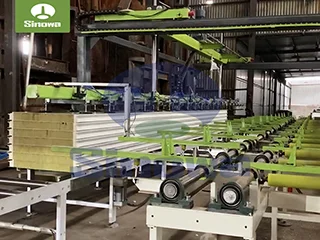
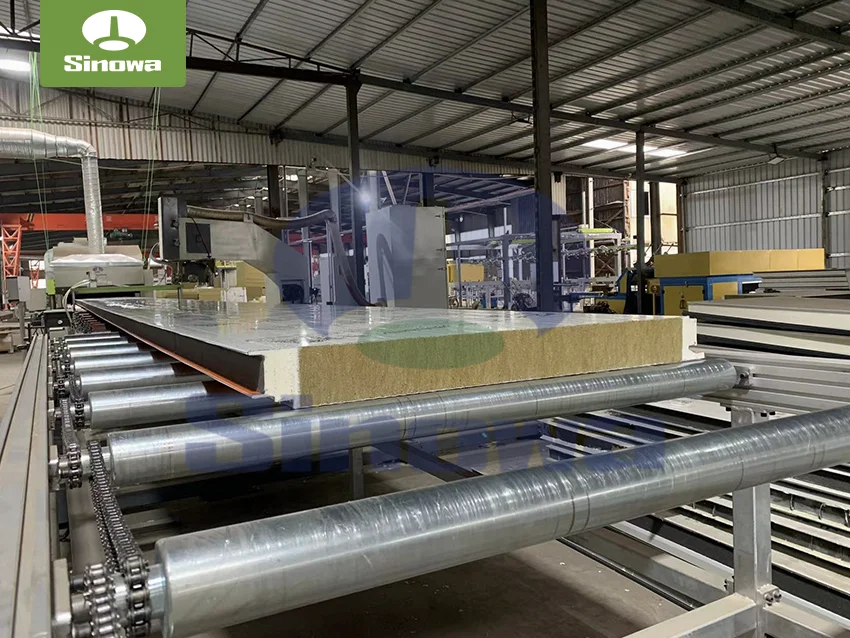
 sandwich panel line
The initial stage of the entire production process is raw material preparation and pretreatment, which lays the fundamental foundation for stable product quality and continuous production. The main raw materials adopted by mineral wool board production are natural mineral materials and industrial solid waste silicate materials with stable chemical composition, including basalt, dolomite, slag and other high-quality raw materials. These raw materials need to go through strict pretreatment procedures before entering the melting link to eliminate impurities and unqualified particles that may affect subsequent processing and product performance. The pretreatment system is equipped with crushing, screening, drying and quantitative proportioning units to complete standardized processing of raw materials. Large-particle raw materials are firstly sent to crushing equipment for graded crushing, and the crushed mineral particles are screened through multi-layer vibrating screening devices to screen out particles with uniform particle size, ensuring that the particle size distribution of raw materials meets the melting process requirements. Excessively large particles will cause insufficient melting in the high-temperature furnace, while overly fine powder materials will affect the ventilation and temperature uniformity inside the furnace, both of which will interfere with the stability of subsequent fibrillation process.
After crushing and screening, qualified mineral particles will enter the automatic drying system to remove residual moisture contained in the raw materials. Moisture in raw materials will rapidly vaporize and expand in the high-temperature melting environment, which not only affects the temperature stability inside the furnace, but also easily causes fluctuations in the flow state of molten liquid, resulting in uneven fiber thickness and inconsistent product density. The dried raw materials are transported to the sealed storage silos for classified storage, and the subsequent accurate proportioning work is completed through the automatic metering and feeding system. According to the preset production process formula, the system quantitatively mixes different types of mineral raw materials and auxiliary modifiers, and the proportioning accuracy is strictly controlled within a tiny error range. Reasonable raw material proportioning can optimize the fluidity and viscosity of high-temperature molten liquid, improve the fineness and toughness of formed fibers, and further enhance the overall performance of finished mineral wool boards. The fully enclosed raw material processing and conveying mode effectively avoids dust overflow, reduces material waste, and improves the cleanliness and environmental protection level of the production workshop.
High-temperature melting is the core thermal processing link of the mineral wool sandwich panel production line, which determines the forming quality of mineral fibers. The proportioned mixed raw materials are continuously and stably sent to the high-temperature melting furnace through the automatic feeding device. Modern production lines mainly adopt closed large-scale melting equipment, which can provide a stable high-temperature environment ranging from 1300 degrees Celsius to 1600 degrees Celsius. In the high-temperature furnace body, solid mineral raw materials undergo complete physical melting and mild chemical recombination, and are gradually converted into homogeneous and smooth silicate molten liquid. The internal temperature field of the melting furnace is uniformly distributed through precise temperature control systems, avoiding local overheating or insufficient heating. Stable high-temperature environment ensures that all mineral components are fully melted, eliminates unmelted particle residues, and guarantees the uniformity of molten liquid composition and fluidity.
The melting process is equipped with a complete flue gas treatment and heat preservation system. The waste gas and heat generated during high-temperature melting are recycled and treated uniformly. The waste heat is recovered and reused for raw material drying and workshop heating, which effectively improves energy utilization efficiency and reduces production energy consumption. The flue gas generated in the production process is filtered and purified through multi-stage environmental protection equipment to remove particulate impurities and harmful substances, ensuring that the exhaust gas meets environmental discharge standards. The closed furnace body structure not only reduces heat loss and improves thermal efficiency, but also isolates external air interference, avoids oxidation and deterioration of molten liquid, and maintains the stability of molten liquid properties required for subsequent fibrillation.
Centrifugal fibrillation is the key process to convert molten mineral liquid into fibrous raw materials, and it is also the core link to determine the structural characteristics of mineral wool boards. The high-temperature molten liquid flowing out stably from the melting furnace passes through the flow guide tank and uniformly drops onto the high-speed rotating centrifugal fibrillation unit. The fibrillation unit is composed of multiple groups of high-precision rotating rollers, which can maintain stable high-speed rotation speed during operation. Under the action of huge centrifugal force, the viscous molten liquid is rapidly stretched and split from liquid droplets into ultra-fine continuous mineral fiber filaments. In the process of fiber stretching and forming, the high-speed airflow generated by the equipment further refines the fibers, making the fiber diameter reach a uniform micron level. Reasonable matching of centrifugal speed and airflow velocity can effectively adjust the fineness and length of mineral fibers, so as to adapt to the production requirements of mineral wool boards with different density and performance parameters.
During the fibrillation process, the atomized binder solution is evenly sprayed on the surface of newly formed mineral fibers through the high-pressure spraying system. The binder is a special polymer material with good adhesion and temperature resistance, which can bond scattered single fibers into an integral fiber network structure. The uniform spraying of binder ensures that each fiber surface is covered with a thin and consistent adhesive layer, avoiding local excessive bonding or insufficient bonding. This step is crucial for the subsequent forming and curing of mineral wool boards. It can enhance the bonding force between fibers, improve the structural integrity and mechanical strength of the board, and prevent fiber shedding and structural loosening in the use process. At the same time, the spraying amount of the binder is accurately controlled according to the production process standards, which not only ensures the forming effect of the product, but also avoids excessive binder residue affecting the environmental protection performance and fire resistance of the finished product.
The fiber collection and wool laying process realizes the preliminary stacking and forming of mineral wool board blanks. The mineral fibers sprayed with binder are suspended in the airflow and uniformly conveyed to the fiber collection and forming equipment. The equipment adopts negative pressure adsorption technology to collect scattered fibers uniformly, and the pendulum type wool laying device reciprocates horizontally to lay fibers layer by layer on the conveying platform. The layered wool laying mode makes the fiber distribution in the board blank three-dimensional and staggered, forming a porous and uniform internal structure. This unique fiber stacking structure endows mineral wool boards with excellent thermal insulation and sound absorption performance, as the a large number of tiny closed pores inside the structure can effectively block heat conduction and sound wave transmission.
The thickness and density of the preliminary board blank are initially adjusted by the wool laying system. By adjusting the reciprocating speed of the pendulum device, the conveying speed of the base belt and the fiber feeding amount, the mineral wool sandwich panel line can stably prepare board blanks with different thickness specifications and density grades. After preliminary wool laying and forming, the board blank enters the pre-pressing unit for preliminary compression shaping. The pre-pressing equipment applies uniform and gentle pressure to the loose fiber board blank to discharge the excess air inside the fiber gap, reduce the volume of the board blank, make the fiber structure more compact and stable, and lay a foundation for subsequent formal curing and shaping. The pre-pressing process strictly controls the pressure intensity and pressing speed to avoid excessive pressure damaging the fiber structure and causing the problem of reduced product elasticity and thermal insulation performance.
Constant temperature curing and shaping is an important link to finalize the structural performance of mineral wool boards. The pre-pressed board blank is continuously sent to the closed curing oven through the conveying system. The interior of the curing oven maintains a stable constant temperature and hot air circulation environment, and the hot air uniformly acts on the surface and interior of the board blank through the circulating air system. Under the action of constant temperature heat, the binder on the fiber surface undergoes cross-linking and curing reaction, gradually solidifying and forming a stable bonding structure between fibers. The curing process is carried out in stages according to the thickness and density of the product. The low-temperature pre-curing stage stabilizes the surface structure of the board blank, and the high-temperature deep curing stage completes the internal fiber bonding and structural shaping, ensuring that the internal and external curing degree of the board is consistent.
The closed circulating hot air design of the curing oven ensures uniform temperature distribution in the entire curing area, avoids local under-curing or over-curing of the board. Insufficient curing will lead to insufficient bonding force between fibers, easy deformation and fiber shedding of the product, while excessive curing will cause aging and failure of the binder, reduce the toughness and durability of the board. After sufficient curing, the loose fiber board blank is completely shaped into a solid and integrated mineral wool board semi-finished product with stable structure, fixed thickness and uniform density. The semi-finished product after curing has basic mechanical properties and functional characteristics, and then enters the cooling and shaping link.
The high-temperature cured semi-finished mineral wool board is sent to the natural cooling and air cooling area for gradual cooling treatment. The staged cooling mode of combining natural heat dissipation and forced air cooling is adopted to avoid quality problems such as board deformation, internal stress concentration and surface cracking caused by rapid temperature drop. In the cooling process, the internal structure of the board is further stabilized, and the residual heat and trace volatile substances generated by binder curing are completely discharged. After cooling to room temperature, the size and structural performance of the mineral wool board tend to be completely stable, meeting the conditions for subsequent precision cutting and finishing processing.
Precision cutting and trimming processing is the final shaping link of finished products, which standardizes the external size and appearance quality of mineral wool boards. The cooled semi-finished boards are accurately positioned and conveyed to the cutting unit through the automatic conveying system. The cutting system includes longitudinal cutting and transverse cutting devices, which respectively complete the fixed-width trimming and fixed-length cutting of the boards. The high-precision cutting equipment adopts stable transmission and positioning technology to ensure that the cutting section is flat and smooth without burrs, cracks and uneven sections. The dimensional error of the cut finished products is controlled within a very small range, realizing the standardization and consistency of product specifications.
In the cutting process, the mineral wool sandwich panel machine is equipped with an automatic waste material recovery system. The edge materials and leftover materials generated by cutting are automatically collected, crushed and screened, and then returned to the raw material pretreatment link for secondary recycling and utilization. This cyclic processing mode effectively improves the utilization rate of raw materials, reduces production waste, and realizes energy-saving and environmentally friendly production. After cutting and trimming, the finished mineral wool boards are inspected for appearance, size and structural flatness, and unqualified products are screened out and reprocessed to ensure that all delivered products meet the production process standards.
The post-processing and packaging system of the mineral wool sandwich panel making machine completes the final finishing and sealed storage of finished products. Qualified mineral wool boards are stacked neatly through the automatic stacking device, and then sealed and packaged by the packaging equipment. The sealed packaging can effectively isolate moisture and dust in the air, prevent the mineral wool boards from absorbing moisture and damp deformation during storage and transportation, and protect the surface integrity and internal structural stability of the products. At the same time, the standardized packaging is convenient for finished product storage, transportation and on-site construction and use, improving the overall operational efficiency of production and sales links.
The automatic control system runs through the whole process of the entire mineral wool insulation board production line, which is the core guarantee to realize continuous, stable and efficient production. The system realizes real-time monitoring and precise regulation of all links including raw material proportioning, melting temperature, centrifugal speed, binder spraying amount, curing temperature and time, cutting size and conveying speed. All process parameters are digitally controlled and automatically adjusted according to the production state, which avoids product quality fluctuations caused by manual operation errors. The real-time data monitoring function can track the production operation state in real time, automatically record production data, and alarm and adjust abnormal parameters in time, ensuring the continuity and stability of the production process.
The modern mineral wool insulation panel production line also has excellent flexible production capacity. By adjusting the process parameters of each link, the production line can produce mineral wool boards with different density, thickness, strength and functional characteristics, meeting the diversified application needs of different scenarios. Low-density lightweight products are suitable for building interior insulation and sound absorption decoration, with the advantages of light weight and convenient construction; medium and high-density products have higher mechanical strength and structural stability, and are suitable for building exterior wall insulation, industrial equipment heat preservation and other scenarios requiring high load-bearing and weather resistance. The flexible adjustment of the production process makes the production line have strong market adaptability and production flexibility.
In terms of production safety and environmental protection, the mineral wool panel production line adopts a full-sealed production design in the whole process. All production links such as raw material conveying, crushing, fibrillation and forming are carried out in closed equipment, which fundamentally reduces dust overflow and noise pollution. The dust generated in the production process is collected and processed by the centralized dust removal system, and the recovered dust is recycled as raw materials, which not only ensures the cleanliness of the production environment, but also realizes resource recycling. The noise generated by high-speed operation equipment is reduced through shock absorption and sound insulation structure design, which improves the working environment of the production workshop.
The waste heat recovery and flue gas purification system configured in the sandwich panel production line effectively reduces energy consumption and environmental pollution. The waste heat generated by high-temperature melting and curing is fully recycled and applied to raw material drying, workshop heating and other links, greatly improving energy utilization efficiency and reducing production energy consumption. The flue gas generated by high-temperature thermal processing is purified by multi-stage filtration and purification equipment to remove particulate matter and harmful components, realizing clean emission of production waste gas. The whole production process meets the requirements of green industrial production, with low energy consumption, low pollution and high resource utilization rate.
The equipment structure of the mineral wool board production line adopts modular integrated design, and each functional unit is closely connected and coordinated with each other to form a complete and continuous production chain. The modular design makes the equipment layout more reasonable, saves production space, and is convenient for daily maintenance and equipment upgrading. Each functional module has independent operation and adjustment functions, which can independently optimize the process parameters of a single link without affecting the normal operation of the whole production line, improving the convenience of production debugging and equipment maintenance.
In the long-term production operation, the stable operation of the mineral wool sandwich panel line depends on the matching of process parameters and the good operation state of the equipment. Regular equipment maintenance, parameter calibration and equipment cleaning can effectively maintain the production accuracy and operation stability of the production line, avoid equipment aging and parameter deviation leading to product quality problems, and extend the service life of the production equipment. The standardized operation and maintenance management mode ensures that the production line can maintain efficient and stable production state for a long time, continuously output high-quality mineral wool board products.
The products manufactured by the mineral wool sandwich panel manufacturing machine have excellent comprehensive performance, relying on the scientific and standardized production process. The unique three-dimensional staggered fiber porous structure gives the product low thermal conductivity, which can effectively block heat transfer and achieve efficient thermal insulation and energy saving effect. A large number of tiny internal pores can absorb and isolate sound waves, with excellent sound absorption and noise reduction performance. At the same time, the raw materials are all inorganic mineral materials, which have good fire resistance and high temperature resistance, and will not burn or release harmful gases in high-temperature environment, with high safety performance. In addition, the product has good chemical stability, corrosion resistance, weather resistance and structural toughness, and can maintain stable performance in complex environments such as high temperature, low temperature and humid corrosion, with long service life.
With the continuous development of building energy conservation and industrial environmental protection industry, the market demand for high-performance mineral wool board products is increasing day by day, which also promotes the continuous upgrading and optimization of mineral wool board production line technology. Modern mineral wool sandwich panel production machine is developing towards higher automation, lower energy consumption, more environmental protection and more flexible production. The continuous optimization of raw material proportioning technology, melting energy-saving technology, fiber forming precision control technology and curing shaping technology further improves product performance and production efficiency, reduces production costs and resource consumption, and promotes the sustainable development of the mineral wool insulation material industry.
In practical industrial production, the operation level of the mineral wool board manufacturing line directly determines the product quality consistency and production efficiency. Scientific process debugging, standardized operation management and perfect equipment maintenance system are important guarantees to give full play to the performance of the production line. By continuously optimizing the production process parameters and equipment operation mode, the sandwich panel machinery can realize efficient, stable and green production, provide high-quality functional insulation materials for construction, industry, energy conservation and environmental protection fields, and make important contributions to building energy conservation, industrial energy consumption reduction and environmental protection improvement.
https://www.cnsinowa.com/sandwich-panel-machines/mineral-wool-board-production-line.html