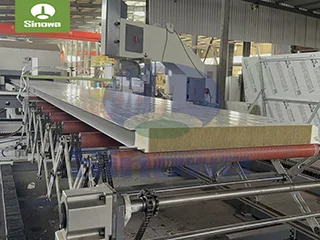
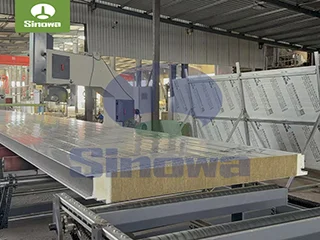
sandwich panel line
The structural composition of such a production line is modular, with each unit working in coordination to achieve the desired product specifications. The system typically starts with a raw material preparation module, where inorganic materials such as basalt, dolomite, and slag are precisely weighed and mixed according to specific ratios. These raw materials are then fed into a melting furnace, often equipped with a circulating cooling system to maintain stable operating temperatures and prevent overheating. The molten material is transferred through a flow trough to a centrifugal device, which uses high-speed rotation and high-pressure air to convert the melt into fine rock wool fibers. A resin supply system sprays a bonding agent onto the fibers in a formation chamber, ensuring uniform adhesion that will later contribute to the panel’s structural integrity.
After fiber formation, the material is collected by a cotton collector and conveyed to a folding machine to form a continuous wool mat with a uniform thickness. This mat then passes through a hot air circulation curing furnace, where controlled temperature and airflow promote the curing of the bonding agent, shaping the mat into a rigid rock wool panel blank. The curing process is critical, as it determines the panel’s density, compressive strength, and thermal insulation performance—parameters that are closely monitored and adjusted through frequency conversion technology to maintain consistency. Following curing, the panel blank undergoes preliminary cutting to remove irregular edges, preparing it for the laminating stage.
The laminating system is the defining component of this production line, responsible for applying a protective or functional facing to one or both sides of the rock wool panel. This system consists of unwinding devices, adhesive application units, pressing rollers, and cooling mechanisms. The facing materials, which can vary based on application needs, are unwound from rolls and fed into the laminating station in synchronization with the rock wool panel. An automatic adhesive spraying system applies a uniform layer of bonding agent—often polyurethane or a cement-based compound—to either the facing material or the panel surface, ensuring strong adhesion without compromising the core’s performance. Bidirectional pressing rollers exert consistent pressure to bond the facing and the core tightly, while adjustable lifting devices accommodate different panel thicknesses, ranging from 30mm to 150mm or more depending on configuration.
After laminating, the composite panel moves to a precision cutting module, equipped with servo-controlled reciprocating cutting tools for vertical and horizontal cutting. This module allows for arbitrary length adjustments and ensures high dimensional accuracy, eliminating material waste and reducing post-processing needs. A cleaning system removes dust and debris from the panel surface, maintaining product cleanliness before packaging. The entire production process is controlled by a centralized computer system, which integrates digital servo technology, frequency conversion vector control, and hydraulic regulation to achieve fully automated operation. Operators input required parameters such as panel thickness, density, and facing material, and the system adjusts each module accordingly, minimizing human intervention and error.
The performance of a rock wool panel production line with a laminating system is characterized by high efficiency, stability, and energy-saving capabilities. One of the key performance metrics is production speed, which typically ranges from 3 to 15 meters per minute depending on the panel thickness and material specifications—thinner panels with lighter facings can be produced at higher speeds, while thicker, denser panels require slower speeds to ensure proper curing and laminating. The line’s annual production capacity can reach hundreds of thousands of square meters when operating under standard working conditions, making it suitable for large-scale manufacturing.
Energy efficiency is another notable performance feature, with modern systems consuming up to 40% less energy compared to older models. This is achieved through optimized furnace design, heat recovery from the curing process, and frequency conversion technology that adjusts motor speed based on production demand, reducing unnecessary power consumption. The system also operates with low noise levels and minimal environmental impact, thanks to integrated dust collection devices that prevent particulate emissions and comply with environmental standards. The laminating process itself enhances the final product’s performance, improving its water resistance, fire resistance, and anti-fall properties compared to unlaminated rock wool panels. The strong bonding between the core and facing prevents delamination, even under extreme temperature changes or mechanical stress.
Reliability and ease of maintenance are additional performance advantages. The modular design allows for easy installation, inspection, and repair of individual components, minimizing downtime. Core components are engineered for durability, with wear-resistant materials used in high-stress areas such as pressing rollers and cutting tools. The centralized control system provides real-time monitoring of all production parameters, issuing alerts for potential issues such as temperature fluctuations, adhesive shortages, or mechanical malfunctions, enabling proactive maintenance and reducing the risk of production disruptions.
Rock wool panel production lines with laminating systems can be categorized based on several factors, including production mode, laminating technology, and product type. Continuous production lines are the most common, offering uninterrupted operation that maximizes efficiency and ensures consistent product quality. These lines are ideal for large-volume orders and standard panel specifications, with automated stacking and packaging modules that streamline the entire workflow. Batch production lines, by contrast, are designed for small-batch or custom-order production, allowing for frequent adjustments to panel thickness, density, and facing materials. This flexibility makes them suitable for specialized applications where unique product specifications are required.
Based on laminating technology, the lines can be divided into dry laminating and wet laminating systems. Dry laminating uses hot-melt adhesives or pressure-sensitive adhesives, which require no drying time and are suitable for heat-sensitive facing materials such as aluminum foil or plastic films. Wet laminating uses water-based or solvent-based adhesives, which require a drying stage after application—this method is often used for cement-based facings or when a stronger bond is needed for heavy-duty applications. Some advanced systems offer hybrid laminating capabilities, allowing manufacturers to switch between different technologies based on production needs.
Another classification is based on the fiber orientation of the rock wool core. Vertical fiber production lines orient the fibers perpendicular to the panel surface, resulting in higher compressive strength and better sound absorption performance, making them suitable for load-bearing applications. Horizontal fiber lines produce panels with fibers parallel to the surface, which offer excellent thermal insulation properties and are often used in non-load-bearing scenarios. The laminating system can be adapted to both fiber orientations, ensuring the facing material bonds effectively regardless of core structure.
The applications of rock wool panels produced by these lines are diverse, spanning the construction, industrial, marine, and automotive sectors, among others. In the construction industry, they are widely used for external wall insulation, roof insulation, and fire isolation belts. The laminating layer enhances the panel’s water resistance and mechanical strength, making it suitable for exterior applications where exposure to weather conditions is inevitable. When used as external wall insulation, the panels reduce heat transfer between the interior and exterior of buildings, improving energy efficiency and reducing heating and cooling costs. As fire isolation belts, they provide a barrier against flame spread, helping to contain fires and protect building structures and occupants.
Structural insulation integration systems also rely on these panels, as the laminating layer enables better integration with building structures, reducing construction time and improving overall structural stability. The panels are easy to install, cutting down on labor costs and minimizing construction waste—addressing the drawbacks of traditional rock wool boards, which were often difficult to handle and install uniformly.
In industrial settings, the panels are used for thermal insulation and sound absorption in equipment, pipelines, and industrial buildings. Their fire resistance and thermal stability make them suitable for high-temperature environments such as power plants, petrochemical facilities, and metallurgical plants. The laminating layer protects the rock wool core from oil, moisture, and chemical corrosion, extending the panel’s service life in harsh industrial conditions. They are also used in cold storage facilities, where their excellent thermal insulation properties help maintain stable low temperatures, while the facing material provides a smooth, easy-to-clean surface.
Marine applications benefit from the panels’ fire resistance and water resistance, as they are used for insulation in ship cabins, engine rooms, and bulkheads. The laminating layer prevents water absorption, which is critical for marine environments where moisture can cause structural damage and reduce insulation performance. In the automotive industry, the panels are used for sound insulation in vehicle interiors, reducing noise from the engine and external sources, and improving passenger comfort.
Cold regions also utilize these panels for road waterproofing and anti-freezing applications. The panels are installed beneath road surfaces to prevent frost heave, which can damage pavement structures. The laminating layer provides a waterproof barrier, preventing water from seeping into the underlying soil and freezing, while the rock wool core offers thermal insulation to maintain stable soil temperatures. This application helps extend the service life of roads in high-cold areas, reducing maintenance costs.
Additionally, the panels are used in soundproofing projects such as concert halls, recording studios, and residential buildings near busy roads. The combination of the rock wool core’s sound absorption properties and the laminating layer’s sound insulation capabilities creates an effective barrier against noise transmission. The facing material can also be customized to meet aesthetic requirements, making the panels suitable for interior decoration applications where both functionality and appearance are important.
The versatility of these production lines allows for the manufacturing of panels with varying specifications to meet specific application needs. By adjusting parameters such as core density, panel thickness, and facing material, manufacturers can produce panels optimized for thermal insulation, fire resistance, sound absorption, or mechanical strength. This adaptability has contributed to the widespread adoption of rock wool panels with laminating layers across multiple industries, as they offer a cost-effective, durable, and environmentally friendly solution for insulation and protection needs.
In summary, a rock wool panel production line with a laminating system is a highly advanced manufacturing solution that combines precision engineering with automated control to produce high-quality composite panels. Its modular structure ensures flexibility and efficiency, while its superior performance characteristics minimize energy consumption and environmental impact. The diverse types of production lines cater to different manufacturing needs, from large-scale continuous production to small-batch custom orders. The resulting panels find applications in a wide range of sectors, driven by their excellent thermal insulation, fire resistance, sound absorption, and durability—attributes enhanced by the integrated laminating process. As industries continue to prioritize energy efficiency and sustainability, the demand for such production lines and their products is expected to grow, driving further technological innovations in design and performance.
https://www.cnsinowa.com/sandwich-panel-machines/rock-wool-panel-production-line-with-laminating-system.html