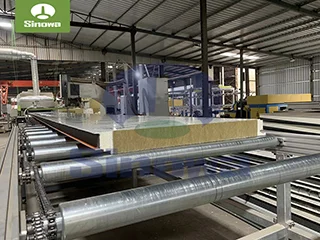
sandwich panel machine
At its core, the rock wool sandwich panel making machine is designed to streamline the production of composite panels consisting of a rock wool core—made from basalt and other inorganic materials melted at high temperatures—and outer facings typically composed of color steel sheets, stainless steel sheets, or aluminum sheets. The production process is a seamless integration of multiple stages, each meticulously coordinated by advanced control systems to ensure the final product meets stringent performance and dimensional requirements. The workflow begins with the preparation and processing of raw materials, progresses through core material handling, adhesive application, lamination, heating and curing, precision cutting, and concludes with stacking and packaging. Each stage is equipped with specialized components that work in harmony to achieve the desired panel properties, making the machinery a testament to the synergy of mechanical engineering, electrical control, and material science.
The raw material preparation stage is the foundation of the entire production process, requiring careful handling of both the outer facing materials and the rock wool core. For the outer panels, coiled metal sheets are loaded onto decoiling systems, which unroll the sheets smoothly while maintaining tension control to prevent wrinkling or deformation. These decoiling systems are equipped with adjustable mechanisms to accommodate different coil widths and thicknesses, ensuring versatility in panel production. The metal sheets then pass through a preheating device, where they are heated to a precise temperature to enhance the adhesion of the adhesive and promote better bonding with the rock wool core. Meanwhile, the rock wool core material, initially in the form of large slabs, undergoes a series of processing steps. First, the rock wool slabs are fed into a slitting device, which cuts them into strips of specified thicknesses—ranging from 50mm to 250mm depending on the intended application. The slitting process is characterized by high precision, ensuring uniform strip dimensions that contribute to the structural integrity of the final panel. After slitting, the rock wool strips are conveyed to a turning device that adjusts their fiber direction to be vertical, a critical step that significantly enhances the mechanical strength and load-bearing capacity of the finished sandwich panel.
Following the preparation of raw materials, the production process moves to the core handling and adhesive application stage. The rock wool strips are transported via a conveyor system to the adhesive spraying area, where specialized spray guns apply a uniform layer of adhesive to both the upper and lower surfaces of the core. The adhesive used is typically a high-performance polyurethane-based compound, chosen for its strong bonding strength, resistance to environmental factors, and compatibility with both rock wool and metal facings. The spraying system is equipped with adjustable nozzles and precise flow control mechanisms, ensuring that the adhesive is applied in the correct dosage—usually between 180g and 250g per square meter—to achieve optimal bonding without excess waste. Simultaneously, the preheated metal sheets are also coated with adhesive on the side that will bond with the rock wool core. This dual adhesive application ensures a secure and durable bond between the core and the outer facings, a key factor in the panel's overall performance and longevity.
The lamination and heating curing stage is where the individual components come together to form the composite panel. The adhesive-coated rock wool core is precisely positioned between the upper and lower metal facings, guided by alignment mechanisms that ensure perfect centering and edge alignment. The assembled structure then enters a double belt conveyor system, where it is subjected to controlled pressure and temperature. The double belt system consists of two parallel, endless belts that apply uniform pressure across the entire surface of the panel, ensuring intimate contact between the core and the facings. Concurrently, a hot air circulating heating furnace maintains a consistent temperature environment, facilitating the curing of the adhesive. The temperature and pressure parameters are carefully calibrated based on the type of adhesive used and the thickness of the panel, with curing temperatures typically ranging from 80°C to 120°C. This controlled curing process is essential for developing the full bonding strength of the adhesive, ensuring that the panel remains structurally stable even under extreme conditions such as high temperatures, humidity, or mechanical stress. The double belt system also plays a role in maintaining the flatness of the panel, preventing warping or distortion during the curing process.
After the curing process is complete, the continuous panel is transported to the precision cutting stage, where it is cut into individual panels of specified lengths. The cutting system employs advanced servo-driven technology, enabling non-stop cutting without disrupting the production flow—a feature that significantly enhances production efficiency. The cutting mechanism is typically a vertical band saw or a three-axis cutting device, capable of making clean, precise cuts with minimal dust generation. The length of the panels can be adjusted arbitrarily within a wide range, from 2 meters to 18 meters, to meet the diverse requirements of different applications. The cutting system is integrated with the machine's control center, which uses digital sensors to ensure that each cut is accurate to within a few millimeters, maintaining consistent dimensional accuracy across all produced panels. Following cutting, the individual panels may undergo additional edge processing, such as edge sealing with polyurethane foam, to enhance their insulation performance and structural strength by preventing heat loss or moisture penetration through the edges.
The final stages of the production process involve stacking and packaging. The cut panels are conveyed to a stacking system, where automated mechanisms lift and place the panels onto a stacking platform in an orderly manner. The stacking system is designed to handle panels of varying sizes and weights, with adjustable lifting arms and sensors that prevent damage to the panel surfaces. Once a specified number of panels are stacked, the stack is moved to the packaging area, where it is wrapped with protective film or packaging material to prevent scratches, dust accumulation, or moisture damage during storage and transportation. Some advanced production lines may also include automated packaging systems that seal the stacks with straps or shrink wrap, further enhancing the protection and facilitating handling.
The rock wool sandwich panel making machine is distinguished by a range of technical features that contribute to its superior performance and versatility. One of the most notable features is its high level of automation, achieved through the integration of digital servo technology, frequency conversion vector technology, and hydraulic control systems. The entire production line is managed by a centralized computer control system, which enables seamless coordination between different stages, real-time monitoring of production parameters, and easy adjustment of settings. Operators can input production parameters such as panel dimensions, thickness, and production speed through a user-friendly man-machine interface, and the system will automatically adjust the relevant components to meet these requirements. This high degree of automation not only reduces the need for manual intervention but also minimizes human error, ensuring consistent product quality and stable production output.
Another key technical feature is the machine's adjustable production capacity and versatility. The production speed can be adjusted within a range of 3 to 8 meters per minute, depending on the panel thickness and material specifications, allowing manufacturers to balance production efficiency with product quality. The machinery is capable of producing panels with varying thicknesses (30mm to 250mm) and widths (600mm to 1250mm), accommodating different core materials such as rock wool, glass wool, and even polyurethane foam when equipped with optional components. This versatility makes the machine suitable for producing panels for a wide range of applications, from industrial factory walls and roofs to cold storage facilities, clean rooms, and temporary modular buildings. Additionally, the machine's modular design facilitates easy installation, maintenance, and upgrades, allowing manufacturers to adapt to changing market demands by adding or modifying components as needed.
Energy efficiency and environmental friendliness are also important characteristics of modern rock wool sandwich panel making machines. Many models feature single-motor drive structures that reduce energy consumption by up to 40% compared to traditional multi-motor systems, while ensuring synchronous operation of all components. The machinery is also equipped with dust collection devices to minimize dust emissions during the rock wool slitting and cutting processes, creating a cleaner and safer working environment. Furthermore, the precise control of adhesive application reduces material waste, and the use of recyclable materials in both the panels and the machine components contributes to a more sustainable production cycle. These environmental and energy-saving features align with the global trend toward green manufacturing, making the machinery an attractive choice for environmentally conscious enterprises.
The advantages of using a rock wool sandwich panel making machine extend beyond technical performance to include significant economic and operational benefits. One of the most prominent advantages is the substantial improvement in production efficiency. Compared to traditional manual or semi-automatic production methods, the continuous automated line can achieve an annual production capacity of up to 800,000 square meters (based on 250 working days per year and 10 working hours per day), a significant increase that enables manufacturers to meet large-scale order requirements in a timely manner. The high production speed and non-stop cutting feature further enhance efficiency, reducing production lead times and improving market responsiveness.
Cost reduction is another key advantage of the machinery. The high level of automation reduces the number of operators required to run the line, typically needing only 5 to 8 personnel to manage the entire production process, compared to dozens of workers needed for manual production. This reduction in labor costs, combined with lower energy consumption and material waste, significantly lowers the overall production cost per panel. Additionally, the consistent product quality achieved by the machine reduces the rate of defective products, eliminating the costs associated with rework or scrapping. Over time, these cost savings translate into higher profit margins for manufacturers, enhancing their competitiveness in the market.
The quality consistency ensured by the machinery is a critical advantage in applications where panel performance is paramount. The precise control of each production stage—from raw material processing to lamination and cutting—ensures that every panel meets the same dimensional and performance standards. This consistency is particularly important for rock wool sandwich panels, which are widely used in applications requiring strict fire resistance and thermal insulation performance, such as industrial facilities, data centers, and public buildings. Panels produced by the machine exhibit uniform core density, consistent adhesive bonding, and accurate dimensions, ensuring reliable performance in real-world applications. The enhanced structural strength of the panels, due to the vertical fiber orientation of the rock wool core and secure lamination, also extends their service life, reducing the need for frequent replacement and maintenance.
The value of the rock wool sandwich panel making machine is further underscored by the diverse applications of the panels it produces. Rock wool sandwich panels are highly versatile, finding use in a wide range of sectors including industrial construction, commercial buildings, public infrastructure, and residential housing. In industrial settings, they are commonly used for the walls and roofs of steel structure workshops, factories, and warehouses, providing excellent thermal insulation to reduce energy consumption for heating and cooling, and soundproofing to create a more comfortable working environment. The fire resistance of the panels makes them ideal for use in high-risk industrial areas such as chemical plants, where fire safety is a top priority.
In commercial and public buildings, rock wool sandwich panels are used for facades, partitions, ceilings, and roofing systems. Their lightweight nature—with a weight of only 12 to 18 kg per square meter—reduces the overall load on the building structure, enabling more flexible architectural designs and reducing construction costs. The panels' aesthetic versatility, with customizable colors and textures, also makes them suitable for decorative applications in shopping malls, airports, stadiums, and hospitals. In cold storage facilities and logistics centers, the excellent thermal insulation performance of the panels—with a thermal conductivity as low as 0.036-0.042 W/(m·K)—helps maintain stable low temperatures, reducing energy consumption for refrigeration. The panels are also used in clean rooms and electronic manufacturing facilities, where their sealed structure prevents dust infiltration, ensuring a controlled environment.
Temporary and modular buildings, such as prefabricated houses, construction site offices, and emergency shelters, also benefit greatly from rock wool sandwich panels produced by this machinery. The quick and easy installation of the panels, due to their modular design and lightweight nature, enables rapid construction, a critical factor in emergency response scenarios. The panels' durability and weather resistance ensure that these temporary structures can withstand harsh environmental conditions, providing a safe and comfortable space for occupants.
To ensure the long-term performance and reliability of the rock wool sandwich panel making machine, regular maintenance and proper operation are essential. A comprehensive maintenance program should include daily, weekly, and annual inspections and servicing of key components. Daily maintenance tasks include cleaning the machine to remove dust and debris, checking the level of lubricants in moving parts, inspecting the conveyor belts for wear or damage, and verifying the functionality of sensors and control systems. Weekly maintenance may involve checking the tension of the decoiling systems, inspecting the adhesive spray nozzles for clogs, and testing the heating system to ensure it maintains the correct temperature. Annual maintenance typically includes a thorough inspection of all mechanical and electrical components, replacing worn parts such as bearings, belts, and seals, and calibrating the control system to ensure precision.
Proper operation of the machinery is also crucial to prevent damage and ensure safety. Operators should receive comprehensive training on the machine's operation, including how to set production parameters, monitor the production process, and handle common issues. They should also adhere to safety protocols, such as wearing appropriate personal protective equipment (PPE) when operating the machine, especially during raw material handling and maintenance. The machine's observation doors, which facilitate monitoring of the production process and provide heat dissipation, should be kept closed during operation to prevent accidents. Additionally, regular training updates for operators on new features or maintenance techniques can help optimize machine performance and extend its service life.
In conclusion, the rock wool sandwich panel making machine represents a significant advancement in composite material production, combining advanced automation, precision engineering, and energy efficiency to deliver high-quality, versatile rock wool sandwich panels. Its seamless integration of multiple production stages, from raw material processing to stacking and packaging, ensures efficient, consistent, and cost-effective production. The technical features of the machinery, including its adjustability, energy-saving design, and environmental friendliness, make it adaptable to a wide range of production requirements and market demands. The economic and operational advantages—enhanced efficiency, reduced costs, and consistent quality—have made it an indispensable tool for manufacturers in the construction and building materials industry. Furthermore, the diverse applications of the panels it produces, from industrial facilities to public buildings and temporary structures, highlight the machinery's role in supporting modern infrastructure development and sustainable construction practices. With proper maintenance and operation, the rock wool sandwich panel making machine continues to be a driving force in the production of high-performance building materials, contributing to the advancement of the global construction industry.
https://www.cnsinowa.com/sandwich-panel-machines/rock-wool-sandwich-panel-making-machine.html