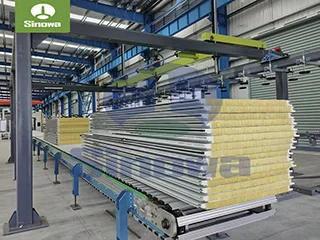
sandwich panel line
The overall structural design of the PU edge sealing rock wool panel line follows the concept of integrated continuous production, and the whole production flow is logically connected by multiple functional units without redundant manual intervention links. The main equipment composition covers raw material unwinding mechanism, surface plate rolling forming system, rock wool core material sorting and flipping device, PU foaming and edge sealing module, high-pressure composite curing system, trimming and cutting mechanism, as well as finished product conveying and stacking components. Each functional unit is coordinated by an intelligent control system to ensure the synchronization of operating speed and processing accuracy in each production link. The mechanical structure of the production line is made of high-strength metal materials, which can maintain stable operating conditions under long-term continuous working conditions, effectively reducing equipment vibration and mechanical wear during high-speed production. The modular assembly design also facilitates daily maintenance and partial component replacement, lowering the long-term operation threshold of the production line and improving the service life of the overall equipment.
In the initial feeding stage of production, the rock wool sandwich panel production line completes the automatic unwinding and preliminary shaping of metal surface plates. The commonly used surface raw materials include coated metal plates with smooth surface and excellent corrosion resistance. These flat metal coils are fixed on the unwinding support, and the constant-speed traction device drives the coils to move forward steadily. Before entering the rolling forming procedure, the surface of the metal plate will go through simple cleaning and flattening treatment to remove surface attachments and eliminate internal stress generated during coil storage. The rolling forming system is composed of multiple groups of precision rollers with different shapes. Through gradual rolling extrusion, the flat metal plate is processed into a specific grooved and folded structure. This structural treatment enhances the fitting tightness between the surface plate and the core material, and also improves the assembly convenience of subsequent panels during on-site construction. The rolling parameters can be adjusted according to the customized production requirements of panels, realizing the flexible switching of multiple plate types on the same production line.
The treatment process of rock wool core materials is one of the core links of the continuous sandwich panel production line, which directly determines the basic thermal insulation and fire resistance performance of finished panels. The bulk rock wool raw materials are transported to the sorting platform through the conveying equipment, and the automatic splitting device divides the continuous rock wool strips into fixed-size core material blocks. Different from the random fiber arrangement of ordinary rock wool panels, this production line is equipped with a special flipping mechanism to adjust the fiber direction of rock wool, making the internal fibers vertically distributed between the upper and lower metal plates. This vertical fiber arrangement optimizes the compressive resistance and structural stability of rock wool, avoiding the problem of easy collapse and deformation of transverse fibers under external pressure. After flipping and sorting, the rock wool core materials are evenly arranged on the lower metal plate at equal intervals, and the automatic deviation correction device ensures that the core materials are neatly arranged without offset, which lays a good foundation for the subsequent composite molding process.
The PU edge sealing module is the most distinctive technological part of this continuous sandwich panel line, and it is also the key to distinguish it from ordinary rock wool panel production equipment. In the traditional rock wool composite panel production process, the edge of the panel is mostly in a bare rock wool state, which is prone to moisture absorption, pulverization and heat conduction leakage in the use environment. The PU edge sealing unit of the production line adopts high-pressure foaming and continuous pouring technology to inject polyurethane raw materials into the reserved gaps on both sides of the rock wool core material. Under the set temperature and pressure conditions, the polyurethane raw materials undergo rapid chemical foaming and curing reactions, forming a dense and hard edge sealing structure. The foaming ratio and curing speed of polyurethane can be precisely regulated by the intelligent batching system to ensure that the edge sealing layer is closely bonded with the rock wool core material and the metal surface plate without gaps. The formed PU edge forms a continuous airtight barrier on the side of the panel, which effectively blocks the penetration of external moisture and air, and eliminates the cold bridge phenomenon that is common in traditional rock wool panels.
After the completion of core material arrangement and edge sealing pouring, the semi-finished panels enter the high-pressure composite curing system for integrated molding. The composite equipment is equipped with a closed heating and pressurizing chamber, which maintains a stable temperature and pressure environment inside. Under the dual effect of constant temperature and uniform pressure, the adhesive between the metal plate and the rock wool core material exerts the best bonding performance, and the foamed polyurethane edge is completely solidified and shaped. The pressure control in the composite process is kept within a reasonable range to ensure that the internal structure of rock wool will not be crushed while the fitting degree of each layer of materials is improved. The temperature gradient setting in the curing chamber realizes staged heating, which avoids the structural defects such as bubble gaps caused by excessive temperature difference during material compounding. After composite curing, the overall bonding strength of the panel is significantly improved, and the integration of metal plate, rock wool core and PU edge is realized.
The post-processing links of the production line include fixed-length cutting, edge trimming, surface finishing and automatic stacking. The continuous composite plates coming out of the curing system are detected by the laser sizing sensor, and the high-precision cutting equipment automatically completes the fixed-length cutting according to the preset dimensional parameters. The cutting tool is made of wear-resistant alloy materials, which can ensure smooth and burr-free cutting sections without damaging the surface coating of metal plates. The edge trimming mechanism further polishes the four sides of the cut panels to eliminate tiny protrusions and uneven parts generated during the molding process, making the edge structure more flat and regular. In the surface finishing stage, the production line is equipped with a dust removal and cleaning device to remove residual debris and dust on the panel surface, maintaining the flat and clean appearance of the finished panels. Finally, the qualified finished panels are transported to the stacking area by the intelligent conveying platform, and the automatic stacking equipment completes orderly stacking, which is convenient for subsequent packaging and transportation.
Compared with conventional rock wool panel production lines, the technological advantages of PU edge sealing rock wool sandwich panel line is reflected in multiple dimensions. In terms of product performance optimization, the continuous PU edge sealing structure effectively solves the inherent defects of traditional rock wool panels such as easy moisture absorption and poor air tightness. The dense polyurethane edge can resist the erosion of humid air and corrosive media, slowing down the aging speed of rock wool core materials and extending the service life of panels. In terms of structural stability, the integrated composite molding process makes the metal plate, rock wool and PU edge form an integrated force-bearing structure. The overall compression resistance and bending resistance of the panel are significantly enhanced, and it is not easy to deform under external force extrusion and temperature alternating changes. In terms of production controllability, the fully automated linkage control system reduces manual operation errors. The production line can realize continuous uninterrupted production, and the consistency of product size and performance is far higher than that of semi-automatic production equipment.
In terms of production operation and energy consumption control, the PU sandwich panel line adopts optimized power distribution and heat circulation design. The heating system of the curing chamber recycles waste heat generated during production, reducing the energy consumption of repeated heating. The frequency conversion speed regulation motor is configured for each transmission mechanism, which can automatically adjust the operating power according to the production load, avoiding unnecessary energy waste during no-load operation. The internal sealing structure of the equipment reduces heat loss during the production process, and the noise reduction components installed at the mechanical connection points effectively lower the operating noise of the production line. These energy-saving and noise-reducing designs not only reduce the comprehensive operating cost of the production line, but also improve the comfort of the on-site production working environment and meet the basic requirements of modern industrial green production.
The finished panels produced by this professional automatic sandwich panel production line have comprehensive performance advantages and are suitable for diverse building application scenarios. In industrial factory buildings and logistics warehouses, the panels are used for exterior wall enclosure and roof paving, relying on excellent fire resistance and thermal insulation performance to reduce building energy consumption and improve the safety level of internal space. In public buildings such as exhibition halls and shopping malls, the flat and neat surface of the panels can meet the aesthetic requirements of building decoration, while the lightweight structure reduces the bearing pressure of the building main body. In special functional buildings with strict requirements on air tightness and moisture resistance, the PU edge sealing structure can effectively block the diffusion of humid gas, maintain the stability of the internal environment of the building, and reduce the frequency of later maintenance. With the continuous upgrading of building energy-saving standards, the market demand for such high-performance composite panels is steadily increasing, which also promotes the continuous technological iteration of production lines.
In the actual production and application process, the operational stability of the PU edge sealing rockwool sandwich panel production line is affected by multiple external factors. The temperature and humidity of the production workshop will interfere with the foaming effect of polyurethane raw materials and the curing speed of adhesives. Therefore, it is necessary to maintain a stable internal environment of the workshop during long-term production. The storage state of raw materials also matters; damp rock wool and deteriorated metal coils will directly affect the molding quality of finished panels. Regular maintenance and inspection of equipment are essential. The staff need to regularly clean the roller sets, cutting tools and conveying tracks of the production line, and check the tightness of the connecting parts to prevent production failures caused by mechanical aging. Standardized operation and maintenance management can maximize the production efficiency of the equipment and ensure the long-term stable output of high-quality panels.
Looking at the development trend of the building material manufacturing industry, the PU edge sealing rock wool panel line will develop towards higher intelligence, higher integration and lower energy consumption in the future. The intelligent monitoring system will be further upgraded to realize real-time collection and analysis of production data such as material consumption, molding temperature and operating speed, providing data support for production optimization. The modular structure of the equipment will be more simplified, which is convenient for rapid disassembly, transportation and installation of the production line, adapting to the production layout needs of different factories. At the same time, the production line will be compatible with more types of surface plates and modified core materials, expanding the production range of composite panels and meeting the personalized customization needs of the construction market. With the continuous progress of material science and mechanical manufacturing technology, the comprehensive performance of such production lines will be continuously optimized to provide more reliable equipment support for the high-quality development of the modern construction industry.
https://www.cnsinowa.com/sandwich-panel-machines/pu-edge-sealing-rock-wool-panel-line.html