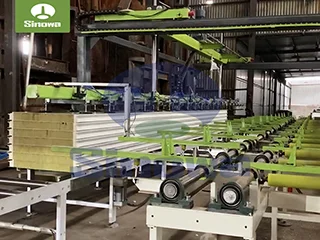
sandwich panel line
The entire production workflow of the rock mineral wool insulation panel production line starts with raw material preparation and pretreatment, which lays a solid foundation for subsequent high-temperature processing and fiber forming. The primary raw materials adopted in the production are natural hard rock materials and auxiliary mineral raw materials, which feature stable chemical composition and excellent high-temperature resistance. Before entering the melting stage, all raw materials need to go through crushing, screening, and proportional batching processes. Specialized crushing equipment breaks bulk raw materials into uniform granular particles with controlled particle size, eliminating oversized impurities and irregular raw material blocks that may affect melting efficiency. The screening system further classifies crushed raw materials to ensure particle size uniformity, avoiding uneven melting caused by inconsistent particle volumes. After screening, raw materials with qualified particle sizes are transported to automatic batching equipment, where mechanical weighing modules accurately distribute different raw materials according to fixed mixing ratios. Scientific batching regulation optimizes the chemical composition of mixed raw materials, improving the toughness and high-temperature stability of the formed mineral fibers while reducing brittle defects in finished panels. In this pretreatment stage, dust removal and raw material drying auxiliary devices are also equipped to reduce moisture content in raw materials and control floating dust inside the production workshop, maintaining a clean and stable production environment and preventing moisture interference with high-temperature melting reactions.
High-temperature melting is the core thermal processing stage of the entire production line, serving as the key procedure to convert solid mineral raw materials into molten raw materials for fiber preparation. The mixed raw materials are continuously transported into vertical melting furnaces through sealed conveying structures, and the internal temperature of the furnace is raised to an extreme high temperature sufficient to completely melt mineral raw materials. Under high-temperature thermal action, solid mineral particles gradually soften and fuse into homogeneous flowing molten liquid, with internal molecular structures rearranged to eliminate original mineral texture and impurity components. The melting furnace is equipped with intelligent temperature adjustment components to maintain stable internal temperature, avoiding quality fluctuations of molten liquid caused by excessive temperature differences. Uniform molten liquid can effectively reduce defective fibers such as thick fibers and broken fibers in subsequent fiber forming processes. Meanwhile, the sealed structure of the melting furnace minimizes heat loss during the heating process, improving thermal energy utilization efficiency and reducing unnecessary energy consumption in continuous production. After full melting and homogenization, the molten mineral liquid flows out steadily from the furnace outlet through quantitative flow control structures, ensuring stable liquid supply for the fiber forming system and maintaining continuous and orderly production rhythm.
Fiber forming is a critical processing link that determines the basic physical characteristics of rock mineral wool insulation panels. The production line adopts high-speed centrifugal fiber forming technology, where the high-temperature molten liquid drops fall onto high-speed rotating centrifugal rollers. Driven by powerful centrifugal force, the molten liquid is stretched and torn into fine and slender mineral fibers. During the centrifugal forming process, airflow auxiliary structures are installed around the centrifugal rollers to cool newly formed fibers rapidly, fixing the fine fiber structure and preventing fiber adhesion and agglomeration. The equipment operating speed and airflow intensity can be dynamically adjusted according to production demands, enabling flexible control over fiber diameter and fiber length. Reasonable fiber diameter distribution endows mineral wool products with uniform porosity, which directly affects thermal insulation and sound absorption capabilities. In this stage, atomized adhesive is evenly sprayed on the surface of scattered fibers through high-pressure spraying devices. The adhesive forms a thin bonding film on the fiber surface, which can connect loose fibers into an integral structure in subsequent processing procedures, enhancing the overall structural strength and compression resistance of mineral wool panels. The spraying volume of adhesive is precisely controlled to avoid excessive adhesive accumulation that may block fiber pores and reduce insulation performance.
The cotton collection and blanket forming process gathers dispersed mineral fibers to complete the preliminary shaping of semi-finished products. The fiber mixture sprayed with adhesive is transmitted to the sealed cotton collection chamber, where negative pressure air suction structures are used to make disordered fibers evenly deposit on the moving conveyor mesh belt. Traditional single-layer deposition technology is upgraded in modern production lines, adopting pendulum-type cotton laying structures to realize staggered lapping of fiber layers. This layered lapping mode changes the single-direction fiber arrangement of traditional products, forming a three-dimensional interwoven fiber structure. The optimized fiber arrangement significantly improves the internal binding force of mineral wool blankets, avoiding delamination and cracking during later use. During the cotton collection process, the thickness sensor monitors the real-time thickness of fiber blankets, and the system automatically adjusts conveyor operating speed and fiber feeding volume to ensure consistent thickness of semi-finished blankets. After preliminary laying, the loose fiber blankets pass through pre-pressing rollers, which apply gentle mechanical pressure to discharge excess air inside the fiber gaps, preliminarily compact the fiber structure, and enhance the flatness of blanket surfaces, creating favorable conditions for subsequent curing processing.
Curing treatment is an essential procedure to stabilize the internal structure of mineral wool panels and solidify adhesive bonding performance. The pre-pressed fiber blankets are continuously sent to a constant-temperature curing oven through conveying equipment. The internal temperature of the curing oven is kept within a reasonable constant-temperature range, providing stable thermal conditions for adhesive polymerization and curing. Under constant-temperature thermal action, the sprayed adhesive undergoes chemical cross-linking reactions, gradually solidifying and tightly connecting interwoven mineral fibers into an integrated porous structure. The internal circulating air system inside the oven ensures uniform temperature distribution in all areas, preventing local incomplete curing or excessive aging of adhesive caused by temperature imbalance. Meanwhile, the airflow system takes away volatile substances generated during adhesive curing to keep the internal production environment clean. The curing time is matched with the conveying speed of the production line to ensure that each fiber blanket stays in the oven for an appropriate duration, achieving thorough curing without excessive energy waste. After curing, the internal structure of mineral wool blankets becomes compact and stable, with significantly improved mechanical strength, and the products gain basic compression resistance and bending resistance to adapt to subsequent cutting and processing operations.
The post-processing section of the production line includes trimming, fixed-size cutting, surface finishing, and stacking, which converts cured semi-finished blankets into standardized finished insulation panels. The continuous cured mineral wool blankets first pass through edge trimming equipment to cut off irregular rough edges on both sides, ensuring neat and flat panel edges. The intelligent cutting system sets fixed cutting dimensions according to market usage requirements, and high-precision cutting tools perform transverse cutting to produce mineral wool panels with unified specifications. In order to enrich product application scenarios, some production lines are equipped with surface composite structures, which can attach functional thin layers such as flat protective films to the panel surface through hot pressing treatment. This surface treatment enhances the panel's surface wear resistance and anti-corrosion ability, expanding its adaptability in complex construction environments. After finishing processing, qualified panels are transported to automatic stacking equipment, which neatly arranges finished products according to standardized stacking modes. In addition, the production line is equipped with a waste recycling mechanism to collect leftover materials generated during trimming and cutting. These waste mineral wool materials are crushed and reintroduced into the raw material pretreatment link, realizing cyclic utilization of production resources and reducing material waste.
The overall structural design and operational logic of the rock mineral wool insulation panel production line embody the characteristics of automation, continuity, and environmental protection. The entire production process adopts closed mechanical transmission structures to reduce manual intervention, and each processing section is equipped with intelligent sensing components to monitor parameters such as temperature, pressure, and conveying speed in real time. The central control system integrates all equipment modules to realize linkage operation between processes; once abnormal parameter fluctuations occur in a single processing unit, the system can automatically make adaptive adjustments to ensure production stability. From the perspective of environmental protection design, the production line is equipped with multi-stage dust removal and waste gas purification devices. Dust generated during raw material crushing and cotton collection is collected by sealed dust removal pipelines, and trace volatile gases produced in the curing stage are purified by filtration structures before being discharged, effectively reducing environmental pollution. In terms of energy consumption optimization, the melting furnace and curing oven adopt thermal insulation lining structures to reduce internal heat loss, and waste heat generated by high-temperature equipment is recycled to preheat raw materials, improving comprehensive energy utilization efficiency.
Products manufactured by mature rock mineral wool insulation panel production lines have outstanding comprehensive performance advantages, which are closely related to precise process control in each production link. The finished panels feature uniform internal fiber distribution and stable porous structure, giving them excellent thermal insulation performance to effectively block heat transfer and reduce energy consumption of building and industrial equipment. The inorganic mineral fiber raw materials endow the products with natural flame retardancy, enabling them to maintain stable physical structures in high-temperature environments without combustion or harmful gas release. Additionally, the interconnected porous structure inside the panels can absorb and isolate sound waves, achieving reliable sound insulation and noise reduction effects. In terms of chemical stability, the processed mineral wool panels are resistant to corrosion by common chemical substances and will not easily deteriorate or mildew in humid environments, ensuring long service life. These performance advantages make mineral wool panels widely applicable in building exterior wall insulation, industrial pipeline thermal protection, equipment high-temperature heat insulation, and public building sound insulation projects.
With the continuous progress of industrial manufacturing technology, rock mineral wool insulation panel production lines are constantly evolving towards higher automation, intelligence, and energy-saving levels. Upgraded production lines adopt more precise batching systems and intelligent temperature control modules to further reduce product quality differences between batches. Optimized fiber forming equipment can produce finer and more uniform mineral fibers, improving the softness and thermal insulation performance of finished products. Meanwhile, the production line has strengthened the closed-loop management of production materials, further improving the recycling rate of waste materials and lowering production resource consumption. As the global requirements for energy conservation, emission reduction, and building safety continue to rise, the market demand for high-performance inorganic insulation materials will keep expanding. The continuous technological iteration and process optimization of rock mineral wool insulation panel production lines will further enhance production efficiency and product quality, providing more reliable and environmentally friendly insulation material solutions for multiple industries. In the future, combining intelligent monitoring technology and green manufacturing concepts, such production lines will gradually realize full-process digital management, promoting the sustainable development of the mineral wool insulation material industry.
https://www.cnsinowa.com/sandwich-panel-machines/rock-mineral-wool-insulation-panel-production-line.html