sandwich panel line
The operational logic of the rockwool insulated sandwich panel production line centers on the physical and chemical processing of mineral raw materials, coupled with composite forming technology between rockwool core materials and metal surface layers. The entire production process can be divided into multiple interconnected stages, starting from raw material pretreatment and feeding, progressing through fiber melting and forming, binder treatment and wool blanket molding, surface layer processing and composite lamination, high-temperature curing and shaping, and ending with precision cutting, finishing, and automatic stacking. Every processing link is precisely calibrated through mechanical transmission and intelligent control systems, ensuring that the density, fiber uniformity, bonding strength, and dimensional accuracy of rockwool panels remain within stable ranges. Unlike intermittent production equipment, the continuous production mode of this line realizes closed-loop operation from raw material input to finished product output, effectively improving production continuity and reducing material waste caused by repeated equipment start and stop.
Raw material preparation and automatic feeding constitute the initial and foundational stage of the entire production workflow. The core raw materials for rockwool core layers are natural mineral aggregates, which undergo strict pretreatment procedures before entering the melting system. Raw mineral materials are first crushed and screened to remove impurity particles and unqualified bulk materials, screening out granular materials with uniform particle size that meet melting requirements. This pretreatment step is critical to avoid incomplete melting and uneven fiber forming caused by inconsistent raw material specifications, which directly affects the internal structure and insulation performance of finished panels. After pretreatment, qualified mineral particles are transported to the automatic metering and feeding device, which quantitatively conveys raw materials to the high-temperature melting furnace through electronic precision control. The feeding system maintains stable and continuous material supply speed, matching the operating rhythm of subsequent melting and fiber forming equipment to ensure the continuity of the rock wool sandwich panel production line. Meanwhile, auxiliary materials including adhesive binders and functional additives are stored in independent sealed supply systems, with automatic proportioning and quantitative spraying functions to guarantee the uniformity of binder distribution in subsequent fiber processing.
High-temperature melting and centrifugal fiber forming are the core processes that determine the basic performance of rockwool core materials. The sealed melting furnace heats the pretreated mineral particles to an extreme high temperature, completely melting the solid mineral materials into homogeneous liquid mineral slurry. The closed furnace body design effectively isolates external air interference, maintains stable internal temperature and heating environment, and avoids raw material oxidation and performance attenuation during the melting process. The fully molten mineral slurry flows steadily into high-speed centrifugal spinning equipment, where multi-roller high-speed rotating structures apply powerful centrifugal force to the liquid slurry, stretching and dispersing it into countless fine and uniform mineral fibers. During the spinning process, oversized unfiberized material particles are screened and separated through airflow classification and mechanical screening structures, effectively eliminating unqualified particles that may affect panel flatness and insulation performance. The refined mineral fibers formed by spinning have slender and uniform structural characteristics, laying a solid foundation for the finished panel’s excellent thermal insulation, sound absorption, and fire resistance.
Binder spraying and wool blanket molding processes shape the preliminary structural form of rockwool core materials. After centrifugal forming, the dispersed mineral fibers are transported to the spraying area, where atomized adhesive binders and functional additives are evenly sprayed on the fiber surface through high-precision spraying systems. The atomization treatment ensures that the binder forms a fine mist layer, which uniformly adheres to each fiber surface without causing local adhesion accumulation or fiber agglomeration. The added functional additives can optimize the moisture resistance and structural stability of fiber materials, enhancing the environmental adaptability of finished panels. Fibers with evenly coated binders are then collected and arranged through a professional cotton collection and pendulum laying system. The pendulum laying device adopts reciprocating uniform laying technology to arrange disordered fibers into continuous, flat, and uniform wool blankets with consistent thickness and density. The pre-pressing device conducts preliminary compression shaping on the laid wool blankets, eliminating internal gaps between fibers, improving the compactness of the wool blanket structure, and enabling the initially formed rockwool wool blankets to have stable preliminary shapes and mechanical strength for subsequent composite processing.
While the rockwool core material is being processed, the metal surface layer processing system operates synchronously to complete the pretreatment of panel outer protective layers. Metal coiled materials are loaded onto automatic unwinding equipment, which realizes stable and continuous material discharge through tension control systems to avoid surface wrinkles and deformation caused by uneven tension. The unwound metal sheet first goes through leveling and trimming procedures to eliminate surface irregularities and edge burrs, ensuring the flatness and dimensional regularity of the surface layer. Subsequent film lamination and surface pretreatment processes improve the surface finish and corrosion resistance of the metal sheet, while enhancing the bonding compatibility between the metal surface layer and rockwool core material. For panels requiring special structural designs, the system can complete automatic punching and edge flanging according to preset technological parameters, realizing one-time forming of panel edge structures and simplifying subsequent installation and construction procedures. The entire surface layer processing process is fully automated, with coordinated operation of multiple functional devices to ensure the consistency of surface layer specifications and surface quality.
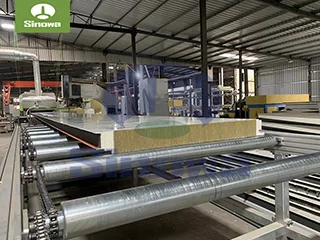
Composite lamination and high-temperature curing are key processes that integrate rockwool core materials and metal surface layers into integral insulated panels. After the completion of core wool blanket pre-shaping and surface layer pretreatment, the rockwool core material is accurately laid between two upper and lower metal surface layers through automatic conveying and positioning devices. The precise positioning system ensures the overall alignment of the core material and surface layers, avoiding offset and misalignment that affect panel structural uniformity. The assembled semi-finished panels are then sent to the double-belt continuous hot-press curing system, which relies on constant-temperature hot air circulation and mechanical pressure to complete composite bonding and structural curing. Inside the closed curing chamber, stable high-temperature environment activates the performance of the adhesive binder, prompting full bonding between mineral fibers and between the core material and metal surface layers. The continuous pressure applied by the double-belt structure ensures that the entire panel bears uniform force, effectively eliminating internal gaps and hollowing problems. The curing time and temperature are intelligently adjusted according to panel thickness and material characteristics, ensuring thorough curing of the binder, stable internal fiber structure, and firm composite combination between layers, so that the integrated panels obtain excellent overall structural rigidity and bonding strength.
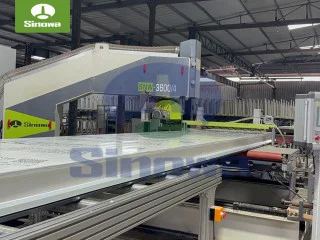
Cooling shaping and precision cutting processes further optimize the dimensional accuracy and surface quality of finished panels. Panels discharged from the high-temperature curing system have a certain residual temperature and slight internal stress, so they first enter the automatic cooling and shaping area. Through controlled circulating air cooling, the panels are evenly cooled at a stable speed, which effectively releases internal structural stress, avoids later deformation and warping, and ensures long-term dimensional stability of finished products. After cooling and shaping, the continuous integrated panel strips are transported to the precision cutting unit. The intelligent cutting system automatically identifies the preset panel length and width specifications, and uses high-precision cutting tools to complete fixed-length cutting and edge finishing. The cutting process features smooth incision without burrs or fiber scattering, and the edge trimming treatment ensures the flatness and regularity of panel edges, meeting the assembly and installation requirements of engineering projects. The system can flexibly switch cutting parameters to adapt to panel products of different thicknesses and sizes, realizing diversified production of specifications.
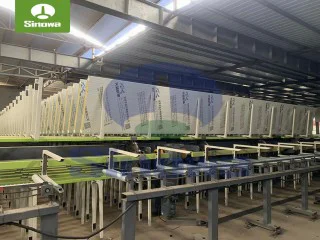
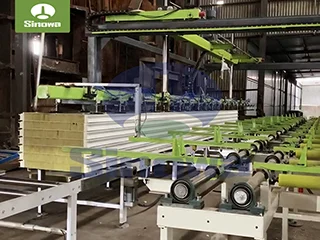
The final stage of the production process covers surface finishing, automatic stacking and finished product output. After cutting and trimming, unqualified adhesive residues and tiny burrs on the panel surface are cleaned by an automatic cleaning device to further improve the finish of finished panels. The qualified finished panels are transported to the stacking area, where intelligent suction cup stacking equipment automatically grabs and stacks panels in order according to standardized placement specifications. The automatic stacking mode ensures neat and stable panel placement, avoids surface friction and collision damage caused by manual handling, and facilitates subsequent centralized storage and transportation. The entire production process forms a closed-loop system from raw material input to finished product stacking, with all links connected efficiently, realizing uninterrupted continuous production and greatly improving industrial production capacity.
The core advantages of the rockwool sandwich panel production line are reflected in its high integration, intelligent automation and stable product performance control. The highly integrated modular design integrates all functional units of raw material processing, fiber forming, composite molding and finishing into a unified production system, with compact equipment layout and efficient process connection, saving production space while improving operational efficiency. The whole line adopts intelligent centralized control technology, with all production parameters including feeding volume, melting temperature, spinning speed, curing time and cutting specifications adjustable and controllable in real time. The system can automatically monitor and correct parameter deviations during operation, effectively avoiding product quality fluctuations caused by human operation errors. In terms of product performance, the standardized and streamlined production mode ensures that the internal fiber structure of each panel is uniform, the density distribution is balanced, and the bonding between layers is firm, so that the finished products have stable thermal insulation, sound insulation, fire resistance and mechanical compression resistance.
In practical industrial production applications, this rock wool sandwich panel line shows strong operational stability and production flexibility. The mechanical transmission and control system is optimized for long-term continuous operation, with low failure rate and convenient daily maintenance, which can meet the requirements of long-hour and high-intensity industrial production. Meanwhile, the equipment parameters can be quickly adjusted according to different product design requirements, enabling the sandwich panel line to manufacture insulated panels with different thicknesses, densities and structural specifications. It can adapt to the production needs of common building thermal insulation panels, clean engineering enclosure panels, industrial equipment insulation lining panels and other multi-scene products, with wide product coverage and strong market adaptability. In terms of production cost control, the precise metering feeding system effectively reduces raw material waste, and the high degree of automation reduces labor investment, realizing efficient and low-consumption production operation.
With the continuous upgrading of modern building energy-saving standards and industrial insulation requirements, rockwool insulated panels, as environmentally friendly and high-performance thermal insulation materials, have been widely used in civil building exterior wall insulation, roof energy-saving structures, industrial workshop enclosure, cold storage thermal insulation, and purification engineering fields. The advanced production technology and stable operation performance of the supporting sandwich panel production line provide reliable technical guarantees for the large-scale promotion and application of rockwool panels. By optimizing fiber forming uniformity, composite bonding firmness and dimensional accuracy of finished products, the rock wool sandwich panel machine effectively improves the comprehensive service performance of insulated panels, enhances the durability and environmental adaptability of products in complex usage environments, and provides high-quality basic materials for energy-saving construction and industrial thermal insulation projects. In the future, with the continuous innovation of intelligent manufacturing technology, the rockwool insulated board production line will further develop towards higher automation accuracy, lower energy consumption and stronger production flexibility, continuously meeting the increasingly stringent performance requirements of the building materials industry for thermal insulation, safety and environmental protection.
https://www.cnsinowa.com/sandwich-panel-machines/rockwool-insulated-panel-production-line.html