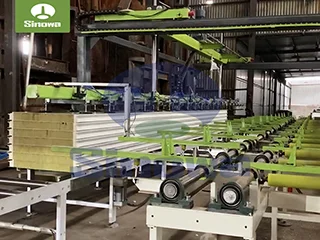
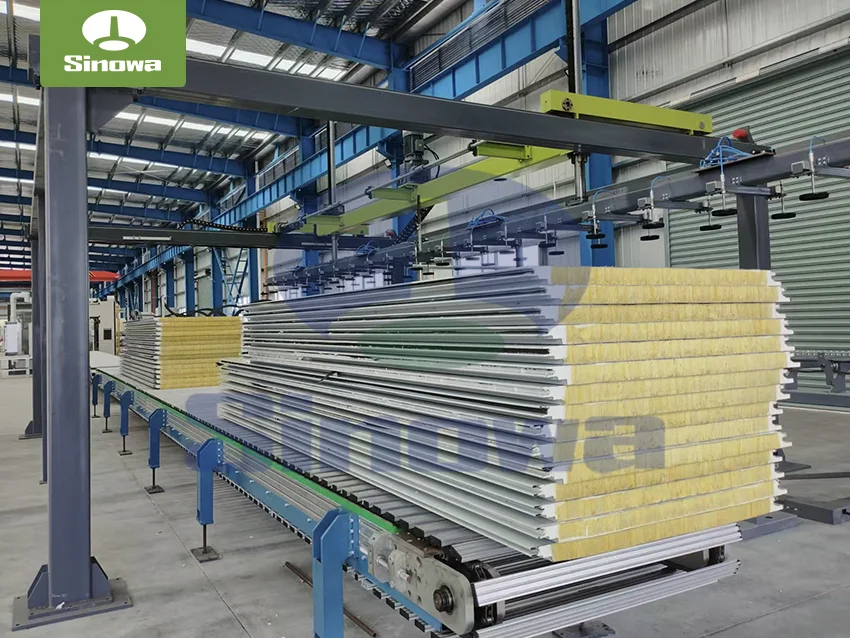
 sandwich panel line
The operational logic of the silencing rock wool sandwich panel production line is based on the physical characteristics of rock wool fibers and the composite molding principle of multi-layer building materials. Rock wool, as the core sound-absorbing and thermal insulation substrate of the panel, is composed of countless fine and irregular mineral fibers. These interlaced fibers form a large number of tiny porous structures inside the material, which can effectively consume sound wave energy, weaken sound transmission, and achieve the effect of noise reduction and silence. The entire production process is designed to fully preserve and optimize the porous structure of rock wool fibers, avoiding fiber compaction, breakage, or uneven distribution caused by improper processing, which would weaken the silencing performance of the finished product. Meanwhile, the rockwool board production line realizes tight composite bonding between the rock wool core layer and metal surface layers through precise mechanical control and environmental-friendly adhesive technology, forming an integrated panel structure that not only enhances structural firmness but also further optimizes the overall sound insulation and noise reduction capacity of the panel.
The complete production workflow of the silencing rock wool sandwich panel line covers full-process operations from raw material pretreatment to finished product stacking and packaging, with each link closely linked and precisely controlled to ensure product quality consistency. The first stage of production is raw material preparation and pretreatment, which includes standardized processing of both rock wool core materials and metal surface materials. For rock wool raw materials, the equipment completes crushing, screening, and impurity removal of original mineral materials, removing large particle impurities and unqualified coarse fibers that affect acoustic performance. Through standardized fiber sorting treatment, the sandwich panel machinery ensures that the rock wool fibers used for panel core layers have uniform thickness and length, forming a stable and continuous porous sound-absorbing structure. For metal coil surface materials, the production line realizes automatic unwinding, leveling, and surface cleaning, eliminating surface wrinkles, dust, and oil stains that may affect bonding accuracy and surface flatness, laying a foundation for subsequent precise composite molding.
After raw material pretreatment, the production enters the adhesive coating and pre-composite stage, which is a key process determining the bonding tightness and overall acoustic performance of the sandwich panel. The rock wool sandwich panel machine adopts uniform and quantitative glue spraying technology to coat high-performance environmental polymer adhesive evenly on the inner surfaces of the upper and lower metal panels and the two sides of the rock wool core layer. This type of adhesive has fast curing speed and strong adhesion, and it will not form a dense and hard isolation layer that hinders sound wave absorption after curing. Different from traditional glue coating processes that easily lead to uneven glue accumulation or missing coating, the automated glue spraying system of the rockwool board production line can adjust the glue application amount uniformly according to the thickness and specification of the panel, ensuring that the adhesive layer is thin and uniform, which not only guarantees the firm bonding between layers but also avoids damaging the porous structure of rock wool fibers, fully retaining the inherent silencing advantages of the core material.
The fiber laying and core layer shaping process is the core link of the rockwool sandwich panel production line to realize panel silencing performance. The pretreated rock wool fibers are evenly dispersed and laid through a professional fiber distribution system, realizing three-dimensional staggered accumulation of fibers in the molding area. The equipment adopts adjustable fiber laying speed and density control technology to ensure that the fiber distribution of each position of the rock wool core layer is uniform without local compaction or hollow gaps. Uniform fiber density distribution enables the panel to maintain consistent sound absorption efficiency in all parts, avoiding the problem of uneven silencing effect caused by inconsistent internal structure. In addition, the sandwich panel production machine is equipped with auxiliary fiber trimming and finishing devices to trim redundant fibers on the edge of the core layer, ensuring that the core layer size matches the surface metal panels completely, avoiding edge gaps that affect structural stability and acoustic performance after composite molding.
The composite pressing and constant-temperature curing stage directly determines the structural stability and comprehensive performance of the finished panel. The pre-combined metal panels and rock wool core layer are sent to the double-belt pressing system through an automatic conveying platform. The rockwool sandwich panel manufacturing line adopts segmented constant-pressure control technology, which can apply stable and uniform pressure to the composite material without causing excessive compression and deformation of the rock wool core layer. Excessive pressure will compact the internal porous structure of rock wool, greatly reducing sound absorption and noise reduction capabilities, while insufficient pressure will lead to loose bonding between layers and easy delamination of the panel. The precise pressure control system of the equipment perfectly balances bonding firmness and core layer structural integrity. Meanwhile, the matching constant-temperature heating and curing system provides a stable temperature environment for adhesive curing, making the adhesive cure evenly and rapidly, forming a high-strength bonding layer between layers. The whole curing process is stable and controllable, which effectively improves the overall structural rigidity of the panel and enhances the durability of long-term silencing performance.
After curing and molding, the rock wool sandwich panel production machine enters the precise cutting, edge trimming and finishing stage. According to the preset dimensional specifications, the integrated molded continuous panel is cut into standard single panels by an automated cutting device. The cutting equipment maintains high-precision operation to ensure flat and smooth cutting sections without burrs, fiber shedding or layer separation. Subsequent edge trimming and sealing processes further optimize the panel edge structure, filling and sealing tiny gaps at the edge of the panel. These tiny gaps are easy sound transmission channels in the use process, and standardized edge sealing treatment can effectively block sound leakage paths, further improving the overall closed sound insulation structure of the panel and maximizing the silencing effect. At the same time, the finishing process also optimizes the surface flatness and edge regularity of the panel, improving the overall appearance quality and assembly convenience of the product.
A major advantage of the silencing rock wool sandwich panel making machine is its built-in noise reduction and environmental protection treatment system during operation, which realizes low-noise production while manufacturing high-performance silencing panels. Traditional sandwich panel production equipment often produces large mechanical vibration noise and fiber dust during operation, which not only affects the production environment but also may cause fiber loss and affect product quality. This optimized production line is equipped with vibration damping structures at key operating parts such as transmission rollers and pressing components to reduce mechanical vibration and operating noise during equipment operation. In addition, a targeted dust collection and fiber recovery device is arranged near the rock wool processing area, which can timely collect scattered fine fibers and floating dust generated in the production process. This not only keeps the production workshop clean and tidy, avoids fiber waste, but also prevents loose fibers from adhering to the surface of semi-finished products and affecting the bonding effect and surface quality of finished panels.
In terms of production performance, the silencing rock wool sandwich panel line realizes high-efficiency continuous production while ensuring product acoustic performance. The fully automated sandwich panel assembly line operation mode reduces manual intervention links, realizes integrated automatic control from raw material feeding, processing and molding to finished product output, effectively improves production efficiency and product consistency. The equipment has strong specification adaptability, and can adjust production parameters such as core layer thickness, panel overall thickness and molding size according to different usage scenarios, meeting the diversified production needs of building materials with different silencing requirements. Whether it is thin panels used for indoor partition walls or thick composite panels used for outer wall sound insulation and noise reduction, the production line can complete stable and high-quality molding production through parameter adjustment.
The finished panels produced by this professional rock wool sandwich panel production line have outstanding comprehensive performance in acoustic insulation, thermal insulation and structural stability. In terms of silencing and noise reduction, the uniformly distributed porous rock wool core layer can effectively absorb medium and high-frequency noise in the air, weaken sound wave reflection and transmission, and significantly reduce indoor and outdoor sound interference. The integrated composite structure avoids the sound leakage problem of traditional assembled sound insulation materials, and the overall sound insulation performance is more stable and lasting. In terms of thermal insulation, the porous structure inside rock wool can lock static air, form a stable thermal insulation layer, effectively block heat conduction, and reduce the energy consumption of building temperature regulation. In terms of structural performance, the double-layer metal surface plate cooperates with the high-strength adhesive composite structure to make the panel have good compression resistance, bending resistance and impact resistance, not easy to deform in long-term use, and can maintain stable silencing and thermal insulation effects for a long time.
In practical application scenarios, silencing rock wool sandwich panels produced by this production line are widely used in various construction fields that require high acoustic comfort and environmental performance. In commercial buildings such as office buildings, shopping malls and conference centers, the panels can effectively isolate indoor mutual noise interference and outdoor traffic noise, creating a quiet and comfortable office and business environment. In public cultural and educational buildings such as schools, libraries and exhibition halls, their excellent sound absorption and insulation performance can ensure the clarity of indoor sound and avoid noise disturbance to teaching and reading environments. In industrial plants, equipment workshops and warehouse buildings, the panels can isolate mechanical operation noise inside the factory and prevent noise from spreading outward, while isolating external environmental noise from affecting internal production operations. In addition, they are also suitable for indoor decoration and partition construction of residential buildings, hotels and entertainment venues, effectively improving the living and leisure acoustic environment.
Compared with panels produced by ordinary production lines, the products of the silencing rock wool sandwich panel making line have more stable performance attenuation resistance in long-term use. Ordinary production equipment is prone to problems such as uneven fiber laying, insufficient bonding tightness and unsmooth edge sealing in the production process. After long-term use, the internal structure of the panel is easy to loosen, fibers fall off, and sound insulation gaps appear, leading to gradual attenuation of silencing performance. The whole process optimization design of the professional silencing production line makes the internal structure of the panel more compact and regular, with no hidden sound leakage points. The stable composite structure can resist the influence of external temperature change, humidity change and slight structural vibration, ensure that the porous sound-absorbing structure of the rock wool core layer remains intact for a long time, and realize long-term stable silencing and noise reduction effects.
With the continuous upgrading of modern building environmental protection and comfort standards, the market demand for high-performance silencing building materials is constantly improving, which also promotes the continuous technological optimization of silencing rock wool sandwich panel manufacturing machine. Modern production lines are gradually developing towards higher automation, more precise control and stronger energy-saving and environmental protection performance. Through intelligent parameter adjustment systems, the equipment can realize real-time monitoring and fine adjustment of production parameters such as fiber laying density, glue coating amount and pressing pressure, further improve the consistency and qualification rate of finished products, and reduce material waste and energy consumption in the production process. At the same time, the optimized production process further enhances the environmental protection performance of the products. The adopted adhesives and processing technologies do not produce harmful substances, and the whole production process is green and low-carbon, which is in line with the development trend of modern green building materials.
In conclusion, the silencing rock wool sandwich panel line is a professional and intelligent manufacturing equipment tailored for high-quality sound-insulating and silencing building panels. Through systematic optimization of raw material processing, composite molding, finishing and environmental protection treatment links, it perfectly combines the excellent sound absorption characteristics of rock wool materials with the structural stability of composite panels. The panels produced by this line have reliable silencing performance, stable structural quality and wide application adaptability, which can effectively meet the diverse acoustic environment improvement needs of modern buildings. As an important supporting equipment in the field of green building materials, it plays an indispensable role in promoting the upgrading of building acoustic environment quality and the sustainable development of the construction industry, and will maintain broad application prospects with the continuous improvement of building comfort and environmental protection standards in the future.
https://www.cnsinowa.com/sandwich-panel-machines/silencing-rock-wool-sandwich-panel-line.html