sandwich panel machine
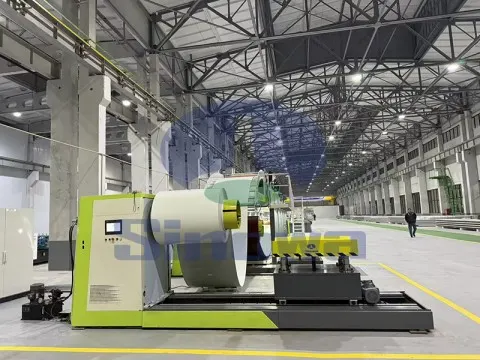
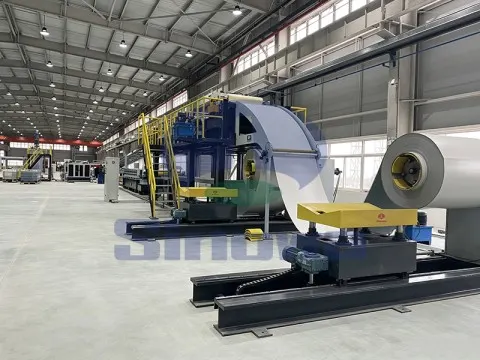
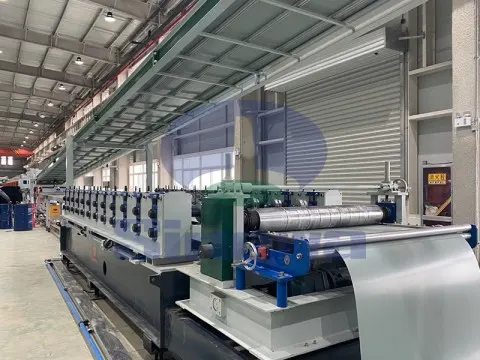
The overall structural composition of sandwich panel production equipment follows a sequential production logic, covering raw material pretreatment, surface layer processing, core material arrangement, glue coating composite, thermal pressure curing, fixed-size cutting, surface post-processing, and finished product stacking. Each functional module is closely connected through conveying systems to form an uninterrupted production chain. The raw material pretreatment module serves as the initial processing unit of the entire production line, undertaking the sorting, cleaning, and shaping of raw materials for face sheets and core materials. For metal face sheets commonly used in industrial production, this module is equipped with leveling and rolling mechanisms to eliminate surface wrinkles, bending deformation, and internal stress generated during metal coil storage and transportation. The rolling components adopt high-hardness alloy steel materials with precision polished surfaces to avoid scratch marks on the metal surface during the rolling process. Meanwhile, the built-in dust removal and oil removal devices in the pretreatment module use air blowing and adsorption structures to clean dust, metal debris, and residual oil stains on the surface of the face sheets. This pretreatment process is crucial for improving the bonding tightness between the face sheet and the core material, as impurities on the material surface will directly reduce the adhesion effect of the adhesive and cause delamination defects in the finished panels in subsequent use. For non-metal face sheets such as fiber cement boards and decorative boards, the pretreatment module is equipped with sanding and trimming structures to smooth rough edges and uneven surfaces, creating flat and clean bonding conditions for subsequent composite processing.
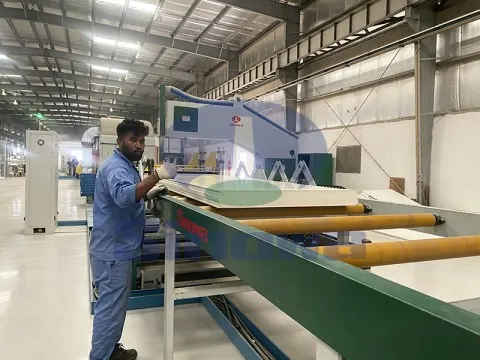
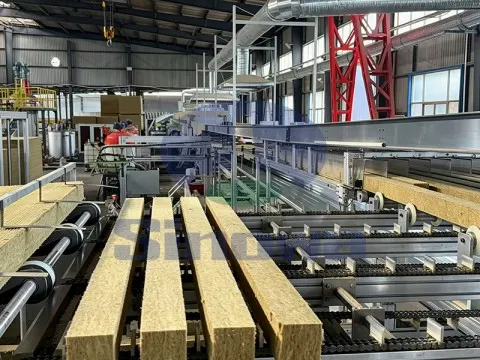
The core material processing unit is an exclusive functional component of sandwich panel production equipment, independently completing the cutting, shaping, and arrangement of various lightweight core materials. Common core materials applicable to the equipment include rock wool, polyurethane foam, polystyrene foam, and honeycomb structural materials, and the equipment can adjust processing parameters according to the physical characteristics of different core materials. For fibrous core materials such as rock wool, the unit is equipped with fixed-length cutting and dense arrangement mechanisms to ensure uniform thickness and consistent density of core material layers, while avoiding hollow gaps caused by messy fiber arrangement. For foam core materials with low density and high compressibility, the processing unit adopts flexible limiting and feeding structures to prevent core material deformation and fragmentation during conveying. In addition, this unit is designed with a quantitative feeding function, which can stably control the feeding amount and arrangement spacing of core materials through mechanical sensing components, ensuring that the core material distribution of each finished sandwich panel maintains high consistency. The rational operation of the core material processing unit directly affects the thermal insulation and mechanical bearing performance of the finished panels. Uniform core material arrangement can effectively avoid local heat conduction anomalies and structural stress concentration, improving the overall service stability of the panels.
The gluing system is the key functional module to realize the composite connection between face sheets and core materials, and its structural design and parameter adjustment determine the bonding durability of sandwich panels. The advanced gluing structure adopted in modern production equipment mainly includes roller coating and spraying modes, which can be switched according to the viscosity characteristics of different adhesives and production process requirements. The internal circulation pipeline of the gluing system is equipped with temperature sensing and heating components to maintain the adhesive within the optimal viscosity range, preventing uneven gluing caused by excessive adhesive fluidity in high-temperature environments or poor spreading performance in low-temperature environments. The gluing thickness can be accurately adjusted through the gap between mechanical rollers and spraying pressure, realizing micro-control of the adhesive coating amount on the surface of the face sheets. During the gluing process, the system adopts a closed circulation design to reduce the volatilization of adhesive components, which not only optimizes the production operation environment but also avoids adhesive waste. Meanwhile, the gluing system is interlocked with the material conveying speed, realizing synchronous adjustment of gluing speed and conveying speed to ensure uniform gluing without missing coating or excessive accumulation. High-precision gluing processing can enhance the interfacial bonding force between layers, effectively resisting the influence of external temperature changes and mechanical vibration on the composite structure of panels, and extending the service life of finished products.
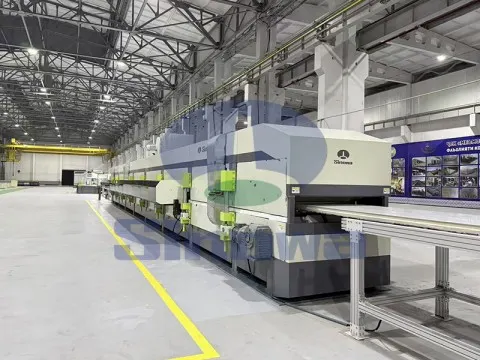
The thermal pressure composite module is the core processing section of the entire production line, responsible for completing the permanent bonding and preliminary shaping of multi-layer materials. This module consists of a sealed heating chamber, multi-group pressure rollers, constant temperature circulation components, and transmission correction structures. During the production process, the initially bonded sandwich semi-finished products are sent to the interior of the heating chamber through the conveying device, and the equipment maintains a stable temperature range through circulating heating components. The reasonable temperature setting can accelerate the curing reaction of the adhesive and promote the tight combination between the adhesive molecules and the material surface. The internal pressure rollers are arranged in an orderly manner according to the material conveying direction, with adjustable pressure values to adapt to core materials of different hardness and compression resistance. For rigid core materials, moderate pressure is applied to eliminate tiny gaps between layers; for flexible porous core materials, low-pressure slow pressing is adopted to prevent irreversible compression deformation of the core structure. In order to ensure the uniformity of stress on the panel surface, the pressure rollers are equipped with horizontal correction devices to avoid lateral deviation of materials during conveying. The thermal pressure composite process requires precise coordination of temperature, pressure, and time parameters. Excessively high temperature will cause aging damage to the core material structure, while insufficient pressure will lead to weak bonding between layers. Therefore, this module is equipped with an independent parameter adjustment system to realize real-time monitoring and dynamic optimization of processing conditions.
The cooling and shaping unit is arranged immediately after the thermal pressure composite module, undertaking the tasks of rapid heat dissipation and structural shaping of high-temperature panels. After thermal pressure curing, the internal temperature of the sandwich panel remains high, and the adhesive is still in a semi-cured state with unstable structural strength. The cooling unit adopts a combination of air cooling and natural heat dissipation structures, using uniform airflow to take away the surface and internal heat of the panel, so that the panel temperature drops to the normal ambient temperature at a stable rate. The slow cooling mode can avoid local stress difference caused by rapid temperature change, preventing the panel from warping, bending, and cracking after molding. During the cooling process, the conveying speed of the equipment is appropriately reduced to extend the heat dissipation time, and the limiting baffles on both sides of the conveying channel fix the panel position to ensure that the flatness of the panel is not affected by external forces. In addition, the cooling unit is equipped with a humidity adjustment structure to adapt to the production requirements in high-humidity environments, preventing condensed water from adhering to the panel surface and affecting the surface finish and subsequent processing effects. Qualified cooling and shaping treatment can stabilize the internal composite structure of the panel, improve the overall flatness and dimensional stability, and lay a foundation for subsequent fixed-size cutting and finished product processing.
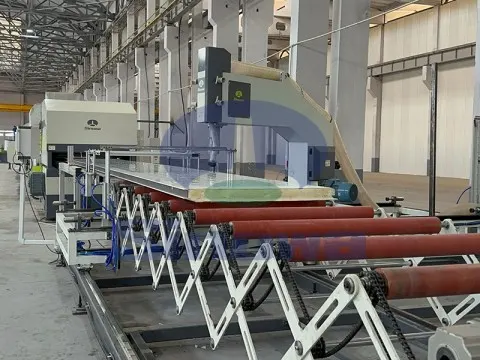
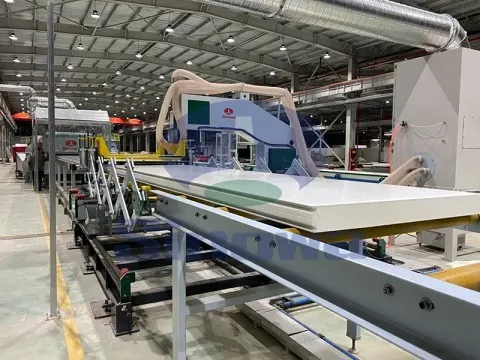
The fixed-size cutting and edge trimming module realizes personalized size processing of finished panels, which is an indispensable processing link to meet diverse application needs. This module is composed of high-speed cutting tools, positioning sensing components, and edge trimming polishing structures. According to the preset production parameters, the equipment can automatically measure the length and width of the conveyed panels and complete fixed-length cutting at accurate positions. The cutting tools are made of wear-resistant high-strength materials, which can maintain smooth cutting sections when processing metal and composite panels, without burrs, cracks, and material peeling defects. In order to improve cutting accuracy, the module is equipped with laser positioning and thickness detection components, which can automatically correct cutting errors caused by material conveying deviation. After cutting, the edge trimming structure polishes and chamfers the panel edges to remove sharp burrs and uneven sections, making the panel edges smooth and neat. For panels requiring special edge sealing treatment, this module can also complete edge sealing and wrapping processing through auxiliary mechanical structures to enhance the edge sealing performance and structural durability of the panels. The cutting and edge trimming process realizes the standardized sizing of sandwich panels, enabling the products to adapt to different building structure sizes and assembly construction requirements.
The surface post-processing and finished product stacking module is the terminal functional unit of the production line, responsible for surface protection treatment and orderly storage of finished panels. The post-processing part includes surface cleaning, film covering, and anti-corrosion spraying processes. The automatic cleaning device uses soft bristles and neutral cleaning fluid to remove dust and processing residues on the panel surface without damaging the surface protective layer. The film covering structure adopts a flat pressing and attaching mode to paste transparent protective films on the surface of metal and decorative panels, preventing surface scratches and corrosion during transportation and stacking. For panels used in harsh outdoor environments, the equipment can complete uniform spraying of anti-corrosion and weather-resistant coatings through automatic spraying components to enhance the environmental adaptability of the products. The finished product stacking part adopts a mechanical arm stacking structure, which can automatically grab, lift, and stack qualified panels according to the set spacing and layers. The stacking mechanism is equipped with buffer protection components to avoid collision and extrusion damage between panels during stacking. At the same time, the stacking height and arrangement mode can be adjusted freely to facilitate subsequent transportation and warehouse storage. The integrated design of post-processing and stacking simplifies the production process, reduces manual intervention links, and improves the overall automation level of the production line.
The automatic control system runs through all functional modules of sandwich panel production equipment and is the core brain to realize intelligent operation of the production line. This system takes programmable logic controllers as the control core, connects sensors, execution motors, and parameter adjustment components of each module through circuit lines, and realizes centralized control of the entire production process. Various high-precision sensors are installed inside the equipment to collect real-time data such as material conveying speed, processing temperature, pressing pressure, and cutting size. The control system automatically compares the collected data with preset standard parameters and triggers the adjustment mechanism to correct deviations when abnormal data is detected. For example, when the gluing thickness is found to be uneven, the system will automatically adjust the gap of the gluing roller; when the heating temperature fluctuates, the heating power will be dynamically stabilized. The human-computer interaction interface of the system is simple and intuitive, allowing operators to set production parameters, view operating data, and manually control individual modules. In addition, the control system has an automatic alarm and fault diagnosis function. When mechanical jamming, material shortage, and component failure occur, the system will send prompt signals and record fault data, providing a basis for subsequent equipment maintenance. The application of the automatic control system effectively reduces human operation errors, ensures the consistency of production parameters, and greatly improves the yield rate of finished products.
The mechanical transmission and auxiliary supporting structure ensure the stable and continuous operation of sandwich panel production equipment. The transmission system is composed of motors, reduction gears, conveyor belts, and transmission rollers, adopting a synchronous transmission design to keep the conveying speed of each module consistent and avoid material stretching and tearing caused by speed difference. The transmission components are equipped with wear-resistant and noise-reducing structures, which reduce mechanical friction loss and operating noise during long-term operation. The supporting frame of the equipment is welded with high-strength steel materials, with a stable overall structure and strong compression resistance, which can bear the long-term vibration and load generated during production. The bottom of the frame is equipped with shock absorption gaskets to reduce the vibration amplitude of the equipment during operation, preventing vibration from affecting the processing accuracy of precision components. In addition, the equipment is designed with a dust collection and waste recovery auxiliary structure, which collects cutting waste, dust, and adhesive residues generated during the production process through negative pressure adsorption. This structure not only keeps the production environment clean but also realizes the centralized recycling of recyclable waste materials, reducing resource waste. The reasonable design of the transmission and auxiliary structure improves the operational stability of the equipment, extends the service life of mechanical components, and reduces the comprehensive operating cost of the production line.
Different types of sandwich panel production equipment have targeted structural adjustments for production scenarios and product types. Continuous integrated production lines are suitable for large-scale mass production, with long equipment layout, compact connection of each module, and uninterrupted production operation. This type of production line has a fast production speed and high output, and is mostly used for the production of ordinary thermal insulation sandwich panels for industrial buildings. Discontinuous split production equipment is composed of independent separable modules, which can be combined and disassembled according to the production site space. It has the characteristics of flexible layout and convenient transportation, and is suitable for small and medium-sized processing plants with limited site conditions. Specialized customized production equipment is optimized for high-performance panels, adding high-temperature resistance, fire prevention, and anti-corrosion processing modules. It can produce fire-resistant rock wool panels, low-temperature resistant cold storage panels, and decorative integrated panels, meeting the high-standard use requirements of special engineering scenarios. In addition, according to the difference in automation degree, the equipment can be divided into semi-automatic and fully automatic types. Semi-automatic equipment requires manual assistance for material feeding and blanking, with low equipment investment and simple operation; fully automatic equipment realizes unmanned continuous production of the whole process, relying on intelligent systems to complete all processing links, which is more in line with the efficient production needs of modern large-scale factories.
In the actual production and application process, the standardized operation and daily maintenance of sandwich panel production equipment are important prerequisites to ensure stable production and prolong equipment service life. Before the equipment is started, operators need to check the tightness of transmission components, the smoothness of feeding channels, and the normal operation of sensing instruments, and preheat the thermal pressure module according to the ambient temperature to avoid processing defects caused by temperature mismatch. During the operation of the equipment, it is necessary to monitor the material conveying state in real time, timely remove accumulated waste materials on the surface of the conveyor belt, and prevent material jamming from causing mechanical failure. For the gluing system, the residual adhesive in the pipeline needs to be cleaned regularly to avoid pipeline blockage caused by adhesive curing. The rolling and cutting tools shall be polished and maintained periodically to keep the surface smooth and sharp and ensure the processing quality of materials. After the daily production is completed, the power supply of each module shall be cut off in sequence, and the dust and oil stains on the equipment surface shall be cleaned. Regular lubrication of transmission bearings and gears shall be carried out to reduce mechanical friction loss. Scientific maintenance measures can effectively reduce the failure rate of the equipment, maintain long-term stable processing accuracy, and reduce the replacement frequency of vulnerable parts.
With the continuous progress of industrial manufacturing technology, the development trend of sandwich panel production equipment presents obvious characteristics of intelligence, energy saving, and environmental protection. In terms of intelligent upgrading, more advanced visual detection and data analysis technologies are applied to the equipment. The built-in image acquisition components can identify tiny defects such as surface bubbles, wrinkles, and delamination of panels in real time, and automatically eliminate unqualified products. The big data statistical system can record production data such as daily output, material consumption, and product qualification rate, providing data support for production optimization and cost control. In terms of energy saving optimization, the equipment adopts variable frequency energy-saving motors and circulating heat preservation structures, which can automatically adjust power consumption according to production load, reduce invalid energy consumption, and improve energy utilization efficiency. In terms of environmental protection improvement, the equipment optimizes the adhesive circulation and waste gas treatment structure, reduces the volatilization of harmful substances during production, and realizes the harmless treatment of production waste. At the same time, the lightweight design of the equipment structure reduces the consumption of steel raw materials in the manufacturing process, which is more in line with the current green manufacturing development concept.
In the context of the booming global construction industry, the market demand for sandwich panels is continuously rising, which also puts forward higher technical requirements for sandwich panel production equipment. The future equipment research and development direction will focus on breaking through the processing limitations of special composite materials, realizing the integrated production of multi-material composite panels. The equipment will further optimize the precision control system, reduce the dimensional error of finished panels to a lower level, and improve the assembly matching degree of building components. In addition, the modular combined design will become the mainstream development direction of the equipment. Users can freely assemble functional modules according to production needs to realize flexible switching of multiple product types on a single production line. With the popularization of digital twin technology, the equipment will realize virtual simulation operation and fault prediction, further improve the intelligent management level of the production line, and lay a solid technical foundation for the high-quality development of the sandwich panel manufacturing industry.
In conclusion, sandwich panel production equipment is a comprehensive mechanical system integrating multiple processing technologies, covering the whole production process from raw material pretreatment to finished product storage. Each functional module has a clear division of labor and close coordination, jointly realizing the standardized and efficient manufacturing of sandwich panels. The structural design, parameter control, and maintenance management of the equipment directly affect product quality, production efficiency, and production cost. With the continuous innovation of manufacturing technology, such equipment is constantly evolving towards intelligence, high efficiency, energy saving, and environmental protection. It not only provides reliable production guarantee for the building material industry but also promotes the optimization and upgrading of modern building structural materials. In the future, driven by market demand and technological progress, sandwich panel production equipment will continuously break through technical bottlenecks, adapt to more complex production scenarios and higher product standards, and make greater contributions to the sustainable development of the global construction industry.
Sinowa is a professional manufacturer of sandwich panel machine in china, we provide diversified and high-performance sandwich panel production lines, including fully automatic continuous PU sandwich panel line and customized special lines to meet mass production and personalized order demands. These sandwich panel lines support processing multiple foam core materials, such as PU, PIR, mineral wool, rock wool and glass wool, covering different insulation and fireproof standards.
Featuring stable operation, high efficiency, energy saving and easy maintenance, our PU sandwich panel line deliver sandwich panels with excellent thermal insulation, fire resistance, sound insulation and lightweight durability. The finished panels are widely applied in industrial workshops, warehouse roofing and wall cladding, cold storage insulation, serving global construction and industrial insulation markets.
https://www.cnsinowa.com/sandwich-panel-machines/sandwich-panel-production-equipment.html