sandwich panel machine
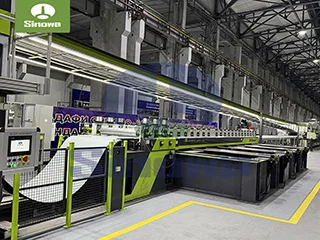
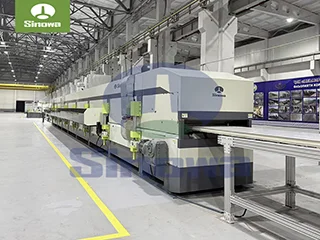
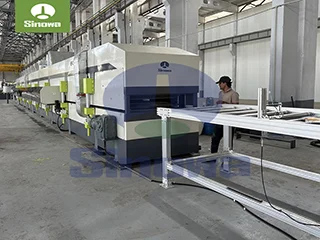
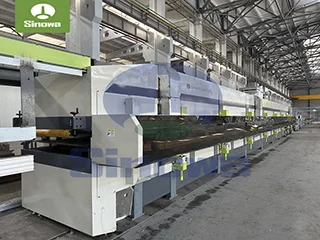
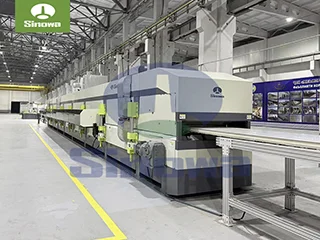
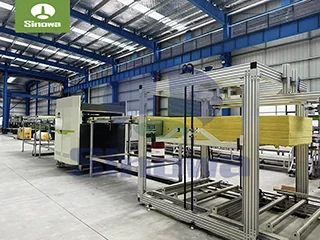
The overall structural composition of thermal insulation sandwich panel production equipment follows a modular integrated design concept, with each functional module independently undertaking specific production process links while maintaining precise collaborative linkage and synchronous operation throughout the entire production line. The basic configuration of the complete production system covers raw material unwinding and conveying units, raw material surface pretreatment and trimming mechanisms, core material automatic feeding and uniform distribution systems, high-precision material mixing and perfusion devices, continuous rolling and composite bonding mechanisms, constant-temperature heating and curing shaping modules, fixed-length cutting and edge trimming assemblies, as well as finished product conveying and automatic stacking auxiliary structures. Each functional part is closely connected in sequence according to the inherent technological process of sandwich panel production, forming an uninterrupted assembly line operation mode from raw material input to finished product output. In the actual production and operation process, all mechanical actions and parameter adjustments do not require frequent manual intervention and debugging, and the whole process can realize automatic cycle operation only through preset production process parameters and operating programs, effectively reducing the impact of human factors on production efficiency and product quality stability. The mechanical structure of the equipment is made of high-strength wear-resistant and corrosion-resistant metal materials through integral welding and precision machining, which can maintain stable mechanical performance and long-term operational reliability under long-term continuous high-load working conditions, avoiding mechanical deformation, part wear and frequent failure shutdown problems that are easy to occur in ordinary simple processing equipment.
The raw material unwinding and conveying unit is the initial starting part of the entire thermal insulation sandwich panel production line, mainly responsible for stably and continuously releasing the upper and lower surface base materials required for processing sandwich panels, and ensuring the flatness and conveying stability of the base materials in the subsequent conveying process. Common surface base materials used for production include various metal sheet materials and flexible protective decorative materials, all of which are supplied in roll-shaped raw material forms, so the unwinding unit is equipped with a special tension adjusting and deviation correcting structure. The tension control system can dynamically adjust the unwinding tension in real time according to the production running speed and material feeding progress, effectively preventing the surface base material from generating wrinkles, stretching deformation or position deviation during the unwinding and conveying process. The automatic deviation correcting mechanism can timely sense the position offset of the base material during conveying through precision sensing components, and automatically fine-tune the operating position of the unwinding roller group and conveying guide roller group, ensuring that the upper and lower surface base materials are always kept in the center position of the production line conveying track, laying a solid foundation for the accurate alignment and subsequent composite bonding of follow-up materials. At the same time, the conveying roller group of the unwinding and conveying unit adopts a symmetrical layout design, with the surface of the roller body treated with anti-slip and anti-scratch processing, which not only ensures the stable conveying power of the base material, but also avoids scratching or damaging the surface coating of the base material, ensuring the surface appearance quality of the final finished sandwich panels.
Following the unwinding and conveying link, the raw material surface pretreatment and trimming mechanism carries out targeted processing on the surface base materials to meet the subsequent composite bonding and forming production requirements. During the production and storage of roll-shaped surface base materials, there may be burrs at the edges, uneven surface attachments or subtle edge irregularities, which will affect the bonding tightness and overall dimensional accuracy of subsequent composite panels if not processed in advance. The pretreatment mechanism is equipped with efficient surface cleaning and trimming components, which can automatically remove dust, oil stains and other attachments on the inner bonding surface of the surface base materials, ensuring that the bonding surface is clean and dry, and improving the bonding firmness between the surface base materials and the internal thermal insulation core materials. The edge trimming part can carry out fixed-width trimming according to the production specification requirements of different sandwich panels, cutting off the irregular edges on both sides of the base materials, ensuring that the width dimensions of the upper and lower surface base materials are completely consistent, and avoiding the problem of uneven edges of the finished panels after subsequent composite forming. All trimming and pretreatment operations are completed synchronously with the conveying speed of the production line, without affecting the continuous operation rhythm of the entire production process, and the processed base materials can directly enter the next production link in a continuous and flat state.
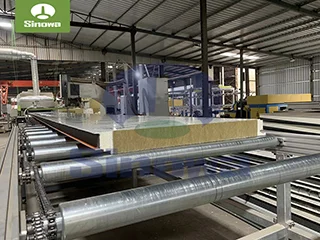
The core material automatic feeding and uniform distribution system is a key functional module that directly determines the thermal insulation performance and internal structural uniformity of finished thermal insulation sandwich panels. The internal thermal insulation core materials of sandwich panels are mostly lightweight porous thermal insulation raw materials with good thermal resistance and heat preservation effects, which need to be evenly paved and distributed between the upper and lower surface base materials to form a continuous and dense thermal insulation intermediate layer. This feeding and distribution system adopts quantitative automatic feeding and dynamic spreading design, which can accurately control the feeding amount of core materials according to the thickness specification and density requirements of different produced panels, avoiding the quality problems of insufficient thermal insulation effect and uneven structural stress caused by excessive or too little core material feeding. The internal spreading structure of the system can break up the agglomerated core material particles and carry out uniform scattering and leveling treatment, ensuring that the core material is evenly distributed in the width and length direction of the base materials, with no local accumulation or missing areas. In addition, the system is equipped with a material level monitoring and feedback adjusting function, which can real-time monitor the thickness and distribution state of the core material pavement, and automatically adjust the feeding speed and spreading amplitude according to the monitoring data, so that the core material pavement state always meets the production process standards, and the thermal insulation performance and internal structure of each position of the produced sandwich panels remain consistent and stable.
The high-precision material mixing and perfusion device is mainly applicable to the production process of sandwich panels that need to use chemical combined thermal insulation core materials, realizing the precise proportioning, full mixing and uniform perfusion of various raw materials required for the formation of the core material. Different from single lightweight core material paving, chemical composite core materials need to mix multiple liquid and powdery raw materials in a strict proportion, and the mixed materials undergo chemical reaction and foaming solidification inside the sandwich panel to form a dense and integrated thermal insulation core layer. The mixing and perfusion device is equipped with a precision metering and conveying structure for various raw materials, which can accurately control the proportion and conveying flow of each raw material, ensuring that the proportion of mixed raw materials completely conforms to the formula requirements for core material preparation. The internal dynamic mixing structure can carry out high-speed stirring and dispersion treatment of various raw materials, fully mixing different raw materials evenly, avoiding the problem of uneven chemical reaction caused by raw material stratification and incomplete mixing, which affects the foaming effect and thermal insulation performance of the core material. The perfusion part adopts reciprocating mobile perfusion design, which can uniformly inject the mixed raw materials between the upper and lower surface base materials according to the set track and speed, ensuring that the mixed materials are evenly distributed in the internal space of the sandwich panel, and form a stable and integrated thermal insulation core layer after subsequent foaming and solidification.
The continuous rolling and composite bonding mechanism is the core equipment module to realize the integral composite forming of surface base materials and internal thermal insulation core materials. After the surface base materials and internal core materials are paved and perfused in place, they need to be pressed and bonded by the rolling mechanism to make the upper and lower surface materials closely fit with the internal core materials, and form an integrated composite structure after preliminary bonding and shaping. The rolling mechanism is composed of multiple groups of upper and lower symmetrically arranged pressing rollers, and the gap between the upper and lower pressing rollers can be accurately adjusted according to the thickness specification of the produced sandwich panels, ensuring that the thickness of each panel is uniform and consistent, and the overall compression density meets the design requirements. The pressing rollers adopt rigid structural design and surface anti-stick treatment, which can apply uniform and stable pressing force to the composite materials, making the surface base materials and core materials closely bonded without gaps, and avoiding the quality problems of hollowing, delamination and poor bonding strength inside the panels. At the same time, the rolling speed of the pressing rollers is synchronized with the conveying speed of the front-end production line, maintaining the continuity and stability of the composite forming process, ensuring that the composite bonding state of the sandwich panels in the continuous production process is always consistent, and the structural firmness of each finished panel is uniform.
The constant-temperature heating and curing shaping module undertakes the key process of accelerating the solidification and shaping of the internal core materials and enhancing the bonding strength between layers of sandwich panels. After composite rolling and preliminary bonding, the sandwich panels need to be placed in a constant-temperature heating environment for a certain period of curing treatment, so that the internal core materials complete chemical reaction foaming or physical solidification shaping, and the bonding interface between the surface materials and the core materials forms stable and firm adhesive force. The heating and curing module adopts a closed thermal insulation box structure with an internal circulating heating system, which can realize uniform heating and constant temperature control of the internal space, avoiding local overheating or low temperature affecting the curing effect of the panels. The internal temperature of the curing area can be adjusted and set according to the material characteristics and production process requirements of different core materials, and the precise temperature control system can maintain the temperature fluctuation within a small range, ensuring that each batch of sandwich panels is cured under the same temperature conditions. The internal conveying track of the curing box is consistent with the running speed of the front-end production line, realizing continuous feeding and discharging of panels, without the need for static placement and intermittent curing, greatly improving the continuous production efficiency of the entire production line. After constant-temperature curing and shaping, the internal structure of the sandwich panels tends to be stable, the bonding between layers is firm and reliable, and the basic performance indexes such as thermal insulation effect and structural strength reach the qualified standard of finished products.
The fixed-length cutting and edge trimming assembly is responsible for cutting the continuously produced long strip composite panels into finished products of specified dimensions, and carrying out fine trimming and finishing treatment on the edges and ends of the panels to ensure that the dimensional accuracy and appearance quality of the finished products meet the delivery and use requirements. The cutting mechanism adopts automatic fixed-length positioning and high-speed cutting design, which can accurately set the cutting length according to the order and use requirements, and automatically complete the positioning and cutting actions when the panels are conveyed to the specified position. The cutting tool adopts high-strength wear-resistant material manufacturing and sharpness maintenance design, which can complete the cutting operation quickly and smoothly, ensuring that the cutting section of the panels is flat and smooth without burrs, cracks and edge damage. The edge trimming part carries out fine trimming treatment on the four sides of the cut single panel, removing tiny irregular edges and burrs generated in the production and cutting process, making the overall dimensions of each finished panel accurate and the edges neat and uniform. All cutting and trimming operations are automatically completed by the equipment in the production process, with high processing precision and fast operation speed, which will not cause damage to the structural performance and surface appearance of the sandwich panels, and effectively ensure the consistency of the finished product specifications and appearance quality.
The finished product conveying and automatic stacking auxiliary structure is the final link of the entire sandwich panel line, responsible for conveying the cut and trimmed qualified finished thermal insulation sandwich panels to the designated position, and realizing automatic stacking and arrangement of finished products, facilitating subsequent packaging, transportation and storage. The finished product conveying mechanism adopts a stable belt conveying structure, which can smoothly convey the finished panels without vibration and impact, avoiding surface scratch and structural damage of the panels during conveying. The automatic stacking device can automatically adjust the stacking position and number of layers according to the production and handling requirements, neatly stacking the finished panels in order, realizing automatic collection and arrangement of finished products without manual carrying and stacking, greatly reducing manual labor intensity and improving the overall automation level of production. The entire stacking process runs stably and reliably, the stacking of panels is neat and stable, and there is no tilting, collision and damage of finished products, ensuring that the quality of finished panels is still intact after stacking and leaving the factory.
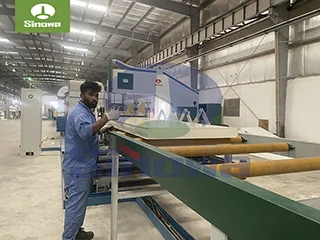
The core control system of thermal insulation sandwich panel production machinery adopts integrated intelligent control design, which centrally manages and regulates the operating speed, process parameters, mechanical actions and operational status of all functional modules of the entire production line. The control system integrates parameter setting, real-time operation monitoring, automatic fault detection and data operation recording functions, and operators only need to set the production specifications, process parameters and operating speed on the control terminal in the early stage of production, and the equipment can realize fully automatic cycle production. During the production process, the system can real-time monitor the operating state of each mechanical module, the change of process parameters and the production progress, and automatically fine-tune various operating parameters according to the actual production situation to ensure the stable operation of the production line and the consistent quality of products. When abnormal conditions such as mechanical failure, parameter deviation and material shortage occur in the production process, the control system can automatically send out prompt signals and take corresponding protective measures such as automatic shutdown to avoid equipment damage and mass production of unqualified products. The intelligent control mode simplifies the operation and management process of equipment production, reduces the professional operation requirements for operators, and improves the overall production stability and safety of the production line.
In the actual production and application process, thermal insulation sandwich panel production machine has strong production adaptability and flexible adjustment performance, and can meet the production and processing needs of sandwich panels with different materials, different thickness specifications and different application performance requirements. By adjusting the operating parameters of each functional module such as unwinding tension, core material feeding capacity, rolling gap, curing temperature and cutting length, the same set of production equipment can produce multiple types of thermal insulation sandwich panels adapted to different building and industrial scenarios. Whether it is thin decorative thermal insulation panels for building exterior walls, thick high-strength thermal insulation panels for cold storage and fresh-keeping warehouses, or special thermal insulation and isolation panels for industrial production workshops, the equipment can complete efficient and standardized production and processing through simple parameter adjustment and module adaptation. The flexible production characteristics of the equipment enable production enterprises to quickly respond to the diversified market demand, adjust product production specifications and types in a timely manner, and improve the market competitiveness and production operation flexibility of enterprises.
Daily maintenance and scientific maintenance are important guarantees to ensure the long-term stable operation and extended service life of thermal insulation sandwich panel machine. Although the equipment has a rigid mechanical structure and stable operating performance, long-term continuous high-load operation will inevitably cause normal wear of mechanical parts and aging of electrical control components. Regular maintenance work mainly includes regular lubrication of rotating and transmission parts, regular inspection and tightening of connecting fasteners, regular cleaning of material conveying and mixing components, regular calibration of precision control parameters and sensing components, and regular inspection and maintenance of heating and curing systems. Scientific daily maintenance can effectively reduce the failure rate of equipment operation, avoid production shutdown losses caused by equipment failure, ensure the continuity and stability of production work, and maintain the high-precision processing performance of the equipment for a long time. At the same time, standardized maintenance management can also extend the overall service life of the production equipment, reduce the long-term production and operation cost of production enterprises, and create more stable economic benefits for enterprise production and development.
With the continuous progress of industrial manufacturing technology and the continuous improvement of social energy conservation and environmental protection requirements, thermal insulation sandwich panel production equipment is also developing in the direction of higher automation degree, more precise control accuracy, more energy-saving operation mode and more environmentally friendly production process. The updated and upgraded production equipment not only further optimizes the mechanical structure and production process flow, improves production efficiency and product qualification rate, but also optimizes the energy consumption structure in the production process, reduces energy consumption and material waste in the production process, and realizes green and low-carbon production and processing. The continuous technological innovation and equipment upgrading of thermal insulation sandwich panel production equipment will further promote the high-quality development of the thermal insulation building material industry, provide more reliable and high-performance thermal insulation sandwich panel products for various construction and industrial fields, and make important contributions to promoting building energy conservation, improving industrial production environment and realizing social green development goals.
https://www.cnsinowa.com/sandwich-panel-machines/thermal-insulation-sandwich-panel-production-equipment.html