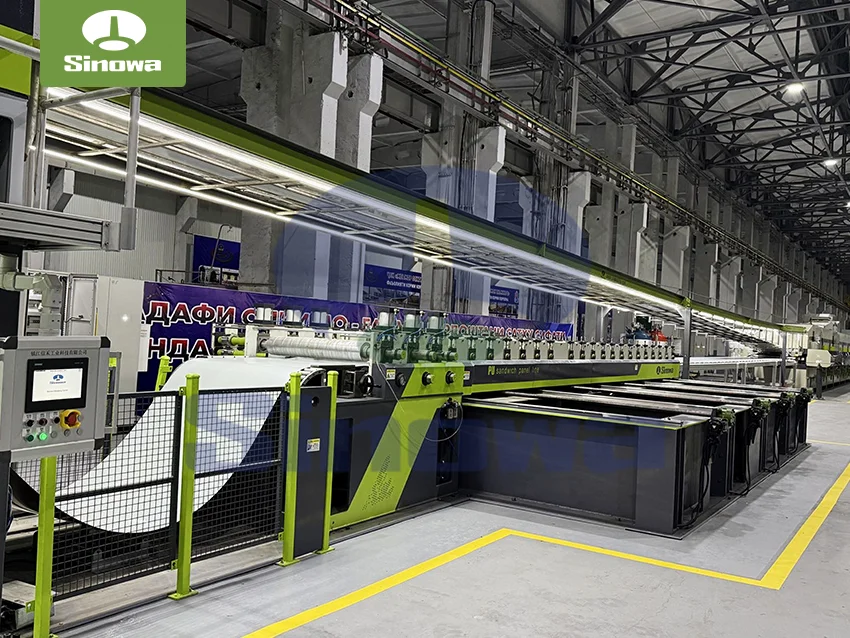
 sandwich panel machine
The overall structural composition of polyurethane sandwich panel production line follows a scientific production logic, with each functional module independently undertaking professional processing tasks while maintaining highly coordinated linkage. The entire production system can be divided into multiple core functional units including surface material processing unit, raw material metering and mixing unit, foam pouring and composite laminating unit, constant temperature curing unit, fixed-length cutting and trimming unit, and finished product conveying and sorting unit. Each unit is equipped with independent transmission and regulation systems, and the operating parameters of all units are uniformly matched through the central control system to ensure the consistency of production rhythm and product quality. The equipment is highly adaptable to production conditions, capable of long-term stable operation in different factory environments, and can adjust operating parameters according to different production requirements such as panel thickness, surface material specifications, and foam density, meeting the diversified production demands of different application scenarios.
The surface material processing unit is the front-end core part of the polyurethane sandwich panel line, responsible for completing the pretreatment and forming of metal or composite surface materials for sandwich panels. This unit mainly includes uncoiling, leveling, preheating, and roll forming mechanisms. The uncoiling mechanism steadily releases coiled surface materials through a passive or active unwinding mode, avoiding material tension fluctuation and uneven feeding caused by manual operation. The matched leveling device adopts multi-group roller calibration structure to eliminate surface wrinkles, bending deformation and internal stress generated during coil storage and transportation, ensuring the flatness and dimensional stability of the surface materials in the subsequent processing process. The preheating mechanism uses uniform heat conduction modes to raise the temperature of the surface materials to the optimal process temperature, which can effectively enhance the bonding activity between the surface materials and polyurethane foam, avoid degumming and layering problems caused by temperature difference during composite forming, and significantly improve the overall bonding strength and structural stability of the panels. The roll forming mechanism adopts multi-station progressive pressing design, which gradually bends and shapes the flat surface materials according to the preset profile specifications through precise roller arrangement, realizing the one-time forming of various edge structures and installation grooves required for sandwich panel assembly, and laying a foundation for the seamless assembly of subsequent building panels.
The raw material metering and mixing unit is the key functional component that determines the core performance of polyurethane sandwich panels, undertaking the precise proportioning and uniform mixing of polyurethane two-component raw materials. Polyurethane foam is formed by the chemical reaction between polyol and isocyanate components, and the proportion accuracy, mixing uniformity and reaction temperature of the two raw materials directly affect the foam density, pore structure, thermal insulation performance and mechanical strength of the finished panels. This unit is equipped with high-precision metering power components, which can stably and quantitatively convey the two raw materials according to the preset process ratio, effectively avoiding product performance differences caused by raw material proportion deviation. The internal mixing structure adopts high-speed impact mixing technology, which can fully fuse the two liquid raw materials in an instant, form a uniform reaction mixture, and ensure the consistency of the reaction degree of each batch of raw materials. In addition, the unit is equipped with a circulating temperature regulation system, which can monitor and adjust the temperature of raw materials in real time, maintain the raw materials in the optimal reaction temperature range, avoid abnormal reaction phenomena such as premature foaming, incomplete curing or excessive bubble pores caused by temperature fluctuation, and ensure the stable physical and chemical properties of the polyurethane foam core layer.
The foam pouring and composite laminating unit is the central link of panel forming, completing the uniform pouring of polyurethane mixed materials and the integral composite pressing of upper and lower surface materials. The pouring mechanism can evenly spray and pour the mixed liquid polyurethane materials on the surface of the lower layer forming material through a movable pouring head, and realize the full coverage of the effective width of the panel through reciprocating or fixed-point uniform discharging, ensuring the uniform thickness and consistent density of the foam core layer in the whole panel area. After the pouring is completed, the upper and lower surface materials with polyurethane reaction materials enter the double-track laminating conveyor together. The laminating mechanism adopts a constant-pressure and constant-speed conveying structure, which can provide stable and uniform pressing force for the composite panel during the foaming and expansion process of polyurethane materials. In the closed space of the laminating equipment, the polyurethane materials undergo orderly foaming, expansion and adhesion reactions. The moderate pressing force can limit the excessive expansion of the foam, make the foam structure compact and uniform, and enable the foam core layer to form a firm integrated bonding state with the upper and lower surface materials. The synchronous operation of the double-track conveyor ensures that the panel maintains a stable linear moving speed during the composite forming process, avoiding product deformation, thickness deviation and surface unevenness caused by speed jitter.
The constant temperature curing unit is an essential part to ensure the complete reaction and stable shaping of polyurethane foam. After preliminary composite pressing, the sandwich panel has not yet completed the full curing reaction, and the internal foam structure is not completely stable. The curing unit provides a closed constant temperature and heat preservation space, which can maintain a stable reaction temperature environment inside the equipment, promote the continuous cross-linking reaction of polyurethane molecular chains, and realize the complete curing and shaping of the foam core layer. The internal temperature distribution of the curing equipment is uniform, without local overheating or low temperature dead zone, which ensures that the curing degree of each part of the panel is consistent, effectively preventing quality problems such as local softness, insufficient strength and uneven shrinkage of the panel. The length of the curing zone is scientifically matched with the production speed, which can fully meet the curing time required for polyurethane foam reaction, ensure that the internal stress of the panel is completely released after forming, and improve the dimensional stability and structural durability of the finished panel. With the gradual advancement of the production process, the panel completes the curing reaction in the constant temperature zone, and the overall structure changes from flexible semi-finished state to rigid stable state, meeting the subsequent cutting and processing conditions.
The fixed-length cutting and trimming unit is responsible for the final shaping and finishing of cured sandwich panels, realizing the precise sizing and edge finishing of products. After curing, the continuous integral panel is conveyed to the cutting station at a constant speed, and the automatic cutting system can identify the preset length parameters and complete fixed-length cutting in a non-stop continuous operation state, which effectively improves production efficiency while ensuring the consistency of panel length dimensions. The cutting mechanism adopts high-precision cutting tools and stable transmission structure, with smooth cutting sections and no burrs, avoiding surface damage and structural cracking of the panel during cutting. The trimming device on both sides of the equipment can perform fine trimming on the edges of the panel, remove the excess foam and edge residues generated in the composite process, make the overall width of the panel uniform, and ensure the flatness and regularity of the assembly interface. All cutting and trimming parameters are adjustable, which can adapt to the processing requirements of panels with different specifications, and realize flexible switching of production sizes.
The finished product conveying and sorting unit undertakes the subsequent transportation, arrangement and temporary storage of processed finished panels. The cut finished panels are stably conveyed outward through the automatic conveying mechanism, and the polyurethane sandwich panel machine is equipped with a buffering and sorting structure, which can arrange the panels in an orderly manner according to the production rhythm, avoid stacking and collision damage between panels, and maintain the flatness and integrity of the finished products. The conveying speed of this unit is synchronized with the front-end production rhythm, realizing the seamless connection of the whole production line, no material accumulation and no production pause, ensuring the continuity and fluency of the whole production process. The unit can be matched with automatic stacking structures according to production needs, realizing automatic stacking of finished panels, reducing manual intervention, improving production automation level, and creating convenient conditions for subsequent packaging, transportation and storage of products.
The operation and control system of PU sandwich panel machine adopts integrated automatic control logic, realizing the centralized regulation and intelligent monitoring of all functional units. The core control system can uniformly set and adjust key process parameters such as raw material proportioning, feeding speed, preheating temperature, curing temperature, laminating pressure, and cutting length. All operating data can be monitored in real time through the human-machine interaction interface, and the system can automatically identify abnormal operating states such as parameter deviation, equipment jitter and material shortage, and trigger corresponding protection and prompt mechanisms to ensure the safe and stable operation of the equipment. The linkage control mode avoids the asynchronous operation of individual units, effectively reduces the fluctuation of product quality caused by human operation errors, and improves the overall production stability and product qualification rate. Meanwhile, the control system has a parameter memory function, which can store the process parameters of different specification products, realizing rapid switching of production formulas and improving the flexible production capacity of the equipment.
In terms of working mechanism, the manufacturing process of polyurethane sandwich panels is a comprehensive process combining physical forming and chemical reaction. The whole production process follows the reaction characteristics of polyurethane rigid foam. The two-component raw materials undergo molecular cross-linking reaction after high-precision mixing, and generate gas during the reaction process to form a fine and closed-cell foam structure. Under the dual action of constant pressure constraint and constant temperature curing of the equipment, the foam expands evenly and forms a compact and stable three-dimensional network structure. This unique pore structure gives the sandwich panel excellent thermal insulation performance, because the closed-cell structure can effectively lock static air, reduce heat conduction and convection, and greatly reduce the heat transfer efficiency of the panel. At the same time, the integrated composite structure formed by the foam core layer and the surface materials under mechanical pressure and chemical adhesion has good overall rigidity and bending resistance, enabling the panel to bear certain external loads and meet the structural use requirements of building enclosure systems.
Modern PU sandwich panel production line has significant advantages in production efficiency and resource utilization compared with traditional intermittent production equipment. The continuous production mode realizes 24-hour uninterrupted cyclic production, greatly shortens the single-panel production cycle and improves the unit time output. The precise raw material metering system avoids raw material waste caused by manual proportioning deviation, and the full-process closed production mode reduces the volatilization loss of chemical raw materials, effectively improving the utilization rate of raw materials. The optimized structural design of the equipment reduces mechanical friction and power consumption during operation, realizing energy-saving production while ensuring stable operation. In addition, the automated production process reduces manual operation links, lowers the labor intensity of operators, and avoids product quality fluctuations caused by manual operation differences, making the product quality more uniform and stable.
The equipment has strong product adaptability and can produce sandwich panels suitable for multiple application scenarios by adjusting process parameters and matching different surface materials. When using metal color steel plates as surface materials, the produced panels have good weather resistance, corrosion resistance and structural strength, and are widely used in industrial factory buildings, warehouse enclosures, and clean workshop partitions. When matching lightweight composite surface materials, the panels have the characteristics of light weight and high thermal insulation, which can be applied to temporary buildings, cold storage insulation structures and mobile building facilities. By adjusting the foaming density and core layer thickness of polyurethane materials, the equipment can produce panels with different thermal insulation grades and mechanical strength, meeting the differentiated performance requirements of different regions, different building types and different environmental conditions for thermal insulation, heat preservation and structural stability.
In terms of equipment operation stability and durability, the key load-bearing and transmission parts of PU sandwich panel line adopt high-strength structural design and wear-resistant materials, which can adapt to long-term continuous high-load operation. The transmission system adopts synchronous transmission structure, with stable operation and low failure rate, avoiding production pause caused by transmission failure. The temperature control system and pressure control system have high precision and good stability, which can maintain long-term consistent process conditions and ensure the long-term stability of product quality. The equipment is equipped with perfect dust-proof, anti-corrosion and wear-resistant protection structures, which can resist the erosion of dust, moisture and chemical residues in the production environment, reduce the wear and aging speed of parts, and extend the overall service life of the equipment. Meanwhile, the modular structural design facilitates daily maintenance and later maintenance of the equipment, and the damaged parts can be quickly disassembled and replaced, effectively reducing maintenance time and production loss.
The technological advancement of polyurethane sandwich panel production equipment is mainly reflected in the optimization of reaction control and forming precision. The traditional production equipment has problems such as low proportioning accuracy, uneven mixing and unstable curing temperature, which easily lead to inconsistent foam pore structure, unqualified bonding strength and large dimensional deviation of products. The upgraded modern equipment optimizes the metering accuracy of raw material components, realizes micro-level precise proportioning, makes the polyurethane reaction more sufficient and uniform, and the formed foam structure more compact and regular. The intelligent temperature and pressure closed-loop control system can adjust the process parameters in real time according to the changes of production environment and raw material state, always maintain the optimal reaction and forming conditions, effectively solve the problem of product quality fluctuation caused by environmental changes and raw material differences, and greatly improve the comprehensive performance and stability of finished panels.
In actual production application, the operation logic of polyurethane sandwich panel machinery follows the principle of front-to-back sequential operation and overall synchronous coordination. The surface material pretreatment and forming process are carried out synchronously with the raw material mixing and metering process. When the formed surface materials are conveyed to the pouring station, the mixed polyurethane materials are accurately poured in place at the same time, realizing zero-delay docking of processes. The composite forming, curing and cutting processes are connected end to end, forming a continuous and uninterrupted production chain. This streamlined production mode not only improves production efficiency, but also avoids quality problems such as interface dislocation and material aging caused by intermittent production and long-time standing of semi-finished products. The whole production process realizes the integration of physical processing and chemical reaction, and the product forming quality and performance stability are far superior to those of traditional manual and semi-automatic production modes.
The polyurethane sandwich panel making machine also has good environmental protection performance in the production process. The closed raw material conveying and mixing system can effectively reduce the volatilization of chemical raw materials, avoid the pollution of harmful gases to the production environment, and improve the safety of the production process. The optimized foaming process reduces the generation of waste materials and residual materials, and the leftover materials generated by trimming and cutting can be recycled and reused, realizing the efficient utilization of resources. The low-energy operation design of the equipment reduces the comprehensive energy consumption per unit product, which conforms to the development trend of energy conservation and environmental protection in the modern building material industry. At the same time, the stable and fully reacted polyurethane foam produced by the equipment has stable chemical properties, no harmful substance precipitation, and good environmental protection and safety of the finished product, meeting the green building material application standards of modern construction projects.
With the continuous development of the construction industry towards lightweight, energy-saving and high-efficiency, the market demand for polyurethane sandwich panels is continuously upgraded, which also promotes the continuous technological iteration and performance optimization of supporting production equipment. Modern polyurethane sandwich panel manufacturing line is developing in the direction of higher automation, stronger intelligence, better flexibility and lower energy consumption. The introduction of intelligent sensing and data analysis technology enables the equipment to realize real-time monitoring, data recording and fault early warning of the whole production process, which is convenient for production personnel to optimize process parameters and manage production quality. The flexible production design enables a single production line to adapt to the production of multi-specification and multi-type panels, reducing the cost of equipment investment and production line replacement for enterprises. The continuous improvement of energy-saving and environmental protection technology makes the production process more green and efficient, and further enhances the market application value of the equipment.
In practical industrial production, the correct operation and scientific maintenance of polyurethane sandwich panel production machine are important guarantees to ensure production efficiency and product quality stability. Operators need to master the matching rules of various process parameters, adjust the operating state of the equipment according to the characteristics of raw materials and production requirements, and avoid product quality defects caused by unreasonable parameter setting. Daily maintenance work includes regular inspection of transmission parts, cleaning of residual materials in the mixing and pouring system, calibration of temperature and pressure control parameters, and lubrication and maintenance of mechanical moving parts. Timely maintenance can effectively reduce equipment failure rate, maintain long-term stable operating performance of the equipment, extend the service life of the equipment, and create stable economic benefits for production enterprises. At the same time, standardized operation and maintenance can ensure the consistency of production process conditions, make the performance of each batch of products stable and reliable, and lay a foundation for the large-scale and standardized application of polyurethane sandwich panels in the construction field.
In conclusion, polyurethane sandwich panel equipment as a professional and integrated production system for energy-saving building materials, relies on sophisticated mechanical structure design and precise process control technology to realize efficient and standardized production of high-performance composite sandwich panels. Its modular functional layout, continuous production mode and intelligent control system endow it with outstanding advantages in production efficiency, product quality stability, resource utilization rate and flexible production capacity. With the continuous progress of construction energy-saving technology and the continuous expansion of the application scope of polyurethane sandwich panels, this type of equipment will continue to carry out technological innovation and performance optimization, adapt to the increasingly stringent production requirements and market demands, and provide reliable core equipment support for the high-quality development of the modern building enclosure material industry. The PU sandwich panel manufacturing line not only promotes the upgrading of production technology in the sandwich panel industry, but also plays an important supporting role in the development of green, energy-saving and lightweight modern construction engineering.
https://www.cnsinowa.com/sandwich-panel-machines/polyurethane-sandwich-panel-equipment.html






