sandwich panel line
Prefab houses rely heavily on the dimensional accuracy, structural stability, and functional uniformity of sandwich panels, as these panels constitute the main wall, roof, and partition components of modular buildings. A mature sandwich panel production line abandons scattered manual processing and semi-automatic intermittent operation, adopting a fully continuous integrated production mode that unifies material feeding, forming, compounding, curing, cutting, and finishing. This systematic production method eliminates the inconsistencies caused by manual operation, ensuring that every batch of finished panels maintains consistent thickness, flatness, and bonding performance, which is critical for the seamless assembly and long-term service stability of prefab houses. As the demand for fast-built temporary residences, modular office buildings, low-rise prefab villas, and emergency shelter buildings continues to rise globally, the technical maturity and operational efficiency of sandwich panel production lines have become key factors restricting the development of the prefab construction industry.
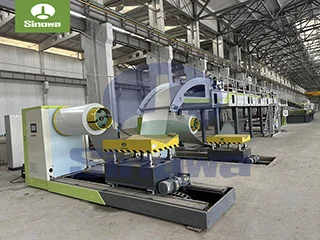
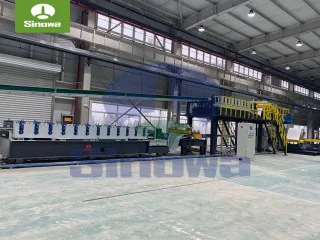
The overall structural design of a modern continuous sandwich panel production line follows modular and synchronized operational logic, with each functional unit closely connected to form an uninterrupted production workflow. The entire system can be divided into multiple core functional sections, each undertaking independent processing tasks while maintaining precise operational synchronization through intelligent linkage control. The initial stage of production focuses on the pretreatment of surface facing materials, which are mostly metal coiled materials with good toughness and weather resistance. The coiled raw materials are stably uncoiled through automatic unwinding equipment, which supports continuous and uniform material feeding to avoid tension fluctuation that may cause material deformation. After uncoiling, the metal sheets pass through multi-group leveling roller sets, which eliminate surface wrinkles, bending deformations, and residual stress generated during coiling and transportation. This leveling process ensures the absolute flatness of the surface materials, directly determining the surface smoothness and overall flatness of the final sandwich panels, and avoiding assembly gaps and structural tilting in subsequent prefab house construction.
Following surface material pretreatment is the roll forming process, a key link that shapes the functional structure of panel surfaces. Different prefab house parts such as exterior walls, interior partitions, and roofs require panels with different edge profiles and structural grooves. The roll forming system is equipped with adjustable multi-stage forming rollers, which gradually press flat metal sheets into customized profile structures through progressive rolling pressure. This gradual forming method avoids material cracking and surface damage caused by one-time stamping, maintaining the integrity of the metal surface coating and structural performance. The flexibility of the roll forming system allows the continuous sandwich panel line to switch between multiple panel specifications, enabling manufacturers to produce wall panels, roof panels, and corner matching panels required for different prefab house designs on a single production line, greatly improving production versatility and resource utilization.
While the surface materials undergo forming processing, the core material feeding and pretreatment system operates synchronously to ensure coordinated production rhythm. Common core materials for prefab house sandwich panels include porous foam materials and inorganic fiber materials, all of which have excellent thermal insulation, sound insulation, and lightweight characteristics suitable for modular buildings. The core material conveying system automatically transports raw core materials to the composite processing area, completing fixed-length cutting, arrangement, and surface cleaning in advance. For foam core materials that require on-site foaming and molding, the sandwich panel line is equipped with a high-precision batching and injection system, which mixes raw materials in accurate proportions and sprays the mixed materials evenly between the upper and lower surface layers. The precise material ratio control ensures that the foamed core layer forms a uniform and dense cellular structure, avoiding hollow areas and density differences that would weaken the thermal insulation and structural bearing capacity of the panels.
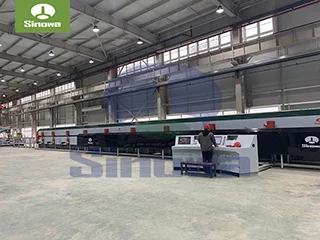
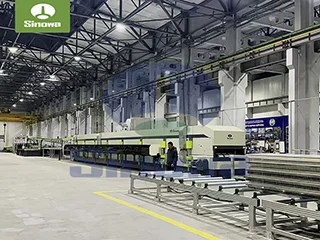
The laminating and curing stage is the core procedure that determines the overall structural performance of sandwich panels. After the surface formed materials and core materials are accurately aligned and compounded, the semi-finished panels enter the constant-temperature and constant-pressure laminating unit. The double-belt laminating structure provides continuous and uniform pressing force across the entire panel surface, ensuring tight fitting between the surface layers and the core layer without local gaps or delamination. The independent temperature control system maintains a stable curing temperature environment, promoting sufficient chemical reaction and bonding curing of adhesive materials or foaming materials. This integrated thermo-compound curing process enables the surface layers and core layer to form an integral composite structure, effectively improving the overall rigidity, peel resistance, and impact resistance of the panels. Panels processed by this curing system can withstand long-term outdoor temperature changes and structural loads, fully adapting to the complex service environments of prefab houses in different regions.
After curing and shaping, the continuous long strip of composite panels enters the precision finishing and cutting stage. The intelligent cutting system automatically identifies the set dimensional parameters and performs fixed-length cutting on the continuous panels, with high dimensional accuracy to meet the standardized assembly requirements of prefab houses. In addition to length cutting, the trimming device removes tiny burrs and uneven edges on the panel sides, ensuring neat and flat panel edges for tight splicing during building assembly. Some optimized production lines are also equipped with automatic grooving and punching modules, which complete reserved hole processing for pipeline laying and structural connection on panels in one step, reducing secondary processing procedures on the construction site and greatly improving the assembly efficiency of prefab houses.
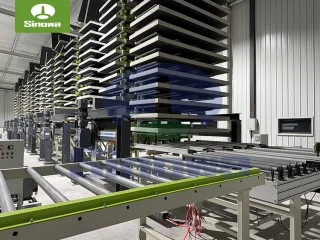
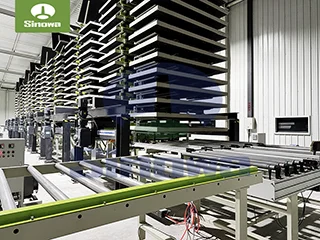
The final stage of the production line includes automatic cooling, stacking, and finishing inspection. The high-temperature panels after curing are gradually cooled through the circulating cooling system to stabilize the internal structural stress and avoid subsequent deformation and warping. The cooled finished panels are automatically stacked and arranged neatly by the stacking device, realizing standardized finished product storage. The built-in detection module of the production line conducts real-time monitoring of panel thickness, flatness, bonding uniformity, and surface quality during the entire production process, automatically identifying and eliminating unqualified products. This full-process quality monitoring mechanism ensures that all delivered panels meet the basic performance requirements of prefab building construction, reducing the risk of quality problems in subsequent building use.
The inherent technical advantages of the sandwich panel machine perfectly match the core development needs of modern prefab houses. First of all, the highly automated production mode greatly improves production efficiency and realizes large-scale batch manufacturing. The continuous operation mode eliminates frequent startup and shutdown intervals of traditional intermittent equipment, achieving stable and efficient output. This mass production capability can quickly meet the large material demand of centralized prefab house construction projects, especially for emergency construction projects such as temporary residential areas and disaster relief shelters that require rapid delivery.
Secondly, the standardized production of the sandwich panel equipment ensures high dimensional consistency of panels. Prefab house construction adopts modular assembly, and all building modules require strict matching of component sizes. The precise processing and intelligent control of the production line make the error range of panel dimensions extremely small, ensuring seamless splicing between panels and stable docking with steel frame structures. This high-precision matching effectively improves the overall sealing performance and structural stability of prefab houses, avoiding common problems such as air leakage, water seepage, and loose assembly caused by inconsistent component sizes in traditional building construction.
In terms of material performance control, the integrated production process of the automatic sandwich panel production line optimizes the comprehensive performance of sandwich panels in multiple dimensions. The uniform core layer structure and firm composite bonding enable the panels to have excellent thermal insulation and heat preservation performance, effectively reducing the energy consumption of prefab houses for heating and cooling throughout the year. At the same time, the integral composite structure improves the wind resistance, pressure resistance, and seismic performance of the panels, enabling prefab houses to adapt to different climatic and geological environments. In addition, the lightweight characteristics of sandwich panels reduce the overall self-weight of prefab buildings, lowering the requirements for foundation bearing capacity, which not only simplifies the foundation construction process but also further shortens the overall construction cycle of prefab houses.
From the perspective of construction economy and environmental protection, the advanced production mode of the sandwich panel production machinery has obvious advantages over traditional building material production and construction methods. The precise material batching and cutting system minimizes raw material waste during production, realizing efficient utilization of building materials. The whole production process adopts closed and environmentally friendly processing technology, with no excessive waste gas, waste residue, and noise pollution, conforming to the green and low-carbon development concept of modern construction industry. Moreover, the prefabricated panels produced by the line can be directly assembled on site, realizing dry construction on the construction site, greatly reducing on-site construction waste, dust pollution, and water resource consumption, and improving the civilized construction level of prefab projects.
With the continuous upgrading of prefab building design and application scenarios, the functional requirements for sandwich panels are becoming increasingly diversified, which also promotes the continuous technological iteration of sandwich panel production lines. Modern sandwich panel manufacturing line has realized multi-specification and multi-functional flexible production, which can adjust production parameters according to different building needs to produce panels with different thermal insulation grades, sound insulation effects, and structural strengths. For high-temperature and high-humidity areas, the production line can optimize the adhesive and core material compounding process to enhance the moisture-proof and corrosion-resistant performance of panels; for cold northern regions, it can produce thickened high-insulation panels to improve the thermal retention capacity of prefab houses; for public prefab buildings with high fire protection requirements, it can support the production of inorganic core fireproof panels to meet higher building safety standards.
The intelligent level of the continuous sandwich panel line is also constantly improving. The modern integrated production system is equipped with a centralized intelligent control platform, which can realize one-click parameter setting, automatic operation monitoring, and real-time fault early warning. The system can record production data in real time, track the production parameters of each batch of panels, and provide data support for product quality traceability and production process optimization. The automatic linkage of each functional unit reduces manual intervention links, reduces the impact of human factors on product quality, and improves the stability and consistency of long-term production operations. In addition, the optimized mechanical structure design reduces equipment failure rates and maintenance costs, ensuring continuous and stable production operation for manufacturing enterprises.
In the entire industrial chain of prefab houses, the sandwich panel machine acts as a key link connecting building material manufacturing and modular construction. Its production efficiency, product quality, and functional flexibility directly determine the construction speed, service performance, and application scope of prefab buildings. Compared with traditional brick and concrete buildings, prefab houses supported by automated sandwich panel production have obvious advantages in construction cycle, environmental protection performance, and later disassembly and reuse. The standardized panels produced by the line can be disassembled and reused after the service cycle of temporary prefab buildings, realizing the cyclic utilization of building materials and further improving the economic and environmental benefits of prefab construction.
Looking at the future development trend of the construction industry, modular prefabricated construction will gradually become the mainstream development direction due to its efficient, green, and flexible characteristics. As the core production equipment of prefab building materials, the sandwich panel production line will develop towards higher intelligence, stronger flexibility, and more energy-saving and environmentally friendly production. With the continuous innovation of material technology and mechanical manufacturing technology, the production line will realize more precise process control, richer product functions, and more efficient production capacity, providing more high-quality and diversified composite panel products for prefab house construction. This will further promote the upgrading of the prefab construction industry, accelerate the transformation of the construction industry from traditional extensive construction to modern industrialized manufacturing, and contribute to the sustainable development of the global construction field.
https://www.cnsinowa.com/sandwich-panel-machines/sandwich-panel-production-line-for-prefab-house.html