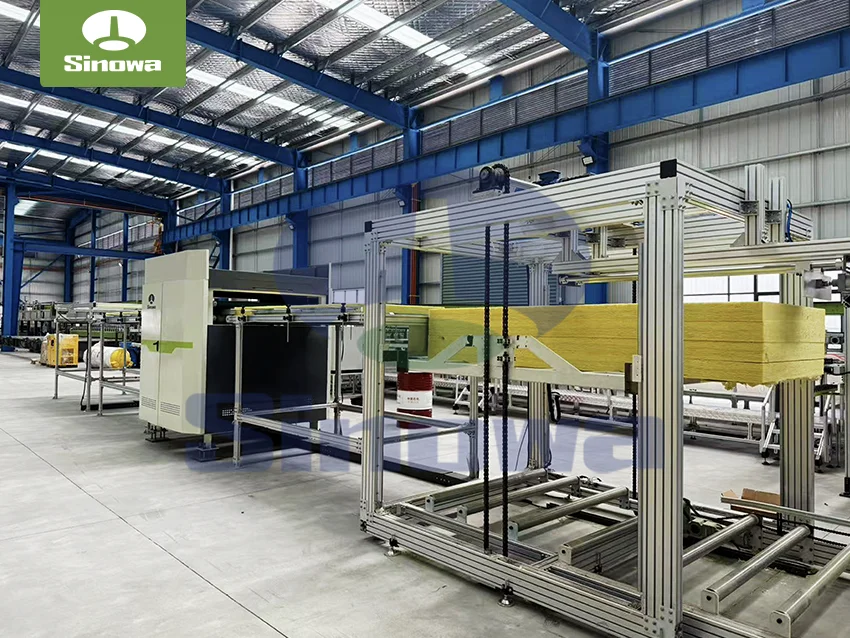
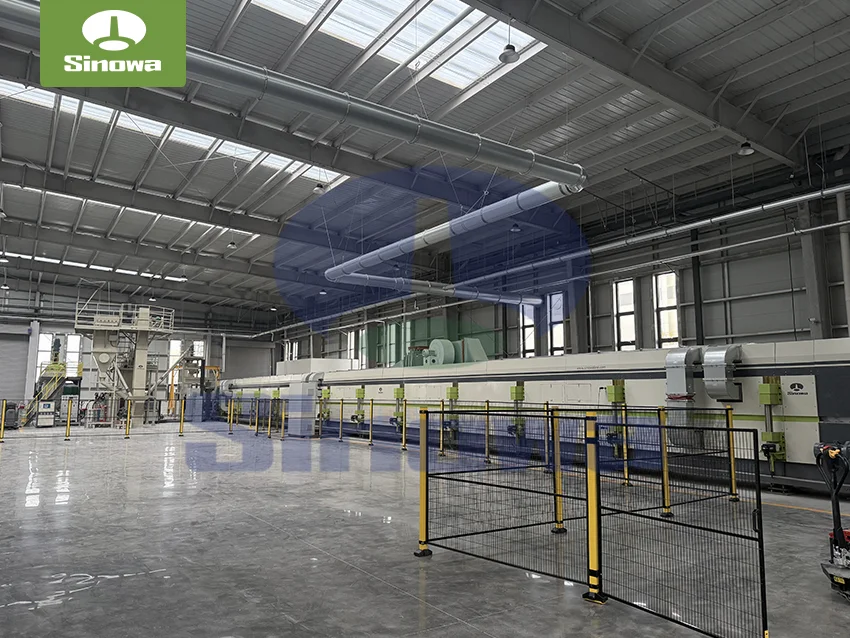
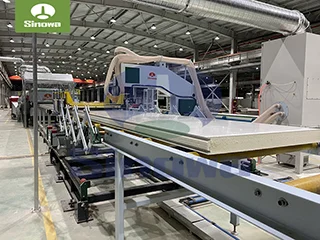
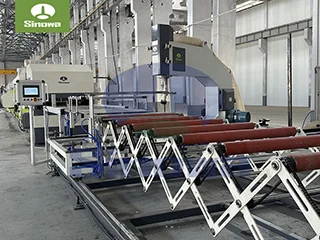
sandwich panel machine
Before initiating any formal production work with the PU sandwich panel machine, comprehensive and meticulous pre-production preparation and safety inspection work must be completed in advance, which is the primary prerequisite to avoid operational failures and product quality problems. The first step of pre-operation preparation is to conduct a full environmental and peripheral inspection of the equipment working area, ensuring that the ground around the entire production line is flat and clean, without scattered sundries, raw material residues, waste metal scraps and other obstacles that may affect the normal operation of mechanical transmission parts and material conveying processes. Operators need to check the safety protection areas on both sides of the equipment, confirm that all safety isolation baffles and protective guardrails are installed in place and firmly fixed, and there are no irrelevant personnel staying or walking randomly in the equipment operation range to prevent accidental contact with rotating rollers, high-pressure mixing pipelines and moving laminating components during equipment operation, which may cause personal safety accidents. After completing the environmental inspection, the next key work is the raw material preparation and quality preliminary inspection link, covering surface metal sheet raw materials and PU foaming raw materials required for panel production. For the surface metal coils used for the upper and lower layers of the sandwich panel, operators need to check the surface integrity of the coils, confirm that there are no obvious scratches, deformation, rust spots and thickness unevenness on the surface of the metal sheets, and check the tightness and winding uniformity of the coils to avoid material deviation, sheet breakage or unsmooth feeding during the subsequent uncoiling and roll forming process. For the two-component PU foaming raw materials used for the core layer foaming and bonding, it is necessary to check the storage status of the raw material tanks, confirm that the raw materials are stored in a dry and constant temperature environment without moisture mixing and raw material deterioration, and check the smoothness of the raw material conveying pipelines to ensure that there is no blockage, leakage or pipeline aging damage in the pipelines, so as to avoid insufficient raw material supply or uneven mixing ratio in the subsequent high-pressure foaming process, which will affect the foaming effect and bonding strength of the PU core layer.
Subsequently, operators need to carry out detailed inspection and state confirmation of each functional system of the polyurethane sandwich panel production line, covering power supply system, pneumatic system, hydraulic system, transmission system, heating system and high-pressure foaming mixing system one by one. In terms of power supply system inspection, it is necessary to check whether the power connection lines of the entire equipment are firmly connected, whether the circuit switches are in normal standby state, and whether the electrical control box has abnormal heat, loose wiring or dust accumulation, and ensure that all emergency stop buttons on the equipment are in normal flexible reset state, so that the equipment can be stopped immediately in case of unexpected situations during subsequent operation. For the pneumatic and hydraulic systems, it is necessary to check the air pressure value of the pneumatic pressure stabilizing device and the oil level of the hydraulic oil tank respectively, adjust the air pressure and hydraulic pressure to the standard range required for production and operation, and carefully check all pneumatic and hydraulic connecting pipes and joints for air leakage and oil leakage phenomena; if any leakage or abnormal pressure fluctuation is found, the operation must be suspended immediately for troubleshooting, and the next operation can only be carried out after the pressure returns to stable normal state. The inspection of the transmission system mainly focuses on the driving motors, transmission chains, driving belts and forming rollers of the equipment, checking whether all transmission components are tightly connected, whether the chains and belts have looseness, wear and aging, and whether the surface of each forming roller is clean without residual PU foam residues and metal sundries, ensuring that the transmission process is stable without abnormal jitter, deviation and stuck phenomena. The heating system inspection is crucial for the PU foaming and curing forming effect, operators need to check the heating components and temperature sensing detection parts of the preheating section and laminating curing section, confirm that the temperature sensing device can accurately detect the internal temperature of the equipment, and the heating components work normally without local overheating or heating failure, laying a foundation for the subsequent accurate temperature parameter setting and stable curing forming of panels.
After all pre-production inspections are completed and all systems are confirmed to be in normal standby state, the formal equipment start-up and no-load trial commissioning operation can be carried out, and it is strictly forbidden to directly start the formal production operation without no-load trial run. The start-up sequence must follow the principle of starting the auxiliary system first and then the main production system, avoiding simultaneous start-up of multiple systems leading to excessive instantaneous load of the equipment and circuit impact. First, turn on the total power switch of the equipment, activate the electrical control system, and wait for the equipment control interface to complete self-inspection and display normal standby state without any fault alarm prompts. Then start the pneumatic system and hydraulic system in sequence, let the pressure stabilizing devices run for a period of time to stabilize the air pressure and hydraulic pressure within the set standard range, and manually test the flexible action of each pneumatic and hydraulic control valve to confirm that all control actions are sensitive and effective without delay or failure. After that, start the heating system of the equipment, set the initial preheating temperature parameters according to the basic production process requirements of PU sandwich panels, and let the equipment preheat slowly; during the preheating process, operators need to observe the temperature change data displayed on the control interface in real time, check whether the temperature rises uniformly and stably, and avoid rapid temperature rise leading to local thermal deformation of equipment components. When the equipment preheating temperature reaches the preset initial value and the temperature state remains stable, start the transmission and operation host of the PU sandwich panel line, and carry out long-time no-load trial operation of the whole production line.
During the no-load trial operation stage, operators need to stay beside the equipment for whole-process observation and inspection, focusing on checking whether all transmission rollers, conveying belts and laminating operation components operate smoothly and synchronously without abnormal noise, severe vibration, jitter and stuck phenomena. It is necessary to test the jog operation function of the equipment, manually control the forward and reverse rotation and start-stop of each functional section separately, confirm that the operation coordination of each link is accurate and consistent, and there is no asynchronous action or mechanical interference between the front and rear functional units. At the same time, during no-load operation, the core production process parameters of the equipment are formally adjusted and set, including production line operating speed, PU foaming raw material mixing ratio, high-pressure injection flow rate, laminating pressure of the double-belt conveyor, curing temperature of the forming section and fixed-length cutting parameters. All parameter settings need to be adjusted reasonably according to the required panel thickness, width, foaming density and bonding performance requirements, and repeated fine debugging is carried out during no-load operation to ensure that all parameters are in the optimal matching state. After the no-load trial operation lasts for a sufficient time and all mechanical actions are normal, parameters are stable and no fault alarms occur, a small number of test production operations can be carried out, putting a small section of surface metal sheet into the uncoiling and roll forming link, conducting simulated production without PU foaming injection, checking the sheet feeding flatness, forming accuracy and conveying stability, and further optimizing the operating speed and forming pressure parameters to lay a solid foundation for formal mass production.
After the completion of no-load commissioning and test production debugging and the confirmation that all indicators meet the production standards, the formal continuous production operation of the PU sandwich panel production line can be officially launched. First, place the prepared metal coils on the uncoiling rack of the equipment, fix the coil position firmly to avoid material deviation and loose coil during the uncoiling process, and introduce the head end of the metal sheet into the roll forming system through manual jog operation, ensuring that the sheet is accurately positioned and smoothly enters the forming roller group. Then start the automatic feeding and uncoiling function of the equipment, so that the metal sheet is continuously and stably sent to the roll forming section, and the flat metal sheet is gradually rolled and pressed into the required panel profile shape through the gradual rolling action of multiple groups of forming rollers. During the formal production process, operators need to always focus on observing the sheet forming state in the roll forming section, regularly check whether the sheet has edge warping, bending deformation and size deviation, and adjust the gap and pressure of the forming rollers in a timely and fine manner according to the actual forming situation to ensure that the surface sheet forming size is accurate and the surface is flat and smooth without forming defects. After roll forming, the upper and lower surface sheets will be transported to the preheating section of the equipment synchronously, and the preheating treatment is carried out under the action of the heating system, which can effectively improve the bonding tightness between the metal sheet and the PU foaming core material, avoid poor bonding and delamination of the panel finished product due to temperature difference, and enhance the overall structural stability of the sandwich panel.
The PU high-pressure foaming mixing and injection compounding link is the most critical core part in the whole operation process of the polyurethane sandwich panel machine, which directly determines the foaming uniformity, core density and bonding quality of the sandwich panel core layer. After the upper and lower surface sheets complete preheating and enter the double-belt laminating conveyor synchronously, the high-pressure foaming system starts to work automatically according to the set parameters. The two-component PU raw materials are accurately transported to the high-pressure mixing head through the raw material conveying pipeline, and are fully and evenly mixed under the action of high-pressure impact stirring. The mixed PU foaming material is evenly and continuously sprayed and injected between the upper and lower surface sheets through the precise injection device. Operators need to keep a close eye on the raw material mixing state and injection uniformity during the whole process, observe whether the PU foaming material is sprayed evenly without intermittent injection, material interruption or local excessive accumulation, and check the raw material consumption status in real time to ensure continuous and sufficient raw material supply. After the PU foaming material is injected in place, the upper and lower surface sheets and the newly injected PU foaming core material enter the double-belt laminating and curing section together. Under the combined action of constant laminating pressure and stable curing temperature set by the equipment, the PU material gradually foams, expands and solidifies naturally, and closely bonds with the inner surface of the upper and lower metal sheets to form an integrated sandwich panel structure with stable performance. During the laminating and curing process, operators must not arbitrarily adjust the set temperature, pressure and operating speed parameters, and any parameter change needs to be carried out after stopping the feeding operation to avoid uneven foaming and insufficient curing caused by parameter fluctuation, resulting in unqualified panel quality.
With the continuous operation of the production line, the cured and formed integrated PU sandwich panel is continuously transported to the fixed-length cutting section along with the conveyor system. According to the preset panel length parameters set in the early stage, the automatic cutting device of the equipment carries out precise fixed-length cutting operation on the continuous integrated panel, ensuring that the length size of each finished sandwich panel is accurate and consistent, without large dimensional deviation. The cutting operation is automatically completed by the equipment according to the set program, and operators only need to monitor the cutting operation state in real time to check whether the cutting incision is flat and smooth without burrs, edge collapse and uneven cutting surface. After the cutting is completed, the qualified single-piece PU sandwich panel is automatically transported to the finished product cooling and conveying section through the rear-end conveyor device. At this stage, the panel still has a certain residual temperature after curing and forming, so it needs to be naturally cooled for a certain period of time to ensure that the internal foaming structure is completely stable and the bonding strength reaches the standard, avoiding structural deformation and core delamination caused by immediate stacking of high-temperature panels. After the cooling treatment is completed, the finished sandwich panels are automatically stacked by the equipment's automatic stacking device, and operators only need to arrange and organize the stacked finished panels regularly to ensure neat stacking and convenient subsequent handling and storage.
Throughout the continuous formal production process, real-time dynamic monitoring and patrol inspection work must not be neglected, and operators need to adhere to the principle of frequent inspection and timely adjustment to ensure stable equipment operation and consistent product quality. It is necessary to regularly check the operating current and voltage of the equipment motor, the pressure change of the pneumatic and hydraulic systems, the temperature fluctuation of the heating and curing system, and the residual amount of PU foaming raw materials, and make simple operation records of key production data every certain time to facilitate subsequent production traceability and equipment maintenance. During the patrol inspection, special attention should be paid to checking whether there is material leakage in the PU foaming pipeline, whether the forming rollers have material residue adhesion, whether the conveyor belt is deviated, and whether the cutting device is worn. Once any small abnormal problem is found, it must be dealt with in a timely manner; if major equipment failure or abnormal quality of finished panels is found, the emergency stop button should be pressed immediately to stop the whole production line for troubleshooting, and production can only be resumed after the problem is completely solved and the equipment returns to normal operating state. It is strictly forbidden for operators to leave their posts without permission during the production process, and it is not allowed to arbitrarily modify the set production parameters or disassemble and adjust equipment components without authorization, so as to avoid unnecessary production accidents and quality losses.
When the daily production task is completed or the equipment needs to be shut down for material replacement, maintenance and other reasons, the standardized shutdown operation of the PU sandwich panel machine must be carried out in strict accordance with the correct shutdown sequence, and illegal sudden power-off and shutdown are strictly prohibited to prevent damage to equipment components and residual material solidification and blockage. The first step of shutdown operation is to stop the feeding of surface metal sheets and the injection of PU foaming raw materials first, stop the work of the high-pressure foaming system and the uncoiling feeding system, and let the production line continue to run for a period of time at no load, so that all the remaining materials inside the equipment are completely transported out and processed, and no residual metal sheet and PU foaming materials are left in the forming, laminating and cutting sections of the equipment. After the residual materials in the sandwich panel equipment are completely discharged, the heating system of the equipment is turned off first, so that the temperature of each heating and curing section of the equipment naturally drops to room temperature, and it is forbidden to turn off the power supply directly when the temperature is too high to avoid thermal damage to electrical components and heating parts. After the temperature drops to normal temperature, the hydraulic system and pneumatic system are turned off in sequence to release the residual pressure in the pipeline, and finally the main transmission motor and the total power switch of the equipment are turned off to complete the basic shutdown operation.
After the equipment is completely shut down, the daily cleaning and simple maintenance work of the polyurethane sandwich panel line must be done well, which is an important measure to extend the service life of the equipment and ensure the stable operation of the next production. Operators need to clean the surface of each forming roller, conveyor belt, cutting device and foaming mixing head of the equipment, remove the residual PU foam debris, metal scraps and dust accumulated on the surface of the equipment, keep all mechanical parts clean and tidy, and avoid residual materials solidifying and adhering to the equipment components, affecting the use effect of the next start-up. For the transmission chains, bearings and other rotating and wearing parts of the equipment, regular lubricating oil filling and maintenance should be carried out according to the use state to ensure flexible operation of mechanical parts and reduce wear and tear loss. Check all connecting bolts and fasteners of the equipment regularly, tighten the loose parts in time, and check the aging and damage of power lines, pneumatic and hydraulic pipelines, and replace the damaged parts in time if any. In addition, the on-site production area should be sorted out after shutdown, raw materials and finished products should be stacked neatly, and the operation records of the day's production and equipment operation should be sorted out to provide effective reference for the next production operation and equipment maintenance and debugging.
In the long-term daily operation of the continuous PU sandwich panel line, in addition to following the standardized start-up, production and shutdown operating procedures, operators also need to always pay attention to daily safety operation specifications and equipment long-term maintenance management requirements. All operators must be familiar with the safety operation guidelines of the equipment, wear necessary protective labor protection supplies when on duty, and it is forbidden to touch rotating parts, high-temperature components and high-pressure pipeline parts of the equipment with hands during operation. Regular professional maintenance and overhaul of the equipment should be arranged regularly, and vulnerable parts and key components should be inspected and maintained regularly to eliminate potential equipment faults in advance. By standardizing every operation link, strictly controlling production process parameters, doing a good job in daily inspection and maintenance, the PU sandwich panel production machine can always maintain an efficient and stable operating state, produce high-quality and qualified PU sandwich panels stably for a long time, and meet the continuous production needs of various engineering construction and industrial supporting fields.
https://www.cnsinowa.com/sandwich-panel-machines/how-to-operate-the-pu-sandwich-panel-machine.html