sinowa@sinowa.cn
+0086 151 0610 6366
Metal Sandwich Panel Production Line

Metal Sandwich Panel Production Line

Jun 23, 2026

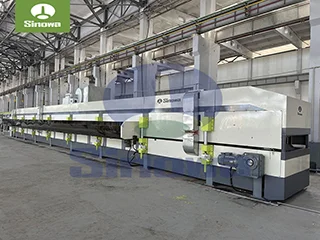
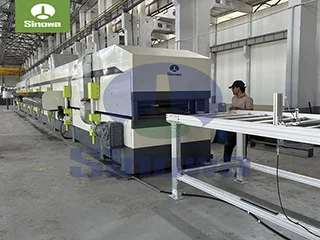
Metal sandwich panel production lines represent a sophisticated and integrated industrial manufacturing system designed for the continuous and efficient production of composite building panels, which consist of dual metal surface layers and a lightweight insulating core material. As a core production equipment in the modern construction material industry, this automated production system integrates mechanical forming, material composite bonding, thermal curing, precision cutting and intelligent conveying functions, realizing streamlined processing from raw material input to finished product output. The panels manufactured by this production line feature excellent structural stability, thermal insulation performance, sound insulation effect and weather resistance, making them widely applicable in industrial factory buildings, commercial venues, cold storage facilities, temporary buildings and various enclosure engineering projects. The continuous upgrading and optimization of production line technology has continuously improved the production efficiency and product quality of metal sandwich panels, meeting the increasingly stringent application requirements of the modern construction industry for energy-saving, environmental protection and high-strength building materials.

Home > Sandwich Panel Machines > Metal Sandwich Panel Production Line

Metal Sandwich Panel Production Linesandwich panel line

The overall operation logic of the metal sandwich panel production line is based on continuous roll forming and integrated composite lamination technology, with the entire production process realizing automated sandwich panel assembly line operation and minimal manual intervention. The whole production flow can be divided into multiple interconnected functional stages, including raw material preparation and feeding, metal sheet leveling and profiling, core material processing and laying, automatic gluing and composite pressing, constant temperature curing and shaping, precision fixed-length cutting, edge finishing and finished product stacking. Each functional unit of the production line operates in a coordinated and synchronous manner, with precise parameter matching between processes, ensuring the continuity and stability of mass production. Different from traditional discrete manufacturing equipment, this integrated production line realizes one-time forming of composite panels, effectively avoiding quality problems such as inconsistent bonding strength and uneven surface flatness caused by secondary processing, and greatly improving the consistency of finished products.

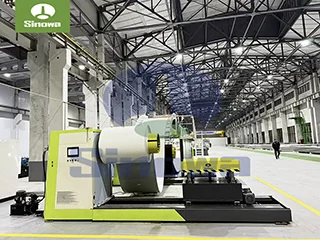
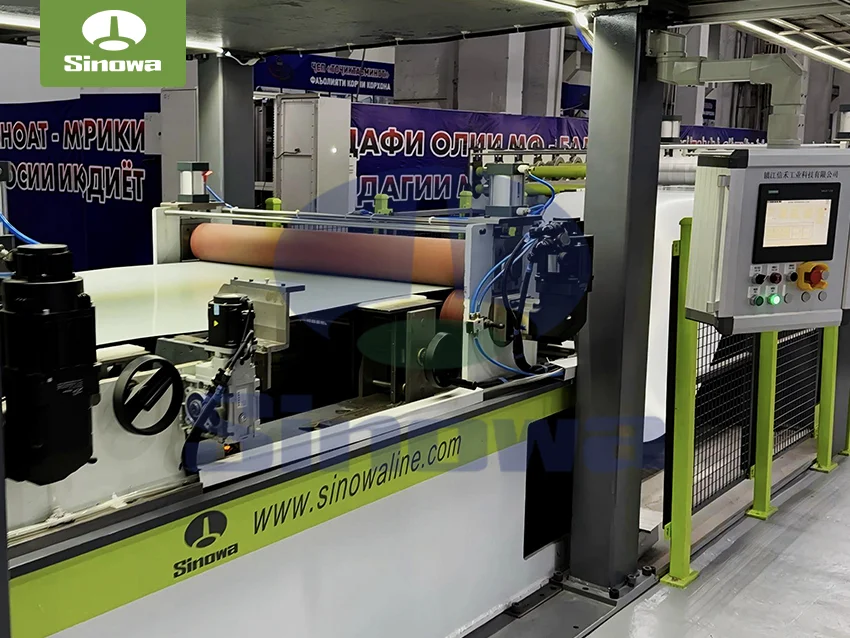
The raw material feeding and pretreatment stage is the foundation of the entire production process, which directly determines the surface quality and structural performance of the final panels. The metal surface materials used for production are mostly color-coated metal coils with uniform thickness and smooth surface, which are loaded on the automatic uncoiling device of the sandwich panel line. The uncoiling system is equipped with a stable tension control structure, which can release the metal coil evenly and stably at a constant speed, effectively preventing sheet deviation, wrinkling and stretching deformation during the unwinding process. After uncoiling, the metal sheet will enter the multi-group leveling system, which eliminates the internal stress of the metal sheet generated during coil winding through multi-directional rolling and calibration, and corrects tiny bending and uneven flatness of the sheet surface. This pretreatment process ensures that the subsequent forming and composite processing can be carried out on a flat and stable substrate, laying a good foundation for the precise forming of panel profiles and firm bonding of composite layers. Meanwhile, the core materials required for production are transported to the designated station through an automatic conveying system according to production scheduling. Common core materials include lightweight foam materials and fibrous thermal insulation materials, all of which need to be pretreated such as fixed-length cutting and surface cleaning to remove impurities and ensure the flatness of the core material surface, so as to fit closely with the metal surface layer in the subsequent composite process.

The metal sheet roll forming and profiling process is a key link to shape the structural form of the sandwich panel. The leveled metal sheet is continuously sent to the multi-pass roll forming unit, which is composed of multiple groups of precision arranged forming rollers with different shapes and specifications. Through gradual rolling and extrusion, the flat metal sheet is processed into various required profile structures, including flat plates, corrugated plates, groove plates and other mainstream shapes. The gradual forming design of the roll forming unit avoids the problem of metal fatigue and surface cracking caused by one-time strong extrusion, and effectively protects the integrity of the metal sheet surface coating. The sandwich panel machine can adjust the gap and operation parameters of the forming rollers according to different production needs, realizing flexible switching of multiple panel profile specifications. After roll forming, the metal sheet will go through fine calibration again to ensure the accuracy of profile size and the uniformity of overall radian, so that the upper and lower metal surface layers can perfectly match the core material in the subsequent composite process, avoiding gaps and dislocation between layers.

The core material laying and automatic gluing system is the core functional module to ensure the composite performance of sandwich panels. After the metal sheet profiling is completed, the pretreated core material is automatically laid between the upper and lower metal sheets through the conveying device, and the position of the core material is accurately positioned by the photoelectric sensing system to ensure the alignment of the core material and the metal surface layer without deviation. Subsequently, the high-precision automatic gluing system starts to work, evenly spraying or coating special high-performance adhesive on the inner surfaces of the upper and lower metal sheets and the contact surface of the core material. The gluing system adopts quantitative and uniform coating technology, which can accurately control the glue application amount and coating range according to the material type and panel thickness, avoiding quality defects such as insufficient glue leading to weak bonding or excessive glue leading to glue overflow and surface contamination. The selected adhesive has excellent adhesion, temperature resistance and aging resistance, which can form a stable bonding layer between the metal layer and the core material, effectively improving the overall structural strength and delamination resistance of the panel. For foam core materials that need on-site foaming and forming, the sandwich panel making machine is equipped with a high-pressure mixed foaming system, which mixes multiple raw materials in proportion and injects them into the gap between metal layers, realizing synchronous foaming, filling and bonding, and ensuring the compactness and uniformity of the core material structure.

The composite pressing and constant temperature curing process determines the bonding firmness and overall shaping effect of the sandwich panel. The semi-finished product after gluing and composite assembly is sent to the continuous pressing unit, which applies stable and uniform mechanical pressure to the composite panel through upper and lower pressing roller sets. The pressure value can be intelligently adjusted according to the panel thickness, core material type and production speed, ensuring that each composite layer is closely fitted without extrusion deformation of the core material. While applying pressure, the pressing unit is equipped with an intelligent constant temperature heating system, which provides a stable curing temperature environment for the adhesive through infrared heating or circulating hot air heating. The constant temperature curing process can accelerate the chemical reaction of the adhesive, make the bonding layer form a stable molecular structure in a short time, and greatly improve the bonding strength and durability between layers. The integrated process of continuous pressing and heating curing realizes synchronous shaping and bonding curing, avoids the long-time static curing required by traditional processes, significantly shortens the production cycle, and ensures the continuous and efficient operation of the assembly line. After curing, the overall structure of the panel tends to be stable, with no relative displacement between layers, and the overall flatness and structural rigidity meet the production standards.

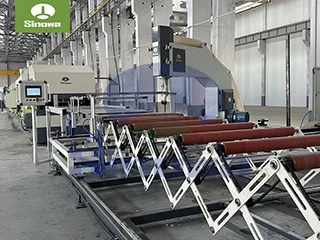
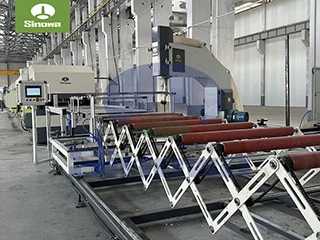
The precision cutting and edge finishing stage realizes the sizing and fine processing of finished panels. The continuously produced long strip composite panel is transmitted to the fixed-length cutting unit in a stable state, and the high-precision servo control system automatically identifies and sets the cutting length according to the production parameters, realizing non-stop dynamic cutting in the continuous production state. The cutting tool adopts high-hardness precision blade, which can complete smooth cutting of metal and composite core materials at one time, with neat cutting section, no burrs, no crushing and no layer delamination. The intelligent cutting system has extremely high dimensional control accuracy, which can control the size error of finished panels within a tiny range, ensuring the consistency of product specifications. After cutting, the edge finishing unit carries out fine trimming and smoothing treatment on the edge of the panel, polishing the sharp parts of the cutting section and trimming the uneven edges, so that the panel edge is flat and smooth, which is convenient for subsequent on-site assembly and docking construction. Some production lines are also equipped with automatic grooving and sealing auxiliary devices, which can complete edge sealing and grooving treatment of panels according to product design requirements, further improving the sealing performance and installation convenience of finished panels.

The final stage of the sandwich panel manufacturing machine includes quality inspection, automatic stacking and finished product output. The finished panels after cutting and finishing will pass through the online quality inspection station, which completes non-destructive inspection of multiple key indicators through automatic sensing and detection equipment, including dimensional accuracy, surface flatness, bonding compactness, surface coating integrity and overall structural uniformity. Unqualified products will be automatically identified and sorted out to ensure that all products entering the finished product area meet the production quality standards. Qualified finished panels are automatically conveyed to the stacking unit through the conveying system, and the intelligent stacking device neatly stacks the panels according to the set number and specification, realizing automatic counting, sorting and stacking. The whole process replaces manual handling and stacking, not only reduces labor cost and labor intensity, but also avoids surface scratches, deformation and stacking disorder caused by manual operation, and improves the overall appearance and packaging quality of finished products. The stacked finished panels can be directly transported to the finished product warehouse or packaged for subsequent transportation and delivery.

The modern metal sandwich panel production machine has obvious technical advantages in production efficiency, product performance and production flexibility compared with traditional processing equipment. In terms of production efficiency, the fully automated assembly line operation realizes uninterrupted continuous production from raw material feeding to finished product output, with a fast production speed and a large single-line output capacity, which can meet the large-scale and centralized production needs of building material manufacturers. In terms of product performance, the integrated composite forming and constant temperature curing process makes the bonding between the metal layer and the core material more firm and uniform, the overall structural stability of the panel is stronger, and the indexes of thermal insulation, sound insulation, compression resistance and wind resistance are more excellent. In terms of production flexibility, the production line supports the switching production of panels with different thicknesses, different profiles and different core materials, and can quickly adjust production parameters according to market demand and customer customization requirements, with strong production adaptability.

In addition, the intelligent level of the new generation of metal sandwich panel production machinery has been significantly improved, realizing digital control and intelligent monitoring of the whole production process. The central control system can uniformly adjust and manage the operating speed, pressing pressure, curing temperature, cutting size and other parameters of each functional unit of the production line, and store production data in real time, which is convenient for production scheduling, quality tracking and equipment maintenance. The production line is also equipped with a perfect fault self-detection and alarm system, which can automatically monitor the operating state of each equipment module in real time, timely identify abnormal conditions such as equipment jamming, parameter deviation and material shortage, and send alarm prompts, effectively avoiding production stagnation and product quality problems caused by equipment faults. At the same time, the optimized mechanical structure design reduces the failure rate of equipment operation, extends the service life of the production line, and reduces the daily maintenance cost and production loss of enterprises.

From the perspective of industrial application and market value, the continuous technological progress of metal sandwich panel manufacturing line has promoted the iterative upgrading of the entire sandwich panel manufacturing industry. The high-efficiency and low-consumption production mode of modern production lines reduces the comprehensive production cost of products while ensuring product quality stability. The produced metal sandwich panels have the characteristics of light weight, high strength, energy saving and environmental protection, convenient installation and wide adaptability, which can effectively reduce the self-weight of building structures, shorten the construction cycle of engineering projects, and reduce the comprehensive construction cost. With the continuous improvement of social requirements for building energy conservation, environmental protection and building safety, metal sandwich panels, as efficient energy-saving and green building materials, have broader market application prospects, and the supporting sandwich panel equipment is also developing towards higher intelligence, higher efficiency and more diversified customization, continuously empowering the high-quality development of the modern construction material industry.

https://www.cnsinowa.com/sandwich-panel-machines/metal-sandwich-panel-production-line.html

Main Products

Any Questins About Continuous Sandwich Panel Production Lines or Other Products

Email us with inquiries or use our contact infomations

Get In Touch